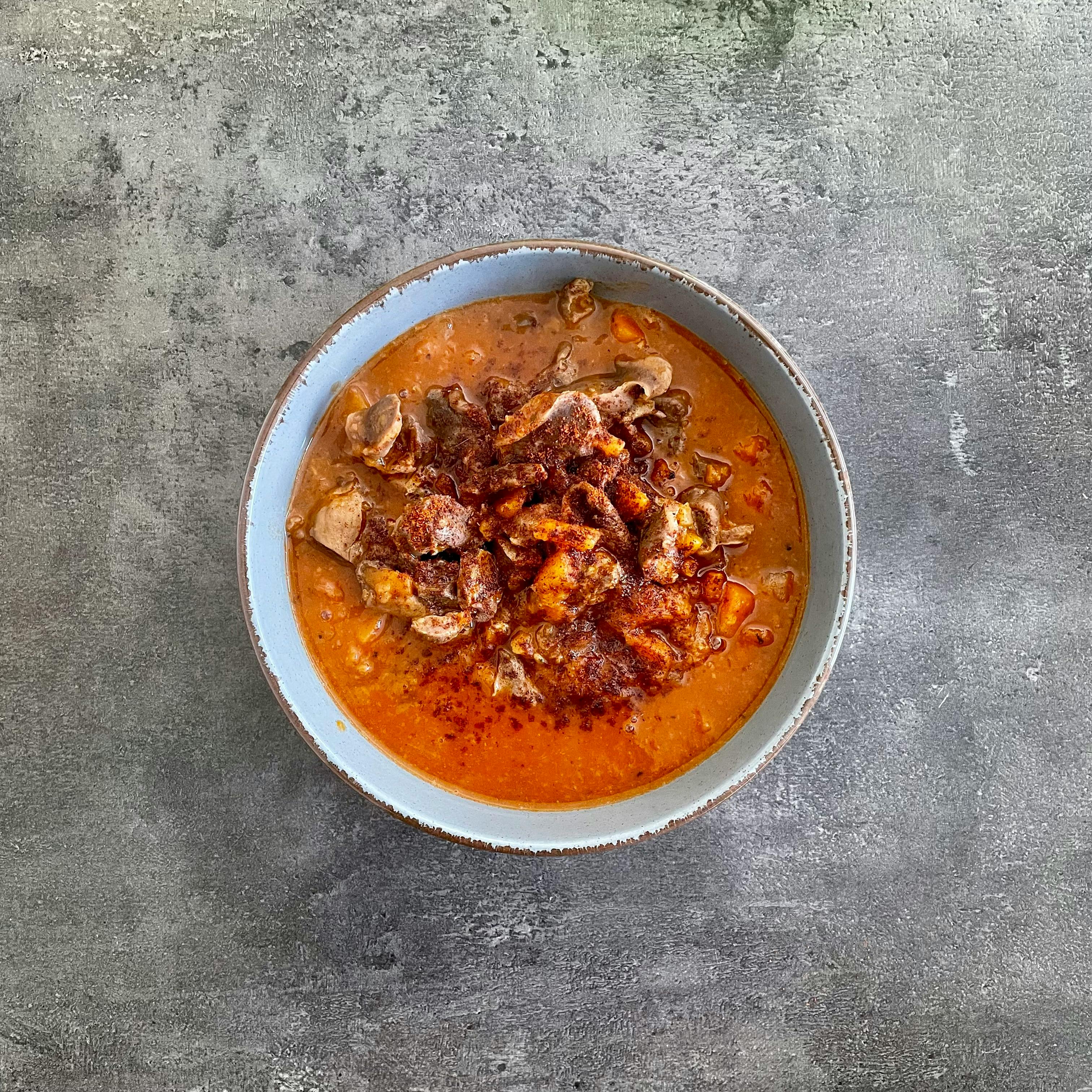
Photo: Pexels User / Pexels
Hungarian
Gulyasleves
The diets react (see scores below)
Common Ingredients
- beef
- onion
- paprika
- potatoes
- carrots
- tomatoes
- garlic
- caraway seeds
Specific recipes may vary.
Incompatible with 5 of 11 diets
Diet Ratings
Gulyasleves (Hungarian goulash soup) contains potatoes and carrots as primary ingredients alongside beef, which makes it incompatible with ketogenic diets in its traditional form. Potatoes alone contribute approximately 15-17g net carbs per 100g, and a typical serving of this soup includes a substantial amount. Carrots add additional net carbs (~7g/100g). Together, these starchy and root vegetables almost certainly push a single serving well over the 20-50g daily net carb limit on their own. While the beef, paprika, garlic, onion (in small amounts), and caraway seeds are keto-friendly components, the structural reliance on potatoes as a core ingredient makes the traditional dish incompatible with ketosis without significant modification.
Gulyasleves (Hungarian goulash soup) contains beef as its primary protein, which is unambiguously an animal product and therefore incompatible with a vegan diet. There is no debate within the vegan community about whether beef is excluded — it is the flesh of a slaughtered animal. All other ingredients (onion, paprika, potatoes, carrots, tomatoes, garlic, caraway seeds) are plant-based, but the presence of beef alone disqualifies this dish entirely.
Gulyasleves (Hungarian goulash soup) is largely paleo-compatible, with grass-fed beef, onion, paprika, carrots, tomatoes, garlic, and caraway seeds all being clearly approved paleo ingredients. The primary point of debate is the white potatoes, which occupy a gray zone: Loren Cordain's original framework excludes them due to their glycemic load and saponin content, while Mark Sisson, Whole30, and many modern paleo practitioners accept them as a whole, unprocessed tuber. Because potatoes are a notable component of this dish and remain genuinely debated, the overall dish lands in caution territory rather than a full approve. There are no grains, legumes, dairy, seed oils, or processed ingredients present, which is a strong positive. If white potatoes were swapped for sweet potatoes, this dish would comfortably earn an approve.
Strict Cordain-school paleo (as outlined in 'The Paleo Diet') discourages white potatoes due to their high glycemic index and glycoalkaloid content. However, Mark Sisson ('The Primal Blueprint') and Whole30 both include white potatoes as acceptable whole foods, arguing that the ancestral exclusion of potatoes is not well-supported when consumed in unprocessed form.
Gulyasleves (Hungarian goulash soup) is centered on beef as its primary protein, which contradicts core Mediterranean diet principles that limit red meat to only a few times per month. While the dish does contain several Mediterranean-friendly vegetables (onions, tomatoes, carrots, potatoes, garlic) and spices (caraway seeds), these supportive ingredients cannot offset the foundational issue of beef being the primary protein in a hearty, meat-forward preparation. The dish also uses no olive oil (traditionally lard or vegetable oil in Hungarian cooking), and the heavy emphasis on red meat as the centerpiece disqualifies it from even a 'caution' rating, which is reserved for moderate animal products like poultry, eggs, and dairy. Occasional consumption as a cultural dish is not catastrophic, but it does not align with Mediterranean diet patterns.
Some Mediterranean diet interpreters take a flexible, whole-foods approach and note that a vegetable-rich broth-based soup with modest amounts of beef — eaten only occasionally — is preferable to processed or fast food red meat. Traditional peasant versions of goulash used small amounts of beef stretched with abundant vegetables, which some nutritionists consider acceptable within a broadly Mediterranean-inspired pattern if red meat frequency is otherwise kept very low.
Gulyasleves (Hungarian goulash soup) is built almost entirely around plant-based ingredients alongside the beef. While the beef itself is carnivore-approved, the dish contains onion, paprika, potatoes, carrots, tomatoes, garlic, and caraway seeds — all strictly excluded plant foods. The primary protein is beef, but it is outnumbered and cooked with multiple vegetables, spices, and starchy tubers. On the carnivore diet, no version of this dish is acceptable as prepared; only the beef component could be salvaged. Even the most permissive carnivore practitioners (those who allow coffee or occasional spices) would not approve a soup with potatoes, tomatoes, carrots, and onions as core structural ingredients.
Gulyasleves (Hungarian goulash soup) is made entirely from Whole30-compliant ingredients. Beef is an allowed protein, and all vegetables listed — onion, potatoes, carrots, tomatoes, and garlic — are compliant whole vegetables. Paprika and caraway seeds are allowed herbs and spices. There are no excluded ingredients: no grains, no legumes, no dairy, no added sugar, no alcohol, and no prohibited additives. This is a straightforward whole-food, meat-and-vegetable soup that aligns well with the spirit and letter of the Whole30 program.
Gulyasleves (Hungarian goulash soup) contains multiple high-FODMAP ingredients that make it unsuitable during the elimination phase. Onion is one of the highest-FODMAP foods tested by Monash University, rich in fructans, and is a foundational ingredient in goulash — it cannot simply be omitted in small quantities. Garlic is similarly a major fructan source and is always rated high-FODMAP at any culinary dose. These two ingredients alone disqualify the dish. Potatoes are generally low-FODMAP at moderate servings, beef is low-FODMAP, carrots are low-FODMAP, tomatoes are low-FODMAP at standard serves (caution at large amounts), paprika is low-FODMAP in typical culinary amounts, and caraway seeds are low-FODMAP in small quantities. However, the presence of both onion and garlic as core structural ingredients — not incidental flavourings — means this dish is unavoidably high-FODMAP in its traditional form.
Gulyasleves (Hungarian goulash soup) contains a mix of DASH-friendly and DASH-cautionary elements. On the positive side, it features an abundance of vegetables — onion, potatoes, carrots, tomatoes, and garlic — along with anti-inflammatory spices like paprika and caraway seeds that contribute potassium, fiber, and beneficial plant compounds. These ingredients align well with DASH principles. However, the primary protein is beef, which DASH guidelines limit due to saturated fat and cholesterol concerns; DASH recommends no more than 6 oz of lean meat per day and encourages replacing red meat with poultry or fish. Traditional gulyasleves often uses fattier cuts of beef (chuck, shank) braised slowly, increasing saturated fat content. Additionally, as a soup, sodium content can be significant if salted generously or made with broth — a critical concern for DASH. If prepared with a lean cut of beef (e.g., trimmed round), limited added salt, and no commercial broth, this dish can be made more DASH-compatible, with the vegetable base being a genuine strength. The standard restaurant or traditional home-prepared version warrants caution due to red meat and likely sodium load.
NIH DASH guidelines explicitly limit red meat consumption and favor lean poultry and fish as primary proteins, placing beef-based dishes in a cautionary category by default. However, updated clinical interpretations note that lean, trimmed beef in modest portions (within the 6 oz/day limit) is not categorically excluded from DASH, and the vegetable-rich, spice-forward composition of this dish may be viewed favorably by DASH practitioners who focus on overall dietary pattern rather than single-ingredient restrictions.
Gulyasleves (Hungarian goulash soup) is a mixed Zone picture. On the positive side, beef provides lean protein (especially if using leaner cuts like beef chuck trimmed of fat), and the vegetables — onion, carrots, tomatoes, garlic — contribute low-to-moderate glycemic carbohydrates rich in polyphenols. Paprika and garlic also have anti-inflammatory properties Sears would appreciate. However, potatoes are the key problem: they are a high-glycemic, 'unfavorable' carbohydrate in Zone terminology, causing a rapid insulin spike that disrupts the hormonal balance the Zone targets. The beef itself may carry meaningful saturated fat depending on the cut used, and traditional recipes may use fatty cuts like shank or chuck without trimming. The carb-to-protein ratio in a traditional serving likely skews high due to potatoes, making it difficult to hit 40/30/30 without modification. With portion control — reducing potato quantity, using a leaner beef cut, and serving a smaller bowl alongside a protein-forward side — this dish can be incorporated into a Zone meal plan, but it cannot be freely consumed as-is.
Some Zone practitioners, particularly those following Sears' later anti-inflammatory framework, might rate this more favorably than early Zone materials would suggest. The soup format naturally limits caloric density, and the rich polyphenol content from paprika, tomatoes, garlic, and onion aligns well with Sears' later emphasis on polyphenol intake for eicosanoid control. If potatoes are reduced to a small quantity (one small potato per pot serving multiple people), the glycemic load per bowl becomes manageable and the dish could approach a 5-6 block Zone meal with appropriate beef portioning.
Gulyasleves (Hungarian goulash soup) presents a genuinely mixed anti-inflammatory profile. On the positive side, it contains several strongly anti-inflammatory ingredients: paprika is rich in carotenoids (capsanthin, beta-carotene) and vitamin C; garlic contains allicin and organosulfur compounds with well-documented anti-inflammatory effects; tomatoes provide lycopene and antioxidants; onions offer quercetin; carrots supply beta-carotene; and caraway seeds have modest anti-inflammatory phenolic content. Together, the vegetable and spice base is quite favorable. However, the primary protein is beef — a red meat high in saturated fat and arachidonic acid, both of which are flagged as pro-inflammatory in anti-inflammatory frameworks. The amount and cut of beef matter significantly: a lean beef used in modest portions shifts the dish toward neutral, while a fatty cut in large quantity tips it toward pro-inflammatory. Potatoes are a moderate-glycemic carbohydrate and a nightshade, generally acceptable in anti-inflammatory eating but not a positive contributor. Overall, this is a dish where the spice and vegetable profile does meaningful anti-inflammatory work, but the red meat anchor prevents an 'approve' rating under most anti-inflammatory frameworks. Prepared with lean beef in modest portions, it sits in the higher end of 'caution.'
Some anti-inflammatory practitioners, particularly those following autoimmune or AIP-adjacent protocols, would flag both the nightshade ingredients (tomatoes, paprika, potatoes) as potential triggers for inflammation-sensitive individuals, pushing the score lower. Conversely, proponents of whole-food, minimally processed eating (including some interpretations of Dr. Weil's pyramid) would note that a homemade goulash soup with abundant vegetables, spices, and real-food ingredients is far preferable to processed alternatives, and that lean beef in a vegetable-rich broth can be a reasonable moderate choice rather than a concern.
Gulyasleves (Hungarian goulash soup) is a broth-based beef soup with vegetables, which gives it several GLP-1-friendly qualities: it is liquid-dominant (easy to digest, hydrating, stomach-friendly in small portions), contains fiber-rich vegetables (carrots, tomatoes, onions, potatoes), and provides meaningful protein from beef. However, the primary protein source is beef, which is typically a fattier cut (chuck or shank) in traditional goulash, raising saturated fat intake — a concern for GLP-1 side effects like nausea and reflux. Paprika and caraway seeds are generally well-tolerated, but the moderate spice level may irritate sensitive GI systems in some patients. Potatoes add starchy carbohydrates with moderate fiber but limited protein density per calorie. The soup format is a genuine positive — broth-based soups are among the most GLP-1-friendly meal formats due to easy digestibility, portion control, and hydration support. Overall this is an acceptable occasional meal, best prepared with a lean beef cut (round, sirloin) and eaten in a small portion, but not an ideal staple due to saturated fat content and low protein density relative to calorie load.
Some GLP-1-focused dietitians accept beef-based soups as reasonable protein sources when lean cuts are used, citing the broth format as a mitigating factor for GI tolerance; others flag any red meat as a consistent trigger for nausea and reflux in GLP-1 patients regardless of preparation, and recommend substituting with chicken or turkey in similar recipes.
*See how scores were generated at our methodology page.
Nutritional profile
Six traits that cut across every diet.
Fiber & Plants
How much whole-plant food and fiber it delivers.
Healthy Fats
The quality of its fats (unsaturated, omega-3).
Whole / Unprocessed
How close it is to its natural, unprocessed form.
Gut Gentle
How easy it is on digestion (low FODMAP, few irritants).
Low Glycemic
How little it spikes your blood sugar.
Protein Density
How much protein it packs per calorie.
Controversy Index
Higher controversy = more disagreement between diets.
Diet-Specific Tips
 Paleo — 5/10
View tips
- Beef is a core paleo protein — fully approved
- Onion, garlic, carrots, tomatoes, paprika, and caraway seeds are all paleo-approved
- White potatoes are the key contested ingredient — excluded by Cordain but accepted by Sisson and Whole30
- No grains, legumes, dairy, seed oils, or processed additives present
- Dish is traditional and minimally processed, aligning with paleo philosophy
- Swapping white potatoes for sweet potatoes would make this a clear approve
 Whole30 — 4/10
View tips
- Beef is a fully approved Whole30 protein
- All vegetables (onion, potatoes, carrots, tomatoes, garlic) are compliant
- Paprika and caraway seeds are allowed spices
- No grains, dairy, legumes, or added sugars present
- Whole, unprocessed ingredients consistent with Whole30 spirit
- Traditional preparation uses no excluded additives
 DASH — 5/10
View tips
- Red meat (beef) as primary protein — DASH limits red meat; saturated fat is a concern depending on cut
- Rich vegetable base (onion, carrots, tomatoes, potatoes, garlic) — strongly DASH-aligned
- Paprika and caraway seeds add antioxidants and flavor without sodium
- Soup format carries significant sodium risk from salting and broth use
- Potatoes and carrots contribute potassium and fiber, supporting DASH mineral targets
- DASH-compatible if made with lean beef, low-sodium broth, and minimal added salt
- Traditional preparation often uses fattier cuts, increasing saturated fat content
 Zone — 5/10
View tips
- Potatoes are a high-glycemic 'unfavorable' carbohydrate in Zone methodology — the primary concern
- Beef provides adequate protein but cut selection determines saturated fat load; lean cuts preferred
- Onion, carrots, tomatoes, and garlic are favorable Zone carbohydrate sources with polyphenol benefits
- Paprika is a high-polyphenol spice aligned with Sears' anti-inflammatory focus
- Traditional recipe carb-to-protein ratio likely skews above Zone's 40/30/30 target without modification
- Soup format can aid portion control and reduce caloric density
- No added fats listed — fat content depends on beef cut, which may need supplementing with monounsaturated fat to hit 30% fat target
 Anti-Inflammatory — 5/10
View tips
- Beef (red meat): pro-inflammatory due to saturated fat and arachidonic acid; cut and portion size critically affect the overall profile
- Paprika: strongly anti-inflammatory — rich in carotenoids (capsanthin, beta-carotene) and vitamin C
- Garlic: anti-inflammatory — allicin and organosulfur compounds reduce inflammatory markers
- Tomatoes: anti-inflammatory — lycopene and antioxidants, though flagged in AIP/nightshade-sensitive protocols
- Onions: anti-inflammatory — quercetin content
- Carrots: anti-inflammatory — beta-carotene and fiber
- Potatoes: moderate-glycemic nightshade, neutral to mildly pro-inflammatory in large quantities
- Caraway seeds: modest anti-inflammatory phenolic contribution
- No processed ingredients, seed oils, refined sugars, or additives — a positive structural feature
 GLP-1 Friendly — 5/10
View tips
- Broth-based format is GLP-1 friendly — easy to digest, hydrating, portion-controllable
- Beef provides meaningful protein but is typically a fatty cut in traditional preparation — raises saturated fat concern
- Paprika and spices are moderate and generally tolerable, but may worsen reflux in sensitive individuals
- Potatoes add starchy carbohydrates — moderate fiber but lower protein density per calorie
- Vegetable content (carrots, tomatoes, onions, garlic) contributes fiber and micronutrients
- Lean beef substitution (round, sirloin) would meaningfully improve the score
- Small serving size strongly recommended — large portions of beef-heavy stews are hard on slowed gastric emptying