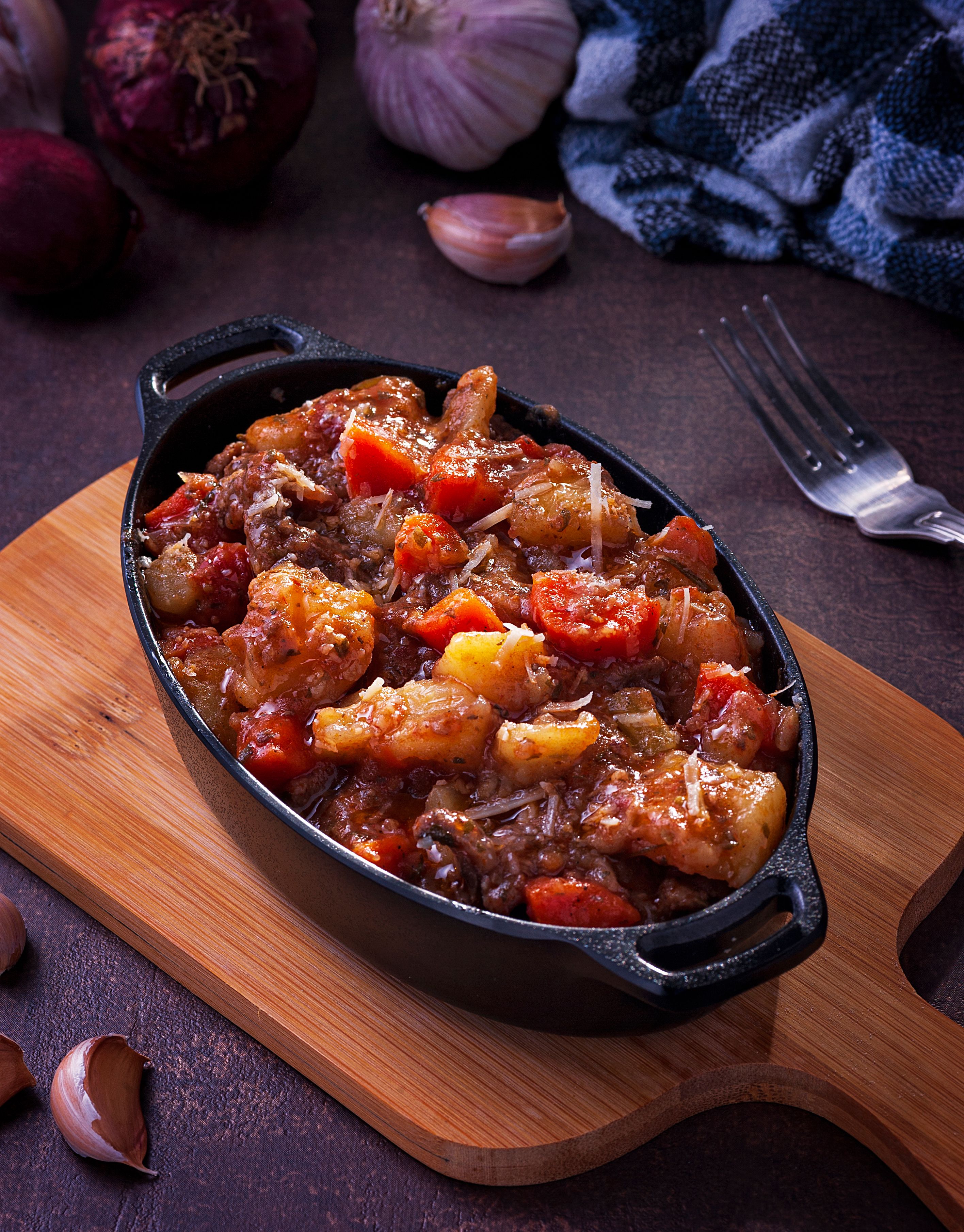
Photo: Marcelo Verfe / Pexels
Hungarian
Porkolt
The diets react (see scores below)
Common Ingredients
- beef
- onion
- paprika
- bell pepper
- tomato
- lard
- garlic
- caraway
Specific recipes may vary.
Incompatible with 6 of 11 diets
Diet Ratings
Pörkölt is a Hungarian beef stew cooked in lard with onion, paprika, bell pepper, tomato, garlic, and caraway. The base is excellent for keto: fatty beef, lard as the cooking fat, and aromatic spices. The carb contributors are onion, bell pepper, and tomato, but in a typical stew serving these are moderate — net carbs per serving likely land in the 6–10g range depending on portion size. Lard is an ideal keto fat, beef provides quality protein, and paprika and caraway add negligible carbs. The dish is naturally grain-free, sugar-free, and whole-food based. A standard portion fits comfortably within daily keto carb limits, making this a solid keto-friendly main.
Some stricter keto practitioners flag the combination of onion, tomato, and bell pepper as cumulatively too high in carbs, particularly if portions are generous or the dish is served with a traditional accompaniment like nokedli (egg noodles). Carnivore-adjacent keto adherents may also object to the vegetable content entirely.
Pörkölt is a traditional Hungarian meat stew that contains multiple animal products. Beef is the primary protein — a clear animal product — and lard (rendered pig fat) is used as the cooking fat. Both ingredients directly disqualify this dish from any vegan diet. The remaining ingredients (onion, paprika, bell pepper, tomato, garlic, caraway) are all plant-based, but they cannot offset the presence of animal-derived beef and lard.
Pörkölt is an excellent fit for the paleo diet. Every ingredient — beef, onion, paprika, bell pepper, tomato, lard, garlic, and caraway — is either a whole animal product or an unprocessed plant food available to hunter-gatherers. Lard is a traditional animal fat fully consistent with paleo principles. Paprika and caraway are natural spices with no processing concerns. There are no grains, legumes, dairy, refined sugars, seed oils, or additives. The dish is traditionally served over egg noodles or dumplings, but evaluated as a standalone stew it is clean paleo. The only minor note is that commercial paprika occasionally contains anti-caking agents or additives, but pure ground paprika is unambiguously paleo.
Pörkölt is a Hungarian beef stew that significantly contradicts Mediterranean diet principles on multiple fronts. Beef is the primary protein, which the Mediterranean diet limits to just a few times per month. More problematically, lard is used as the primary cooking fat — a saturated animal fat that is fundamentally at odds with the diet's emphasis on extra virgin olive oil as the sole primary fat. While the dish does include several Mediterranean-friendly ingredients (onion, garlic, bell pepper, tomato, paprika), these vegetables play a supporting role rather than being the centerpiece. The combination of red meat and lard as the core components pushes this dish firmly into 'avoid' territory.
Pörkölt is a traditional Hungarian beef stew that, while centered on beef and lard (both carnivore-approved), is heavily loaded with plant-based ingredients that are entirely excluded from the carnivore diet. Onion, paprika, bell pepper, tomato, garlic, and caraway are all plant-derived foods — vegetables and spices that are explicitly off-limits. The dish cannot be meaningfully separated from these ingredients; they are structural to the recipe, not incidental. Even the most lenient carnivore practitioners who allow occasional spices would draw the line at multiple vegetables forming the base of the dish. The beef and lard are the only carnivore-compatible components.
Pörkolt is a traditional Hungarian beef stew whose core ingredients are all Whole30-compliant. Beef is an approved protein, onion, bell pepper, tomato, and garlic are all allowed vegetables, paprika and caraway are permitted spices, and lard is a natural animal fat explicitly compatible with the program. There are no grains, legumes, dairy, added sugars, or other excluded ingredients present. This is a simple, whole-food dish that aligns well with the spirit and letter of the Whole30 program.
Pörkolt contains multiple high-FODMAP ingredients that make it unsuitable during the elimination phase. Onion is one of the highest-FODMAP foods tested by Monash University, rich in fructans, and is a foundational ingredient in this dish — it cannot be reduced to a safe portion while still making an authentic pörkolt. Garlic is similarly high in fructans and is a core aromatic. These two ingredients alone would disqualify the dish. Bell pepper is low-FODMAP at small servings (≤43g) but can become moderate at larger quantities. Tomato is generally low-FODMAP at standard servings. Paprika (the spice) is low-FODMAP. Lard is fat and FODMAP-free. Caraway seeds are low-FODMAP at culinary quantities. Beef is protein and FODMAP-free. However, the combination of onion and garlic as structural, non-optional components of the dish makes it clearly high-FODMAP at any realistic serving size during elimination phase.
Pörkölt is a Hungarian beef stew that poses several significant concerns for DASH diet compliance. The primary issues are lard (a saturated animal fat that DASH explicitly limits) and red meat (beef), which DASH recommends limiting. Lard is high in saturated fat, directly conflicting with DASH guidelines that restrict saturated fats to support cardiovascular health. Beef, particularly in stew preparations where fattier cuts are traditional, contributes additional saturated fat and is categorized as a red meat that DASH limits. On the positive side, the dish contains several DASH-friendly ingredients: onion, bell pepper, tomato, and garlic are all vegetables encouraged on DASH; paprika (rich in antioxidants) and caraway are DASH-compatible spices; and the vegetable components contribute potassium and fiber. However, the combination of lard and red beef makes this dish fundamentally incompatible with regular DASH consumption. A modified version substituting olive or canola oil for lard and using a leaner cut or smaller portion of beef could improve the score to caution territory.
NIH DASH guidelines explicitly limit both saturated fats (like lard) and red meat, placing traditional Pörkölt outside recommended foods. However, some DASH-oriented clinicians note that if lean beef (e.g., round or loin cuts, trimmed) replaces fattier cuts and vegetable oil substitutes for lard, the dish's substantial vegetable base and spice profile could make it acceptable in moderation — a modified version might score in the caution range rather than avoid.
Pörkölt is a Hungarian beef stew with a generally reasonable macro profile but notable Zone concerns. The protein source (beef) can be acceptable if lean cuts are used, though traditional pörkölt often uses fattier cuts like chuck or shoulder. The vegetable base — onion, bell pepper, tomato, garlic — is excellent from a Zone perspective, providing low-glycemic carbohydrates and polyphenols. Paprika is rich in antioxidants and aligns with Sears' anti-inflammatory emphasis. The critical Zone issue is lard as the cooking fat: lard is predominantly saturated fat, which Zone Diet — especially early Sears methodology — flags as unfavorable compared to monounsaturated fats like olive oil. Additionally, traditional beef cuts used in pörkölt tend to be fattier, increasing saturated fat load further and potentially skewing the fat block balance. However, pörkölt lacks problematic high-glycemic carbohydrates (no potatoes, pasta, or bread in the base dish — though it is often served with egg noodles or spaetzle, which would worsen the rating). As a standalone stew with portion control, it can be adapted into a Zone meal by substituting olive oil for lard, using a lean beef cut, and pairing with additional low-GI vegetables instead of starchy sides. In its traditional form, it sits firmly in 'caution' territory.
Some Zone practitioners following Sears' later writings (e.g., 'The Mediterranean Zone') may view this more favorably, as Sears shifted toward accepting moderate saturated fat in the context of an overall anti-inflammatory diet rich in polyphenols. The paprika, garlic, tomato, and onion in pörkölt provide substantial polyphenol content that Sears' later work celebrates. A practitioner emphasizing his post-2000 framework might rate this dish higher, particularly if a leaner cut of beef is used.
Pörkölt presents a genuinely mixed anti-inflammatory profile. On the positive side, the dish is built around a powerful anti-inflammatory spice base: paprika is rich in capsaicin and carotenoids (including beta-carotene and lutein), garlic provides allicin and organosulfur compounds, caraway seeds contain flavonoids and antioxidants, and onions supply quercetin. Bell peppers and tomatoes contribute vitamin C, lycopene, and additional carotenoids. These ingredients collectively offer meaningful anti-inflammatory support. However, two significant concerns weigh the dish down: (1) Beef as the primary protein is categorized as red meat, which is associated with elevated arachidonic acid, saturated fat, and increased inflammatory markers (CRP, IL-6) when consumed regularly — the anti-inflammatory framework explicitly limits red meat. (2) Lard (rendered pork fat) is a saturated fat source that the anti-inflammatory framework advises limiting; it lacks the beneficial polyphenol profile of extra virgin olive oil and contributes to saturated fat load. The dish would score considerably better if prepared with olive oil and a leaner protein (chicken, turkey, or legumes). As an occasional indulgence within an otherwise anti-inflammatory diet, Pörkölt is acceptable, but its regular consumption is not recommended.
Some traditional and ancestral diet advocates (including paleo-leaning practitioners) argue that lard from pasture-raised pigs and unprocessed red meat from grass-fed cattle have better fatty acid profiles and are not inherently pro-inflammatory — grass-fed beef has a notably higher omega-3 and CLA content than grain-fed. Mainstream anti-inflammatory authorities like Dr. Weil, however, consistently place red meat in the 'limit' category and favor olive oil over animal fats regardless of sourcing.
Pörkölt is a Hungarian beef stew built on a base of lard-fried onions with generous paprika, which creates a dish that is inherently high in saturated fat from two sources: lard (a rendered animal fat used as the cooking medium) and fatty beef cuts traditionally used in this dish (chuck, shank, or shoulder). While the dish does offer meaningful protein from beef and contains vegetables (onion, bell pepper, tomato) that provide some fiber and nutrients, the fat profile is the critical disqualifier for GLP-1 patients. Lard alone makes this a poor fit — high dietary fat significantly worsens GLP-1 side effects including nausea, bloating, and reflux because slowed gastric emptying means fatty food sits in the stomach far longer than usual. The spice load from paprika and caraway is moderate and unlikely to cause reflux on its own, but combined with the fat content it compounds GI discomfort risk. Garlic in cooked form is generally tolerable. The dish is also not small-portion-friendly — it is a rich, heavy stew designed to be eaten in substantial volume. A leaner adaptation (substituting olive oil for lard, using lean beef or chicken, reducing fat by skimming) could shift this toward caution territory, but as traditionally prepared it belongs in the avoid category.
Some GLP-1-focused dietitians note that beef stews can be a reasonable protein vehicle if fat is carefully controlled through preparation — skimming rendered fat after cooking and using lean cuts can substantially change the fat profile. The disagreement centers on whether traditional preparations should be rated as-is or whether common home adaptations should be considered; this rating reflects the traditional recipe.
*See how scores were generated at our methodology page.
Nutritional profile
Six traits that cut across every diet.
Fiber & Plants
How much whole-plant food and fiber it delivers.
Healthy Fats
The quality of its fats (unsaturated, omega-3).
Whole / Unprocessed
How close it is to its natural, unprocessed form.
Gut Gentle
How easy it is on digestion (low FODMAP, few irritants).
Low Glycemic
How little it spikes your blood sugar.
Protein Density
How much protein it packs per calorie.
Controversy Index
Higher controversy = more disagreement between diets.
Diet-Specific Tips
 Keto — 8/10
View tips
- Lard is an ideal high-fat keto cooking medium
- Beef provides quality protein and natural fat
- Onion, tomato, and bell pepper add moderate net carbs (~6–10g per serving)
- No grains, added sugars, or starchy vegetables
- Paprika, garlic, and caraway are keto-friendly spices with negligible carbs
- Portion control matters — larger servings or additions like sour cream increase carb load
- Traditional serving with nokedli (noodles) must be avoided on keto
 Paleo — 9/10
View tips
- Beef is a core paleo protein, ideally grass-fed
- Lard is a fully paleo-compliant animal fat
- Paprika, garlic, and caraway are natural herbs and spices — all approved
- Onion, bell pepper, and tomato are whole vegetables with no paleo concerns
- No grains, legumes, dairy, seed oils, or refined ingredients present
- Traditional accompaniments (noodles/dumplings) are non-paleo, but the stew itself is fully compliant
 Whole30 — 9/10
View tips
- Beef is a fully approved Whole30 protein
- Lard is a compliant natural animal fat
- All vegetables (onion, bell pepper, tomato, garlic) are Whole30-approved
- Paprika and caraway are permitted spices
- No grains, legumes, dairy, or added sugars present
- Dish is a whole-food stew, not a recreation of a junk food or baked good
 Zone — 5/10
View tips
- Lard is a saturated fat, unfavorable compared to Zone-preferred monounsaturated fats like olive oil
- Traditional pörkölt often uses fatty beef cuts (chuck, shoulder), increasing saturated fat content
- Vegetable base (onion, bell pepper, tomato, garlic) is low-glycemic and Zone-favorable
- Paprika and garlic provide polyphenols consistent with Sears' anti-inflammatory focus
- No high-glycemic carbohydrates in the base dish — Zone-friendly if served without noodles or bread
- Dish can be Zone-adapted by substituting olive oil for lard and selecting lean beef
- Protein portion needs to be controlled to ~25g per serving to fit Zone blocks
 Anti-Inflammatory — 4/10
View tips
- Red beef as primary protein — associated with elevated inflammatory markers; anti-inflammatory diet recommends limiting red meat
- Lard as cooking fat — high in saturated fat, lacks the oleocanthal and polyphenols of extra virgin olive oil
- Paprika — rich in carotenoids and capsaicin with documented anti-inflammatory properties
- Garlic — potent anti-inflammatory via allicin and organosulfur compounds
- Onion — high in quercetin, a flavonoid with anti-inflammatory effects
- Bell pepper and tomato — provide vitamin C, lycopene, and antioxidants
- Caraway seeds — contain flavonoids and have mild anti-inflammatory potential
- No refined carbohydrates or trans fats — dish is whole-food based despite its limitations