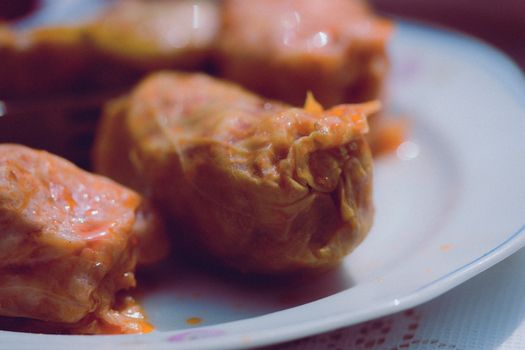
Hungarian
Toltott Kaposzta
The diets react (see scores below)
Common Ingredients
- cabbage leaves
- ground pork
- rice
- onion
- paprika
- sauerkraut
- smoked meat
- sour cream
Specific recipes may vary.
Incompatible with 9 of 11 diets
Diet Ratings
Töltött Káposzta (Hungarian stuffed cabbage) is fundamentally incompatible with ketogenic eating due to the inclusion of rice as a core ingredient in the pork filling. Rice is a high-glycemic grain that contributes significant net carbs — a standard serving of this dish can easily contain 30-50g of net carbs from rice alone, immediately exhausting or exceeding the daily keto carb budget. While several other ingredients are keto-friendly (cabbage leaves, ground pork, paprika, sauerkraut, smoked meat, sour cream, onion in moderation), the rice is a structural component of the recipe, not a garnish. Removing it would fundamentally change the dish into something different. Sour cream adds fat and is acceptable, and fermented sauerkraut is a keto-positive ingredient, but these benefits are completely overshadowed by the rice content.
Töltött Káposzta (Hungarian stuffed cabbage) contains multiple animal products that are entirely incompatible with a vegan diet. Ground pork is the primary protein, smoked meat adds additional animal flesh, and sour cream is a dairy product. All three ingredients are clearly animal-derived with no ambiguity. This dish is fundamentally built around animal products and cannot be considered vegan in any interpretation.
Toltott Kaposzta (Hungarian stuffed cabbage) contains multiple non-paleo ingredients that make it incompatible with the Paleolithic diet. Rice is a grain and is excluded under strict paleo rules. Smoked meat is typically a processed meat product, often containing added salt, preservatives, and additives. Sour cream is a dairy product, which is excluded. While the base ingredients — cabbage leaves, ground pork, onion, and paprika — are paleo-friendly, the presence of rice, processed smoked meat, and sour cream are clear disqualifiers with strong consensus in the paleo community.
Toltott Kaposzta (Hungarian stuffed cabbage) is fundamentally misaligned with Mediterranean diet principles. The dish centers on ground pork as its primary protein, which falls into the red meat category that the Mediterranean diet restricts to only a few times per month. It is further compounded by smoked meat, which is a processed meat product — one of the most discouraged foods in Mediterranean dietary guidelines due to high saturated fat, sodium, and preservative content. Sour cream adds saturated dairy fat in a non-incidental way. While cabbage, onion, and rice are acceptable ingredients, they serve merely as vehicles for the problematic components. The overall dish profile — red meat, processed/smoked meat, and heavy sour cream — stacks multiple 'avoid' elements together, making this a poor fit for Mediterranean eating patterns regardless of its culinary merit.
Toltott Kaposzta (Hungarian stuffed cabbage) is fundamentally incompatible with the carnivore diet. The dish contains multiple plant-derived ingredients that are explicitly excluded: cabbage leaves (the primary vessel), rice (a grain), onion, paprika (a spice), and sauerkraut (fermented cabbage). While the dish does include carnivore-compatible components — ground pork, smoked meat, and sour cream — these are completely overshadowed by the pervasive plant content. Rice alone as a grain is a hard exclude, and cabbage/sauerkraut as the structural base of the dish makes this impossible to adapt without fundamentally changing what the dish is. This is not a close call; the majority of the ingredient list and the entire structural concept of the dish are plant-based.
Toltott Kaposzta (Hungarian stuffed cabbage) contains multiple Whole30-excluded ingredients. Rice is a grain and is explicitly excluded from the Whole30 program. Sour cream is a dairy product and is also explicitly excluded. These are not edge cases or ambiguous ingredients — both are clearly prohibited. Additionally, smoked meat commonly contains added sugars and sulfites (though sulfites are now allowed per 2024 rule changes, sugar is still excluded), requiring careful label scrutiny. The dish as traditionally prepared cannot be made Whole30-compliant without fundamental alterations to its core recipe.
Toltott Kaposzta (Hungarian stuffed cabbage) contains multiple high-FODMAP ingredients that make it unsuitable for the elimination phase. Onion is one of the highest-FODMAP foods tested by Monash University, rich in fructans, and is a core ingredient in the filling. Sauerkraut, while fermented, is high-FODMAP at typical serving sizes (Monash rates it as high-FODMAP above about 30g due to excess fructose and fructans from cabbage). Sour cream contains lactose and is high-FODMAP at standard serving sizes (Monash rates it high-FODMAP above 2 tablespoons, and it is typically used more generously as a topping on this dish). Regular cabbage leaves in large quantities can also contribute moderate FODMAPs. The combination of onion (unavoidable in traditional preparation), sauerkraut (used in quantity as a base/wrapping), and sour cream (served as a generous topping) makes this dish clearly high-FODMAP with no realistic low-FODMAP adaptation without fundamentally altering the recipe.
Toltott Kaposzta (Hungarian stuffed cabbage) presents multiple serious conflicts with DASH diet principles. The dish combines smoked meat (very high sodium), sauerkraut (extremely high sodium — typically 700-900mg per half cup), and ground pork (saturated fat), creating a sodium load that could easily exceed the entire daily DASH sodium budget in a single serving. The full-fat sour cream adds saturated fat, further conflicting with DASH guidelines. While cabbage, onion, and rice offer some DASH-compatible elements, the overall profile is dominated by high-sodium preserved and smoked ingredients. DASH guidelines explicitly limit sodium, saturated fat, and processed/smoked meats — this dish features all three prominently. The combination of sauerkraut and smoked meat alone makes this a dish that would need near-complete reformulation to be DASH-compatible.
Toltott Kaposzta (Hungarian stuffed cabbage) presents a mixed Zone profile. The cabbage and sauerkraut are excellent low-glycemic, high-polyphenol vegetables that align well with Zone principles. Ground pork provides protein but is fattier than ideal Zone proteins (skinless chicken, fish, lean beef), contributing excess saturated fat beyond the Zone's preferred 30% fat target from monounsaturated sources. Rice is an 'unfavorable' Zone carbohydrate — moderate-to-high glycemic index that can spike insulin; it is typically limited or replaced in Zone meals. Smoked meat adds additional saturated fat and sodium, and sour cream further increases saturated fat content. The dish does have a reasonable protein-to-carb structure in its bones, but the fat profile skews heavily saturated and the rice inclusion is problematic. With significant modifications — using lean ground turkey or extra-lean pork, eliminating or drastically reducing rice (substituting cauliflower rice), and replacing sour cream with a small amount of monounsaturated fat source — this dish could be brought into Zone compliance. As traditionally prepared, the ratio balance is off and multiple unfavorable ingredients coexist, placing it firmly in caution territory.
Some Zone practitioners, particularly those following Sears' later anti-inflammatory work, might be more permissive about small amounts of saturated fat from whole food sources like pork and sour cream, viewing the cabbage and sauerkraut's polyphenol and probiotic benefits as offsetting factors. A Zone-friendly adaptation with portion-controlled rice (as the sole carb block) and minimal sour cream could bring this into a 5-6 range for flexible Zone followers.
Töltött Káposzta (Hungarian stuffed cabbage) presents a genuinely mixed anti-inflammatory profile. On the positive side, cabbage is a cruciferous vegetable with anti-inflammatory glucosinolates and vitamin C; sauerkraut provides beneficial probiotics that can reduce gut-derived inflammation; paprika contributes capsaicin and carotenoids; and onion supplies quercetin, a notable flavonoid. These are meaningful anti-inflammatory contributors. However, the dish is anchored by ground pork and smoked meat — both red/processed meats that anti-inflammatory frameworks recommend limiting or avoiding. Processed smoked meats in particular are associated with elevated inflammatory markers (CRP, IL-6) due to nitrates, advanced glycation end-products (AGEs) from smoking, and high saturated fat content. Sour cream adds full-fat dairy, another ingredient in the 'limit' category due to saturated fat. The rice is a neutral refined starch with minimal inflammatory impact either way. Overall, the dish has a bifurcated profile: genuinely beneficial plant-based components undermined by processed and red meat content and full-fat dairy. As an occasional dish it sits in cautious territory; as a regular meal it leans toward the problematic end of caution.
Some anti-inflammatory nutritionists, particularly those emphasizing a Mediterranean or whole-food framework, would note that traditional home-prepared versions with fresh pork (not heavily processed smoked meats) and fermented cabbage (sauerkraut) have meaningful redeeming qualities — the probiotic and cruciferous vegetable content is non-trivial. Conversely, stricter anti-inflammatory and autoimmune protocol (AIP) practitioners would rate this dish more harshly, citing both the red/processed meat load and the potential for nightshade sensitivity (paprika) as reasons to avoid it more categorically.
Töltött Káposzta (Hungarian stuffed cabbage) is a nutritionally mixed dish that ultimately scores poorly for GLP-1 patients in its traditional form. The core protein source is ground pork, which is typically high in saturated fat. The dish is further compounded by the addition of smoked meat, which adds more saturated fat, sodium, and often preservatives. Sour cream is used liberally as a finishing element, adding significant saturated fat with minimal protein payoff per calorie. The fermented sauerkraut is a genuine positive — it provides fiber, probiotics, and high water content — and cabbage leaves as a wrapper are low-calorie and fibrous. Rice adds digestible carbohydrates but minimal protein or fiber. Paprika and onion are fine. The overall fat load from ground pork plus smoked meat plus sour cream in a single dish is the disqualifying factor for GLP-1 patients: high saturated fat worsens nausea, bloating, and reflux, and slowed gastric emptying means fatty foods sit heavily for extended periods. Protein content exists but comes packaged with too much fat to be considered protein-dense per calorie in the GLP-1 context. Sodium load from sauerkraut and smoked meat is also a concern for some patients.
Some GLP-1-focused dietitians would argue this dish can be modified to a 'caution' rating if prepared with lean ground turkey or chicken in place of pork, reduced smoked meat, and Greek yogurt substituted for sour cream — a common adaptation that preserves the dish's structure while meaningfully reducing saturated fat. The disagreement centers on whether traditional recipes should be rated as-is or whether culturally important dishes should receive guidance on modification rather than a blanket avoid verdict.
*See how scores were generated at our methodology page.
Nutritional profile
Six traits that cut across every diet.
Fiber & Plants
How much whole-plant food and fiber it delivers.
Healthy Fats
The quality of its fats (unsaturated, omega-3).
Whole / Unprocessed
How close it is to its natural, unprocessed form.
Gut Gentle
How easy it is on digestion (low FODMAP, few irritants).
Low Glycemic
How little it spikes your blood sugar.
Protein Density
How much protein it packs per calorie.
Controversy Index
Higher controversy = more disagreement between diets.
Diet-Specific Tips
 Zone — 4/10
View tips
- Cabbage and sauerkraut are excellent low-glycemic Zone-favorable vegetables with polyphenol and probiotic benefits
- Ground pork is a higher-fat, higher-saturated-fat protein source, less ideal than lean Zone proteins
- Rice is an 'unfavorable' Zone carbohydrate with moderate-to-high glycemic index, included in the filling
- Sour cream and smoked meat add significant saturated fat, pushing the fat profile away from Zone's monounsaturated preference
- Traditional preparation makes macronutrient ratio control difficult without substantial ingredient substitutions
- Dish could be Zone-adapted with lean ground turkey, cauliflower rice substitution, and reduced sour cream
 Anti-Inflammatory — 4/10
View tips
- Ground pork and smoked meat are red/processed meats associated with elevated inflammatory markers — key negative factor
- Smoked meat likely contains nitrates and AGEs from processing/curing — pro-inflammatory
- Sour cream adds saturated fat from full-fat dairy — in the 'limit' category
- Sauerkraut provides beneficial probiotics supporting gut health and reducing systemic inflammation — positive
- Cabbage is a cruciferous vegetable with glucosinolates and anti-inflammatory antioxidants — positive
- Paprika contributes carotenoids and capsaicin with anti-inflammatory properties — positive
- Onion provides quercetin and other anti-inflammatory flavonoids — positive
- Rice is a neutral refined carbohydrate with minimal inflammatory impact