Photo: Jack Baghel / Pexels
Indian
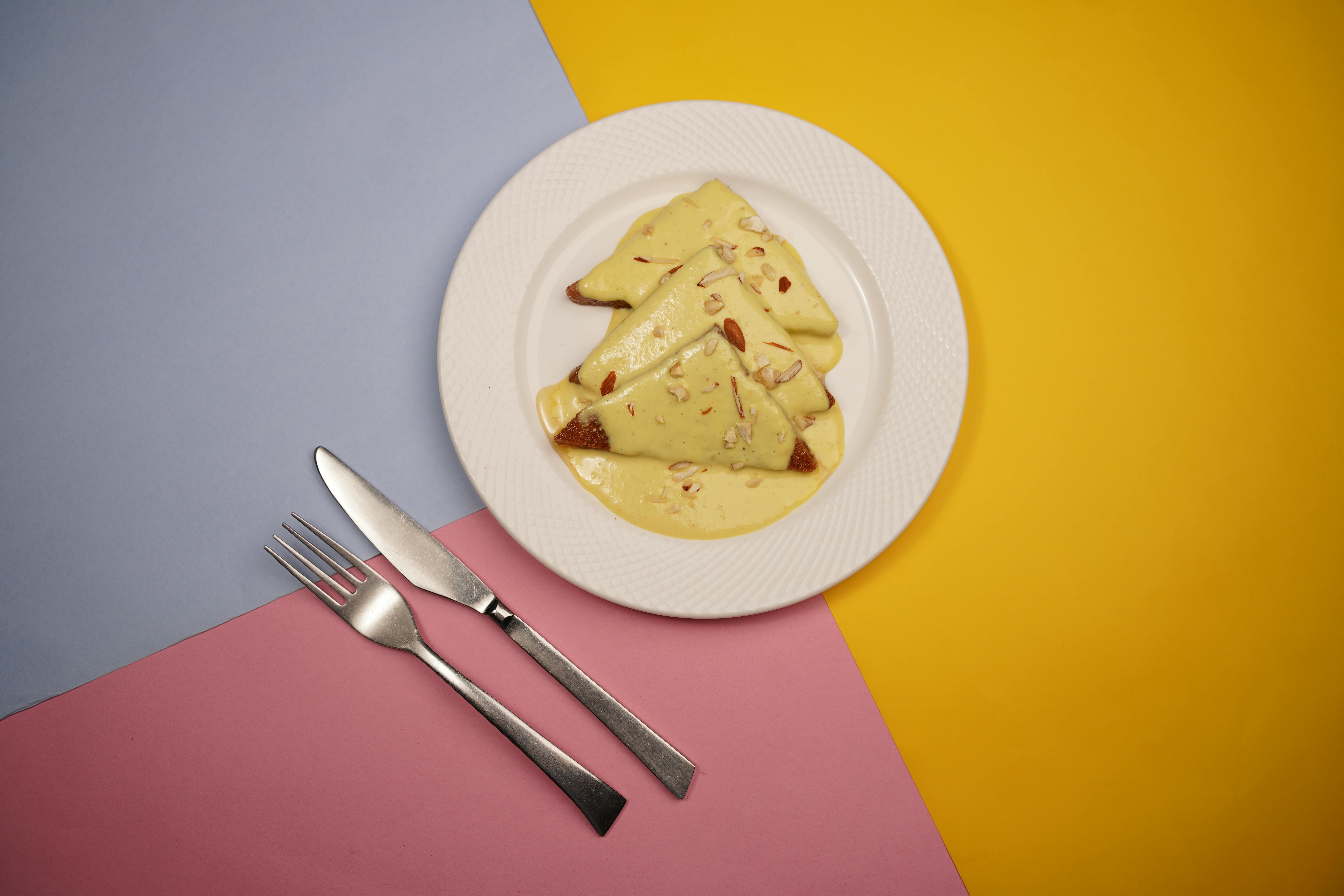
Double Ka Meetha
The diets react (see scores below)
Common Ingredients
- bread
- milk
- sugar
- ghee
- cardamom
- saffron
- almonds
- cashews
- condensed milk
Specific recipes may vary.
Incompatible with 11 of 11 diets
Diet Ratings
Double Ka Meetha is a traditional Indian bread pudding dessert that is fundamentally incompatible with a ketogenic diet. The dish is built on white bread (high-carb grain product) soaked in a mixture of full-fat milk, sugar, and condensed milk — three additional high-carbohydrate, high-sugar ingredients. A single serving would deliver an enormous net carb load, easily exceeding the entire daily keto carb allowance (20-50g) many times over. The ghee, almonds, and cashews are keto-friendly in isolation, and cardamom and saffron are fine, but they cannot offset the dominant carb and sugar content. This dish exists in a category of clear, unambiguous incompatibility with ketosis.
Double Ka Meetha contains multiple animal-derived ingredients that disqualify it from a vegan diet. Milk, ghee (clarified butter), and condensed milk are all dairy products — direct animal derivatives. These are core, non-incidental components of the dish, not trace contaminants. There are no vegan-friendly substitutions implied by the listed ingredients. The nuts, bread, cardamom, saffron, and sugar are plant-based, but they are insufficient to salvage the dish's vegan status when dairy is foundational to the recipe.
Double Ka Meetha is a traditional Indian bread pudding that is fundamentally incompatible with the Paleo diet. The dish is built on bread (a grain-based product), which alone is a hard disqualifier. Beyond that, it contains refined sugar and condensed milk — both strictly excluded from Paleo. Milk and condensed milk are dairy products, also prohibited. Ghee is debated but would be the least of the concerns here. The only Paleo-friendly ingredients are cardamom, saffron, almonds, and cashews. With four core ingredients (bread, milk, sugar, condensed milk) being clear Paleo violations, this dish cannot be adapted to Paleo without completely dismantling it.
Double Ka Meetha is an Indian bread pudding dessert that fundamentally contradicts Mediterranean diet principles on multiple fronts. It is built on refined white bread (a refined grain), sweetened with both added sugar and condensed milk (high added sugar content), and uses ghee (saturated animal fat) as the primary fat rather than olive oil. The dish is heavily processed and sugar-laden, placing it firmly in the 'avoid' category. While it contains nuts (almonds, cashews) and spices (cardamom, saffron) that are Mediterranean-friendly, these are minor components that do not offset the core issues. This is essentially a dessert defined by refined grains, added sugars, and saturated fat — three of the key items the Mediterranean diet minimizes.
Double Ka Meetha is a traditional Indian bread pudding dessert that is almost entirely incompatible with the carnivore diet. It is built on a base of bread (a grain product), loaded with sugar and condensed milk (highly processed and sugar-rich), and includes numerous plant-derived ingredients: cardamom, saffron, almonds, and cashews. While ghee and milk are animal-derived and debated within carnivore circles, they are entirely overshadowed here by the dominant plant-based, grain-based, and sugar-laden components. There is no meaningful animal protein present. This dish violates virtually every core carnivore principle simultaneously.
Double Ka Meetha contains multiple excluded ingredients that make it incompatible with Whole30. Bread is a grain-based product (wheat), which is explicitly excluded. Sugar is added sugar, also explicitly excluded. Condensed milk is a dairy product with added sugar, doubly excluded. Milk is excluded dairy. Furthermore, this dish is essentially a bread pudding/dessert — even if the individual ingredients could somehow be swapped out, it falls squarely into the 'no recreating baked goods/junk food/sweets' rule. This dish fails on nearly every axis of the Whole30 program.
Double Ka Meetha is a traditional Hyderabadi bread pudding that is problematic for the low-FODMAP elimination phase due to multiple high-FODMAP ingredients. The primary issues are: (1) Bread — standard white or wheat bread is high in fructans; even small servings of regular wheat bread are problematic during elimination. (2) Milk — used in significant quantity, milk is high in lactose and a major FODMAP trigger. (3) Condensed milk — also high in lactose and present in notable quantities. (4) Cashews — high-FODMAP above 10 nuts per serving, and this dish typically uses a generous handful. The combination of fructans from bread and lactose from milk and condensed milk makes this dish a significant FODMAP load even in a small portion. Ghee is low-FODMAP (fat-soluble, no lactose), cardamom and saffron are low-FODMAP at culinary amounts, almonds are low-FODMAP at ≤10 whole almonds, and sugar is low-FODMAP. However, the bread + milk + condensed milk + cashews combination creates an unavoidable high-FODMAP dish regardless of serving size.
Double Ka Meetha is an Indian bread pudding dessert that is fundamentally incompatible with DASH diet principles. It is loaded with multiple high-concern ingredients simultaneously: ghee (high in saturated fat), condensed milk (high in added sugar and saturated fat), sugar (added sweetener), and white bread (refined carbohydrate with negligible fiber). The dish is deep-fried or pan-fried in ghee before being soaked in sweetened milk, resulting in a very high saturated fat and added sugar load. DASH explicitly limits saturated fat, full-fat dairy products like condensed milk and ghee, and added sugars. While almonds and cashews offer some nutritional value (magnesium, healthy fats), and cardamom and saffron are benign spices, these minor positives are overwhelmed by the dish's overall nutritional profile. This is a dessert/indulgence food with essentially no DASH-friendly characteristics beyond trace minerals from nuts.
Double Ka Meetha is an Indian bread pudding dessert that is fundamentally incompatible with Zone Diet principles. The dish is built around white bread (high-glycemic, refined carbohydrate), sugar (pure glucose/fructose spike), condensed milk (high sugar, high calorie), and ghee (saturated fat) — a trifecta of exactly the foods Dr. Sears identifies as most disruptive to eicosanoid balance and insulin regulation. The carbohydrate load is extremely high-glycemic with virtually no fiber to slow absorption. There is no meaningful lean protein source to balance the macros (listed as 'none'). The fat profile is dominated by saturated fat from ghee and condensed milk rather than the monounsaturated fats Zone favors. The only Zone-friendly components are the almonds, cardamom, and saffron — present in negligible quantities as garnish. There is no realistic portioning strategy that would bring this dish into a 40/30/30 Zone block structure without essentially not eating it. This dish is not a 'ratio problem' that can be solved with careful portioning — it is structurally a high-glycemic, high-saturated-fat, zero-protein dessert with no Zone-compatible core.
Double Ka Meetha is a traditional Hyderabadi bread pudding dessert that presents multiple red flags from an anti-inflammatory perspective. The dish is built on a foundation of refined white bread (a refined carbohydrate with a high glycemic index that can spike blood sugar and promote inflammatory markers), fried in ghee (a saturated fat that should be limited), and sweetened with both sugar and condensed milk (concentrated added sugars). The combination of refined carbohydrates and significant added sugars is one of the clearest pro-inflammatory dietary patterns identified in anti-inflammatory nutrition research, associated with elevated CRP and IL-6 levels. Ghee, while not as harmful as trans fats, is a form of clarified butter high in saturated fat, which anti-inflammatory guidelines advise limiting. Condensed milk compounds the sugar and saturated fat burden further. The dish does contain some redeeming elements — cardamom and saffron have documented anti-inflammatory properties, and almonds and cashews provide beneficial monounsaturated fats, vitamin E, and some anti-inflammatory micronutrients. However, these positives are overwhelmed by the sheer volume of refined carbohydrates, added sugars, and saturated fat that define this dish's core structure. This is an occasional treat at best, and is clearly outside the boundaries of regular anti-inflammatory eating.
Double Ka Meetha is a traditional Hyderabadi bread pudding dessert made by deep-frying bread in ghee, then soaking it in sweetened milk and condensed milk, garnished with nuts and saffron. It is fundamentally incompatible with GLP-1 dietary guidelines on nearly every axis. The dish is very high in sugar (sugar plus condensed milk), high in saturated fat (ghee, condensed milk), made from refined white bread (low fiber, high glycemic), and contains virtually no meaningful protein. The combination of high sugar and high fat in a single dish is particularly problematic for GLP-1 patients — it maximizes caloric density while offering minimal nutritional return, directly violating the nutrient-density-per-calorie principle. The high fat content is likely to worsen GLP-1 side effects including nausea, bloating, and reflux due to slowed gastric emptying. Ghee and condensed milk are both dense saturated fat sources. The refined bread offers no fiber benefit. The small amounts of almonds and cashews provide negligible protein and fiber relative to the overall dish profile. Even a small serving delivers a concentrated hit of sugar and saturated fat with almost no protein or fiber payoff.
*See how scores were generated at our methodology page.
Nutritional profile
Six traits that cut across every diet.
Fiber & Plants
How much whole-plant food and fiber it delivers.
Healthy Fats
The quality of its fats (unsaturated, omega-3).
Whole / Unprocessed
How close it is to its natural, unprocessed form.
Gut Gentle
How easy it is on digestion (low FODMAP, few irritants).
Low Glycemic
How little it spikes your blood sugar.
Protein Density
How much protein it packs per calorie.
Controversy Index
Higher controversy = more disagreement between diets.