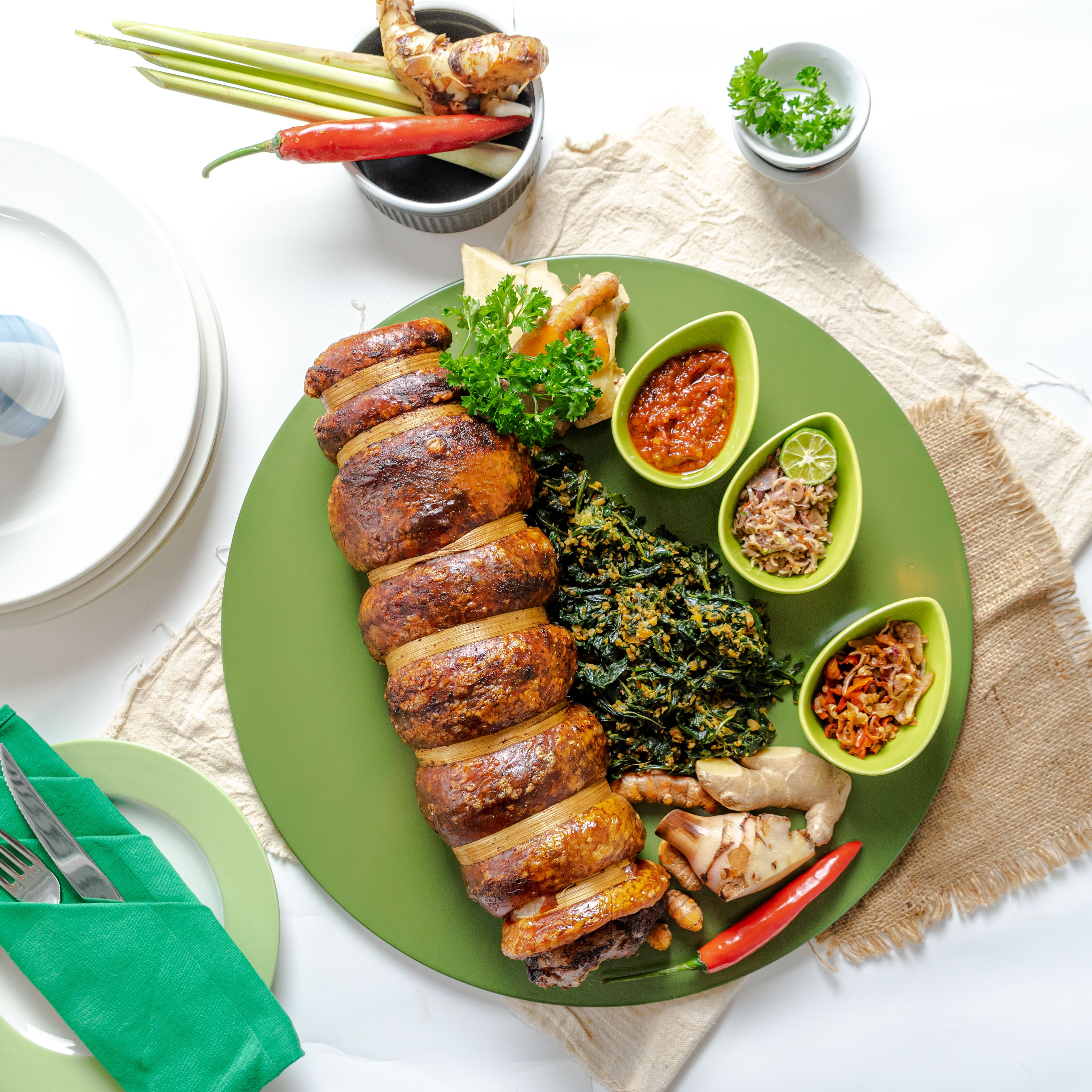
Photo: Tamba Budiarsana / Pexels
Indonesian
Babi Guling
The diets react (see scores below)
Common Ingredients
- pork
- turmeric
- lemongrass
- garlic
- shallots
- galangal
- candlenuts
- coriander
- chili
- cassava leaves
Specific recipes may vary.
Incompatible with 6 of 11 diets
Diet Ratings
Babi Guling is a Balinese spit-roasted suckling pig dish, and pork itself is an excellent keto protein source — high in fat and zero carbs. The spice paste (base genep) includes turmeric, lemongrass, garlic, shallots, galangal, candlenuts, coriander, and chili, all of which are used in relatively small amounts and contribute minimal net carbs per serving. The critical concern is cassava leaves, which are a starchy component with moderate carb content. However, cassava leaves contain significantly less starch than cassava root, and in this dish they are used as a stuffing/wrapping ingredient in modest quantities. Candlenuts also add some carbs but in small amounts. The overall dish is predominantly pork (fat and protein), making it conditionally keto-friendly if the cassava leaf portion is kept minimal and no sugary marinades or rice accompaniments are included. Standard restaurant servings of Babi Guling often come with rice and lawar (mixed vegetables), which must be avoided.
Some strict keto practitioners would avoid this dish entirely due to the cassava leaves — even in leaf form, cassava is a high-carb root vegetable family ingredient, and strict protocols argue that any cassava-derived component is a red flag. Lazy keto practitioners, conversely, may fully approve given the dominant pork base and minimal spice carbs.
Babi Guling is a traditional Balinese spit-roasted pork dish. Pork is the primary and defining ingredient, making this dish entirely incompatible with a vegan diet. While the spice paste (base genep) and accompanying ingredients such as turmeric, lemongrass, garlic, shallots, galangal, candlenuts, coriander, chili, and cassava leaves are all plant-based, the central protein is animal flesh. There is no version of Babi Guling that qualifies as vegan — it is defined by the presence of whole roasted pig.
Babi Guling is an Indonesian spit-roasted pork dish with a largely paleo-compatible ingredient list. Pork is fully approved, and the aromatic base — turmeric, lemongrass, garlic, shallots, galangal, coriander, and chili — consists of whole herbs and spices that are unambiguously paleo. Candlenuts (kemiri) are a tree nut used as a thickening agent and are generally considered paleo-compatible. The primary concern is cassava leaves: while cassava root (a tuber) is broadly accepted in paleo, the leaves contain naturally occurring cyanogenic glycosides and are not a standard paleo food. They require significant processing (boiling, discarding cooking water) to be safe to eat, which places them in a gray area philosophically. Additionally, traditional Babi Guling preparations often include added salt and may use non-paleo seasonings or preparation aids depending on the recipe. The dish scores reasonably well given its protein and herb foundation, but the cassava leaves and potential for added salt prevent a full approval.
Some ancestral health advocates, particularly those aligned with the Perfect Health Diet (Paul Jaminet) or tropical ancestral eating patterns, would accept cassava leaves as a traditional whole food consumed safely after proper preparation, arguing that detoxification through cooking mirrors what hunter-gatherers would have done with many plants.
Babi Guling is a whole roasted pork dish, which directly conflicts with Mediterranean diet principles. Pork is a red meat that should be consumed only a few times per month at most, and a whole roasted pork preparation implies a centerpiece, high-portion serving rather than an occasional small serving. While many of the aromatic spices and herbs used (turmeric, lemongrass, garlic, shallots, galangal, coriander, chili) are plant-based and would be welcome in a Mediterranean context, they do not offset the primary issue: the dish is built around a substantial serving of red meat (pork) as the main protein. The cassava leaves add some plant value, but the overall dish structure is incompatible with Mediterranean dietary guidance.
Babi Guling is a traditional Balinese roasted suckling pig that, while centered on pork, is loaded with numerous plant-based ingredients that are strictly excluded from the carnivore diet. The marinade and spice paste (base genep) contains turmeric, lemongrass, garlic, shallots, galangal, candlenuts, coriander, and chili — all plant-derived and prohibited. Most critically, cassava leaves are stuffed inside the pig during roasting, making plant matter an integral structural component of the dish, not merely a trace seasoning. The pork itself would be carnivore-approved, but in this traditional preparation it cannot be separated from the extensive plant-based marinade and stuffing. This dish as prepared is fundamentally incompatible with the carnivore diet.
Babi Guling (Balinese spit-roasted pork) as described contains only Whole30-compliant ingredients. Pork is an allowed protein, and all the aromatics and spices — turmeric, lemongrass, garlic, shallots, galangal, candlenuts, coriander, and chili — are natural herbs and spices explicitly permitted on the program. Cassava leaves are a vegetable and fully compliant. There are no grains, legumes, dairy, added sugars, alcohol, or other excluded ingredients in this ingredient list. The dish is a whole, minimally processed preparation of meat with real-food seasonings, which aligns well with the Whole30 spirit.
Babi Guling contains multiple high-FODMAP ingredients that make it unsuitable during the elimination phase. Garlic is one of the highest FODMAP foods tested by Monash University, containing significant fructans even in small amounts. Shallots are likewise high in fructans and essentially equivalent to onion in FODMAP content — both are among the most problematic foods on the low-FODMAP diet. These two ingredients alone are sufficient to classify this dish as high-FODMAP. Cassava leaves add further concern as they are not well-tested by Monash and contain compounds that may be problematic. The remaining spices — turmeric, lemongrass, galangal, coriander, and chili — are generally low-FODMAP in cooking quantities, and pork itself is a free protein with no FODMAP load. Candlenuts (kemiri) have limited Monash data but are used in small quantities as a thickener and are unlikely to contribute significant FODMAPs. However, the garlic and shallot base of the spice paste (base genep/bumbu) is inseparable from the dish's preparation, making safe modification impractical in a restaurant or traditional setting.
Babi Guling is a Balinese spit-roasted whole pig dish that is fundamentally incompatible with DASH diet principles. The dish is centered on whole pork — including the skin, fatty cuts, and organ meats — which is high in saturated fat and cholesterol. The crispy skin (crackling) is particularly problematic as it is essentially pure pork fat rendered and crisped. DASH guidelines explicitly limit red meat consumption, recommend lean cuts only in small amounts, and restrict saturated fat intake. While the spice blend (turmeric, lemongrass, garlic, shallots, galangal, coriander, chili) and cassava leaves are DASH-friendly and offer anti-inflammatory and nutritional benefits, these ingredients are overwhelmed by the high saturated fat content of the fatty pork preparation. Babi Guling is not a lean protein preparation — it is a celebratory whole-roast dish prized for its rich, fatty flavors and crispy skin. There may be added salt in the marinade as well, contributing to sodium load. The combination of high saturated fat, red meat as the centerpiece, and fatty skin makes this an 'avoid' under NIH DASH guidelines.
Babi Guling is a Balinese whole roasted suckling pig, which presents several Zone Diet challenges. The primary protein — pork — is not inherently off-limits in Zone, but this dish is specifically made from whole pig including skin and fatty cuts, meaning the saturated fat content is significantly higher than Zone's preferred lean protein sources (skinless chicken, fish, egg whites). The fat profile skews saturated rather than monounsaturated, which conflicts with Zone's anti-inflammatory emphasis. On the positive side, the spice blend (turmeric, lemongrass, garlic, galangal, coriander) is rich in polyphenols and anti-inflammatory compounds that Dr. Sears actively promotes, and cassava leaves add some vegetable-based carbohydrates. However, cassava itself is a high-glycemic starch, and cassava leaves — while lower glycemic than the root — still need careful portioning. Candlenuts contribute additional fat load, pushing the fat ratio higher. The overall dish as traditionally prepared is fatty, lacks a controlled 40/30/30 block structure, and is difficult to portion into a lean protein block without consuming excess saturated fat. It could be partially incorporated by selecting leaner cuts and removing skin, but as served, it is a 'caution' food requiring significant modification.
Some Zone practitioners would argue that pork, even in fattier preparations, is not categorically excluded by Dr. Sears — Zone is ratio-based, not exclusion-based. If one selects a leaner portion of the roasted pork (loin rather than belly or skin), limits the serving to approximately 3 oz, and pairs it with Zone-favorable vegetables while adding monounsaturated fat separately, Babi Guling components could technically be incorporated. The anti-inflammatory spice profile (turmeric especially) aligns well with Sears' later OmegaRx Zone and anti-inflammatory writings, which could soften the critique of this dish.
Babi Guling is a Balinese whole-roasted suckling pig, and its inflammatory profile is a study in contrasts. On the positive side, the spice blend is genuinely impressive from an anti-inflammatory standpoint: turmeric (curcumin), galangal (a ginger-family rhizome with its own anti-inflammatory properties), lemongrass, garlic, shallots, coriander, and chili all contain meaningful polyphenols, flavonoids, and bioactive compounds that research associates with reduced inflammatory markers (CRP, IL-6). Cassava leaves provide fiber and micronutrients. However, the primary protein is whole roasted pork — a red meat that is higher in saturated fat than poultry or fish. As a spit-roasted whole pig, Babi Guling is characterized by its crispy skin (chicharrón-style), meaning the fat content — including saturated fat — is substantially elevated compared to a lean pork loin preparation. The cooking method (whole roasting) renders and concentrates fat rather than reducing it. Candlenuts are high in omega-6 fatty acids, though used in modest amounts as a spice paste ingredient. Anti-inflammatory frameworks consistently place red meat in the 'limit' category and fatty preparations of it in the 'avoid' range, even when accompanied by beneficial spices. The spice profile partially offsets the pro-inflammatory signal of the pork fat, but cannot override it at the portion sizes typical of a main dish. This dish is acceptable as an occasional indulgence but should not be a dietary staple under anti-inflammatory principles.
Some anti-inflammatory practitioners (notably those influenced by ancestral or whole-food frameworks) argue that unprocessed pork fat from pasture-raised animals is meaningfully different from industrial processed meats, and that the rich polyphenol spice rub may blunt post-meal inflammatory response — pointing to studies showing that herb-and-spice marinades reduce advanced glycation end-products (AGEs) and lipid oxidation during cooking. Mainstream anti-inflammatory guidance (Dr. Weil's pyramid, IF Rating system) nonetheless categorizes red and fatty meats as 'limit' foods regardless of sourcing or accompaniments.
Babi Guling is a Balinese whole roasted suckling pig dish where the entire carcass — including the skin — is spit-roasted over an open flame. The cooking method produces very high fat content, particularly from the rendered subcutaneous fat and the signature crispy crackling skin, which is essentially pure saturated fat. A typical serving contains significant amounts of fatty pork belly and skin alongside the leaner meat portions. This combination of high saturated fat, fried/roasted skin, and heavy spice paste (including chili) directly violates three of the core GLP-1 dietary rules: it worsens nausea and reflux due to high fat content, slows already-delayed gastric emptying further, and the spicy chili component can aggravate GI irritation. While the spice blend (turmeric, lemongrass, galangal, coriander) offers anti-inflammatory value and the pork itself provides protein, the fat load from the preparation method overwhelms any nutritional benefit. Cassava leaves add some fiber but do not offset the primary concerns. This dish is a known trigger for exactly the GI side effects GLP-1 patients most need to avoid.
*See how scores were generated at our methodology page.
Nutritional profile
Six traits that cut across every diet.
Fiber & Plants
How much whole-plant food and fiber it delivers.
Healthy Fats
The quality of its fats (unsaturated, omega-3).
Whole / Unprocessed
How close it is to its natural, unprocessed form.
Gut Gentle
How easy it is on digestion (low FODMAP, few irritants).
Low Glycemic
How little it spikes your blood sugar.
Protein Density
How much protein it packs per calorie.
Controversy Index
Higher controversy = more disagreement between diets.
Diet-Specific Tips
 Keto — 5/10
View tips
- Pork is zero-carb and high in fat — ideal keto protein
- Cassava leaves are the primary concern, adding moderate net carbs
- Cassava leaves have lower carbs than cassava root but still meaningful
- Spice paste ingredients (garlic, shallots, lemongrass) contribute minor carbs in small quantities
- Candlenuts add modest carbs but are used in small amounts
- Traditional serving with rice must be strictly avoided
- Portion control of cassava leaf stuffing is key to staying in ketosis
 Paleo — 5/10
View tips
- Pork is fully paleo-approved as an unprocessed animal protein
- Aromatic spices and herbs (turmeric, lemongrass, galangal, coriander, garlic, shallots, chili) are all paleo-compliant
- Candlenuts are a tree nut and generally paleo-acceptable
- Cassava leaves contain cyanogenic glycosides and require processing to be safe — a paleo gray area
- Cassava root (tuber) is paleo-accepted but leaves are not a standard paleo food
- Traditional recipes typically include added salt, which is excluded under strict paleo rules
- Overall dish philosophy aligns with ancestral eating but specific ingredients create ambiguity
 Whole30 — 6/10
View tips
- Pork is a fully compliant Whole30 protein
- All spices (turmeric, lemongrass, garlic, shallots, galangal, coriander, chili) are natural and allowed
- Candlenuts are tree nuts — compliant on Whole30
- Cassava leaves are a compliant vegetable
- No excluded ingredients (no grains, legumes, dairy, added sugar, or alcohol) present
- Traditional preparation aligns with whole-food philosophy of the program
 Zone — 4/10
View tips
- Whole roasted pork with skin = high saturated fat, conflicts with Zone's lean protein preference
- Turmeric, garlic, lemongrass, galangal, coriander = excellent polyphenol and anti-inflammatory profile aligned with Zone principles
- Cassava leaves add vegetable carbohydrates but cassava is a high-glycemic starch family — leaves are more acceptable than the root
- Candlenuts add additional fat load, skewing fat ratio higher and less monounsaturated
- As traditionally served, macronutrient ratio is difficult to balance to 40/30/30 without significant portion modification
- Lean pork cuts (loin) can fit Zone protein blocks at approximately 7g protein per block; fatty cuts and skin disqualify easy incorporation
 Anti-Inflammatory — 4/10
View tips
- Pork is a red meat classified as 'limit' under anti-inflammatory frameworks
- Whole-roasted preparation emphasizes fatty skin and high saturated fat content
- Turmeric, galangal, garlic, lemongrass, and chili provide strong anti-inflammatory polyphenols and bioactives
- Cassava leaves add fiber and micronutrients
- Candlenuts contribute some omega-6 fatty acids but in small culinary quantities
- Spice profile partially offsets but does not neutralize the pro-inflammatory signal of fatty pork
- Acceptable occasionally; not suitable as a regular anti-inflammatory diet staple