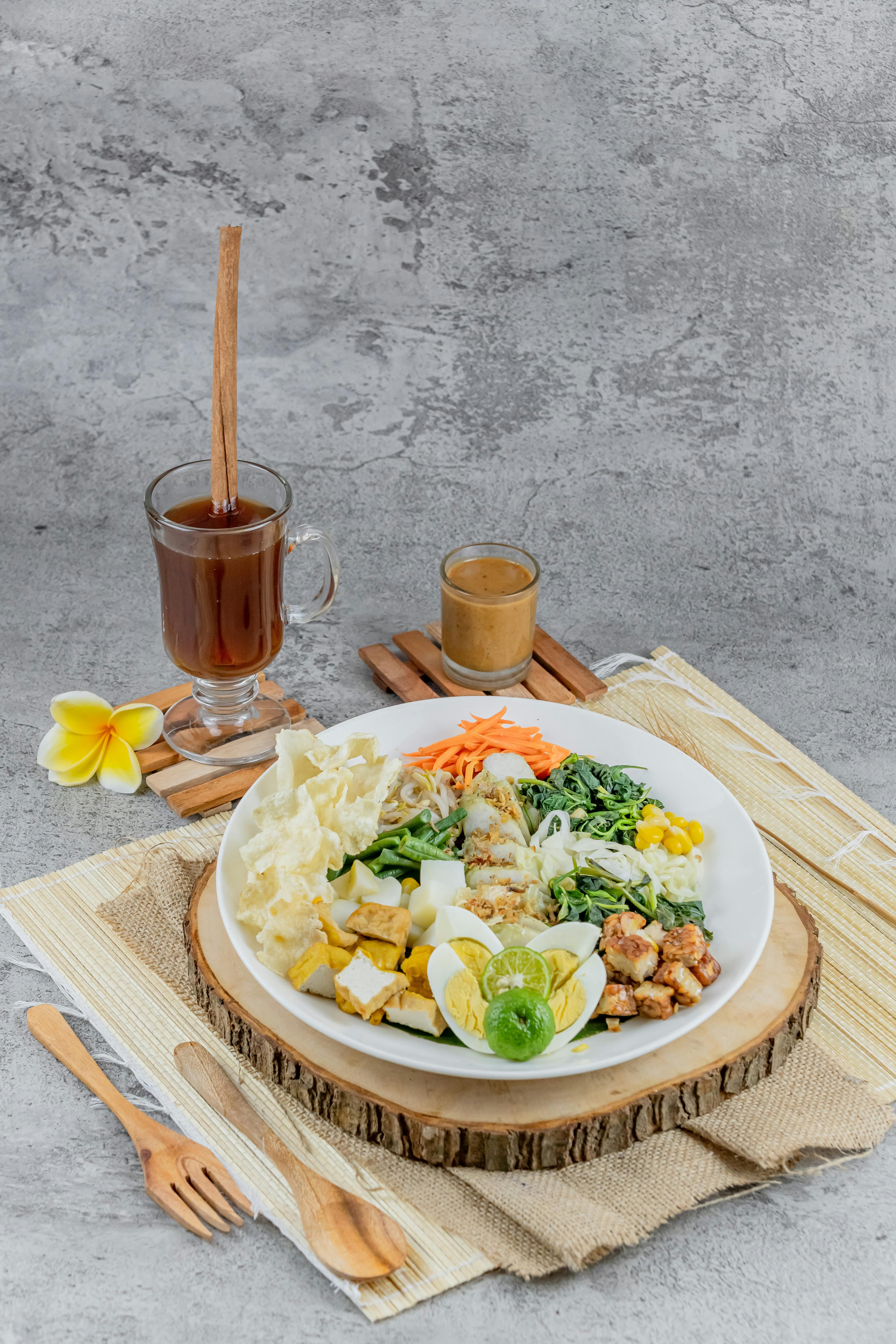
Photo: Dovinda Rd / Pexels
Indonesian
Gado Gado
The diets react (see scores below)
Common Ingredients
- tofu
- tempeh
- eggs
- bean sprouts
- long beans
- cabbage
- potatoes
- peanut sauce
- cucumber
- fried shallots
Specific recipes may vary.
Incompatible with 6 of 11 diets
Diet Ratings
Gado Gado is fundamentally incompatible with a ketogenic diet due to multiple high-carb ingredients. Potatoes alone can contain 15-30g net carbs per serving, and the traditional peanut sauce is typically made with sugar or sweet soy sauce (kecap manis), adding significant sugar content. Tempeh, while fermented, carries moderate carbs (~7g per 100g). Bean sprouts, long beans, and cabbage are relatively lower-carb but still contribute. Combined, the total net carbs in a standard serving easily exceed 40-60g, surpassing the entire daily keto carb budget in one meal. Fried shallots also add carbs. There is no practical way to consume a traditional Gado Gado portion without breaking ketosis.
Gado Gado as listed contains eggs, which are an animal product and explicitly excluded from a vegan diet. The dish is otherwise largely plant-based — tofu, tempeh, bean sprouts, long beans, cabbage, potatoes, cucumber, and peanut sauce are all vegan-compatible ingredients, and fried shallots are typically plant-based. However, the presence of eggs makes this dish non-vegan in its traditional preparation. A vegan version of Gado Gado can easily be made by omitting the eggs, which would result in an excellent whole-food plant-based dish.
Gado Gado is fundamentally incompatible with the Paleo diet. The dish contains multiple core non-Paleo ingredients: tofu and tempeh are soy-based legume products, explicitly excluded from Paleo. Peanut sauce is made from peanuts, also a legume, and typically contains added sugar and salt. Bean sprouts and long beans are legumes. Fried shallots are typically coated in wheat flour and cooked in seed oil. Potatoes occupy a debated gray area in Paleo, but even if permitted, the surrounding ingredients make this dish clearly non-compliant. Eggs and vegetables like cabbage and cucumber are Paleo-approved, but they cannot redeem a dish where the protein sources, sauce, and several other components are all excluded foods.
Gado Gado is a nutrient-dense, largely plant-forward dish with many Mediterranean-compatible elements: abundant vegetables (bean sprouts, long beans, cabbage, cucumber), legume-based proteins (tofu, tempeh), and eggs. These align well with Mediterranean principles emphasizing whole, plant-based foods. However, the peanut sauce introduces a significant caloric load from peanuts and often added sugar, and is made without olive oil — peanut butter/peanuts are not a traditional Mediterranean fat source. Fried shallots add refined oil of unknown type. Potatoes are acceptable but starchy. The eggs and tofu/tempeh are moderate-frequency foods in Mediterranean eating. Overall, the dish is wholesome and minimally processed, but the peanut sauce and frying method introduce uncertainty that prevents a full 'approve' rating.
Some modern Mediterranean diet interpretations, particularly those emphasizing plant-based whole foods broadly, would view peanuts and legume-based sauces favorably as healthy plant fats and proteins — placing this dish closer to 'approve.' The traditional Mediterranean diet is geographically specific, but functional nutrition advocates argue that the dietary pattern's principles (whole foods, plant protein, healthy fats) are well met by Gado Gado.
Gado Gado is an Indonesian vegetable salad that is almost entirely plant-based and incompatible with the carnivore diet. The dish is dominated by plant foods: tofu and tempeh (soy-based protein), bean sprouts, long beans, cabbage, potatoes, cucumber, and fried shallots. The peanut sauce is made from peanuts (legumes) combined with plant oils and often sugar. While eggs are present and would be acceptable to most carnivore practitioners, they are a minor component in a dish that is fundamentally plant-derived. No meaningful animal protein or fat is featured. Every core ingredient — from the soy proteins to the vegetables to the legume-based sauce — is explicitly excluded on the carnivore diet.
Gado Gado contains multiple Whole30-excluded ingredients. Tofu and tempeh are soy-based products, which are legumes and explicitly excluded from Whole30. Peanut sauce is made from peanuts, also a legume and explicitly excluded. These are not edge cases — soy and peanuts are named exclusions in the official Whole30 rules. The dish is fundamentally built around these non-compliant ingredients, making it impossible to evaluate as compliant even if other components (eggs, bean sprouts, long beans, cabbage, potatoes, cucumber) are individually allowed.
Gado Gado contains multiple high-FODMAP ingredients that make it problematic during the elimination phase. Tempeh is high in GOS and is rated high-FODMAP by Monash. Fried shallots are a significant source of fructans — shallots are among the highest-FODMAP alliums and are typically used in meaningful quantities as a topping. Long beans (snake beans) are high-FODMAP at standard servings due to GOS. Peanut sauce as typically prepared contains garlic and sometimes onion, adding further fructan load; even plain peanut butter must be kept to small servings (2 tbsp) to remain low-FODMAP. Firm tofu is generally low-FODMAP (water is pressed out, removing GOS), and eggs, cucumber, potatoes, bean sprouts, and cabbage (in moderate portions) are individually low-FODMAP. However, the combination of tempeh, fried shallots, long beans, and garlic/onion-containing peanut sauce creates cumulative FODMAP stacking that makes a standard restaurant serving of Gado Gado high-FODMAP overall. Even a home-cooked version would require substituting or eliminating several core ingredients to be safe during elimination.
Monash University rates firm tofu and several vegetable components as low-FODMAP, and some clinical FODMAP practitioners argue that careful home preparation — omitting tempeh, replacing long beans with green beans at a capped 75g serving, using a garlic-free peanut sauce, and skipping fried shallots — could bring this dish into a cautious 'caution' range. However, as traditionally served, the multiple high-FODMAP components make avoidance the safer elimination-phase recommendation.
Gado Gado is a nutrient-rich Indonesian salad featuring many DASH-friendly ingredients: tofu and tempeh are excellent lean plant proteins, eggs provide quality protein (with evolving guidance), and the vegetables (bean sprouts, long beans, cabbage, cucumber) are core DASH foods rich in potassium, magnesium, and fiber. Potatoes add complex carbohydrates and potassium. However, two components complicate the DASH rating: (1) Peanut sauce, while made from heart-healthy peanuts, is typically high in sodium, added sugar, and caloric density — a generous serving can contribute 400-700mg sodium and significant saturated fat from coconut milk if included. (2) Fried shallots add saturated fat and calories from frying. The dish has strong DASH potential in its vegetable and protein components, but the peanut sauce and frying method push it into the caution zone as commonly prepared. Requesting low-sodium peanut sauce with reduced portion or asking for sauce on the side would substantially improve the DASH compatibility.
NIH DASH guidelines would flag the sodium load from traditional peanut sauce (often 500mg+ per serving) and fried elements as problematic. However, updated clinical interpretations note that peanuts and peanut butter are explicitly endorsed DASH foods (nuts/seeds group), and the predominantly vegetable and plant-protein base of Gado Gado aligns closely with DASH principles — some DASH-oriented dietitians would approve a modified version with reduced-sodium sauce as a strong DASH meal.
Gado Gado is a nutritionally rich Indonesian salad with a mixed Zone profile. On the positive side, it contains multiple Zone-favorable ingredients: tofu and tempeh (vegetarian protein sources), eggs (lean protein), and an abundance of low-glycemic vegetables including bean sprouts, long beans, cabbage, and cucumber. These align well with Zone principles. However, several elements complicate its Zone compatibility. Potatoes are a high-glycemic carbohydrate that Dr. Sears explicitly lists as 'unfavorable' — they spike insulin and should be minimized or eliminated in a Zone meal. Peanut sauce is a significant concern: while peanuts contain monounsaturated fat, peanut sauce is typically high in omega-6 fatty acids, often sugar-sweetened, and calorie-dense in ways that distort the 40/30/30 ratio. Fried shallots add unnecessary omega-6-heavy frying oil. The combination of tofu and tempeh as vegetarian proteins means fat blocks need adjustment (3g fat per block rather than 1.5g), making the already-rich peanut sauce even harder to balance. A Zone-adapted version — removing or minimizing potatoes, swapping peanut sauce for a lighter almond-based dressing, and eliminating fried shallots — would score considerably higher. As typically served, this dish requires substantial modification to achieve Zone ratios.
Some Zone practitioners following Sears' later anti-inflammatory work (Toxic Fat, The Zone Diet) might rate Gado Gado more favorably, noting that the dish is predominantly vegetables with quality protein sources and that traditional peanut sauce in modest portions provides acceptable fat. The vegetable density and protein variety (tofu, tempeh, eggs) mirror Zone-favorable meal construction. Additionally, potatoes in small amounts can technically fit as a carbohydrate block — Sears classifies them as 'unfavorable' but not absolutely forbidden, and the portion in Gado Gado is typically modest relative to the overall dish volume.
Gado Gado is a nutrient-dense Indonesian salad with a strong anti-inflammatory foundation. Tofu and tempeh are whole soy foods explicitly emphasized in anti-inflammatory frameworks like Dr. Weil's pyramid for their isoflavones and plant protein. The vegetable base — cabbage, bean sprouts, long beans, and cucumber — provides fiber, antioxidants, and phytonutrients with negligible inflammatory load. Potatoes are a whole food with modest anti-inflammatory polyphenols (especially if skin-on), though they carry some debate as nightshades. Eggs are a moderate-tier food with mixed anti-inflammatory profiles. The peanut sauce is the most nuanced element: peanuts contain resveratrol and oleic acid with some anti-inflammatory benefit, but also omega-6 fatty acids (linoleic acid) and are often prepared with added sugar, salt, and sometimes refined oils — the inflammatory impact scales with preparation. Fried shallots, though alliums are anti-inflammatory, introduce refined oil (typically palm or corn oil) and a frying step that could add an oxidized fat burden. Overall the dish skews positive due to the soy protein emphasis, diverse vegetables, and plant-forward structure, but the peanut sauce quality and fried shallots introduce meaningful variability that prevents a high-confidence approval.
Mainstream anti-inflammatory nutrition would broadly approve this dish given its whole-food, plant-forward profile with emphasized soy foods and vegetable diversity. However, practitioners following stricter omega-6 management (e.g., Zone Diet anti-inflammatory protocols) would flag peanut sauce as a concentrated omega-6 source, and AIP-aligned practitioners would caution against both eggs and nightshade-adjacent potatoes for autoimmune-sensitive individuals.
Gado Gado is a nutrient-dense Indonesian salad with a strong protein foundation from tofu, tempeh, and eggs — all GLP-1-friendly sources. The vegetables (bean sprouts, long beans, cabbage, cucumber) add meaningful fiber and water content, supporting digestion and hydration. Potatoes contribute digestible complex carbohydrates. The primary concern is the peanut sauce, which is calorie-dense and high in fat per serving — even a modest 3–4 tablespoon portion adds 150–200 calories and 12–16g of fat, which can worsen nausea, bloating, or reflux in GLP-1 patients given slowed gastric emptying. Fried shallots, while used as a garnish in small amounts, add unnecessary saturated fat. The dish is not inherently problematic, but portion control of the peanut sauce is essential, and the fried shallots should be minimized or omitted. With sauce moderated (1–2 tbsp), this dish scores closer to an approve; with a generous sauce pour typical in restaurant servings, the fat load tips it into caution territory.
Some GLP-1-focused dietitians view Gado Gado favorably as a whole-food, plant-forward dish where the fat in peanut sauce comes from unsaturated sources and supports satiety in small volumes — arguing the dish's overall nutrient density outweighs the fat concern. Others flag the cumulative fat load from peanut sauce plus fried shallots plus tofu as a meaningful GI risk for patients in early dose titration phases or those with persistent nausea, recommending the dish only after GI side effects have stabilized.
*See how scores were generated at our methodology page.
Nutritional profile
Six traits that cut across every diet.
Fiber & Plants
How much whole-plant food and fiber it delivers.
Healthy Fats
The quality of its fats (unsaturated, omega-3).
Whole / Unprocessed
How close it is to its natural, unprocessed form.
Gut Gentle
How easy it is on digestion (low FODMAP, few irritants).
Low Glycemic
How little it spikes your blood sugar.
Protein Density
How much protein it packs per calorie.
Controversy Index
Higher controversy = more disagreement between diets.
Diet-Specific Tips
 Mediterranean — 6/10
View tips
- Rich in vegetables (bean sprouts, long beans, cabbage, cucumber) — strongly Mediterranean-positive
- Tofu and tempeh are excellent plant-based proteins consistent with Mediterranean legume emphasis
- Eggs are acceptable in moderation per Mediterranean guidelines
- Peanut sauce is not a traditional Mediterranean fat source and may contain added sugar
- Fried shallots introduce oil of unknown quality and additional calories
- No red meat or highly processed ingredients
- Potatoes are acceptable but contribute refined starch
 DASH — 5/10
View tips
- Excellent vegetable variety (bean sprouts, long beans, cabbage, cucumber) — core DASH foods
- Tofu and tempeh are ideal DASH-approved plant proteins
- Eggs are acceptable in moderation under current DASH-aligned guidance
- Peanut sauce is high in sodium as traditionally prepared (400-700mg+ per serving)
- Fried shallots add saturated fat and excess calories
- Peanut sauce may contain coconut milk, adding saturated fat
- Potatoes contribute DASH-friendly potassium and fiber
- Low-sodium peanut sauce version would score 7-8 (approve range)
- Overall sodium per serving can approach or exceed 1,000mg depending on sauce quantity
 Zone — 5/10
View tips
- Potatoes are explicitly 'unfavorable' high-glycemic carbs in Zone methodology
- Peanut sauce is typically high in omega-6 fats and often sugar-sweetened, distorting Zone fat ratios
- Fried shallots add inflammatory omega-6 frying oils
- Tofu and tempeh are Zone-acceptable vegetarian proteins but require higher fat block counts (3g/block)
- Bean sprouts, long beans, cabbage, and cucumber are excellent Zone-favorable low-glycemic vegetables
- Eggs are a lean Zone-approved protein source
- The dish can be Zone-adapted with modifications: remove potatoes, reduce/modify peanut sauce, eliminate fried shallots
 Anti-Inflammatory — 7/10
View tips
- Tofu and tempeh are emphasized whole soy foods in anti-inflammatory frameworks — strong positive
- Diverse vegetable base (cabbage, bean sprouts, long beans, cucumber) provides antioxidants and fiber
- Peanut sauce contains omega-6 fatty acids and often added sugar — inflammatory impact depends on preparation
- Fried shallots introduce refined frying oil, a potential pro-inflammatory element
- Eggs are a moderate-tier food with mixed anti-inflammatory research
- Potatoes are nutritionally acceptable whole foods but may be flagged by autoimmune-protocol practitioners as nightshades
- No red meat, processed foods, or trans fats present
 GLP-1 Friendly — 6/10
View tips
- Strong multi-source protein from tofu, tempeh, and eggs
- High fiber and water content from vegetables supports GLP-1 digestion and hydration needs
- Peanut sauce is calorie-dense and high in fat — portion is the critical variable
- Fried shallots add saturated fat and should be minimized or omitted
- Potatoes are easily digestible and GLP-1-compatible in moderate portions
- Dish is nutrient-dense per calorie when sauce is controlled
- Restaurant portions of peanut sauce likely exceed GLP-1-safe fat threshold per meal
- Unsaturated fat profile of peanuts is preferred over saturated fat sources