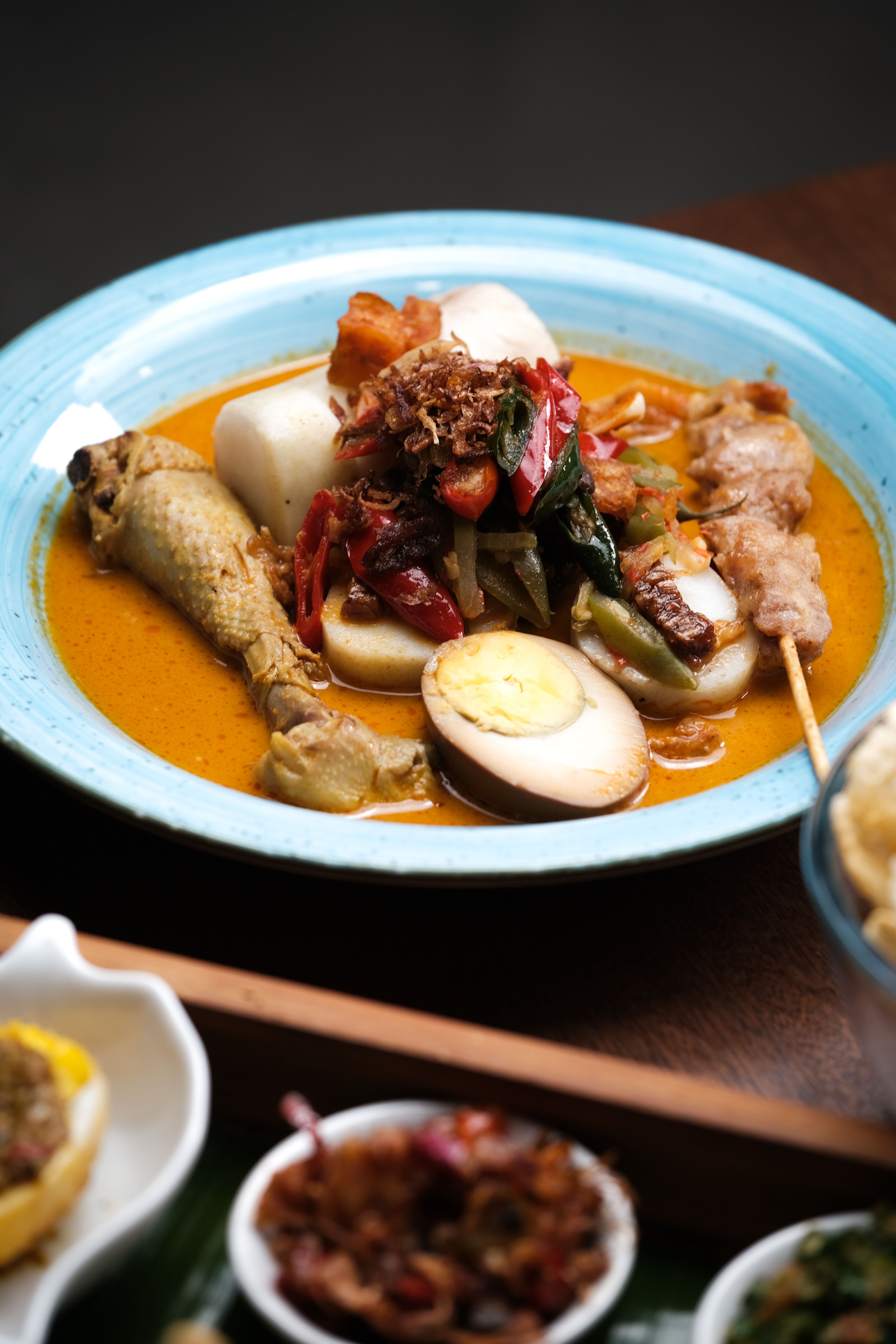
Photo: Desmond Lim, Chef / Pexels
Indonesian
Lontong
The diets react (see scores below)
Common Ingredients
- rice
- banana leaves
- water
- salt
- pandan leaf
Specific recipes may vary.
Incompatible with 4 of 11 diets
Diet Ratings
Lontong is compressed rice cake, making it almost entirely starch. A typical 100g serving contains approximately 23-25g of net carbs with virtually no fiber, fat, or protein to offset the glycemic impact. Even a small portion would consume the entire daily keto carb budget, and rice is one of the most carb-dense staple foods. There is no meaningful fat content, making this incompatible with keto macros on every level. The banana leaves, pandan leaf, salt, and water are merely cooking vessels and flavoring agents that contribute no nutritional value.
Lontong is compressed rice cake cooked in banana leaves with water, salt, and pandan leaf for fragrance. Every single ingredient is entirely plant-based: rice is a whole grain, banana leaves and pandan leaf are plant materials used as natural cooking vessels and flavoring, and salt is a mineral. There are no animal products, animal-derived ingredients, or ethically contested components anywhere in this dish. It is a minimally processed, whole-food preparation that aligns excellently with vegan principles.
Lontong is compressed rice cake wrapped in banana leaves — its primary ingredient is rice, a grain that is categorically excluded from the paleo diet. Grains, including rice, are rejected by paleo principles due to their anti-nutrient content (phytates, lectins) and absence from the Paleolithic diet. The banana leaves, water, and pandan leaf are benign, but they are merely cooking vessels and aromatics; the dish itself is defined by rice. Salt is also on the avoid list under strict paleo guidelines. There is no meaningful paleo-compatible substitution here — the dish is fundamentally a grain product.
Lontong is compressed rice cake made by boiling rice in banana leaves. The ingredients are clean and minimal — no additives, no refined sugars, no unhealthy fats — which is positive. However, white rice is a refined grain that lacks the fiber and nutrients of whole grains preferred by Mediterranean diet guidelines. As a side dish eaten in moderation, it is acceptable, but it is not a staple Mediterranean food and should not replace whole grains like farro, barley, or bulgur. The aromatic leaves (banana leaf, pandan) add no nutritional concern.
Some traditional Mediterranean cuisines, particularly in regions like Greece and the Middle East, do incorporate white rice (e.g., pilaf, rice-stuffed vegetables) as an acceptable component, suggesting that plain white rice in moderate portions need not be strictly avoided. Modern clinical Mediterranean diet frameworks, however, consistently prefer whole grains over refined ones.
Lontong is a compressed rice cake cooked in banana leaves — it is entirely plant-based with zero animal-derived ingredients. Rice is a grain (carbohydrate), banana leaves and pandan leaf are plant materials, and there is no protein source at all. Every single ingredient violates carnivore diet principles. This is one of the clearest possible avoid verdicts.
Lontong is a compressed rice cake made by cooking rice inside banana leaves until it forms a dense, solid cake. The primary ingredient is rice, which is explicitly excluded on Whole30 as a grain. All other ingredients (banana leaves, water, salt, pandan leaf) are compliant, but the foundational ingredient — rice — disqualifies this dish entirely. There are no compliant substitutions that would make this traditional dish Whole30-compatible while still being lontong.
Lontong is compressed rice cooked in banana leaves, and all its ingredients are clearly low-FODMAP. White rice is one of the safest, most definitively low-FODMAP staple foods per Monash University, with no FODMAP concerns even at generous servings. Banana leaves are used purely as a cooking vessel and contribute no FODMAPs. Pandan leaf (screwpine) is a Southeast Asian aromatic herb used in small amounts for fragrance; it has no known FODMAP content and is generally regarded as safe. Salt and water are inherently FODMAP-free. The dish contains no onion, garlic, wheat, legumes, lactose, polyols, or excess fructose. A standard serving of lontong (1-2 rice cakes, approximately 100-200g cooked rice) is well within safe low-FODMAP limits.
Lontong is compressed rice cake made by boiling rice in banana leaves until very dense. From a DASH perspective, white rice is a refined grain — not a whole grain — and thus not emphasized by DASH guidelines, which favor whole grains (brown rice, whole wheat, oats). However, lontong itself is low in sodium, contains no saturated fat, no added sugars, and no processed ingredients, which aligns well with DASH principles. The small amount of salt used is minimal per serving. The main DASH concern is the refined grain base and relatively low fiber, potassium, magnesium, and calcium content compared to DASH-preferred whole grains or vegetables. As a side dish eaten in portion-controlled amounts alongside vegetables, lean proteins, and legumes (common in Indonesian cuisine), it is acceptable in moderation. DASH allows 6-8 servings of grains daily, with at least half being whole grains — lontong can occupy some of that allowance but should not dominate.
NIH DASH guidelines specifically call for whole grains and do not endorse refined grains like white rice as a primary carbohydrate source; however, updated clinical interpretations note that white rice as part of a varied diet rich in DASH-recommended foods (vegetables, legumes, lean protein) does not meaningfully worsen cardiovascular outcomes, and some DASH practitioners in Asian dietary contexts accept white rice as a culturally appropriate grain staple in moderation.
Lontong is compressed rice cake — essentially pure white rice packed tightly in banana leaves. White rice is a high-glycemic carbohydrate that Dr. Sears explicitly classifies as 'unfavorable' in Zone terminology. It has a high glycemic index and glycemic load, causing rapid blood sugar and insulin spikes that directly work against the Zone's anti-inflammatory goals. The compression cooking method results in a very dense, starchy product with minimal fiber to slow glucose absorption. While technically it can be counted as carbohydrate blocks, it would require very small portions (roughly 30g or less per meal) to stay within Zone carb limits, and even then it would 'waste' your carb blocks on a high-GI source rather than the preferred low-GI vegetables and fruits. There is no protein, no fat, no fiber, and no meaningful polyphenol content. The banana leaf wrapping and pandan leaf add negligible nutritional value. As a side dish, it provides no Zone-favorable macronutrient contribution and actively challenges Zone ratios by being a pure, rapidly absorbed carbohydrate. It scores a 3 rather than 1-2 only because it is a real food (not processed sugar or soda) and can technically be portioned into a Zone block system, albeit poorly.
Lontong is compressed rice cake cooked in banana leaves — a simple, minimally processed whole food with no additives, trans fats, or added sugars. The banana leaves and pandan leaf contribute trace phytonutrients and antioxidants (chlorophyll, flavonoids from pandan), and the cooking method is clean. However, the primary ingredient is white rice, a refined grain with a high glycemic index that can spike blood sugar and promote low-grade inflammation, particularly when consumed in significant quantities. It lacks fiber, omega-3s, or meaningful antioxidant density on its own. The salt content is minimal. Anti-inflammatory frameworks generally prefer whole grains over refined white rice, placing lontong in a neutral-to-cautious zone — acceptable as a modest side dish alongside anti-inflammatory accompaniments (e.g., vegetables, legumes, fatty fish), but not a net positive on its own.
Some anti-inflammatory researchers, including Dr. Weil, take a relatively permissive view of white rice in the context of an otherwise nutrient-rich diet, noting it is less harmful than other refined carbohydrates and is a staple in longevity-associated Asian dietary patterns. Others, particularly those following lower-glycemic anti-inflammatory protocols, would rate white rice more negatively due to its glycemic impact on insulin and inflammatory markers.
Lontong is compressed rice cake cooked in banana leaves — essentially a refined carbohydrate with minimal protein, minimal fiber, very low fat, and easy digestibility. For GLP-1 patients eating significantly reduced calories, it offers poor nutrient density per calorie: mostly starch with negligible protein and fiber contribution. It is not inherently harmful — it is low fat, easy to digest, and gentle on the GI tract — but it fails the two top priorities (protein and fiber) and represents an empty-calorie risk when appetite is severely suppressed. As a side dish paired with high-protein, high-fiber mains (e.g., grilled fish, tempeh, vegetable curries), it is acceptable in a small portion. On its own or as a meal base without adequate accompaniments, it is a poor choice for GLP-1 patients who cannot afford nutritionally empty bites.
*See how scores were generated at our methodology page.
Nutritional profile
Six traits that cut across every diet.
Fiber & Plants
How much whole-plant food and fiber it delivers.
Healthy Fats
The quality of its fats (unsaturated, omega-3).
Whole / Unprocessed
How close it is to its natural, unprocessed form.
Gut Gentle
How easy it is on digestion (low FODMAP, few irritants).
Low Glycemic
How little it spikes your blood sugar.
Protein Density
How much protein it packs per calorie.
Controversy Index
Higher controversy = more disagreement between diets.
Diet-Specific Tips
 Vegan — 9/10
View tips
- Rice is a whole-grain plant food — fully vegan
- Banana leaves are plant-based cooking vessels, not an ingredient consumed
- Pandan leaf is a plant-based aromatic — fully vegan
- Salt is a mineral with no animal involvement
- No animal products, dairy, eggs, or animal-derived additives present
- Minimal processing — traditional preparation method
- All ingredients are whole or natural plant materials
 Mediterranean — 5/10
View tips
- White rice is a refined grain — lower fiber than whole grain alternatives preferred in Mediterranean diet
- No added sugars, unhealthy fats, or processed ingredients — clean preparation
- Minimal ingredient list with natural aromatics only
- No protein source, no vegetables or legumes to balance the refined carbohydrate
- Acceptable as an occasional side but not a Mediterranean staple grain
 Low-FODMAP — 9/10
View tips
- White rice is definitively low-FODMAP at all standard serving sizes per Monash University
- Banana leaves function only as a cooking wrapper and contribute no FODMAPs
- Pandan leaf used in small aromatic quantities has no known FODMAP content
- Salt and water are completely FODMAP-free
- No high-FODMAP ingredients present — no onion, garlic, wheat, legumes, lactose, or polyols
- Dish is naturally gluten-free and dairy-free
 DASH — 5/10
View tips
- Refined grain (white rice), not whole grain — DASH prefers whole grains
- Very low sodium content — positive for DASH
- No saturated fat, trans fat, or added sugar — positive
- Low in fiber, potassium, calcium, and magnesium compared to DASH-core foods
- Portion control important — acceptable within the 6-8 grain servings/day allowance
- No lean protein or vegetables inherent in the dish — nutrient density is limited
 Zone — 5/10
View tips
- Pure white rice — high glycemic index carbohydrate, explicitly 'unfavorable' in Zone methodology
- No protein, no fat, no fiber to slow glucose absorption or balance macros
- Dense compressed form increases glycemic load per serving
- Provides no polyphenols or omega-3s — no anti-inflammatory value
- Tiny portion required to fit Zone carb blocks, making it impractical as a side dish
- Banana leaf and pandan are aromatic only — no Zone macronutrient contribution
 Anti-Inflammatory — 5/10
View tips
- White rice is a refined grain with high glycemic index — not preferred in anti-inflammatory frameworks
- No added sugars, trans fats, seed oils, or artificial additives — clean ingredient profile
- Pandan leaf and banana leaves contribute minor phytonutrients and antioxidants
- Minimal nutritional density — lacks fiber, omega-3s, and meaningful antioxidants
- Appropriate as a modest side dish within an otherwise anti-inflammatory meal
- Low-glycemic whole grains (brown rice, quinoa) would be preferred alternatives
 GLP-1 Friendly — 4/10
View tips
- Refined carbohydrate — white rice with negligible fiber after compression and cooking
- No meaningful protein contribution (listed as none)
- Low fat — does not worsen GLP-1 GI side effects
- Easy to digest — gentle on slowed gastric emptying
- Poor nutrient density per calorie — counterproductive given suppressed appetite
- Portion-sensitive: small amounts as a side alongside protein and fiber-rich dishes are acceptable
- Banana leaves and pandan are aromatic only — no significant nutritional contribution