Photo: Tamba Budiarsana / Pexels
Indonesian
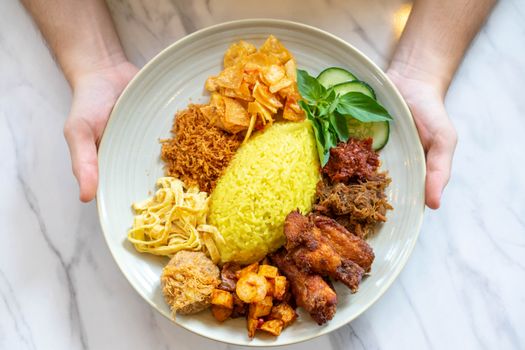
Nasi Kuning
The diets react (see scores below)
Common Ingredients
- rice
- coconut milk
- turmeric
- lemongrass
- pandan leaves
- bay leaves
- kaffir lime leaves
- salt
- galangal
Specific recipes may vary.
Incompatible with 7 of 11 diets
Diet Ratings
Nasi Kuning is fundamentally a rice-based dish, and rice is one of the most keto-incompatible staple foods. A single cup of cooked white rice contains approximately 45g of net carbs, which alone meets or exceeds the entire daily keto carb limit (20-50g). While the coconut milk and aromatic spices (turmeric, lemongrass, pandan, galangal, bay leaves, kaffir lime leaves) are keto-friendly ingredients that add fat and flavor, they are present in small quantities relative to the rice and cannot offset its overwhelming carbohydrate content. This dish would immediately disrupt ketosis for virtually any keto practitioner.
Nasi Kuning as described is entirely plant-based. The dish consists of rice cooked in coconut milk (a plant-derived fat source) and seasoned with a collection of aromatic herbs and spices — turmeric, lemongrass, pandan leaves, bay leaves, kaffir lime leaves, galangal, and salt. Every ingredient is derived from plants with no animal products or animal-derived additives present. Coconut milk is a whole-food plant ingredient, and all aromatics are unprocessed plant materials. This version scores a 9 (rather than 10) only because traditional Nasi Kuning is often served with accompaniments such as boiled eggs, fried anchovies (ikan teri), or meat floss, which would not be vegan — but the rice dish itself as listed is fully compliant. Vegans should simply be aware of non-vegan accompaniments when ordering in a restaurant context.
Nasi Kuning is fundamentally a rice dish — 'nasi' means rice in Indonesian — and rice is a grain, which is explicitly excluded from the paleo diet. While several of the accompanying aromatics and flavorings are paleo-friendly (turmeric, lemongrass, pandan leaves, bay leaves, kaffir lime leaves, galangal, coconut milk), and even unrefined, the base ingredient is white rice, a grain that is categorically excluded under paleo principles. Added salt is also non-paleo. The dish cannot be considered paleo in any standard form because its identity and structure depend entirely on rice.
Nasi Kuning is Indonesian yellow rice cooked in coconut milk with aromatic spices. From a Mediterranean diet perspective, it presents two significant concerns: (1) it uses white rice, a refined grain that the Mediterranean diet discourages in favor of whole grains, and (2) coconut milk is the cooking fat, replacing the canonical extra virgin olive oil. Coconut milk is high in saturated fat and is entirely absent from traditional Mediterranean culinary traditions. While the aromatic spices (turmeric, lemongrass, galangal) are anti-inflammatory and add nutritional interest, they do not offset the structural incompatibility. The dish lacks the plant-based fiber richness, whole grains, legumes, or olive oil that define Mediterranean eating patterns.
Some modern integrative nutrition perspectives argue that coconut milk, as a plant-derived fat, can fit within broader interpretations of plant-forward eating, and turmeric's anti-inflammatory properties are well-regarded even in Mediterranean diet research. If served as an occasional side in a meal rich in vegetables and lean protein, moderate portions might be tolerated.
Nasi Kuning is entirely plant-derived with zero animal products. It consists of rice (a grain), coconut milk (a plant fat), and multiple plant-based aromatics and spices (turmeric, lemongrass, pandan leaves, bay leaves, kaffir lime leaves, galangal). Every single ingredient violates carnivore diet principles. Grains are explicitly excluded, plant oils and milks are excluded, and all spices and herbs are excluded. There is no animal protein, no animal fat, and no animal-derived ingredient whatsoever. This dish is incompatible with even the most lenient interpretations of the carnivore diet.
Nasi Kuning is a traditional Indonesian yellow rice dish, and its primary base ingredient is rice — a grain that is explicitly excluded on the Whole30 program. Regardless of how wholesome and compliant the remaining ingredients are (coconut milk, turmeric, lemongrass, pandan leaves, bay leaves, kaffir lime leaves, salt, and galangal are all Whole30-compatible), the rice itself disqualifies the dish entirely. There is no compliant substitution that would still make this 'Nasi Kuning' — rice is the defining ingredient.
Nasi Kuning is Indonesian yellow rice cooked with coconut milk, turmeric, and aromatic herbs. Most individual ingredients are low-FODMAP: white rice is a safe staple, turmeric is low-FODMAP, lemongrass is low-FODMAP at typical culinary amounts, pandan leaves and bay leaves are used in small quantities with negligible FODMAP content, kaffir lime leaves are used in trace amounts and considered low-FODMAP, salt is FODMAP-free, and galangal (related to ginger) is generally considered low-FODMAP at culinary doses. The main concern is coconut milk, which is low-FODMAP at ½ cup (125ml) per serve but becomes high-FODMAP above that threshold due to polyols (sorbitol). In Nasi Kuning, coconut milk is cooked into the rice and the absorbed quantity per serving may be difficult to estimate — if a generous amount is used in cooking and distributed across fewer servings, individual portions could exceed the safe threshold. A standard restaurant or home serving of Nasi Kuning likely keeps coconut milk within acceptable limits when prepared traditionally (coconut milk diluted across multiple servings of rice), but portion ambiguity warrants caution.
Monash University lists coconut milk as low-FODMAP at ½ cup (125ml), but many clinical FODMAP practitioners advise caution with coconut milk-based dishes during elimination because the absorbed quantity per serving is hard to quantify and individuals vary in polyol sensitivity. If the dish is prepared with a high coconut milk ratio, it may exceed safe thresholds.
Nasi Kuning is a fragrant Indonesian yellow rice dish cooked with coconut milk, which is a tropical oil-rich ingredient high in saturated fat — a category explicitly limited by DASH guidelines. The base is white rice rather than a whole grain, missing the fiber benefit DASH emphasizes. Coconut milk significantly elevates the saturated fat content per serving, often providing 5–10g or more depending on the ratio used. Additionally, salt is added during cooking, contributing to sodium load. The aromatic herbs (turmeric, lemongrass, pandan, galangal, bay leaves, kaffir lime leaves) are DASH-friendly and bring anti-inflammatory benefits, but they do not offset the core concerns. The combination of white rice, coconut milk, and added salt places this dish outside DASH alignment as typically prepared.
NIH DASH guidelines explicitly limit saturated fat and tropical oils like coconut milk, making Nasi Kuning a poor fit. However, some updated clinical interpretations note that medium-chain triglycerides (MCTs) in coconut milk may behave differently metabolically than long-chain saturated fats, and a small portion of Nasi Kuning alongside abundant vegetables could be accommodated within a flexible DASH framework — particularly if prepared with light coconut milk to reduce saturated fat content.
Nasi Kuning is essentially fragrant yellow rice cooked in coconut milk — a dish built almost entirely on two Zone-unfavorable components. White rice is a high-glycemic carbohydrate that Sears explicitly classifies as unfavorable; it spikes blood sugar rapidly and is very difficult to incorporate into a Zone block structure without tiny, unsatisfying portions. Coconut milk adds predominantly saturated fat rather than the monounsaturated fat the Zone favors, and contributes additional calories without the lean protein the Zone requires. The aromatics (turmeric, lemongrass, pandan, galangal, kaffir lime) are nutritionally negligible in quantity and, while turmeric has anti-inflammatory polyphenol value, they cannot redeem the macronutrient profile. There is no protein source listed at all, making this a carbohydrate-and-saturated-fat combination with no protein block — the opposite of Zone balance. Even as a side dish component, the portion needed to stay within a Zone carb block (about 9g net carbs) would be roughly 1/4 cup cooked rice, which is culturally impractical and leaves the fat and protein blocks unaddressed. This dish as defined is extremely difficult to incorporate into any Zone-balanced meal without radical restructuring.
Nasi Kuning is a fragrant Indonesian yellow rice dish with a genuinely mixed anti-inflammatory profile. On the positive side, it contains an impressive array of anti-inflammatory herbs and aromatics: turmeric (curcumin), lemongrass (citral, antioxidants), galangal (a relative of ginger with documented anti-inflammatory properties), kaffir lime leaves, pandan, and bay leaves — all contribute polyphenols and bioactive compounds that reduce inflammatory markers. This spice blend is a meaningful anti-inflammatory asset. However, two ingredients temper the verdict: white rice (the base) is a refined carbohydrate with a moderate-to-high glycemic index that can spike blood sugar and mildly promote inflammation when eaten in large portions; and coconut milk, while containing medium-chain triglycerides (MCTs) that are metabolically distinct from long-chain saturated fats, is still high in saturated fat, which most anti-inflammatory frameworks advise limiting. The net result is a dish that is neither strongly pro-inflammatory nor clearly anti-inflammatory — its herb and spice profile is excellent, but the white rice and coconut milk create a ceiling on the overall rating. Portion size matters significantly here: a modest serving alongside lean protein and vegetables would shift this toward a more favorable outcome.
Some integrative nutrition practitioners, including adherents of Dr. Weil's broader dietary philosophy, may rate this more favorably, arguing that the density of anti-inflammatory spices (turmeric, galangal, lemongrass) meaningfully offsets the refined carb load, especially since the glycemic impact of white rice is moderated by coconut milk's fat content slowing absorption. Conversely, stricter anti-inflammatory protocols (e.g., those targeting metabolic inflammation or autoimmune conditions) may rate this lower, citing white rice as a glycemic stressor and coconut milk's saturated fat as potentially pro-inflammatory at typical serving amounts.
Nasi Kuning is a traditional Indonesian yellow rice dish cooked with coconut milk, which significantly raises its fat content and calorie density relative to plain rice. The dish is essentially a refined carbohydrate base (white rice) with added saturated fat from coconut milk and negligible protein — a poor nutritional profile for GLP-1 patients. With no meaningful protein source, very low fiber, high glycemic impact from white rice, and saturated fat from coconut milk, nearly every GLP-1 dietary priority is unmet. The aromatic spices (turmeric, lemongrass, galangal, pandan, kaffir lime) are nutritionally neutral and generally well-tolerated, offering no meaningful benefit to offset the macronutrient shortcomings. As a standalone dish with no primary protein, it would leave a GLP-1 patient consuming empty, low-nutrient calories from their already-limited appetite window. It could be salvaged as a small side portion paired with a high-protein main, but as a standalone meal it scores poorly. The score is held at 3 rather than lower solely because the spices are non-irritating and it is not fried or high in sugar.
*See how scores were generated at our methodology page.
Nutritional profile
Six traits that cut across every diet.
Fiber & Plants
How much whole-plant food and fiber it delivers.
Healthy Fats
The quality of its fats (unsaturated, omega-3).
Whole / Unprocessed
How close it is to its natural, unprocessed form.
Gut Gentle
How easy it is on digestion (low FODMAP, few irritants).
Low Glycemic
How little it spikes your blood sugar.
Protein Density
How much protein it packs per calorie.
Controversy Index
Higher controversy = more disagreement between diets.
Diet-Specific Tips
 Vegan — 9/10
View tips
- Coconut milk is fully plant-derived — no dairy
- All aromatics (turmeric, lemongrass, pandan, galangal, kaffir lime, bay leaves) are plant-based
- No eggs, meat, fish sauce, or other animal products in the listed ingredients
- Traditional accompaniments (eggs, anchovies, meat) are not vegan but are separate from the rice itself
- Minimally processed whole-food ingredients score highly under whole-food plant-based standards
 Low-FODMAP — 6/10
View tips
- White rice is a low-FODMAP staple — safe at standard servings
- Coconut milk is low-FODMAP at ≤½ cup (125ml) but high-FODMAP above this — key dose-dependent risk
- Turmeric, lemongrass, pandan leaves, bay leaves, and kaffir lime leaves are used in culinary amounts and considered low-FODMAP
- Galangal is low-FODMAP at typical culinary doses similar to ginger
- No high-FODMAP ingredients like onion, garlic, wheat, or legumes present
- Coconut milk quantity per serving is difficult to standardize — primary source of ambiguity
 Anti-Inflammatory — 5/10
View tips
- Turmeric (curcumin) is a well-documented anti-inflammatory spice with strong research support
- Galangal and lemongrass provide additional anti-inflammatory and antioxidant compounds
- Kaffir lime leaves, pandan, and bay leaves contribute polyphenols and aromatic bioactives
- White rice is a refined carbohydrate with moderate-to-high glycemic index — a mild pro-inflammatory factor
- Coconut milk adds saturated fat, which most anti-inflammatory frameworks advise limiting
- No omega-3 sources, no significant fiber from vegetables or legumes in this base dish
- Overall profile is moderate: exceptional spice blend partially offset by refined carb and saturated fat base
 GLP-1 Friendly — 5/10
View tips
- No primary protein source — fails the #1 GLP-1 dietary priority
- White rice is a refined carbohydrate with high glycemic index and low fiber
- Coconut milk adds saturated fat, worsening GLP-1 side effect risk (nausea, reflux, bloating)
- Very low fiber — does not support digestion or constipation prevention
- High calorie density relative to nutrient content — poor nutrient density per calorie
- Aromatic spices are well-tolerated and not a concern
- Could function as a very small side dish alongside a high-protein, high-fiber main — not suitable as a standalone meal