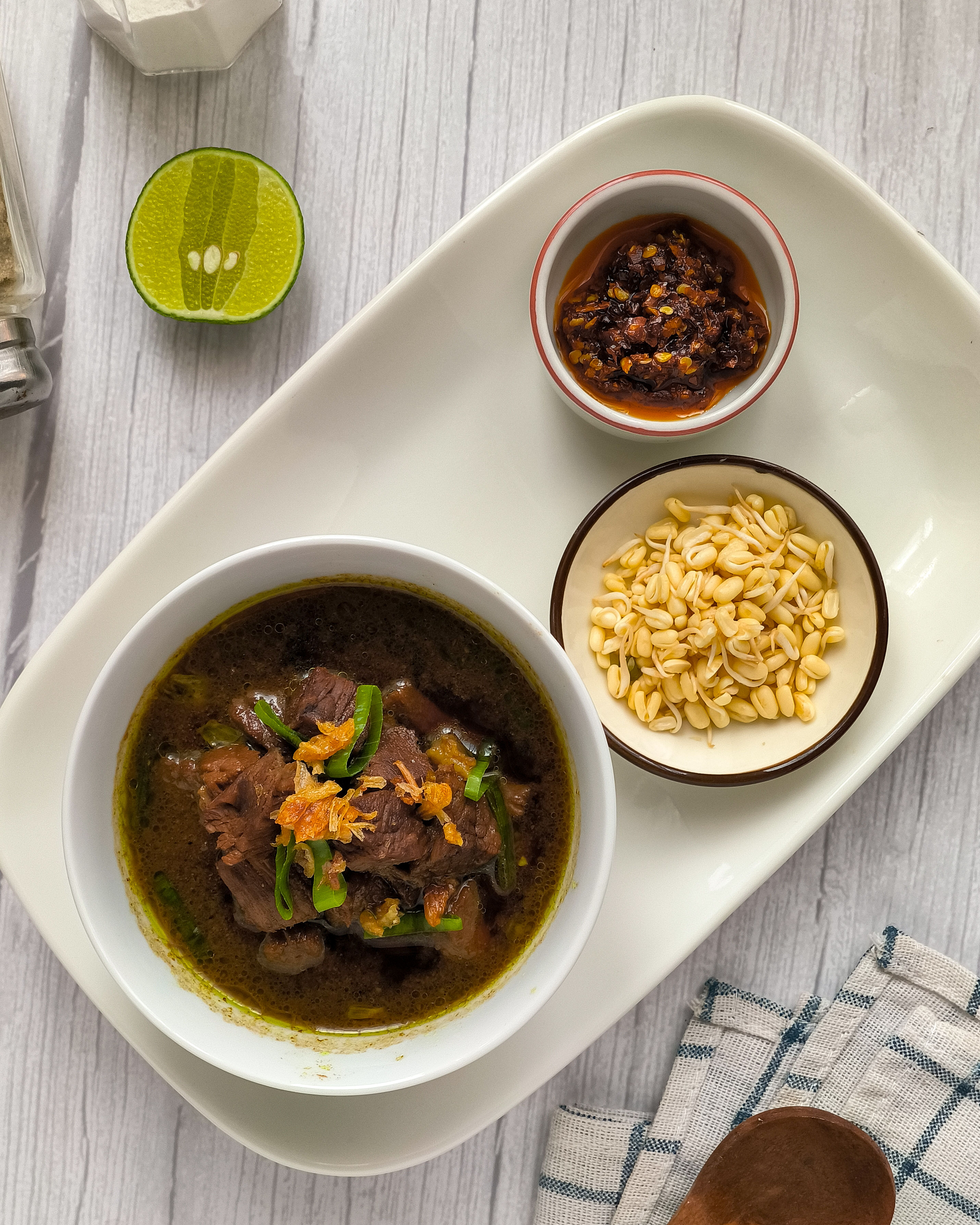
The diets react (see scores below)
Common Ingredients
- beef
- keluak nuts
- lemongrass
- galangal
- kaffir lime leaves
- garlic
- shallots
- turmeric
- tamarind
- bean sprouts
Specific recipes may vary.
Incompatible with 4 of 11 diets
Diet Ratings
Rawon is an Indonesian black beef soup whose base ingredients are largely keto-friendly: beef provides high-quality protein and fat, and the aromatic spices (lemongrass, galangal, kaffir lime leaves, garlic, shallots, turmeric, galangal) contribute minimal net carbs in typical culinary quantities. The problematic element is keluak (kluwek) nuts, which are the defining ingredient giving rawon its distinctive black color. Keluak nuts contain moderate carbohydrates — roughly 5-10g net carbs per 2-3 nuts used per serving — which adds up depending on portion. Tamarind also contributes a small but non-negligible sugar/carb load. Bean sprouts are relatively low in net carbs but add a small amount. The dish is not inherently grain-based or sugar-laden, but the cumulative carb load from keluak nuts, tamarind, shallots, and bean sprouts together could push a serving toward or beyond 10-15g net carbs, requiring careful portion control. For someone tracking strict keto under 20g/day, this dish could consume a significant portion of the daily carb budget in one meal.
Strict keto practitioners may argue this dish should be avoided outright due to the keluak nuts being a novel, high-carb nut not well-characterized in keto literature, combined with tamarind's sugar content — preferring to eliminate dishes where carb sources are difficult to quantify or control. Conversely, lazy keto or moderate keto followers (targeting 50g net carbs/day) may comfortably approve this dish given its protein-rich beef base and absence of grains or added sugars.
Rawon is a traditional Indonesian black beef soup where beef is the primary protein and a central ingredient. The dish is defined by beef (typically short ribs or brisket) cooked in a rich broth flavored with keluak nuts, which give it its distinctive dark color. Beef is an animal product and is completely incompatible with a vegan diet. All other ingredients — keluak nuts, lemongrass, galangal, kaffir lime leaves, garlic, shallots, turmeric, tamarind, and bean sprouts — are fully plant-based, but the presence of beef makes the dish non-vegan.
Rawon is a traditional Indonesian black beef soup whose ingredients are mostly paleo-friendly — beef, lemongrass, galangal, kaffir lime leaves, garlic, shallots, turmeric, and tamarind are all whole, unprocessed foods clearly within paleo guidelines. Bean sprouts, however, are derived from mung beans, a legume, which is excluded under strict paleo rules. The most debated ingredient is keluak (kluwak) nuts, the fruit of the Pangium edule tree that gives rawon its distinctive black color. Keluak is botanically a seed/nut rather than a true legume, and it undergoes a traditional fermentation and detoxification process to remove hydrogen cyanide before use. Its paleo status is genuinely unsettled: it is not a grain or legume, but the necessary processing and fermentation complicate its classification as a 'wild food.' The combination of the legume-derived bean sprouts and the ambiguous status of keluak nuts pushes this dish into caution territory, despite an otherwise strong paleo foundation.
Some paleo practitioners argue that bean sprouts, being a minimally processed sprouted seed with reduced anti-nutrients, occupy a gray zone similar to other fermented or sprouted foods tolerated in paleo-adjacent protocols (e.g., the Perfect Health Diet). Additionally, strict paleo purists (Cordain school) would push this dish firmly into 'avoid' solely on the basis of the legume-derived bean sprouts, regardless of keluak's classification.
Rawon is an Indonesian black beef soup whose primary protein is beef, which directly conflicts with Mediterranean diet principles limiting red meat to a few times per month. The keluak nuts (black pangium nuts) are an exotic ingredient entirely outside the Mediterranean pantry, and while the aromatic herbs and spices (lemongrass, galangal, kaffir lime leaves, garlic, shallots, turmeric, tamarind) and bean sprouts are plant-based positives, they cannot offset the central issue of beef as the dominant ingredient. There is no olive oil, no legumes as the protein base, no whole grains, and no fish or seafood. The dish is built around a red meat that Mediterranean guidelines restrict heavily. The overall dish structure and protein source place it firmly in the 'avoid' category.
Rawon is a traditional Indonesian black beef soup that, while centered on beef, is heavily defined by its plant-based ingredients. The keluak nuts (Pangium edule) give the dish its distinctive black color and are a core component — a plant food entirely excluded on carnivore. The broth is built on lemongrass, galangal, kaffir lime leaves, garlic, shallots, turmeric, and tamarind — all plant-derived aromatics and spices. Bean sprouts are served as a garnish, adding yet another plant food. The beef itself would be carnivore-approved, but the dish as prepared is overwhelmingly plant-based in its flavoring and composition. Even the most lenient carnivore practitioners who allow occasional spices would draw the line at a dish whose identity and bulk of ingredients are plant-derived. This dish cannot be adapted to carnivore without being fundamentally reconstructed into a plain beef broth, at which point it is no longer Rawon.
Rawon is an Indonesian black beef soup whose distinctive color and flavor come from keluak (kluwek) nuts — the fermented seeds of the Pangium edule tree. Most of the ingredients are straightforwardly Whole30-compliant: beef, lemongrass, galangal, kaffir lime leaves, garlic, shallots, turmeric, tamarind, and bean sprouts are all allowed whole foods. The problematic ingredient is keluak nuts. Keluak are not peanuts or soy, nor are they a true legume in the botanical sense (they are seeds from a tropical tree), so they do not fall under the explicit legume exclusion. However, they are not explicitly addressed by Whole30 guidelines, and their fermented preparation introduces ambiguity. The fermentation process is traditional and does not add excluded ingredients, but the lack of explicit Whole30 guidance on this unusual ingredient warrants caution. Bean sprouts (from mung beans) are technically a legume-derived food, which is another point of concern — though some Whole30 practitioners treat bean sprouts as acceptable since they are not the mature legume itself. Overall, the dish is conceptually aligned with Whole30 (whole-food protein + vegetables + spices), but two ingredients — keluak and bean sprouts — require scrutiny.
Official Whole30 guidelines do not explicitly address keluak nuts or bean sprouts from mung beans. Some community members and practitioners argue that mung bean sprouts should be avoided since mung beans are legumes, while others consider the sprouted form sufficiently different. Similarly, keluak's tree-seed origin may make it acceptable, but without official Whole30 guidance, conservative practitioners would likely advise caution or omission of these ingredients.
Rawon contains multiple high-FODMAP ingredients that make it unsuitable during the elimination phase. Garlic and shallots are both significant fructan sources and are core to this dish's flavor base — they cannot be omitted without fundamentally changing the dish. Shallots are high-FODMAP even at small amounts (Monash rates them as high-FODMAP at just 1 medium shallot), and garlic is one of the highest-fructan foods known. Keluak (kluwak) nuts are a unique Indonesian black nut ingredient with very limited Monash testing data, adding further uncertainty. Bean sprouts (mung bean sprouts) are generally considered low-FODMAP at standard servings per Monash. Lemongrass, galangal, kaffir lime leaves, turmeric, and tamarind are generally low-FODMAP at typical culinary amounts. Beef itself is a safe low-FODMAP protein. However, the combination of garlic and shallots as foundational aromatics — typically used in substantial amounts for this dish — makes Rawon a clear avoid during elimination. A modified version using garlic-infused oil and the green tops of spring onions instead could theoretically be made low-FODMAP, but traditional Rawon as prepared cannot be approved.
Monash University has not specifically tested keluak nuts, leaving uncertainty about their FODMAP contribution. Some clinical FODMAP practitioners suggest that long-simmered soups where high-FODMAP aromatics like garlic and shallots are removed before serving may reduce fructan load, though this is not standard Monash guidance and most practitioners advise avoiding such dishes entirely during elimination.
Rawon is an Indonesian black beef soup whose DASH compatibility is mixed. On the positive side, it features aromatic herbs and spices (lemongrass, galangal, kaffir lime leaves, garlic, shallots, turmeric, tamarind) that are DASH-friendly, and bean sprouts add fiber and micronutrients. However, beef is a red meat that DASH discourages — particularly fatty cuts commonly used in Rawon (such as short ribs or brisket) which contribute saturated fat. Keluak (black pangium) nuts are the defining ingredient and give the soup its dark color; while they provide some minerals, they are high in fat and their specific DASH profile is not well-characterized. The broth, as traditionally prepared, can accumulate significant sodium through salting and fermented condiments (e.g., shrimp paste, salted egg served as accompaniments), though the listed ingredients alone are not inherently high in sodium. Portion control of beef and mindful sodium management during preparation could make this dish more acceptable, but as typically served it warrants caution.
NIH DASH guidelines categorically limit red meat due to saturated fat content, which would push Rawon toward 'avoid.' However, updated clinical interpretations note that lean beef cuts in moderate portions (2–3 oz) can fit within DASH's weekly red meat allowance, and the herb-heavy, minimally processed nature of traditional Rawon (absent fermented high-sodium condiments) is more favorable than typical processed red meat dishes — some DASH-oriented dietitians would permit it occasionally with lean beef and sodium-conscious preparation.
Rawon is an Indonesian black beef soup with a complex spice profile. The primary protein is beef, which in Zone terms is acceptable but ideally should be lean cuts — traditional rawon often uses brisket or chuck, which carry higher saturated fat content than Zone-preferred lean proteins like skinless chicken or fish. The keluak nuts are the signature ingredient that give rawon its dark color; they contain fat (including some monounsaturated) and carbohydrates, and function somewhat like a nut-paste base, which adds complexity to macro counting. The aromatic spice base (lemongrass, galangal, kaffir lime leaves, garlic, shallots, turmeric, tamarind) is actually Zone-positive: these are low-glycemic, anti-inflammatory, polyphenol-rich ingredients that Sears would appreciate, particularly turmeric (curcumin) and tamarind. Bean sprouts are an excellent Zone carbohydrate — low glycemic, fibrous, and vegetable-based. The main concerns are: (1) beef cut selection — fattier cuts push saturated fat above Zone ideals; (2) keluak nuts are nutritionally complex and not clearly categorized in Zone literature; (3) the dish as traditionally served lacks a complete protein-carb-fat block balance without additional vegetables or portion control. If made with lean beef (round, sirloin), the dish becomes more Zone-compatible. The anti-inflammatory spice profile is a genuine strength. Overall this is a 'caution' food that can be adapted into a Zone-compatible meal with lean beef and attention to portions.
Zone practitioners who emphasize anti-inflammatory polyphenols (reflecting Sears' later work in 'The Zone Diet and Anti-Aging') might rate rawon more favorably due to its exceptional spice profile — turmeric, galangal, lemongrass, and kaffir lime are among the most polyphenol-dense aromatics in any cuisine. Additionally, if lean beef cuts are used and served with extra bean sprouts, the macros can be reasonably balanced, potentially warranting an 'approve' at score 6-7.
Rawon is a rich Indonesian black beef soup with a genuinely mixed anti-inflammatory profile. On the positive side, it contains an impressive array of anti-inflammatory aromatics and spices: turmeric (curcumin), galangal (a relative of ginger with similar bioactive compounds), lemongrass (citral, anti-inflammatory flavonoids), garlic (allicin), shallots (quercetin), kaffir lime leaves (antioxidant limonoids), and tamarind (polyphenols, tartaric acid). Bean sprouts add fiber and micronutrients. The keluak (kluwak) nut — Pangium edule — is the defining ingredient that gives rawon its distinctive black color; it contains flavonoids and some antioxidant compounds, though it is not well-studied in anti-inflammatory research and must be fermented to remove toxic hydrocyanic acid. The primary drag on the score is beef, which is the central protein source and typically used in fatty cuts (brisket or shank) for this dish. Red meat is in the 'limit' category under anti-inflammatory principles due to saturated fat and arachidonic acid content. However, the long-simmered, broth-based preparation and the dense concentration of anti-inflammatory spices and aromatics partially offset the beef's pro-inflammatory potential. This dish is not a regular anti-inflammatory staple, but occasional consumption is acceptable — it is meaningfully better than, say, a beef stew with no anti-inflammatory herbs.
Some anti-inflammatory practitioners, particularly those following Dr. Weil's framework, might rate this slightly higher given the exceptional concentration of anti-inflammatory spices (turmeric, galangal, garlic, lemongrass), which research suggests can reduce CRP and IL-6 even when paired with moderate red meat. Conversely, stricter anti-inflammatory protocols (e.g., those targeting autoimmune conditions) would rate it lower due to the red meat base and the poorly characterized keluak nut, whose anti-inflammatory properties are not well-documented in clinical literature.
Rawon is a traditional Indonesian black beef soup whose GLP-1 compatibility is mixed. On the positive side, it is a broth-based soup with high water content supporting hydration, contains aromatic spices with anti-inflammatory properties (galangal, turmeric, lemongrass, kaffir lime leaves), and includes bean sprouts which add modest fiber and are easy to digest. The protein source (beef) is meaningful, though the specific cut matters enormously — traditional rawon often uses brisket or shank, which are moderately to highly fatty cuts, raising saturated fat concerns that can worsen GLP-1 GI side effects including nausea and bloating. The defining ingredient, keluak (kluwak) nuts, contributes a rich, fatty, dark paste that adds significant fat to the broth and increases caloric density without improving protein or fiber quality. Tamarind adds mild acidity which is generally tolerable but could aggravate reflux in sensitive patients. The dish is not fried, is moderately spiced rather than aggressively spicy, and the soup format supports small-portion eating. Overall, rawon sits in caution territory: it has redeeming qualities (broth base, protein, aromatic spices, bean sprouts) but the fatty beef cut and keluak nut fat content are real drawbacks for GLP-1 patients managing nausea and prioritizing lean protein.
Some GLP-1-focused dietitians would rate beef soups more favorably when consumed as a small portion of broth-forward soup, arguing that the dilution of fat in a large liquid volume reduces the gastric impact compared to eating the same fat content in a solid meal. Others would flag the keluak nut content and fatty beef cut as sufficient reason to avoid entirely during dose escalation phases when GI tolerance is lowest.
*See how scores were generated at our methodology page.
Nutritional profile
Six traits that cut across every diet.
Fiber & Plants
How much whole-plant food and fiber it delivers.
Healthy Fats
The quality of its fats (unsaturated, omega-3).
Whole / Unprocessed
How close it is to its natural, unprocessed form.
Gut Gentle
How easy it is on digestion (low FODMAP, few irritants).
Low Glycemic
How little it spikes your blood sugar.
Protein Density
How much protein it packs per calorie.
Controversy Index
Higher controversy = more disagreement between diets.
Diet-Specific Tips
 Keto — 5/10
View tips
- Beef is highly keto-compatible, providing protein and fat with zero carbs
- Keluak nuts are the main carb concern — moderate net carbs, roughly 5-10g per serving depending on quantity used
- Tamarind adds small but notable sugar/carb content
- Aromatic spices (lemongrass, galangal, garlic, shallots, turmeric) contribute minimal carbs in cooking quantities
- Bean sprouts add a small net carb load but are relatively benign
- No grains, added sugars, or starchy vegetables present
- Cumulative carb load from multiple moderate-carb ingredients requires portion awareness
- Dish can fit keto with careful portioning but is not freely consumable
 Paleo — 5/10
View tips
- Beef is fully paleo-approved as primary protein
- Lemongrass, galangal, kaffir lime leaves, garlic, shallots, turmeric, and tamarind are all paleo-approved aromatics and spices
- Bean sprouts are derived from mung beans, a legume excluded under paleo rules
- Keluak nuts are botanically a seed/nut but require traditional fermentation/detoxification, making their paleo status ambiguous and actively debated
- No grains, dairy, refined sugar, or seed oils present in the base recipe
- Traditional preparation may include added salt (shrimp paste/terasi is common in some versions), which would further complicate compliance
 Whole30 — 5/10
View tips
- Keluak nuts are not explicitly addressed by Whole30 — their tree-seed origin suggests they are not a legume, but their fermented preparation and lack of official ruling create ambiguity
- Bean sprouts (mung bean origin) are technically derived from a legume, which is excluded; their status is debated in the Whole30 community
- Core ingredients — beef, lemongrass, galangal, kaffir lime leaves, garlic, shallots, turmeric, tamarind — are all Whole30-compliant
- No grains, dairy, soy, added sugar, or other clearly excluded ingredients in the listed components
- Dish is a traditional savory soup, not a baked good or junk food recreation, so rule 4 does not apply
 DASH — 4/10
View tips
- Beef (red meat) is discouraged by DASH due to saturated fat; fatty cuts worsen the profile
- Keluak nuts are high in fat with an unclear DASH-specific nutritional profile
- Herb and spice base (lemongrass, galangal, turmeric, garlic, tamarind) is DASH-compatible
- Bean sprouts add DASH-valued fiber and micronutrients
- Sodium content depends heavily on preparation — traditional accompaniments (shrimp paste, salted eggs) can significantly increase sodium load
- Portion control of beef and choosing lean cuts would improve DASH compatibility
 Zone — 5/10
View tips
- Beef protein is Zone-acceptable but cut selection matters — fatty cuts (brisket/chuck) add excess saturated fat
- Bean sprouts are an ideal Zone carbohydrate: low glycemic, high fiber, vegetable-based
- Spice base (turmeric, galangal, lemongrass, tamarind) is highly anti-inflammatory and polyphenol-rich — a Zone strength
- Keluak nuts are nutritionally complex (fat + carbs) and not explicitly classified in Zone literature
- Dish lacks significant non-starchy vegetables beyond bean sprouts — Zone typically requires more vegetable volume
- No high-glycemic carbohydrates present in the soup itself, which is favorable
- Traditionally served with white rice on the side, which would push it into unfavorable Zone territory if included
 Anti-Inflammatory — 5/10
View tips
- Beef (red meat) is the primary protein — classified as 'limit' due to saturated fat and arachidonic acid content
- Turmeric provides curcumin, one of the most well-researched anti-inflammatory phytonutrients
- Galangal contains bioactive compounds (galangin, kaempferol) with demonstrated anti-inflammatory properties similar to ginger
- Garlic and shallots contribute allicin and quercetin, both associated with reduced inflammatory markers
- Lemongrass and kaffir lime leaves add citral and limonoids with antioxidant activity
- Tamarind provides polyphenols and tartaric acid with antioxidant properties
- Keluak (kluwak) nut is the defining ingredient — contains some flavonoids but is poorly studied in anti-inflammatory research
- Bean sprouts contribute fiber and modest micronutrients
- Broth-based preparation is preferable to high-fat cooking methods
- Rich fatty cuts of beef typically used in authentic rawon increase saturated fat load
 GLP-1 Friendly — 5/10
View tips
- Beef cut is likely fatty (brisket/shank) — elevated saturated fat worsens GLP-1 nausea and bloating
- Keluak nuts add significant fat and caloric density with minimal protein or fiber benefit
- Broth-based format supports hydration and small-portion tolerance
- Bean sprouts contribute modest fiber and are easy to digest
- Anti-inflammatory aromatics (turmeric, galangal, lemongrass) are GLP-1 neutral to mildly positive
- Not fried; moderately spiced — does not trigger spice-related GI concerns
- Protein content is present but lean protein density is undermined by fatty cut selection
- Tamarind acidity may aggravate reflux in sensitive GLP-1 patients