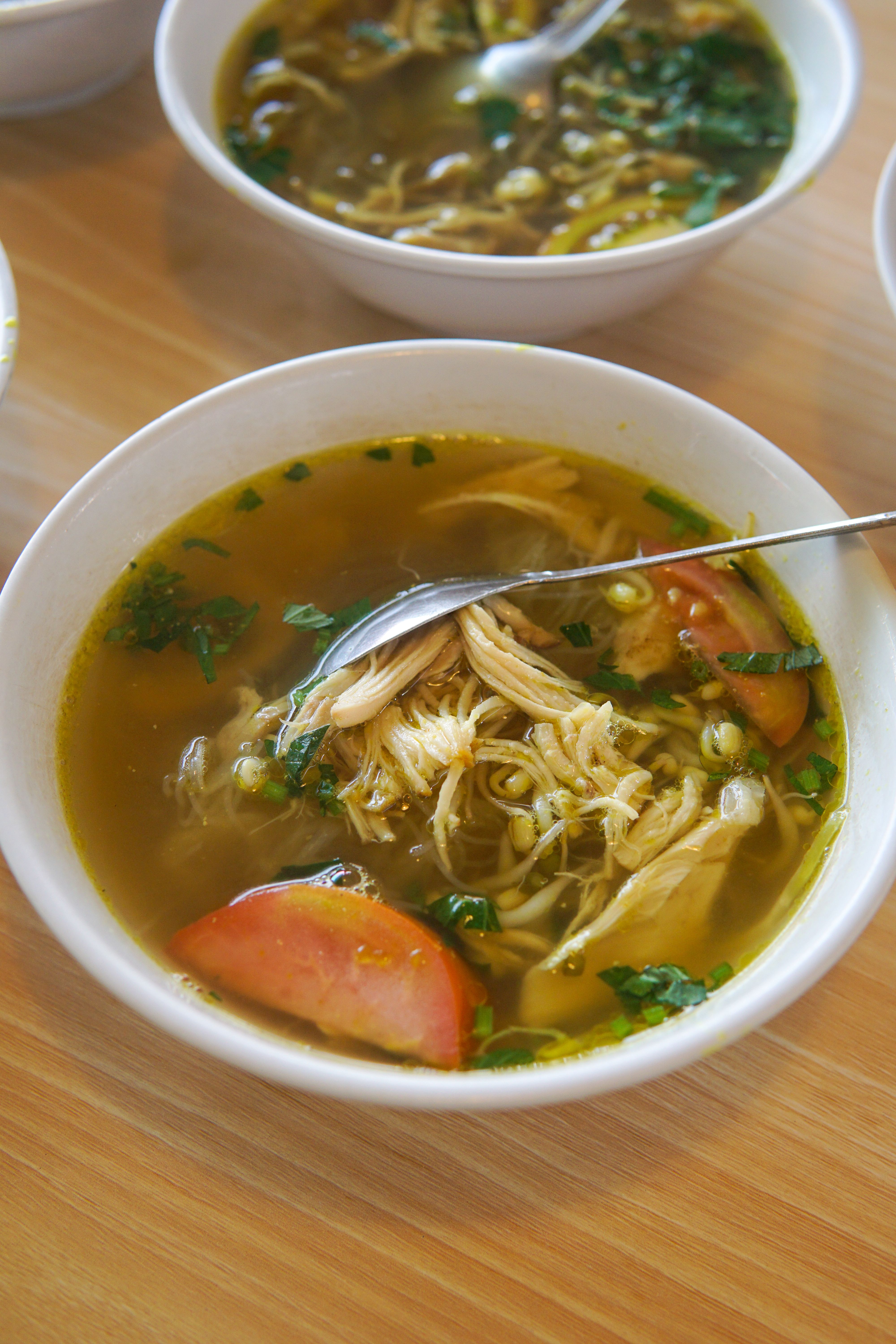
Photo: Dwi Rizqi F / Pexels
Indonesian
Soto Ayam
The diets react (see scores below)
Common Ingredients
- chicken
- turmeric
- lemongrass
- kaffir lime leaves
- vermicelli
- bean sprouts
- boiled eggs
- garlic
- shallots
- celery
Specific recipes may vary.
Incompatible with 5 of 11 diets
Diet Ratings
Soto Ayam is a turmeric-spiced Indonesian chicken soup that is mostly keto-friendly in its base components — chicken, eggs, aromatic herbs (turmeric, lemongrass, kaffir lime leaves, garlic, shallots, celery) are all low-carb or negligible. However, the dish traditionally includes vermicelli noodles (glass noodles or rice vermicelli), which are a significant source of net carbs — a standard serving can add 20-35g of net carbs, easily pushing a single meal over the daily keto limit. Bean sprouts contribute modest carbs (~3-4g per cup) but are manageable in small amounts. With vermicelli removed or replaced with a keto-friendly substitute (e.g., shirataki noodles or extra vegetables), the dish would be approvable. As traditionally served, the vermicelli makes it a cautious choice requiring modification.
Soto Ayam is an Indonesian chicken soup that contains multiple animal-derived ingredients, making it entirely incompatible with a vegan diet. The dish contains chicken (poultry), boiled eggs (animal product), and is built on a chicken-based broth. These are unambiguous animal products that directly violate the foundational rules of veganism. The remaining ingredients — turmeric, lemongrass, kaffir lime leaves, vermicelli, bean sprouts, garlic, shallots, and celery — are all plant-based, but the presence of chicken and eggs renders the dish non-vegan without significant reformulation.
Soto Ayam is a traditional Indonesian chicken soup that is largely paleo-friendly in its base — chicken, turmeric, lemongrass, kaffir lime leaves, garlic, shallots, and boiled eggs are all unprocessed whole foods well within paleo guidelines. However, two ingredients disqualify the dish as traditionally prepared: vermicelli (rice or mung bean noodles) represents either a grain or a legume derivative, both excluded from paleo; and bean sprouts are germinated legumes (typically mung beans), which are also excluded from paleo. These are not peripheral garnishes — they are core structural components of the dish. Without substitution of these ingredients (e.g., replacing vermicelli with zucchini noodles and omitting bean sprouts), the dish cannot be approved.
Soto Ayam is a light Indonesian chicken soup with a largely Mediterranean-compatible ingredient profile. Chicken (poultry) is acceptable in moderation under Mediterranean guidelines, and the aromatics — turmeric, lemongrass, kaffir lime leaves, garlic, shallots, and celery — are all plant-based flavor compounds with recognized anti-inflammatory properties. Bean sprouts add a legume-adjacent vegetable element. Boiled eggs are acceptable in moderate servings. The main concern is vermicelli, which is a refined grain product offering little fiber or nutritional complexity compared to whole grains preferred by Mediterranean guidelines. The dish is not cooked in olive oil (likely vegetable or palm oil in traditional preparation), and the overall fat profile diverges from Mediterranean norms. However, it is low in saturated fat, minimally processed, and vegetable-forward for a protein dish, keeping it in the acceptable-but-not-ideal range.
Some Mediterranean diet practitioners applying a broader 'whole foods, plant-rich' framework would view this soup favorably given its abundance of anti-inflammatory spices, vegetables, and lean protein — arguing that cultural food traditions with similar principles should be accommodated. Others following stricter interpretations would flag the refined vermicelli and non-olive-oil cooking fat as meaningful departures from core Mediterranean guidelines.
Soto Ayam is fundamentally incompatible with the carnivore diet. While chicken and boiled eggs are carnivore-approved proteins, the dish is built around a heavily plant-based ingredient list. Turmeric, lemongrass, kaffir lime leaves, garlic, shallots, and celery are all plant-derived aromatics and vegetables that are excluded on any tier of carnivore. Vermicelli is a grain-based noodle — a clear carbohydrate source completely off-limits. Bean sprouts are a legume sprout and equally excluded. The only salvageable components are the chicken and boiled eggs, but the dish as a whole cannot be considered carnivore in any meaningful sense. Even the most lenient 'animal-based' practitioners would not include this dish given the sheer volume and variety of plant ingredients central to its identity.
Soto Ayam contains vermicelli, which is a grain-based noodle (typically made from rice or mung bean starch). Grains and grain-derived products are excluded on Whole30. Rice vermicelli falls under the excluded grains category (rice), and mung bean vermicelli is derived from a legume, also excluded. The remaining ingredients — chicken, turmeric, lemongrass, kaffir lime leaves, bean sprouts, boiled eggs, garlic, shallots, and celery — are all Whole30-compliant. However, the presence of vermicelli makes the dish as traditionally prepared non-compliant. Additionally, bean sprouts can sometimes be from mung beans (a legume), but sprouted legumes are generally considered compliant per Whole30 guidance. The core disqualifying ingredient is the vermicelli noodle component.
Soto Ayam contains two high-FODMAP ingredients that are standard and non-negotiable in its preparation: garlic and shallots. Both are significant sources of fructans and are high-FODMAP at any culinary quantity. Garlic in particular is one of the highest-FODMAP foods tested by Monash University, and shallots are similarly problematic. These aromatics are foundational to the dish's flavor base and cannot be omitted without fundamentally altering the recipe. The remaining ingredients are largely low-FODMAP: chicken (protein, FODMAP-free), turmeric (low-FODMAP), lemongrass (low-FODMAP at standard use), kaffir lime leaves (low-FODMAP), rice vermicelli (low-FODMAP), boiled eggs (FODMAP-free), and celery (low-FODMAP at ≤10g per Monash). Bean sprouts are low-FODMAP at a standard 65g serving. However, the presence of garlic and shallots as core aromatics makes this dish high-FODMAP as traditionally prepared. A modified version using garlic-infused oil and the green tops of scallions instead of shallots could make it low-FODMAP, but as presented with standard ingredients, it must be avoided during the elimination phase.
Soto Ayam, an Indonesian chicken soup, is built on a foundation of DASH-friendly ingredients: lean chicken, anti-inflammatory spices (turmeric, lemongrass, kaffir lime leaves), aromatic vegetables (garlic, shallots, celery), bean sprouts, and boiled eggs. These elements align well with DASH principles — lean protein, vegetables, and minimal saturated fat. However, the dish earns a 'caution' rating primarily due to sodium concerns. As commonly prepared and served in restaurants or households, Soto Ayam broth is often moderately to heavily salted, and accompaniments like kecap manis (sweet soy sauce), sambal, fried shallots, or emping crackers can add significant sodium, saturated fat, and added sugar. Vermicelli (rice noodles) is a refined carbohydrate rather than a whole grain. Boiled eggs introduce moderate cholesterol, though this is less of a concern under current dietary guidelines. Home-prepared versions with controlled sodium, reduced salt, and whole-grain noodle substitutions could score higher (7-8). The dish has strong DASH potential but requires mindful preparation to be fully compliant.
NIH DASH guidelines are not specific to Soto Ayam as a dish, so this rating relies on ingredient-level analysis. Some DASH-oriented dietitians would argue that a home-cooked, low-sodium version of Soto Ayam — with its lean chicken, abundance of vegetables, and anti-inflammatory spices — could be considered an 'approve' food, noting that the sodium concern is largely preparation-dependent and not intrinsic to the dish itself.
Soto Ayam is an Indonesian chicken soup that aligns reasonably well with Zone principles but requires portion adjustment, particularly around the vermicelli. The protein base — skinless chicken — is a lean, favorable Zone protein. The broth is built on anti-inflammatory spices (turmeric, lemongrass, kaffir lime leaves, garlic, shallots), all of which are polyphenol-rich and consistent with Sears' anti-inflammatory emphasis. Bean sprouts and celery are low-glycemic, high-fiber vegetables that count as favorable Zone carbs. Boiled eggs add additional protein and some fat. The main Zone concern is the vermicelli (rice noodles), which are a refined, higher-glycemic carbohydrate — classified as an 'unfavorable' carb in Zone terminology. In a typical serving, vermicelli can easily dominate the carbohydrate block count with a high glycemic load. However, if vermicelli is kept to a small portion (roughly 1/4 cup cooked, ~1 carb block) and the soup is loaded with bean sprouts and vegetables, the dish can be brought into Zone balance. The fat content from this dish is minimal, so a small amount of added healthy fat (e.g., a few slices of avocado on the side or a drizzle of olive oil) would help complete the 30% fat target. As traditionally served in generous noodle portions, this dish trends carb-heavy and glycemically unfavorable, hence the caution rating rather than an approve.
Some Zone practitioners would rate this higher (score 7) because the dish is protein-anchored with lean chicken and eggs, the broth is anti-inflammatory, and the vegetable components (bean sprouts, celery) are favorable. If the cook uses glass noodles (mung bean vermicelli) instead of rice vermicelli, the glycemic impact is lower and Zone compliance improves. Sears' later writings on polyphenols would also credit the turmeric and lemongrass as beneficial beyond their macro profile.
Soto Ayam is a turmeric-forward Indonesian chicken soup with a genuinely strong anti-inflammatory profile. Turmeric is the standout ingredient — its curcumin content is one of the most studied anti-inflammatory compounds in nutrition research, consistently associated with reduced CRP and IL-6 markers. Lemongrass and kaffir lime leaves contribute polyphenols and antioxidant flavonoids. Garlic and shallots provide allicin and quercetin, both associated with anti-inflammatory effects. Celery contains apigenin and luteolin, documented anti-inflammatory flavonoids. Lean chicken (typically breast or thigh without skin in traditional preparations) fits the 'moderate lean poultry' category cleanly. Bean sprouts add fiber and micronutrients. Boiled eggs add choline and selenium, which have roles in immune regulation. The main concern is vermicelli — typically made from refined rice or mung bean starch. Rice vermicelli is relatively neutral (low glycemic index, minimal additives) compared to wheat pasta, and mung bean vermicelli is even better. Neither is a strong pro-inflammatory ingredient. The dish contains no seed oils, trans fats, added sugars, or processed additives in its traditional form. Overall, this is a nutrient-dense, spice-rich, lean-protein soup that aligns well with anti-inflammatory principles.
The egg inclusion introduces mild debate: some anti-inflammatory practitioners flag arachidonic acid in egg yolks as a pro-inflammatory concern, while mainstream anti-inflammatory nutrition (including Dr. Weil's framework) considers whole eggs acceptable in moderation. Real-world Soto Ayam may also use coconut milk in some regional variants, which would shift the profile toward higher saturated fat and warrant a score reduction; this evaluation assumes the clear broth version.
Soto Ayam is a light Indonesian chicken soup with a clear, turmeric-based broth — an excellent GLP-1-friendly dish. Chicken provides lean, high-quality protein (15–25g per serving depending on portion). Boiled eggs add additional protein and nutrients. The broth is low in fat and easy to digest, aligning well with slowed gastric emptying. Bean sprouts contribute fiber and water content, supporting hydration and digestion. Aromatics (lemongrass, kaffir lime leaves, garlic, shallots, celery) are low-calorie and add micronutrient value. Turmeric has anti-inflammatory properties that may be beneficial. The main caution is the vermicelli noodles — a refined carbohydrate with low fiber and protein density — which dilutes the nutritional profile somewhat. Overall, this is a nutrient-dense, easily digestible, protein-forward, hydrating dish well-suited for GLP-1 patients, especially during periods of nausea or reduced appetite.
Some GLP-1-focused dietitians would recommend swapping vermicelli for a higher-fiber alternative (e.g., glass noodles made from mung bean starch, or simply reducing the noodle portion) to better support blood sugar stability and fiber targets. Individual tolerance to the aromatic spice profile (garlic, lemongrass, shallots) may vary — a small subset of GLP-1 patients report heightened sensitivity to pungent aromatics triggering nausea, particularly in the first weeks of medication use.
*See how scores were generated at our methodology page.
Nutritional profile
Six traits that cut across every diet.
Fiber & Plants
How much whole-plant food and fiber it delivers.
Healthy Fats
The quality of its fats (unsaturated, omega-3).
Whole / Unprocessed
How close it is to its natural, unprocessed form.
Gut Gentle
How easy it is on digestion (low FODMAP, few irritants).
Low Glycemic
How little it spikes your blood sugar.
Protein Density
How much protein it packs per calorie.
Controversy Index
Higher controversy = more disagreement between diets.
Diet-Specific Tips
 Keto — 4/10
View tips
- Vermicelli noodles are the primary keto concern, adding 20-35g net carbs per serving
- Chicken and boiled eggs are excellent keto protein sources
- Turmeric, lemongrass, kaffir lime leaves, and garlic are negligible in carbs
- Bean sprouts are moderate-carb; small portions are manageable but should be limited
- Shallots contribute slightly more carbs than regular onions — portion awareness needed
- Dish is easily made keto-compliant by omitting vermicelli and reducing bean sprouts
 Mediterranean — 6/10
View tips
- Chicken is an acceptable moderate protein under Mediterranean guidelines
- Rich array of anti-inflammatory aromatics (turmeric, lemongrass, garlic, shallots)
- Bean sprouts and celery add plant-based nutritional value
- Vermicelli is a refined grain, not a whole grain
- Traditional preparation likely uses non-olive oils, diverging from Mediterranean fat principles
- Boiled eggs are permissible in moderation
- Dish is minimally processed and low in added sugars or saturated fat
 DASH — 6/10
View tips
- Lean chicken is an approved DASH protein source
- Turmeric, lemongrass, garlic, shallots, and celery are DASH-compatible aromatics and vegetables
- Bean sprouts add fiber, potassium, and micronutrients consistent with DASH goals
- Broth is typically high in sodium as commonly prepared — a key DASH concern
- Common accompaniments (kecap manis, sambal, fried shallots, crackers) can substantially increase sodium, sugar, and saturated fat
- Vermicelli is a refined grain; substituting with whole-grain noodles would improve DASH alignment
- Boiled eggs are moderate cholesterol but acceptable under current DASH-aligned clinical guidance
- Home preparation with sodium control can significantly improve DASH compatibility
 Zone — 6/10
View tips
- Lean chicken protein is a favorable Zone protein source
- Turmeric and lemongrass are polyphenol-rich and anti-inflammatory, aligned with Sears' later Zone framework
- Bean sprouts and celery are favorable low-glycemic Zone carbohydrates
- Vermicelli (rice noodles) is a refined, higher-glycemic 'unfavorable' carb that can skew the carb block ratio
- Boiled eggs contribute additional protein and some fat, improving macro balance
- Dish is naturally low in fat; requires supplemental monounsaturated fat to meet the 30% fat target
- Portion control of noodles is critical — as traditionally served, carb blocks are likely excessive
 Anti-Inflammatory — 8/10
View tips
- Turmeric provides curcumin, a potent anti-inflammatory polyphenol with strong research support
- Lemongrass and kaffir lime leaves contribute antioxidant flavonoids and phenolic compounds
- Garlic and shallots provide allicin and quercetin with documented anti-inflammatory effects
- Lean chicken fits the anti-inflammatory 'moderate lean poultry' guideline
- Bean sprouts add fiber and micronutrients without inflammatory load
- Celery contributes apigenin and luteolin, anti-inflammatory flavonoids
- Vermicelli (rice or mung bean) is relatively neutral — low glycemic, no additives in traditional form
- No seed oils, refined sugars, trans fats, or processed additives in traditional preparation
 GLP-1 Friendly — 8/10
View tips
- Lean chicken protein supports muscle preservation and satiety
- Clear broth is low-fat and easy to digest — ideal for slowed gastric emptying
- Boiled eggs add high-quality protein and micronutrients
- Bean sprouts provide fiber and water content, supporting hydration
- Turmeric offers anti-inflammatory benefit
- Vermicelli is a refined carb with low fiber — a nutritional weak point
- Mild spice profile generally well-tolerated by GLP-1 patients
- High water content in broth supports hydration, critical given reduced thirst on GLP-1s