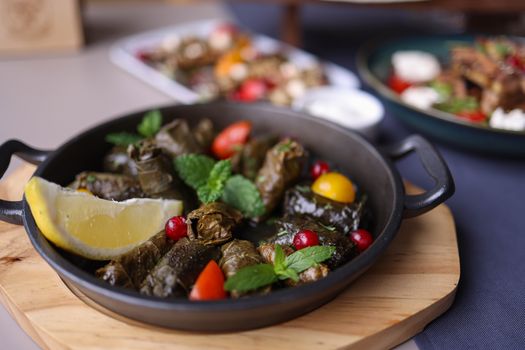
Photo: Valeria Boltneva / Pexels
The diets react (see scores below)
Common Ingredients
- grape leaves
- bell peppers
- onion
- rice
- lamb
- tomato paste
- pomegranate molasses
- dill
Specific recipes may vary.
Incompatible with 6 of 11 diets
Diet Ratings
Iraqi Dolma is fundamentally incompatible with ketogenic diet principles. The primary filling ingredient is rice, a high-glycemic grain that alone can contain 30-45g of net carbs per serving, far exceeding the daily keto limit. Grape leaves used as wrappers add modest carbs but are not the main issue. Pomegranate molasses is a concentrated sugar source, adding significant additional net carbs and spiking glycemic load. Tomato paste and onion contribute further carbohydrates. While lamb is an excellent keto protein, it is overwhelmed by the carb-heavy components. The dish as traditionally prepared makes ketosis maintenance essentially impossible in any reasonable serving size.
Iraqi Dolma as described contains lamb as a primary protein ingredient, making it clearly incompatible with a vegan diet. Lamb is an animal product, and its presence is an absolute disqualifier under vegan rules. The remaining ingredients — grape leaves, bell peppers, onion, rice, tomato paste, pomegranate molasses, and dill — are all plant-based, but the dish as presented cannot be considered vegan due to the lamb filling.
Iraqi Dolma is firmly non-paleo due to rice, which is a grain and a clear exclude under all mainstream paleo frameworks. Rice is the structural foundation of the filling, not an incidental ingredient — it cannot simply be omitted without transforming the dish entirely. The remaining ingredients are a mixed picture: lamb, bell peppers, onion, dill, and grape leaves are all paleo-approved whole foods. Tomato paste is generally acceptable in small amounts. Pomegranate molasses is a gray-area ingredient due to its concentrated sugar content, but it is at least derived from a whole fruit. However, none of this offsets the rice, which is a non-negotiable disqualifier. This dish as traditionally prepared cannot be considered paleo-compatible.
Iraqi dolma combines several Mediterranean-compatible ingredients (grape leaves, bell peppers, onion, tomato paste, fresh dill, pomegranate molasses) with lamb as the primary protein and white rice as the filler. The vegetable wrappers and aromatics are strongly Mediterranean-aligned, but lamb (red meat) is meant to be limited to a few times per month or once weekly, and white rice is a refined grain rather than a whole grain. The pomegranate molasses is a natural, minimally processed fruit-based ingredient consistent with Mediterranean flavors. Overall, this dish sits in 'caution' territory: it has genuine Mediterranean character but the red meat content and white rice prevent a full approval.
Stuffed grape leaves (dolmades/dolma) are a well-established dish across the Eastern Mediterranean and Levant, and traditional preparations in Greece, Turkey, and the Levant frequently use lamb or a lamb-beef mix as culturally normative. Some Mediterranean diet frameworks acknowledge that lean lamb in modest portions within a vegetable-heavy dish represents an acceptable occasional indulgence rather than a dietary contradiction. The ratio of vegetables to meat matters: a lightly meat-filled dolma is very different from a lamb-dominant preparation.
Iraqi Dolma is almost entirely plant-based in composition. While lamb is listed as a protein component, it is a minor ingredient surrounded by a predominantly plant-based dish. The primary ingredients are grape leaves (plant), bell peppers (plant), onion (plant), rice (grain), tomato paste (plant), pomegranate molasses (plant/sugar), and dill (herb/spice). Every one of these ingredients is explicitly excluded from the carnivore diet. Rice is a grain, grape leaves and bell peppers are vegetables, onion is a vegetable, tomato paste is a processed plant product, pomegranate molasses is a plant-derived sugar, and dill is a plant spice. Even the lamb content is insufficient to redeem this dish — the carnivore diet requires animal products exclusively, and this dish is overwhelmingly plant-derived. There is complete consensus across all carnivore authorities and protocols that this dish is incompatible with the carnivore diet.
This Iraqi dolma contains rice, which is an excluded grain on the Whole30 program. Rice is explicitly listed as a prohibited grain, and its presence as a primary filling ingredient makes this dish non-compliant regardless of the other ingredients. Additionally, pomegranate molasses is typically made with added sugar (concentrated pomegranate juice plus sugar), which is also excluded. Even if a pure pomegranate molasses with no added sugar were used, the rice alone disqualifies the dish. The remaining ingredients — grape leaves, bell peppers, onion, lamb, tomato paste, and dill — are all Whole30-compatible.
Iraqi Dolma contains multiple high-FODMAP ingredients that make it problematic during the elimination phase. The most significant offender is onion, which is high in fructans and is a major FODMAP trigger — it is used as a core flavoring ingredient and cannot easily be removed. Grape leaves themselves have limited Monash testing data, but the dish as a whole is disqualifying due to onion. Pomegranate molasses is made from concentrated pomegranate juice and often contains added sugars; concentrated fruit products can be high in excess fructose or polyols, and there is limited Monash data on pomegranate molasses specifically. Tomato paste is low-FODMAP only at very small servings (around 2 tablespoons per Monash); in a dish like dolma it is typically used in larger quantities, pushing it into high-FODMAP territory due to excess fructose accumulation. Rice and lamb are individually low-FODMAP, bell peppers are low-FODMAP, and dill is low-FODMAP. However, the combination of onion (unavoidable high-FODMAP), likely excess tomato paste, and uncertain pomegranate molasses makes this dish a clear avoid during elimination.
Monash University has not specifically tested grape leaves or pomegranate molasses, so their FODMAP status relies on inference from related foods. Some clinical FODMAP practitioners might consider a modified version of dolma — omitting onion, using garlic-infused oil, limiting tomato paste, and skipping pomegranate molasses — as potentially tolerable, but the traditional recipe as described warrants avoidance during elimination.
Iraqi Dolma contains a mix of DASH-friendly and DASH-cautionary ingredients. On the positive side, grape leaves are nutrient-dense and low in calories, bell peppers and onion are excellent DASH vegetables rich in potassium and fiber, and pomegranate molasses adds antioxidants with minimal fat. However, lamb is a red meat with notable saturated fat content, which DASH guidelines advise limiting. The dish also commonly uses grape leaves preserved in brine (high sodium) and tomato paste can add moderate sodium. Rice contributes refined carbohydrates unless brown rice is used. The overall dish can be acceptable in moderation if portion-controlled and prepared with lean cuts of lamb (or substituted with turkey or chicken), low-sodium grape leaves, and no-salt-added tomato paste. As commonly prepared, the combination of lamb and brined grape leaves pushes this into caution territory.
NIH DASH guidelines explicitly limit red meat including lamb due to saturated fat content; however, updated clinical interpretations note that lean lamb in moderate portions (2-3 oz) within an otherwise vegetable-rich dish like dolma may be compatible with DASH, particularly when grape leaves are rinsed or fresh rather than heavily brined — some DASH-oriented dietitians would approve this dish with those modifications.
Iraqi Dolma presents a mixed Zone Diet profile. On the positive side, grape leaves, bell peppers, onion, dill, tomato paste, and pomegranate molasses are largely vegetable-based, low-glycemic, and polyphenol-rich ingredients that align well with Zone anti-inflammatory principles. However, the dish has two significant Zone concerns: (1) Rice is a high-glycemic, 'unfavorable' carbohydrate in Zone terminology and is typically a central filling ingredient in dolma, making it difficult to keep carb blocks low-glycemic. (2) Lamb is a fattier red meat with meaningful saturated fat content, which Zone prefers to limit in favor of leaner proteins. The combination of rice (unfavorable carb) and lamb (higher saturated fat protein) in a single dish pushes the macro balance away from Zone ideals. Pomegranate molasses adds additional sugar load. The dish can technically fit Zone principles with careful portion control — smaller servings, emphasis on the vegetable wrappers and filling ingredients over rice — but as traditionally prepared, the rice-to-protein-to-fat ratios are likely imbalanced relative to Zone's 40/30/30 target.
Some Zone practitioners and later Sears writings take a more flexible view of lamb, recognizing that the omega-3 to omega-6 ratio of grass-fed lamb is more favorable than conventional grain-fed beef, and that small portions of rice can be incorporated as part of a mixed carb block alongside the lower-glycemic vegetable ingredients. Grape leaves, bell peppers, and dill are excellent Zone-favorable carb sources that partially offset the rice. A half-portion of traditional dolma could be balanced into a Zone meal with added lean protein and monounsaturated fat on the side.
Iraqi dolma is a mixed dish from an anti-inflammatory perspective. On the positive side, grape leaves are rich in polyphenols and antioxidants; bell peppers and onion provide vitamin C, quercetin, and flavonoids; tomato paste offers concentrated lycopene; pomegranate molasses contributes potent polyphenols and anthocyanins with documented anti-inflammatory effects; and dill adds beneficial phytonutrients. These ingredients collectively represent a meaningful anti-inflammatory contribution. However, lamb is a red meat with relatively high saturated fat content, which is categorized as 'limit' in anti-inflammatory guidelines due to its potential to elevate inflammatory markers. White rice, the typical choice in dolma, is a refined carbohydrate with a higher glycemic index and limited fiber. The dish therefore balances genuinely anti-inflammatory plant components against a pro-inflammatory protein and starch base. Portion size matters considerably — a moderate serving where the grain and vegetable components dominate relative to the lamb would shift the profile more favorably. The dish is acceptable in moderation but not an anti-inflammatory standout due to the lamb and white rice combination.
Some anti-inflammatory practitioners, drawing on Mediterranean and Middle Eastern dietary research, would argue that traditional lamb dishes consumed with abundant vegetables and herbs — as in this dolma — represent a relatively balanced pattern consistent with anti-inflammatory eating, particularly if lamb is grass-fed (better omega-3 ratio). Conversely, strict anti-inflammatory protocols would flag any regular red meat consumption as problematic regardless of the accompanying vegetables.
Iraqi dolma is a mixed dish with meaningful nutritional strengths and notable concerns for GLP-1 patients. On the positive side, grape leaves and vegetables (bell peppers, onion) contribute fiber and micronutrients, and the dish is generally well-cooked and easy to digest in moderate portions. Pomegranate molasses adds some antioxidants but also concentrated sugar, which should be noted. The primary protein concern is lamb: while it provides complete protein, it is a fatty red meat with meaningful saturated fat content, which can worsen GLP-1 side effects like nausea, bloating, and reflux. Rice is a refined carbohydrate with low fiber density, reducing the overall nutrient-per-calorie profile. The protein yield per serving is moderate but not high-density relative to the fat and carbohydrate load. The dish is not fried and is portion-friendly in small servings, which helps. Overall, it is acceptable in moderation — particularly if lamb is a smaller component of the filling — but is not an optimal GLP-1 meal due to saturated fat from lamb and the rice-heavy base.
Some GLP-1-focused dietitians would rate dolma more favorably, noting that lamb in stuffed vegetable dishes is typically present in modest quantities relative to the vegetable and grain base, and that the slow-cooked preparation makes it highly digestible. Others apply stricter limits on any fatty red meat regardless of portion size, citing the heightened GI sensitivity common in GLP-1 patients, and would recommend substituting ground turkey or chicken to bring the dish into the approve range.
*See how scores were generated at our methodology page.
Nutritional profile
Six traits that cut across every diet.
Fiber & Plants
How much whole-plant food and fiber it delivers.
Healthy Fats
The quality of its fats (unsaturated, omega-3).
Whole / Unprocessed
How close it is to its natural, unprocessed form.
Gut Gentle
How easy it is on digestion (low FODMAP, few irritants).
Low Glycemic
How little it spikes your blood sugar.
Protein Density
How much protein it packs per calorie.
Controversy Index
Higher controversy = more disagreement between diets.
Diet-Specific Tips
 Mediterranean — 5/10
View tips
- Lamb is red meat, restricted to a few times per month on a Mediterranean diet
- White rice is a refined grain; whole-grain alternatives would be preferred
- Grape leaves are a traditional Mediterranean wrapper and a nutritious plant food
- Bell peppers, onion, dill, and tomato paste are strongly Mediterranean-aligned vegetables and herbs
- Pomegranate molasses is a minimally processed fruit-derived ingredient with antioxidant value
- No added sugars, no highly processed ingredients detected
- Dish has strong cultural roots in the broader Eastern Mediterranean region
 DASH — 5/10
View tips
- Lamb is a red meat high in saturated fat — DASH advises limiting red meat
- Grape leaves are often preserved in brine, significantly increasing sodium content
- Bell peppers, onion, and grape leaves provide DASH-friendly vegetables rich in potassium and fiber
- Pomegranate molasses adds antioxidants but also concentrated sugar — use sparingly
- Tomato paste may add sodium depending on brand — no-salt-added versions preferred
- Refined white rice is common — substituting brown rice would better align with DASH whole grain recommendations
- Dish can be modified toward DASH approval with lean protein substitution and low-sodium ingredients
 Zone — 4/10
View tips
- Rice is a high-glycemic 'unfavorable' carbohydrate in Zone terminology, raising the dish's glycemic load
- Lamb has higher saturated fat content compared to Zone-preferred lean proteins like chicken or fish
- Grape leaves, bell peppers, onion, and dill are Zone-favorable, low-glycemic, polyphenol-rich vegetables
- Pomegranate molasses adds additional sugar/glycemic load
- Tomato paste is a Zone-acceptable concentrated vegetable source with beneficial lycopene
- As traditionally prepared, the carb-to-protein-to-fat ratio likely skews high in carbs (from rice) and high in saturated fat (from lamb)
- Portion control and reducing rice quantity could bring the dish closer to Zone balance
 Anti-Inflammatory — 5/10
View tips
- Lamb (red meat, saturated fat) — anti-inflammatory guidelines advise limiting red meat
- Grape leaves — rich in polyphenols and antioxidants, a net positive
- Pomegranate molasses — potent anti-inflammatory polyphenols and anthocyanins
- Bell peppers and onion — provide quercetin, vitamin C, and flavonoids
- Tomato paste — concentrated lycopene with anti-inflammatory properties
- White rice — refined carbohydrate, higher glycemic index, limited fiber
- Dill — beneficial phytonutrients including flavonoids
- Overall balance depends heavily on lamb-to-vegetable ratio and portion size
 GLP-1 Friendly — 5/10
View tips
- Lamb is a fatty red meat with saturated fat that may worsen nausea and reflux on GLP-1 medications
- Rice base is a refined carbohydrate with low fiber density, reducing nutrient-per-calorie value
- Grape leaves and vegetables contribute fiber and micronutrients, a meaningful positive
- Pomegranate molasses adds concentrated sugar — a minor concern in typical recipe quantities
- Dish is not fried and is slow-cooked, supporting digestibility
- Protein yield is moderate but not high-density relative to fat and carbohydrate load
- Small-portion friendly — a modest serving is more GLP-1 appropriate than a full portion
- Substituting lamb with lean ground turkey or chicken would significantly improve the rating