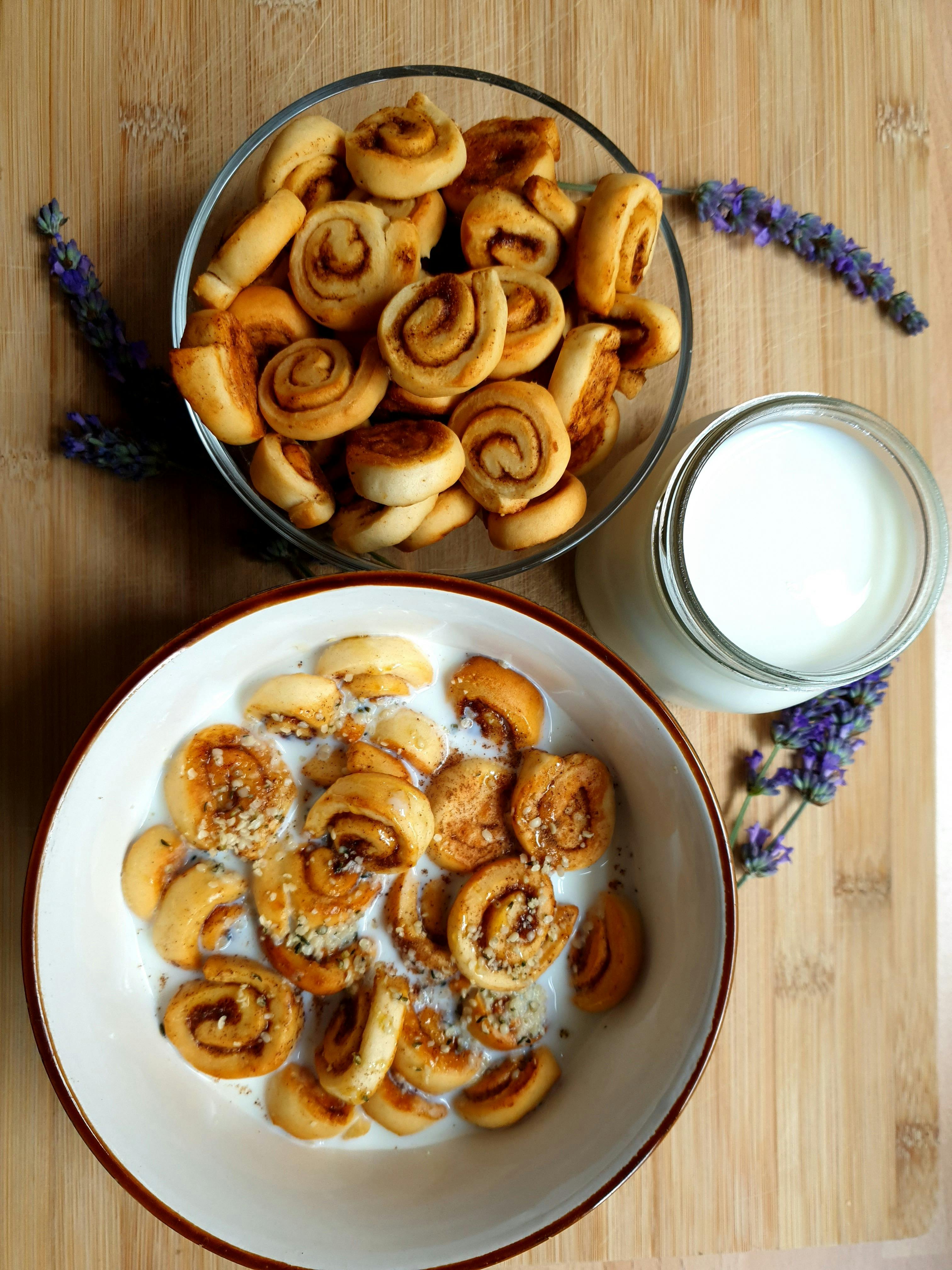
Photo: Ana Palade / Pexels
The diets react (see scores below)
Common Ingredients
- flour
- dates
- butter
- cardamom
- rose water
- nigella seeds
- sugar
- yeast
Specific recipes may vary.
Incompatible with 9 of 11 diets
Diet Ratings
Kleicha is an Iraqi date-filled cookie that is fundamentally incompatible with the ketogenic diet. Every primary ingredient is a keto disqualifier: wheat flour is a high-carb grain, dates are extremely high in sugar and net carbs (roughly 18g net carbs per date), and added sugar further compounds the carbohydrate load. A single piece of kleicha could easily contain 30-50g of net carbs, which alone would exceed or nearly exhaust an entire day's keto carb budget. The butter is the only keto-friendly ingredient. There is no meaningful modification possible while retaining the identity of this dish.
Kleicha contains butter, which is a dairy product derived from cow's milk and is therefore not vegan. All other ingredients — flour, dates, cardamom, rose water, nigella seeds, sugar, and yeast — are plant-based. The dish can be made vegan by substituting the butter with a plant-based alternative such as coconut oil or vegan margarine, but as traditionally prepared, it fails the vegan standard due to the butter.
Kleicha is an Iraqi date-filled cookie that is fundamentally incompatible with the paleo diet. The primary structural ingredient is wheat flour, a grain that is strictly excluded from all paleo frameworks. Additionally, refined sugar and yeast-leavened dough are non-paleo. Butter is a dairy product excluded under strict paleo guidelines. While dates, cardamom, rose water, and nigella seeds are paleo-friendly ingredients, they are minor components that cannot redeem a dish whose foundation is built on multiple core paleo violations. This is a baked good in the most traditional sense — exactly the category of food the paleo diet is designed to eliminate.
Kleicha is a traditional Iraqi date-filled cookie made primarily with refined white flour, butter, and added sugar — three ingredients that conflict with Mediterranean diet principles. Refined flour is a processed grain with minimal nutritional value, butter is a saturated animal fat directly contrary to the Mediterranean emphasis on olive oil as the primary fat, and the added sugar makes this a high-glycemic sweet treat. While dates are a whole fruit with nutritional merit (fiber, minerals), they are used here in a concentrated, sweet filling context within a pastry rather than eaten whole. The overall profile — refined grain base, saturated fat, added sugar — places Kleicha firmly in the 'occasional treat' category that Mediterranean guidelines advise minimizing.
Some Mediterranean diet interpreters note that dates are a traditional whole food across Middle Eastern and North African Mediterranean-adjacent cultures, and that small amounts of naturally sweetened traditional sweets are culturally embedded in the diet. A few authorities (e.g., those following a broader 'Blue Zones'-style Mediterranean interpretation) argue that occasional traditional sweets made with real ingredients are preferable to processed confections, and that moderate indulgence in cultural foods supports dietary adherence.
Kleicha is an Iraqi date-filled pastry that is entirely plant-based and incompatible with the carnivore diet. Every single ingredient — flour, dates, butter (the only potentially animal-derived ingredient, but here used in a heavily plant-based context), cardamom, rose water, nigella seeds, sugar, and yeast — is either plant-derived or a refined carbohydrate. Flour (grain), dates (fruit), cardamom (spice), rose water (plant extract), nigella seeds (plant seed), sugar (refined plant carbohydrate), and yeast (fungus) are all explicitly excluded from carnivore. Even if the butter is dairy-derived, it is irrelevant here given the overwhelming plant and grain base of this dish. This is essentially a sweet grain-and-sugar pastry with zero animal protein and no redeeming carnivore qualities.
Kleicha is an Iraqi date-filled cookie/pastry that violates multiple Whole30 rules simultaneously. It contains flour (a grain, excluded), butter (dairy, excluded — only ghee/clarified butter is allowed), and added sugar (explicitly excluded). Beyond the ingredient violations, even if these were substituted with compliant alternatives, Kleicha is a cookie/pastry by nature, and Whole30 Rule 4 explicitly prohibits recreating baked goods, cookies, and similar junk food items regardless of ingredient compliance.
Kleicha contains two major high-FODMAP ingredients that make it unsuitable during the elimination phase. First, wheat flour is the primary structural ingredient and a significant source of fructans, which are highly problematic FODMAPs — there is no realistic serving size of a wheat-flour-based baked good that would be low-FODMAP. Second, dates are high in excess fructose and polyols (sorbitol) and are rated high-FODMAP by Monash University at typical serving sizes (more than 1 medjool date or roughly 2 dried dates). A kleicha pastry will contain multiple dates in or as filling. The remaining ingredients — butter, cardamom, rose water, nigella seeds, sugar (sucrose), and yeast — are generally low-FODMAP and do not raise concerns on their own. However, the combination of wheat flour and dates as the two foundational ingredients makes this pastry incompatible with the FODMAP elimination phase at any reasonable portion.
Kleicha is a traditional Iraqi date-filled cookie/pastry made with refined white flour, butter (saturated fat), sugar, and dates. While dates provide natural fiber, potassium, and magnesium that align with DASH principles, the overall profile is problematic: refined flour lacks the fiber of whole grains, butter contributes saturated fat which DASH limits, and added sugar places this firmly in the 'sweets' category that DASH restricts to ≤5 servings per week. The spices (cardamom, nigella seeds, rose water) are DASH-neutral or mildly beneficial. Sodium content is low, which is a positive. This is essentially a sweet pastry — acceptable very occasionally within the DASH sweets allowance, but not a food to consume regularly or in large portions.
NIH DASH guidelines categorize pastries and sweets as limited items regardless of their natural ingredient base. However, some DASH-oriented dietitians note that date-based sweets with no added refined syrups or trans fats occupy a better nutritional position than processed cookies, and that the fiber and minerals from dates partially offset the sugar load — suggesting Kleicha could fit into a DASH plan more readily than commercially processed confections if portion is controlled to 1-2 pieces.
Kleicha is a traditional Iraqi date-filled cookie/pastry that presents multiple Zone Diet challenges simultaneously. The primary ingredients — white flour, dates, and sugar — are all high-glycemic carbohydrates that spike insulin dramatically. White flour is a refined carb Dr. Sears specifically categorizes as 'unfavorable,' dates are one of the highest-sugar fruits (very high glycemic load, explicitly discouraged in Zone), and added sugar compounds the problem further. Butter adds saturated fat rather than the preferred monounsaturated fat. Critically, there is no protein source whatsoever, making any 40/30/30 block balance impossible without completely rebuilding the meal around it. As a snack category item with no protein, it cannot function as a standalone Zone snack. The macro profile is essentially: high-GI carbohydrates + saturated fat + zero protein — the near-opposite of Zone ratios. Even with careful portioning to limit carb blocks, the glycemic spike from refined flour + dates + sugar in combination is severe. This is one of the clearer 'avoid' cases in Zone because the food fundamentally cannot be portioned into Zone compliance without stripping it of its defining characteristics.
Kleicha is a traditional Iraqi date-filled pastry with a mixed anti-inflammatory profile. On the positive side, dates provide natural sugars alongside fiber, potassium, magnesium, and some antioxidants (polyphenols), and cardamom is a recognized anti-inflammatory spice with antioxidant properties. Nigella seeds (black seed) are notably anti-inflammatory, containing thymoquinone which has demonstrated anti-inflammatory effects in research. Rose water contributes minor antioxidant flavonoids. However, the base of refined white flour is a refined carbohydrate that can spike blood glucose and promote inflammatory markers when consumed regularly. Butter contributes saturated fat, which anti-inflammatory guidelines recommend limiting. Added sugar amplifies the glycemic load. The overall profile is a sweet baked good — the kind of food the anti-inflammatory framework treats as an occasional treat rather than a dietary staple. The beneficial spices (cardamom, nigella seeds) and dates partially offset the refined flour, butter, and sugar, but do not overcome the net pro-inflammatory character of regular consumption. Suitable as an occasional indulgence, not a dietary cornerstone.
Kleicha is a traditional Iraqi date-filled cookie made primarily from refined flour, butter, dates, and sugar. This combination creates a high-sugar, high-saturated-fat, low-protein, low-fiber snack that is poorly suited for GLP-1 patients. The refined flour and sugar deliver fast-digesting carbohydrates with little nutritional payoff, while butter contributes significant saturated fat that can worsen nausea, bloating, and reflux — known GLP-1 side effects. Dates add natural sugar but negligible fiber in the small quantities used as filling. There is no meaningful protein source. As a calorie-dense, nutrient-poor food requiring multiple pieces to feel satisfying, Kleicha is a poor use of the reduced caloric budget GLP-1 patients have. Cardamom, rose water, and nigella seeds are benign in small amounts but do not offset the overall nutritional profile.
*See how scores were generated at our methodology page.
Nutritional profile
Six traits that cut across every diet.
Fiber & Plants
How much whole-plant food and fiber it delivers.
Healthy Fats
The quality of its fats (unsaturated, omega-3).
Whole / Unprocessed
How close it is to its natural, unprocessed form.
Gut Gentle
How easy it is on digestion (low FODMAP, few irritants).
Low Glycemic
How little it spikes your blood sugar.
Protein Density
How much protein it packs per calorie.
Controversy Index
Higher controversy = more disagreement between diets.
Diet-Specific Tips
 DASH — 4/10
View tips
- Dates provide fiber, potassium, and magnesium — DASH-positive nutrients
- Butter contributes saturated fat, which DASH limits
- Refined white flour lacks the fiber of whole grains emphasized by DASH
- Added sugar places this in the DASH 'sweets' category, limited to ≤5 servings/week
- Low sodium content is favorable
- Spices (cardamom, nigella seeds) are nutritionally neutral to mildly positive
- Portion control is essential — occasional small serving is acceptable on DASH
 Anti-Inflammatory — 4/10
View tips
- Refined white flour — refined carbohydrate, raises glycemic load, pro-inflammatory at regular intake
- Butter — source of saturated fat, limited by anti-inflammatory guidelines
- Added sugar — contributes to glycemic burden and inflammatory potential
- Dates — natural sugars but also fiber, polyphenols, and micronutrients with mild anti-inflammatory benefit
- Cardamom — recognized anti-inflammatory spice with antioxidant compounds
- Nigella seeds — contain thymoquinone, a well-studied anti-inflammatory phytochemical
- Rose water — minor antioxidant contribution
- Overall profile: sweet pastry best treated as an occasional treat on an anti-inflammatory diet