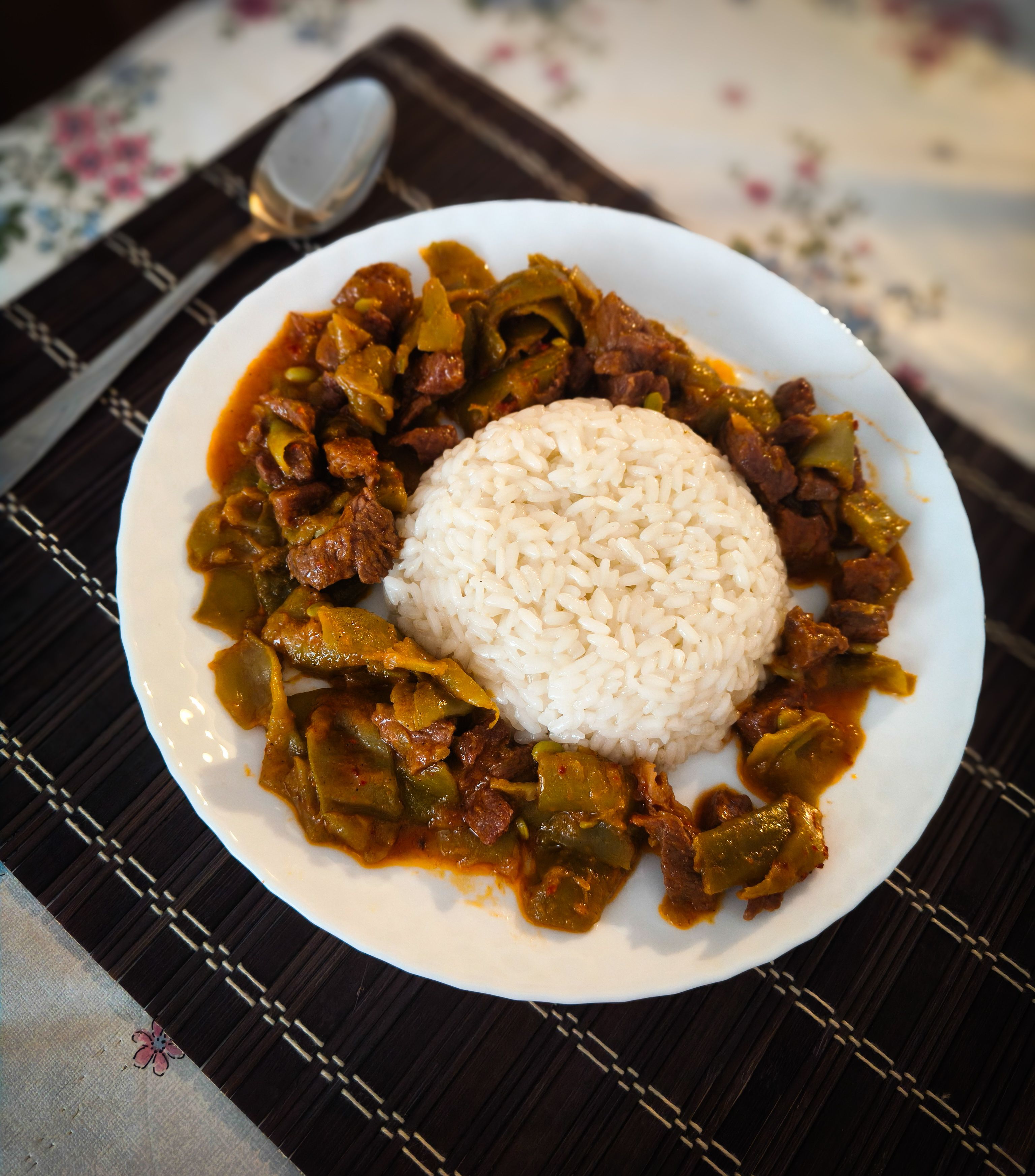
Iraqi
Margat Bamia
The diets react (see scores below)
Common Ingredients
- okra
- tomatoes
- tomato paste
- lamb
- garlic
- onion
- dried lime
- coriander
Specific recipes may vary.
Incompatible with 3 of 11 diets
Diet Ratings
Margat Bamia is an Iraqi okra and lamb stew that sits in a gray zone for keto. Lamb is an excellent high-fat protein source, and okra is relatively low in net carbs (~4g net per 100g). However, the dish relies heavily on tomatoes and tomato paste, which add meaningful carbohydrates — tomato paste in particular is concentrated and can contribute 10-15g net carbs per few tablespoons. Onion and dried lime add smaller but non-trivial carb loads. The total net carb content of a standard serving (250-350g) likely lands in the 12-18g range, which is manageable within a strict daily 20g limit only if the rest of the day is near-zero carb. The lack of grains, added sugar, or starchy vegetables is a positive. With portion control and reduced tomato paste, this dish is workable on keto, but a full traditional serving may push daily limits.
Some stricter keto practitioners would flag the tomato paste and cumulative vegetable carbs as too unpredictable for maintaining reliable ketosis, particularly for metabolically sensitive individuals or those following clinical keto protocols where carb targets are firm. Conversely, lazy keto or cyclical keto practitioners may freely approve this as a whole-food, low-starch meal.
Margat Bamia is an Iraqi okra stew whose primary protein is lamb, a red meat and clear animal product. Despite the otherwise plant-based supporting ingredients — okra, tomatoes, tomato paste, garlic, onion, dried lime, and coriander — the inclusion of lamb makes this dish entirely incompatible with a vegan diet. There is no ambiguity here: lamb is animal flesh and is categorically excluded under all vegan frameworks.
Margat Bamia is an Iraqi okra and lamb stew built entirely from paleo-compliant whole foods. Lamb is an unprocessed animal protein fully embraced by the paleo framework. Okra, tomatoes, tomato paste (assuming no added sugar or salt), garlic, and onion are all vegetables available in nature and consistent with hunter-gatherer eating. Dried lime (loomi) is simply a naturally preserved citrus fruit with no additives, and coriander is an approved herb/spice. There are no grains, legumes, dairy, seed oils, refined sugars, or processed ingredients present. This dish is a strong paleo fit.
Margat Bamia is a traditional Iraqi okra and lamb stew. The dish has several Mediterranean-friendly elements: okra and tomatoes are excellent vegetables, garlic and onion are staples, and the spicing with dried lime and coriander is wholesome. However, lamb is a red meat, which the Mediterranean diet restricts to a few times per month or once weekly at most. The dish is not processed and uses whole, natural ingredients, which is a positive, but the primary protein source works against it. It could be adapted to be more Mediterranean-compliant by reducing the lamb portion significantly or substituting with legumes or fish, but as traditionally prepared it sits in caution territory due to the red meat centerpiece.
Some Mediterranean diet interpretations, particularly those referencing traditional Eastern Mediterranean and Levantine practices, acknowledge that lamb has been consumed in moderate amounts in countries like Greece, Turkey, and the broader region for centuries, and small portions of lamb in a vegetable-rich stew like this could be considered acceptable within a flexible Mediterranean framework.
Margat Bamia is almost entirely plant-based in composition. While it contains lamb as the primary protein, the dish is dominated by okra, tomatoes, tomato paste, garlic, onion, dried lime, and coriander — all plant-derived ingredients that are strictly excluded on a carnivore diet. The vegetables and spices are not incidental seasonings but structural, defining components of the dish. No version of this stew could be considered carnivore-compatible without a complete reformulation. The presence of lamb does not redeem the dish when the majority of ingredients are explicitly prohibited plant foods.
Margat Bamia is an Iraqi okra and lamb stew whose ingredients are all Whole30-compliant. Lamb is an approved protein, okra and tomatoes are vegetables, tomato paste (plain, no additives) is compliant, garlic and onion are allowed aromatics, dried lime (loomi) is a natural citrus ingredient, and coriander is an approved spice. There are no grains, legumes, dairy, added sugars, or other excluded ingredients in this dish. It is a whole-food, minimally processed stew that aligns perfectly with the spirit of the program.
Margat Bamia contains two major high-FODMAP ingredients that make it unsuitable during the elimination phase: garlic (high in fructans at any culinary quantity) and onion (high in fructans, one of the worst FODMAP offenders). These are used as foundational flavor bases in this dish, not trace amounts, so avoidance is clear-cut. Okra is low-FODMAP at a standard serving (Monash rates it as green light at ~75g). Lamb is a plain protein with no FODMAPs. Tomatoes are low-FODMAP at standard servings (one medium tomato or about 65g). Tomato paste is low-FODMAP at 2 tablespoons but can become moderate at larger amounts — a minor concern. Dried lime (loomi) is not extensively Monash-tested but is used in small amounts as a souring agent and is unlikely to contribute significant FODMAPs at culinary doses. Coriander (cilantro) is low-FODMAP. Despite the low-FODMAP status of most ingredients, the combination of both garlic and onion as core aromatics makes this dish a definitive avoid during elimination.
Margat Bamia is an Iraqi okra and lamb stew with a strong vegetable base (okra, tomatoes, garlic, onion) and DASH-friendly aromatics (coriander, dried lime). Okra is an excellent DASH food — high in fiber, potassium, magnesium, and calcium. Tomatoes and garlic also align well with DASH principles. The primary concern is lamb, which is classified as red meat under DASH guidelines. DASH recommends limiting red meat due to its saturated fat and cholesterol content, favoring lean poultry and fish instead. However, lamb in a stew context is often lean cuts simmered with fat skimmed off, which reduces but does not eliminate the saturated fat concern. Tomato paste can add moderate sodium depending on preparation. The dish contains no added sugars, processed ingredients, or tropical oils. If made with lean lamb, trimmed of visible fat, and low-sodium tomato paste, this dish could score higher. As commonly prepared, it sits in the caution range due to red meat use.
NIH DASH guidelines categorize red meat as a food to limit due to saturated fat content. However, updated clinical interpretations note that lean lamb in moderate portions, especially in a vegetable-rich stew, may be acceptable within a DASH framework — some DASH-oriented dietitians apply the principle that overall dietary pattern matters more than exclusion of any single food, particularly for non-hypertensive individuals following the standard 2,300mg sodium threshold.
Margat Bamia is an Iraqi okra stew built on a foundation of Zone-friendly ingredients: okra is an excellent low-glycemic vegetable rich in fiber and polyphenols, tomatoes and tomato paste provide favorable carbohydrates with lycopene, garlic and onion are favorable low-GI aromatics, and dried lime adds flavor without significant carbohydrate load. The primary issue is the protein source — lamb is not a lean protein in Zone terminology. While lamb provides complete protein, it carries meaningful saturated fat, making it an 'unfavorable' Zone protein compared to skinless chicken, fish, or egg whites. A typical lamb stew serving may exceed Zone fat block targets and skew the 30% fat calorie goal toward saturated rather than monounsaturated fat. However, Zone methodology does not categorically exclude lamb — leaner cuts (leg of lamb, trimmed loin) can be portioned into Zone blocks with careful serving size management. The carbohydrate profile of this dish is genuinely Zone-friendly, with predominantly low-GI vegetables contributing the carb blocks. The fat imbalance from lamb and the absence of explicit monounsaturated fat sources (no olive oil listed, though likely used in preparation) temper the rating. With trimmed lean lamb cuts and olive oil in cooking, this dish can be reasonably Zone-balanced.
Some Zone practitioners and Sears' later anti-inflammatory writing (notably 'The Mediterranean Zone') take a more permissive view of traditional Mediterranean and Middle Eastern lamb dishes, recognizing that lamb from grass-fed or traditional sources contains a more favorable fatty acid profile with higher CLA and omega-3 content than grain-fed beef or pork. In this context, moderate portions of traditional lamb stew with vegetable-heavy ingredients like okra and tomatoes could be elevated closer to a score of 7, particularly if prepared with olive oil.
Margat Bamia is an Iraqi okra and lamb stew with a genuinely mixed anti-inflammatory profile. On the positive side, okra is rich in antioxidants (quercetin, kaempferol) and soluble fiber, tomatoes provide lycopene and vitamin C, garlic is a well-established anti-inflammatory agent, and coriander/dried lime contribute polyphenols. These plant-based ingredients meaningfully support an anti-inflammatory eating pattern. The primary concern is lamb, which is red meat — categorized under 'limit' in anti-inflammatory guidelines due to saturated fat content and its potential to elevate inflammatory markers (CRP, IL-6) with regular consumption. However, lamb is less processed than cured meats, and the quantity per serving in a stew context is typically moderate relative to the vegetable volume. The dish contains no refined carbohydrates, added sugars, or problematic oils, and the spice/aromatics profile is solid. Overall, this is a traditional whole-food dish that sits in 'caution' territory primarily because of the red meat component — it can be consumed occasionally without concern, but is not a dietary staple in a strict anti-inflammatory framework.
Some anti-inflammatory nutritionists, particularly those aligned with a Mediterranean or whole-food approach (like Dr. Weil), would view this dish more favorably, arguing that lamb consumed in moderate portions within a vegetable-rich, herb-forward stew represents an acceptable inclusion — especially given the absence of processed ingredients. Conversely, stricter anti-inflammatory and autoimmune-oriented protocols (e.g., AIP) would flag both lamb's saturated fat content and the nightshade ingredients (tomatoes) as potentially problematic for inflammation-sensitive individuals.
Margat Bamia is an Iraqi okra and lamb stew with a tomato-based broth. It has genuine nutritional strengths: okra is a high-fiber, easy-to-digest vegetable with mucilaginous properties that may actually soothe GI discomfort, and the tomato-rich broth adds hydration, lycopene, and low-calorie volume. Garlic, onion, coriander, and dried lime are all GLP-1 friendly aromatics and spices. The primary concern is lamb as the protein source — lamb is a moderate-to-high saturated fat red meat depending on the cut used. Shoulder or shank cuts common in Iraqi stewing are notably fatty and can worsen nausea, bloating, and reflux in GLP-1 patients. Slow-cooked lamb does become tender and easier to digest than, say, grilled fatty lamb, and the broth-based format of a soup is generally well-tolerated. Protein content per serving is meaningful but fat load is a real drawback. In a small portion — as a soup rather than a heavy meat dish — it is manageable, but the saturated fat from lamb prevents an approve rating.
Some GLP-1-focused RDs accept red meat in slow-cooked, broth-based preparations because the cooking method reduces fat density per serving and improves digestibility, and argue that the protein benefit outweighs saturated fat concerns in moderate portions. Others hold that lamb specifically should be avoided on GLP-1 therapy due to its high saturated fat content reliably worsening nausea and slowed gastric emptying symptoms regardless of cooking method.
*See how scores were generated at our methodology page.
Nutritional profile
Six traits that cut across every diet.
Fiber & Plants
How much whole-plant food and fiber it delivers.
Healthy Fats
The quality of its fats (unsaturated, omega-3).
Whole / Unprocessed
How close it is to its natural, unprocessed form.
Gut Gentle
How easy it is on digestion (low FODMAP, few irritants).
Low Glycemic
How little it spikes your blood sugar.
Protein Density
How much protein it packs per calorie.
Controversy Index
Higher controversy = more disagreement between diets.
Diet-Specific Tips
 Keto — 5/10
View tips
- Lamb is a keto-ideal high-fat protein source
- Okra is relatively low net carb (~4g/100g) and adds beneficial fiber
- Tomato paste is carb-dense and can significantly raise net carbs depending on quantity used
- Tomatoes and onion add moderate carb load
- No grains, starches, or added sugars — whole food ingredients
- Dried lime is used in small quantity and contributes minimal carbs
- Standard serving likely 12-18g net carbs — manageable but portion-sensitive
 Paleo — 9/10
View tips
- Lamb is a fully approved paleo protein
- Okra, tomatoes, garlic, and onion are all paleo-approved vegetables
- Dried lime is a naturally preserved citrus — no additives
- Coriander is an approved paleo spice
- Tomato paste should be verified to contain no added sugar or salt — plain tomato paste is acceptable
- No grains, legumes, dairy, seed oils, or refined sugars present
 Mediterranean — 4/10
View tips
- Lamb is a red meat, limited to a few times per month in Mediterranean diet guidelines
- Okra and tomatoes are excellent Mediterranean vegetables
- No processed ingredients or added sugars
- Garlic, onion, and spices are Mediterranean staples
- Vegetable-to-meat ratio and portion size of lamb are critical determinants
- Whole, natural ingredient list is a positive factor
 Whole30 — 9/10
View tips
- Lamb is a fully approved Whole30 protein
- Okra and tomatoes are compliant vegetables
- Tomato paste should be checked for added sugar or citric acid, though plain versions are widely available and compliant
- Dried lime (loomi) is a natural, whole-food souring agent — Whole30 compliant
- Coriander, garlic, and onion are all approved seasonings and aromatics
- No excluded ingredients (no grains, dairy, legumes, or added sugar) present in the traditional recipe
 DASH — 5/10
View tips
- Lamb is red meat, which DASH guidelines recommend limiting due to saturated fat
- Okra is a DASH-ideal vegetable: high in fiber, potassium, magnesium, and calcium
- Tomatoes and garlic are DASH-approved, nutrient-dense ingredients
- No processed ingredients, added sugars, or tropical oils
- Sodium level depends heavily on tomato paste and any added salt — low-sodium preparation improves score
- Lean lamb cuts with fat trimmed would reduce saturated fat content significantly
- Dried lime and coriander are low-sodium, DASH-compatible flavor enhancers
 Zone — 6/10
View tips
- Okra is an excellent Zone carbohydrate: low-glycemic, high-fiber, reducing net carb blocks significantly
- Tomatoes and tomato paste are favorable Zone carbs with polyphenol content (lycopene)
- Lamb is an 'unfavorable' Zone protein due to higher saturated fat content compared to lean poultry or fish
- Garlic, onion, coriander, and dried lime are Zone-neutral flavor contributors with anti-inflammatory polyphenols
- No monounsaturated fat source explicitly listed; olive oil use in cooking would improve Zone compatibility
- Lean lamb cuts (trimmed leg or loin) can bring the dish closer to Zone protein block targets (~7g protein per block)
- Overall carbohydrate profile of the dish is Zone-favorable due to vegetable-dominant ingredients
 Anti-Inflammatory — 5/10
View tips
- Lamb (red meat): pro-inflammatory due to saturated fat; classified as 'limit' in anti-inflammatory guidelines
- Okra: anti-inflammatory — rich in quercetin, kaempferol, and soluble fiber
- Tomatoes: anti-inflammatory — high in lycopene and vitamin C; nightshade consideration for autoimmune conditions
- Garlic: strongly anti-inflammatory — well-supported by research for reducing CRP and IL-6
- Coriander: anti-inflammatory spice with antioxidant properties
- Dried lime: provides flavonoids and vitamin C; supportive
- No refined carbohydrates, added sugars, or seed oils — favorable absence of common pro-inflammatory ingredients
- Stew format dilutes protein-to-vegetable ratio, moderating the red meat impact
 GLP-1 Friendly — 5/10
View tips
- Lamb is a high-saturated-fat red meat — primary concern for GLP-1 patients prone to nausea and reflux
- Okra is an excellent high-fiber, easy-to-digest vegetable with potential gut-soothing properties
- Broth-based soup format supports hydration and is generally well-tolerated on GLP-1 medications
- Tomato base adds nutrient density, hydration, and low-calorie volume
- Slow-cooked preparation improves digestibility compared to grilled or fried lamb
- Portion size is critical — a small bowl is more appropriate than a full serving
- Spice profile is mild and GLP-1 friendly — no high-heat ingredients
- Protein content is present but fat-to-protein ratio is less favorable than lean protein sources