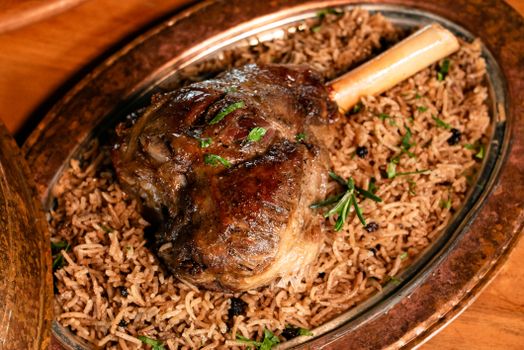
Photo: Mohamed Olwy / Pexels
The diets react (see scores below)
Common Ingredients
- lamb
- rice
- almonds
- raisins
- pine nuts
- onion
- baharat
- saffron
Specific recipes may vary.
Incompatible with 7 of 11 diets
Diet Ratings
Quzi is fundamentally incompatible with a ketogenic diet. The dish is built around rice as a primary base ingredient, which is a high-carb grain that alone can deliver 40-50g of net carbs per serving — immediately exceeding or maxing out the daily keto limit. Raisins add concentrated sugars and additional carbs. While the lamb, nuts (almonds, pine nuts), and spices (baharat, saffron) are individually keto-friendly, they cannot offset the massive carbohydrate load from the rice and raisins. This dish as traditionally prepared is a strict avoid for anyone maintaining ketosis.
Quzi is a traditional Iraqi slow-roasted lamb dish served over spiced rice. Lamb is a direct animal product (meat), making this dish entirely incompatible with a vegan diet. There is no ambiguity here — animal flesh is the primary and defining ingredient of this dish.
Quzi is a traditional Iraqi slow-roasted lamb dish served over spiced rice, and rice is a grain explicitly excluded from the paleo diet. While the lamb, almonds, pine nuts, raisins, onion, saffron, and baharat spice blend are all paleo-compatible, rice forms the foundational base of this dish and cannot be omitted without fundamentally changing the recipe. The presence of an excluded grain makes this dish a clear avoid verdict regardless of the quality of the other ingredients.
Quzi is a traditional Iraqi slow-roasted lamb dish served over spiced rice with nuts and dried fruit. The primary protein is lamb, a red meat that the Mediterranean diet restricts to only a few times per month. The rice base is likely white rice (refined grain), which is discouraged in favor of whole grains. However, the dish does include several Mediterranean-friendly elements: almonds and pine nuts are excellent plant-based fats and proteins strongly encouraged in the diet, raisins and onion add plant diversity, and the aromatic spices (baharat, saffron) are consistent with Mediterranean flavor profiles. Despite these positive elements, the centerpiece of the dish — a large portion of slow-roasted lamb — combined with refined white rice makes this dish incompatible with regular Mediterranean diet consumption. It may be enjoyed very occasionally as a red meat indulgence, but cannot be rated as acceptable in regular rotation.
Some broader interpretations of the Mediterranean diet acknowledge that lamb is consumed in traditional Eastern Mediterranean and Levantine cuisines (e.g., Greek and Turkish traditions) more frequently than Western clinical guidelines suggest, and a moderate portion of lamb within an otherwise plant-rich meal pattern could be considered acceptable on a limited basis by some practitioners.
Quzi is fundamentally incompatible with the carnivore diet. While lamb is an excellent carnivore-approved protein, the dish is built around rice as a base and includes multiple plant-derived ingredients: almonds, raisins, pine nuts, onion, baharat (a plant-based spice blend), and saffron. Rice is a grain — entirely excluded. Almonds and pine nuts are plant seeds/nuts — excluded. Raisins are dried fruit — excluded. Onion is a vegetable — excluded. Baharat and saffron are plant-derived spices — excluded on strict carnivore. The lamb itself would be approved in isolation, but as prepared in this dish, the overwhelming majority of ingredients violate carnivore principles. This is a classic mixed dish where the animal component cannot be meaningfully separated from the plant components in the recipe as defined.
Quzi is a traditional Iraqi slow-roasted lamb dish served over spiced rice, garnished with nuts and raisins. The lamb, almonds, raisins, pine nuts, onion, baharat, and saffron are all Whole30-compatible. However, rice is explicitly excluded on the Whole30 as a grain. Since rice is a foundational, structural component of this dish — not an incidental ingredient — the dish as traditionally prepared cannot be made Whole30-compliant without fundamentally changing its character.
Quzi contains multiple high-FODMAP ingredients that make it unsuitable during the elimination phase. Onion is one of the highest-FODMAP foods tested by Monash University, rich in fructans, and is a core ingredient in this dish — it cannot be omitted without fundamentally changing the recipe. Raisins are high-FODMAP due to excess fructose and fructans; a standard serving (1 tablespoon / ~13g) exceeds safe thresholds. Baharat spice blend typically contains garlic and onion powder, both extremely high in fructans. These three problematic ingredients together make the dish a clear avoid during elimination. Rice, lamb, almonds (at ≤10 per serve), pine nuts (at ≤1 tablespoon), and saffron are individually low-FODMAP, but the high-FODMAP components are structural to the dish and present in significant quantities.
Quzi is an Iraqi slow-roasted lamb and rice dish with nuts, raisins, and aromatic spices. The primary concern for DASH compliance is lamb, which is a red meat with higher saturated fat content than DASH-preferred proteins like poultry or fish. DASH guidelines explicitly limit red meat, recommending it only occasionally and in small portions. However, the dish has several DASH-positive components: almonds and pine nuts provide healthy unsaturated fats, magnesium, and potassium; raisins contribute potassium and fiber; onion adds beneficial micronutrients; and spices like baharat and saffron add flavor without sodium. Rice (ideally brown rice for full DASH alignment) provides energy and some fiber. The overall dish is relatively unprocessed and sodium levels depend heavily on preparation — if salt is used minimally, sodium can remain moderate. The saturated fat from lamb is the primary limiting factor. In moderate portions with lean cuts (leg of lamb, trimmed), this dish can be consumed occasionally on DASH but is not a staple.
NIH DASH guidelines categorize red meat like lamb as a food to limit, emphasizing poultry and fish instead. However, some updated clinical interpretations note that unprocessed red meat in moderate portions, when part of an otherwise DASH-compliant diet rich in vegetables and whole grains, may be less impactful on cardiovascular outcomes than previously thought — particularly when lean cuts are used and sodium is controlled.
Quzi is a traditional Iraqi slow-roasted lamb dish served over spiced rice with nuts and raisins. From a Zone perspective, it presents several challenges. The base is white rice, which is a high-glycemic carbohydrate and an 'unfavorable' Zone carb that spikes blood sugar rapidly. Raisins are explicitly flagged as unfavorable in Zone methodology due to their concentrated sugar content and high glycemic load. Lamb, while a usable Zone protein, tends to be fattier than preferred lean proteins like skinless chicken or fish, contributing excess saturated fat. On the positive side, almonds and pine nuts provide monounsaturated fats consistent with Zone fat blocks, onion adds a low-glycemic vegetable component, and baharat spices and saffron are anti-inflammatory polyphenol sources Sears would appreciate. The dish's macro ratio is significantly skewed: the rice and raisins create a carbohydrate-heavy profile far exceeding the 40% target, while the fat content (from lamb and nuts) likely overshoots the 30% fat ceiling. Portion control could theoretically bring this into Zone balance — using a very small rice portion, trimmed lamb, and treating the nuts as the fat block — but this would fundamentally alter the dish's character. As served traditionally, Quzi is difficult to fit into Zone ratios without significant modification.
Some Zone practitioners in Sears' later writings (The Anti-Inflammation Zone) acknowledge that a small portion of white rice alongside high-polyphenol foods (saffron, baharat spices) and omega-3-supportive meals can be accommodated in a broader anti-inflammatory eating pattern. If lamb is trimmed of visible fat and served with a very small rice portion supplemented by additional vegetables, the dish could be modified toward Zone compliance. Additionally, nuts in the recipe serve as the fat block component, which aligns well with Zone's monounsaturated fat preference.
Quzi is a traditional Iraqi slow-roasted lamb dish served over spiced rice with nuts and dried fruit. Its anti-inflammatory profile is genuinely mixed. On the positive side, the dish features several potent anti-inflammatory components: baharat spice blend typically contains turmeric, black pepper, cinnamon, and cloves — all with documented anti-inflammatory properties. Saffron contains crocin and safranal, which show anti-inflammatory activity in research. Almonds and pine nuts provide healthy monounsaturated fats and vitamin E (an antioxidant). Raisins contribute polyphenols. Onion supplies quercetin. On the negative side, lamb is red meat — classified under 'limit' in the anti-inflammatory framework due to saturated fat content and arachidonic acid, which can promote inflammatory eicosanoids. However, lamb is less processed than cured meats and provides zinc and selenium (anti-inflammatory micronutrients). White rice, while likely the base here, is a refined carbohydrate with minimal fiber. The dish is not inherently 'bad' — it's a whole-food, traditionally prepared meal with meaningful anti-inflammatory spicing — but the lamb-and-white-rice foundation keeps it in the 'caution' zone for regular consumption.
Some anti-inflammatory practitioners, particularly those following Dr. Weil's broader Mediterranean-adjacent framework, may give more credit to the rich spice profile and whole-food preparation method, viewing occasional red meat as acceptable (especially grass-fed lamb). Conversely, stricter anti-inflammatory protocols and AIP-aligned approaches would flag lamb's saturated fat and arachidonic acid content more heavily, pushing it toward a lower score.
Quzi is a traditional Iraqi slow-roasted lamb and rice dish with nuts and raisins. It contains meaningful protein from lamb, but lamb is a fatty red meat — a standard serving carries significant saturated fat, which can worsen GLP-1 side effects including nausea, bloating, and reflux due to slowed gastric emptying. The white rice base is a refined carbohydrate with low fiber and low protein density per calorie, taking up valuable stomach real estate without strong nutritional return. Raisins add concentrated sugar with minimal fiber benefit. Almonds and pine nuts contribute healthy unsaturated fats but also add to the overall fat load of the dish. Baharat and saffron are generally well-tolerated spices at normal quantities. The dish is not fried and is slow-cooked, which aids digestibility somewhat, but the combination of high saturated fat from lamb, refined rice, and calorie-dense nuts makes this a portion-sensitive, caution-tier choice. A small serving focused on the lamb protein with minimal rice is the most GLP-1-compatible approach.
Some GLP-1-focused dietitians argue that slow-cooked fatty cuts like lamb shoulder are better tolerated than expected because the long cook time breaks down connective tissue and fat in ways that ease digestion; others maintain that any high-saturated-fat meal meaningfully worsens GI side effects and that lean protein substitutions are always preferable. Individual tolerance to lamb fat varies considerably among GLP-1 patients.
*See how scores were generated at our methodology page.
Nutritional profile
Six traits that cut across every diet.
Fiber & Plants
How much whole-plant food and fiber it delivers.
Healthy Fats
The quality of its fats (unsaturated, omega-3).
Whole / Unprocessed
How close it is to its natural, unprocessed form.
Gut Gentle
How easy it is on digestion (low FODMAP, few irritants).
Low Glycemic
How little it spikes your blood sugar.
Protein Density
How much protein it packs per calorie.
Controversy Index
Higher controversy = more disagreement between diets.
Diet-Specific Tips
 DASH — 4/10
View tips
- Lamb is a red meat high in saturated fat — DASH limits red meat significantly
- Almonds and pine nuts provide DASH-friendly healthy fats, magnesium, and potassium
- Raisins contribute potassium and natural fiber
- No inherently high-sodium ingredients; sodium level depends on preparation
- Spices replace salt for flavor, which is a DASH-positive cooking approach
- White rice is commonly used — substituting brown rice would improve fiber and DASH alignment
- Portion control critical: smaller lamb portions with more rice and nuts improves DASH compatibility
- Lean lamb cuts (e.g., trimmed leg) reduce saturated fat burden
 Zone — 4/10
View tips
- White rice is a high-glycemic 'unfavorable' Zone carbohydrate that dominates the dish's carb profile
- Raisins are explicitly unfavorable in Zone methodology due to concentrated sugar and high glycemic load
- Lamb is higher in saturated fat than preferred Zone lean proteins, requiring careful trimming
- Almonds and pine nuts are excellent Zone monounsaturated fat sources
- Saffron and baharat spices contribute anti-inflammatory polyphenols aligned with Sears' later work
- Overall macro ratio is carbohydrate and fat heavy relative to Zone's 40/30/30 target
- Traditional portion sizes make Zone compliance very difficult without significant modification
 Anti-Inflammatory — 5/10
View tips
- Lamb (red meat) is high in saturated fat and arachidonic acid — classified as 'limit' in anti-inflammatory guidelines
- Baharat spice blend contains turmeric, cinnamon, cloves, and black pepper — strong anti-inflammatory spices
- Saffron contains crocin and safranal with documented anti-inflammatory and antioxidant activity
- Almonds and pine nuts provide monounsaturated fats and vitamin E
- Raisins and onion contribute polyphenols and quercetin
- White rice is a refined carbohydrate with limited fiber and minimal anti-inflammatory benefit
- Whole-food preparation with no processed ingredients or additives is a positive factor
 GLP-1 Friendly — 4/10
View tips
- Lamb is a high-saturated-fat protein — worsens nausea and bloating on GLP-1 medications
- Meaningful protein source but fat content undermines its GLP-1 suitability
- White rice is a refined carbohydrate with low fiber, displacing more nutrient-dense foods
- Raisins add concentrated sugar and calories with minimal nutritional benefit
- Almonds and pine nuts add healthy fats but elevate total fat load per serving
- Slow-cooked preparation improves digestibility compared to fried or grilled fatty meats
- Portion sensitivity is high — a small serving centered on lean lamb pieces is significantly better than a full plate
- Baharat and saffron are mild, well-tolerated spices unlikely to worsen GI side effects