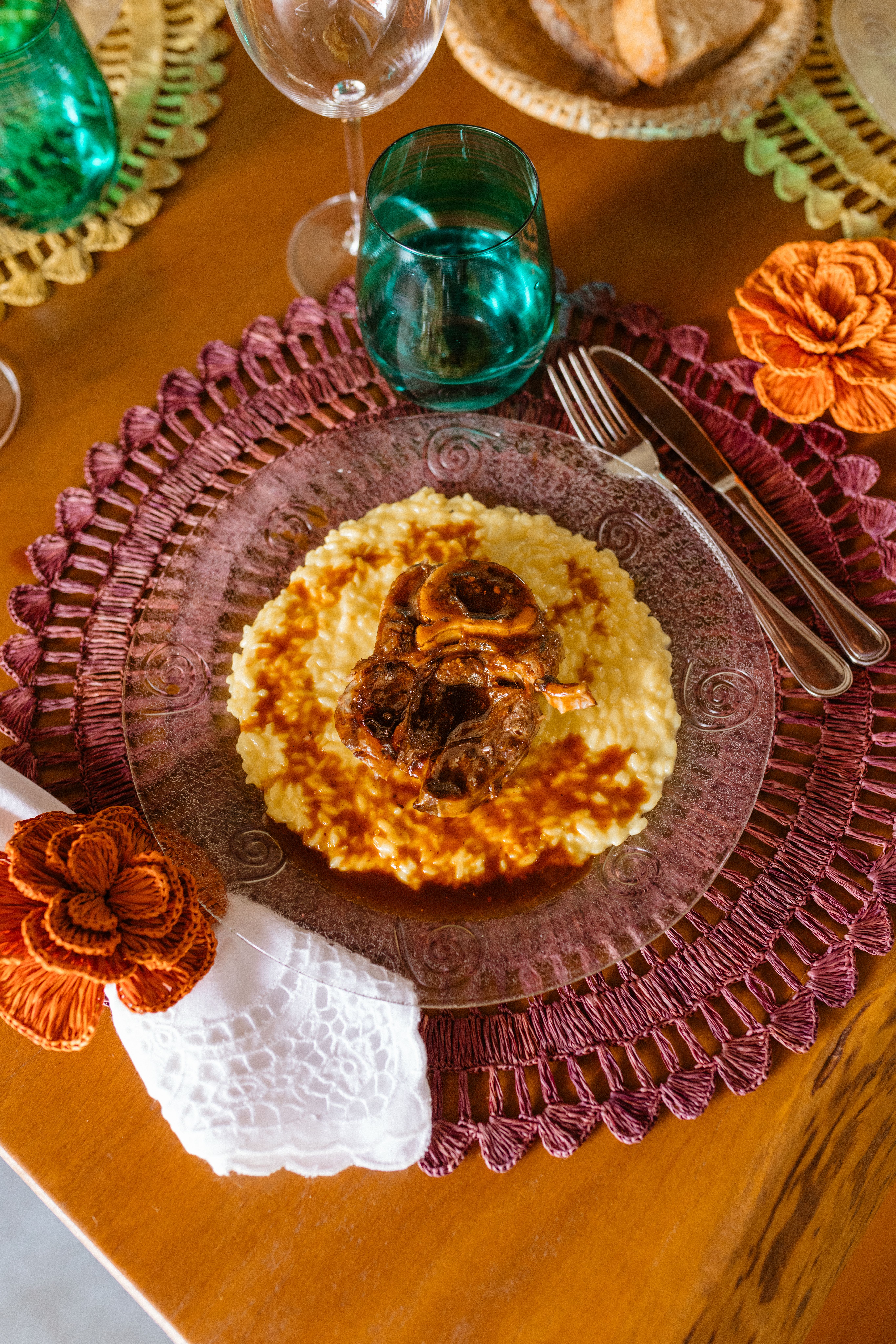
Photo: Jonathan Borba / Pexels
Italian
Ossobuco alla Milanese
The diets react (see scores below)
Common Ingredients
- veal shanks
- onion
- carrot
- celery
- white wine
- broth
- tomato
- gremolata
- butter
- lemon zest
Specific recipes may vary.
Incompatible with 6 of 11 diets
Diet Ratings
Ossobuco alla Milanese is built around veal shanks braised in butter and broth — both keto-friendly — but the traditional recipe introduces several carb concerns. White wine adds residual sugars and carbs (though much cooks off), and the mirepoix of onion, carrot, and celery contributes meaningful net carbs, especially carrot which is moderately starchy. Tomato adds a small additional carb load. The gremolata (parsley, lemon zest, garlic) is negligible. Critically, the traditional accompaniment is risotto alla Milanese or polenta — both strictly off-limits — but the protein-and-fat core of the dish itself is sound. Without the starchy sides and with portion-controlled vegetables, a serving can potentially fit within daily carb limits, but it sits firmly in caution territory due to carrot, wine, and tomato accumulation.
Some stricter keto practitioners would push this toward 'avoid,' arguing that the carrot and white wine are unnecessary carb sources with no clear workaround in an authentic preparation, and that the cumulative carb load from multiple moderate-carb ingredients makes it too risky for those targeting the lower 20g net carb threshold.
Ossobuco alla Milanese is a classic Italian braised veal shank dish and is entirely incompatible with a vegan diet. It contains multiple animal products: veal shanks (meat from a young calf), butter (dairy), and broth (typically meat-based). There is no ambiguity here — this dish is built around animal flesh and animal-derived ingredients at its core.
Ossobuco alla Milanese contains two clear paleo violations: butter (dairy) and white wine (alcohol, a processed/fermented product excluded by strict paleo). The core ingredients — veal shanks, onion, carrot, celery, tomato, broth, lemon zest, and gremolata (parsley, garlic, lemon) — are all paleo-compliant and excellent. However, butter is an unambiguous dairy product excluded under strict paleo rules (unlike ghee, the casein and lactose remain). White wine adds a second violation. The dish could theoretically be modified (substitute coconut oil or olive oil for butter, omit wine or substitute additional broth), but as traditionally prepared, it fails paleo compliance on two counts.
Ossobuco alla Milanese is centered on veal shanks, which fall under red meat — a category limited to a few times per month in the Mediterranean diet. The dish is also prepared with butter as the primary fat rather than olive oil, directly contradicting a core Mediterranean principle. While the supporting ingredients (onion, carrot, celery, tomato, white wine, gremolata with lemon zest) are strongly Mediterranean, they cannot offset the two main non-conforming elements: red meat as the primary protein and butter as the cooking fat. The braising technique and vegetable-rich base are positive, but the dish's foundation conflicts with Mediterranean guidelines.
Some Mediterranean diet interpreters, particularly those following traditional Northern Italian regional practices, would argue that veal is leaner than beef and has historically appeared in Mediterranean coastal and Northern Italian cuisine. A moderate monthly serving could be acceptable, especially given the dish's abundant vegetables, aromatic base, and wine — all of which align well with Mediterranean principles. If prepared with olive oil substituted for butter, the overall profile improves meaningfully.
Ossobuco alla Milanese is fundamentally incompatible with the carnivore diet. While the veal shanks themselves are an excellent carnivore-approved ruminant meat, the dish is heavily laden with plant-based ingredients that violate core carnivore principles. Onion, carrot, celery, tomato, and gremolata (parsley, lemon zest, garlic) are all plant foods explicitly excluded from the carnivore diet. White wine adds plant-derived fermented sugars and compounds. The butter is a minor dairy positive, but it cannot offset the extensive plant-based ingredient list. This is a classic braised dish whose entire flavor profile and preparation method depends on vegetables, aromatics, and wine — not a dish that can be easily modified while retaining its identity. The bone marrow within the shank is carnivore gold, but the preparation as traditionally executed makes this dish a clear avoid.
Ossobuco alla Milanese contains butter, which is a dairy product explicitly excluded from the Whole30 program. Only ghee and clarified butter are permitted as dairy exceptions. While most other ingredients are compliant — veal shanks, onion, carrot, celery, broth, tomato, and gremolata (parsley, garlic, lemon zest) are all Whole30-friendly — white wine is also excluded as alcohol. The dish as traditionally prepared fails on two counts: butter and white wine. A modified version substituting ghee for butter and omitting or replacing the wine with compliant broth could be made compliant.
Ossobuco alla Milanese contains onion and celery as core aromatic ingredients, both of which are high-FODMAP due to fructans and should be avoided entirely during the elimination phase. Onion is one of the most problematic FODMAP foods and cannot be made safe by reducing portion size of the dish alone — fructans leach into the cooking liquid (broth/wine sauce), meaning even removing the onion pieces before serving does not make the dish safe. Celery at standard cooking quantities also exceeds the low-FODMAP threshold. Garlic is commonly added to gremolata in traditional recipes, though it is listed here as just lemon zest and parsley; if classic gremolata with garlic is used, this adds another high-FODMAP ingredient. The remaining ingredients — veal shanks, carrot, white wine (in cooked form at typical serving), tomato (in moderate amounts), butter, lemon zest, and broth — are generally low-FODMAP or acceptable at standard servings. However, the onion and celery disqualify this dish during the elimination phase.
Ossobuco alla Milanese occupies a middle ground in DASH diet compatibility. On the positive side, veal shank is a leaner cut than most red meats, and the dish is rich in DASH-friendly vegetables (onion, carrot, celery, tomato) and aromatics (gremolata with lemon zest, parsley). These contribute potassium, fiber, and antioxidants. However, several factors warrant caution: butter adds saturated fat, which DASH limits; broth (especially commercial versions) often carries significant sodium; and veal, while leaner than beef, is still red meat, which DASH recommends limiting. The braising method concentrates flavors but also fats from the bone marrow. White wine is acceptable in cooking as most alcohol evaporates, leaving minimal residue. With modifications — using low-sodium broth, minimizing butter, and controlling portion size — this dish can fit into a DASH framework occasionally. As typically prepared in a restaurant or traditional recipe, sodium and saturated fat content may exceed DASH targets for a single serving.
NIH DASH guidelines broadly limit red meat and saturated fat, which would push this dish toward 'avoid' due to butter and veal classification. However, updated clinical interpretations note that veal is among the leanest red meats and that the vegetable-forward braising base and gremolata make this dish more nutrient-dense than most red meat preparations — some DASH-oriented dietitians would permit it as an occasional choice with low-sodium broth and reduced butter.
Ossobuco alla Milanese has several Zone-compatible elements but requires meaningful modifications to fit the 40/30/30 framework. Veal shank is a lean-to-moderate protein source — leaner than most red meats but still contains more fat than skinless chicken or fish, and the shank cut carries collagen and some marrow fat. The vegetable base (onion, carrot, celery, tomato) provides favorable low-glycemic carbohydrates, and gremolata (parsley, lemon zest, garlic) adds polyphenols that align well with Sears' anti-inflammatory emphasis. However, butter is the primary fat, which is saturated — the early Zone strictly limited saturated fat in favor of monounsaturated sources like olive oil. White wine adds some fermentable sugars but in cooking quantities these are largely burned off. The main Zone concern is the fat profile: butter-braised bone-in veal with marrow means the fat blocks are dominated by saturated fat rather than the preferred monounsaturated fats. Traditional serving with saffron risotto (not listed here) would make this a clear Zone problem, but as listed, the dish itself can be portioned for a Zone meal by controlling shank portion (~25g protein serving), skipping the marrow, and pairing with additional non-starchy vegetables rather than risotto. The dish is not categorically unfavorable but requires intentional portioning and fat awareness.
Later Sears writings (The OmegaRx Zone, Zone Perfect Meals in Minutes) show some relaxation around saturated fat when overall omega-3 and polyphenol intake is high. A practitioner following later Sears methodology might rate this more favorably given the anti-inflammatory gremolata, vegetable braising base, and the relatively lean nature of veal compared to other red meats — potentially scoring it a 6 and treating butter as an acceptable fat block in modest quantities within a polyphenol-rich meal context.
Ossobuco alla Milanese presents a mixed anti-inflammatory profile. On the positive side, the dish centers on a rich array of anti-inflammatory supporting ingredients: onion, carrot, and celery provide polyphenols and antioxidants; tomato contributes lycopene; white wine adds some resveratrol-related polyphenols; and gremolata (parsley, garlic, lemon zest) is genuinely anti-inflammatory — garlic in particular has well-documented anti-inflammatory properties, and lemon zest provides flavonoids. The broth-braising method is relatively lean compared to frying. However, the primary protein is veal (red meat), which anti-inflammatory guidelines recommend limiting due to its saturated fat content and potential to elevate arachidonic acid and pro-inflammatory eicosanoids. Butter is a saturated fat explicitly listed under 'limit' in the anti-inflammatory framework. The dish is also traditionally served with bone marrow, though that is not listed here, which would add more saturated fat. Veal is leaner than most red meats, which is a partial mitigating factor — it has a more favorable fat profile than beef or lamb — but it still falls under the 'limit' category. The overall profile is a dish with genuinely beneficial vegetable and herb components offset by red meat and butter, placing it firmly in the 'caution/moderation' zone. Occasional consumption is acceptable within an anti-inflammatory diet, particularly for those who are not managing active inflammatory or autoimmune conditions.
Some anti-inflammatory practitioners, including those following Dr. Weil's more flexible pyramid, would note that veal is among the leaner red meats and that the vegetable-heavy braising base with gremolata meaningfully offsets the inflammatory load — they might rate this more leniently as an occasional moderate choice. Stricter anti-inflammatory and autoimmune protocol (AIP) approaches, however, would flag both the red meat and the butter more firmly, and the tomato could be flagged for nightshade sensitivity in autoimmune contexts.
Ossobuco alla Milanese presents a mixed profile for GLP-1 patients. Veal shank is a relatively lean braised meat compared to other beef cuts, and the slow braising process makes the protein tender and easy to digest — a meaningful advantage given slowed gastric emptying. A standard serving (one shank, ~200-250g meat) provides a reasonable 30-40g of protein. However, the dish carries notable drawbacks: butter adds saturated fat, the cooking method releases significant collagen and marrow fat into the braising liquid, and the overall fat content per serving is moderate-to-high by GLP-1 standards. White wine is used in cooking (most alcohol cooks off, residual amount is minimal and generally considered acceptable in traditional preparations). The vegetable base — onion, carrot, celery, tomato — adds fiber and micronutrients. Gremolata (parsley, lemon zest, garlic) is a positive addition with no meaningful drawbacks. The dish is typically served with risotto alla Milanese (saffron risotto made with butter and parmesan), which would substantially worsen the fat and refined-carb profile — that pairing should be avoided; substituting a small portion of legumes or steamed vegetables is strongly preferred. Evaluated as a standalone braised protein with vegetables, it earns a caution rather than avoid, but portion control is essential and the butter content is a real concern for patients managing GI side effects.
Some GLP-1-focused dietitians accept braised veal as an occasional lean protein choice given its digestibility and high protein yield, and argue that the saturated fat from butter in a restaurant portion is modest enough to tolerate. Others flag that the rich braising liquid — absorbing marrow fat and butter — makes the effective fat content difficult to estimate and advise patients with active nausea or reflux to avoid rich braises entirely until GI side effects stabilize.
*See how scores were generated at our methodology page.
Nutritional profile
Six traits that cut across every diet.
Fiber & Plants
How much whole-plant food and fiber it delivers.
Healthy Fats
The quality of its fats (unsaturated, omega-3).
Whole / Unprocessed
How close it is to its natural, unprocessed form.
Gut Gentle
How easy it is on digestion (low FODMAP, few irritants).
Low Glycemic
How little it spikes your blood sugar.
Protein Density
How much protein it packs per calorie.
Controversy Index
Higher controversy = more disagreement between diets.
Diet-Specific Tips
 Keto — 5/10
View tips
- Veal shanks are high-quality protein with good fat content — keto core is solid
- Carrot is the most problematic ingredient, adding ~4-6g net carbs per serving
- White wine contributes residual carbs and sugars even after cooking
- Tomato adds minor but cumulative carb load
- Butter-based braise aligns well with keto fat ratios
- Traditional sides (risotto, polenta) are strictly forbidden and must be substituted
- Gremolata and lemon zest are negligible carb contributors
- Dish is manageable with reduced carrot, cauliflower mash substitution, and portion control
 DASH — 5/10
View tips
- Veal shank is leaner than most red meats but still classified as red meat, which DASH limits
- Butter adds saturated fat — a key DASH-restricted nutrient
- Broth often contributes high sodium; low-sodium broth significantly improves DASH compatibility
- Vegetable base (onion, carrot, celery, tomato) provides potassium, fiber, and micronutrients aligned with DASH
- Gremolata (lemon zest, parsley, garlic) adds flavor without sodium, supporting DASH-friendly seasoning
- Bone marrow from veal shank releases additional saturated fat during braising
- Portion control is critical — traditional serving sizes may exceed DASH red meat recommendations
 Zone — 5/10
View tips
- Veal shank is moderately lean red meat — acceptable Zone protein but not ideal compared to chicken or fish
- Butter as primary fat source is saturated, conflicting with Zone preference for monounsaturated fats
- Vegetable braising base (onion, carrot, celery, tomato) contributes favorable low-glycemic Zone carbohydrate blocks
- Gremolata provides polyphenols and lemon zest, aligning with Sears' anti-inflammatory focus
- Bone marrow in shank adds hidden saturated fat beyond butter
- White wine reduces during cooking, minimizing glycemic impact
- Portioning the shank to ~25g protein per serving is achievable but requires attention to cut size
- Dish is typically served with risotto which would create a high-glycemic Zone imbalance — pairing matters greatly
 Anti-Inflammatory — 4/10
View tips
- Veal shank is red meat — falls under anti-inflammatory 'limit' category despite being leaner than most red meats
- Butter contributes saturated fat, a pro-inflammatory factor
- Gremolata (garlic, parsley, lemon zest) provides meaningful anti-inflammatory polyphenols and flavonoids
- Onion, carrot, celery, and tomato add antioxidants, fiber, and lycopene
- Braising method is healthier than frying; dish is not heavily processed
- Tomato may be a concern for individuals following autoimmune or nightshade-sensitive protocols
- Overall: nutrient-rich preparation with inflammatory offset from vegetables and herbs, but protein and fat sources limit approval
 GLP-1 Friendly — 5/10
View tips
- Veal shank is relatively lean for a red meat cut and provides substantial protein (~30-40g per shank)
- Braising technique makes protein tender and easy to digest — favorable for slowed gastric emptying
- Butter in the braise adds saturated fat, worsening GI side effect risk
- Marrow from the bone releases additional fat into the cooking liquid
- Vegetable base (onion, carrot, celery, tomato) contributes fiber and micronutrients
- Gremolata is a positive, low-calorie flavoring addition
- Residual alcohol from white wine after cooking is negligible
- Traditional pairing with saffron risotto significantly worsens the overall nutritional profile — substitute with vegetables or legumes
- Portion sensitivity is high — a full restaurant portion may be too large and too fatty for GLP-1 patients
- Not suitable for patients in early GLP-1 treatment with active nausea or reflux