Italian
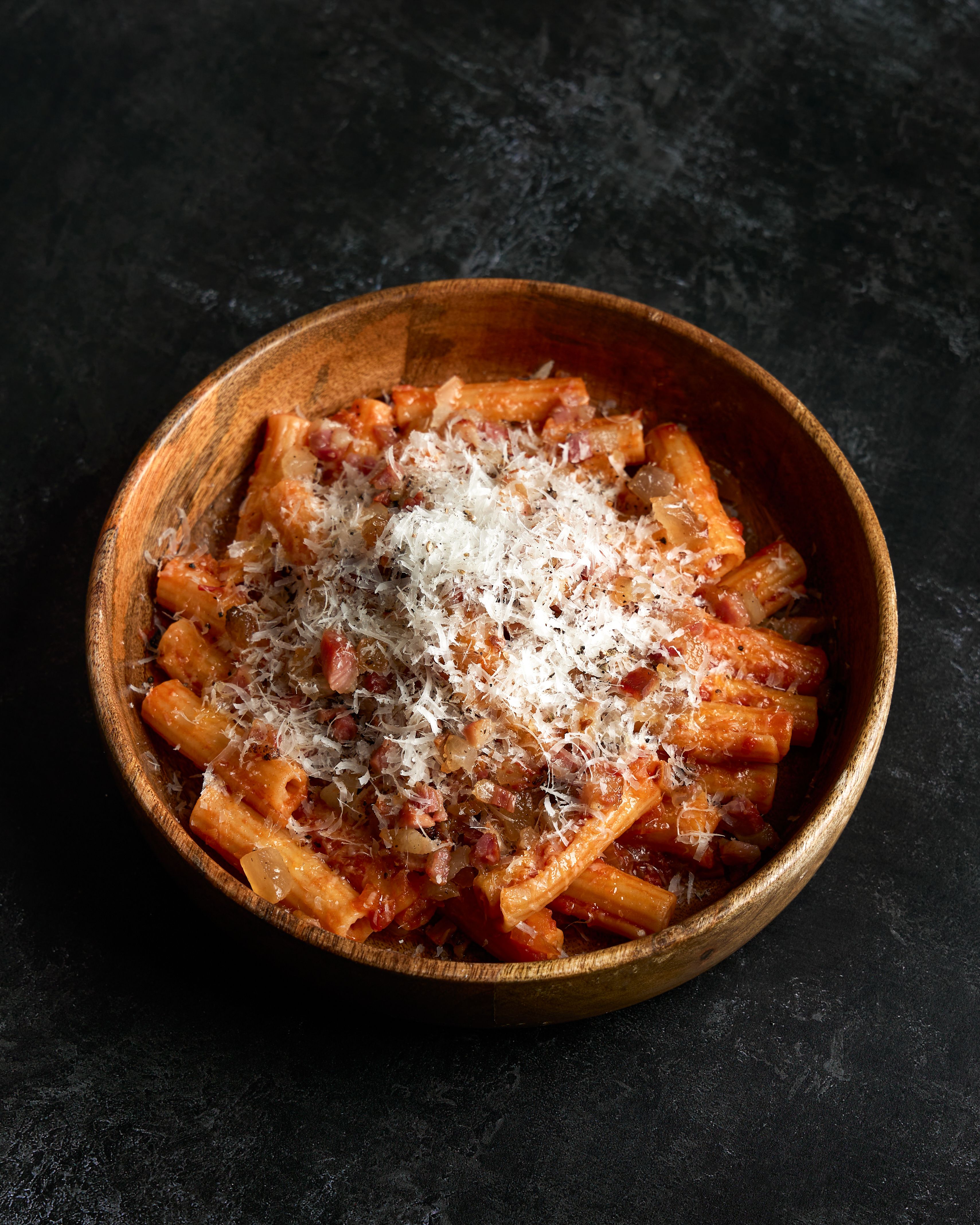
Pasta alla Gricia
The diets react (see scores below)
Common Ingredients
- rigatoni
- guanciale
- pecorino romano
- black pepper
- salt
Specific recipes may vary.
Incompatible with 10 of 11 diets
Diet Ratings
Pasta alla Gricia is built on rigatoni, a wheat-based pasta that is fundamentally incompatible with a ketogenic diet. A standard serving of rigatoni (about 2 oz dry / 56g) contains roughly 40-42g of net carbs, which alone nearly exceeds or fully consumes the entire daily net carb budget for ketosis. The dish offers no meaningful fat or protein compensation for this carb load. While guanciale (cured pork cheek) and pecorino romano are excellent keto-friendly ingredients — high in fat and protein with negligible carbs — they cannot redeem the dish when the primary base ingredient is a high-carb grain product. There is no portion size of traditional Pasta alla Gricia that fits within keto macros.
Pasta alla Gricia contains two direct animal products: guanciale (cured pork cheek) and pecorino romano (sheep's milk cheese). Both are unambiguously animal-derived and central to the dish — not incidental trace ingredients. This dish cannot be considered vegan in any interpretation.
Pasta alla Gricia is fundamentally incompatible with the paleo diet. The base ingredient, rigatoni, is a wheat-based pasta — a grain that is categorically excluded from paleo. Pecorino Romano is a hard sheep's milk cheese, which is dairy and also excluded. Guanciale (cured pork cheek) is a processed/cured meat with added salt, placing it in the avoid category. Salt itself is excluded from strict paleo. Black pepper is the only ingredient that passes paleo scrutiny. With three out of five ingredients being clear violations — including the two most dominant components of the dish (pasta and cheese) — this dish cannot be adapted into a paleo-compliant form without ceasing to be Pasta alla Gricia entirely.
Pasta alla Gricia is a Roman classic built around guanciale (cured pork jowl), which is a processed red/cured meat high in saturated fat and sodium — a category the Mediterranean diet restricts to a few times per month at most. The pasta is refined (white rigatoni), not whole grain, adding another strike. Pecorino romano is a high-sodium, high-fat aged cheese used in a prominent rather than condiment role. There is no olive oil, no vegetables, no legumes, and no fiber-rich components. The dish is almost entirely saturated fat, refined carbohydrate, and salt, which runs directly counter to Mediterranean diet principles.
Some traditional Italian regional diets, particularly from Lazio, do include cured pork products like guanciale and aged cheeses as part of a broader dietary pattern that is otherwise plant-forward. Moderate, occasional consumption of such traditional preparations — perhaps a few times per month — could be argued to fit within a culturally authentic Italian Mediterranean lifestyle, especially if the overall diet is otherwise compliant.
Pasta alla Gricia is fundamentally incompatible with the carnivore diet. The dish's base is rigatoni, a wheat-based pasta, which is a grain and a plant-derived food — categorically excluded from all tiers of carnivore eating. Black pepper is also a plant-derived spice, excluded from strict carnivore. While guanciale (cured pork cheek) is an excellent carnivore-approved ingredient, and pecorino romano (aged sheep's milk cheese) would be debated but acceptable to many practitioners, these animal-derived components cannot redeem a dish that is built around a grain-based staple. No carnivore variant of this dish is possible without fundamentally changing its identity.
Pasta alla Gricia contains two excluded ingredients: rigatoni (a pasta/grain product made from wheat, which is an excluded grain) and pecorino romano (a hard cheese made from sheep's milk, which is dairy and therefore excluded). Even if those could be substituted, the dish itself is a pasta dish, which falls squarely under the Whole30 rule against recreating pasta or noodle dishes. All five ingredients would need to be evaluated — guanciale (cured pork cheek) may be compliant if it contains no added sugar or off-limits ingredients, black pepper is compliant, and salt is compliant — but the foundational ingredients of the dish (pasta and cheese) are explicitly excluded.
Pasta alla Gricia contains two significant FODMAP concerns that make it problematic during the elimination phase. First and most critically, rigatoni is made from wheat flour, which is high in fructans — a major FODMAP category. A standard serving of regular wheat pasta (~180g cooked) far exceeds the safe fructan threshold. Second, pecorino romano is an aged hard cheese, which is generally low in lactose and considered low-FODMAP in moderate portions — this ingredient is not a concern. Guanciale (cured pork cheek) is a plain cured meat with no FODMAP-relevant ingredients, and black pepper and salt are low-FODMAP. However, the wheat-based pasta alone is sufficient to make this dish high-FODMAP at any standard serving size. The dish could theoretically be made low-FODMAP by substituting gluten-free rice or corn-based rigatoni, which would make most ingredients safe.
Monash University clearly identifies wheat pasta as high-FODMAP due to fructans, but some clinical FODMAP practitioners note that certain pasta shapes and cooking methods (e.g., al dente, then cooled) may slightly reduce FODMAP load through resistant starch formation — however, this does not reduce fructan content meaningfully and is not a recognized workaround in the elimination phase. The substitution of gluten-free pasta would change the verdict to 'approve' with high confidence.
Pasta alla Gricia is fundamentally incompatible with DASH diet principles. Guanciale (cured pork cheek) is a processed, high-sodium, high-saturated-fat meat — exactly the type of food DASH explicitly limits. Pecorino Romano is one of the saltiest common cheeses, with a single ounce containing roughly 450-600mg sodium, and it is a full-fat aged cheese high in saturated fat. Together, a typical serving of this dish likely delivers 1,200-1,800mg of sodium or more, approaching or exceeding the entire daily sodium budget on the low-sodium DASH plan (1,500mg) in a single dish. The saturated fat load from both guanciale and pecorino is also well above DASH thresholds. The pasta (rigatoni) is typically refined, not whole grain, adding another DASH concern. While black pepper is fine and pasta in whole-grain form would be acceptable, the dish as traditionally prepared across all three of its primary components conflicts with core DASH principles around sodium, saturated fat, processed meat, and full-fat dairy.
Pasta alla Gricia is a challenging dish from a Zone perspective. The primary carbohydrate source is rigatoni (refined white pasta), which is high-glycemic and considered 'unfavorable' in Zone terminology — it spikes insulin rapidly and lacks the fiber and micronutrient density of preferred Zone carbs like vegetables. The protein source is guanciale (cured pork jowl), which is extremely high in saturated fat, far from the lean protein ideal of the Zone Diet. Pecorino romano adds additional saturated fat. There is no monounsaturated fat, no vegetables, and no fiber to slow glycemic response. The macro ratio is heavily skewed: high carb (high-GI), high saturated fat, and modest protein relative to calories — essentially the opposite of a 40/30/30 Zone-favorable ratio. While the Zone is ratio-based and not fully exclusionary, this dish's core ingredients are simultaneously unfavorable on all three macronutrient axes (high-GI carb, fatty non-lean protein, saturated fat). Even with portion control, it is very difficult to build a Zone-compliant meal around this dish without fundamentally altering it. A score of 3 reflects that it is technically edible in tiny portions but provides almost no Zone-friendly foundation.
Pasta alla Gricia is built almost entirely on ingredients that conflict with anti-inflammatory principles. Guanciale (cured pork cheek) is very high in saturated fat and sodium, and is a processed cured meat — a category consistently associated with elevated inflammatory markers (CRP, IL-6) and linked to increased NF-κB activity. Pecorino Romano is a high-fat, high-sodium aged cheese, representing full-fat dairy that anti-inflammatory frameworks recommend limiting. Rigatoni is a refined white pasta — a refined carbohydrate with a high glycemic load that promotes postprandial inflammation. The dish contains no vegetables, no omega-3 sources, no meaningful antioxidants or polyphenols, and no fiber. Black pepper is the sole ingredient with minor anti-inflammatory properties (piperine), but its contribution at typical cooking quantities is negligible against the inflammatory profile of the rest of the dish. The overall pattern — processed fatty meat, full-fat aged cheese, refined carbs, high sodium — is the opposite of anti-inflammatory eating.
Pasta alla Gricia is a poor fit for GLP-1 patients. The dish is built around guanciale (cured pork cheek), which is extremely high in saturated fat — typically 70–80% of its calories come from fat. Pecorino Romano adds additional saturated fat and sodium. Rigatoni is a refined grain with minimal fiber and no meaningful protein contribution. The dish provides very little protein relative to its calorie load, offers essentially no fiber, and the fat content directly worsens the GLP-1 side effect profile: nausea, bloating, slowed gastric emptying compounded by a high-fat meal, and potential reflux. Even a modest portion delivers a large saturated fat burden with little nutritional return per calorie. There is no meaningful modification path that preserves the dish's identity — guanciale and pecorino are the dish.
*See how scores were generated at our methodology page.
Nutritional profile
Six traits that cut across every diet.
Fiber & Plants
How much whole-plant food and fiber it delivers.
Healthy Fats
The quality of its fats (unsaturated, omega-3).
Whole / Unprocessed
How close it is to its natural, unprocessed form.
Gut Gentle
How easy it is on digestion (low FODMAP, few irritants).
Low Glycemic
How little it spikes your blood sugar.
Protein Density
How much protein it packs per calorie.
Controversy Index
Higher controversy = more disagreement between diets.
Diet-Specific Tips
 Zone — 5/10
View tips
- Rigatoni is refined white pasta — high-glycemic, 'unfavorable' Zone carb that spikes insulin
- Guanciale is cured fatty pork jowl — opposite of lean Zone protein, very high in saturated fat
- No vegetables present — Zone strongly emphasizes 8 servings of low-GI vegetables daily
- No monounsaturated fat source — the only fat is saturated fat from guanciale and pecorino
- Macro ratio is inverted from Zone ideal: high-GI carb dominant, fat-heavy, protein-light by Zone standards
- Pecorino romano adds further saturated fat and sodium with minimal Zone benefit
- No omega-3s or polyphenols — anti-inflammatory pillar of Zone Diet is absent