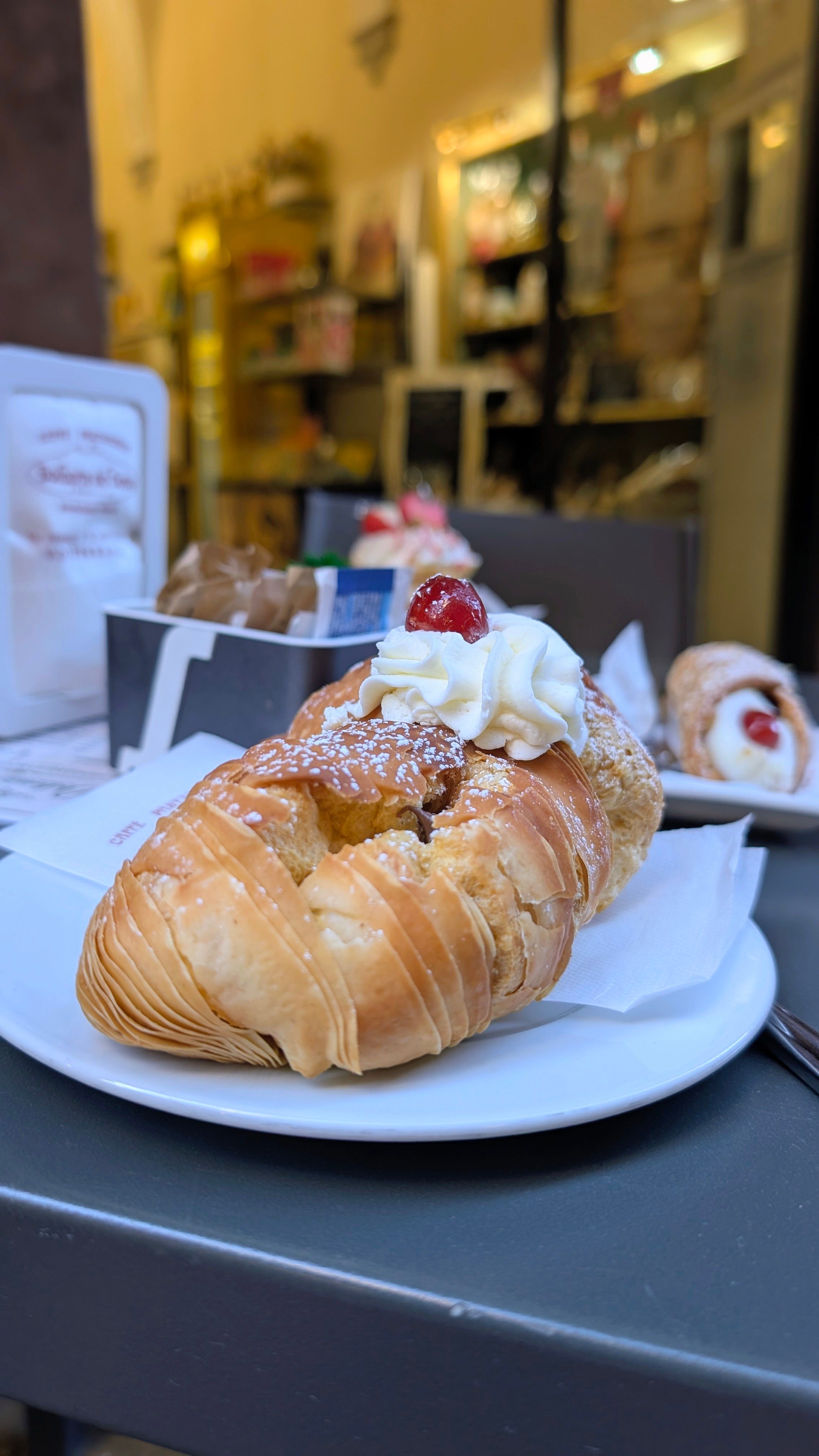
Italian
Sfogliatella
The diets react (see scores below)
Common Ingredients
- flour
- ricotta
- semolina
- candied orange peel
- sugar
- cinnamon
- egg
- butter
Specific recipes may vary.
Incompatible with 11 of 11 diets
Diet Ratings
Sfogliatella is a traditional Italian pastry built almost entirely on keto-incompatible ingredients. The shell is made from flour (refined wheat), and the filling combines semolina, sugar, and candied orange peel — all high-carb, high-sugar components. A single sfogliatella contains roughly 30-45g of net carbs, which can single-handedly exceed or max out an entire day's keto carb budget. There are no redeeming keto qualities: it is grain-based, sugar-laden, and ultra-processed as a pastry. The small amounts of ricotta, egg, butter, and cinnamon are keto-friendly in isolation, but they are entirely overwhelmed by the dominant high-carb ingredients. This food is fundamentally incompatible with ketosis.
Sfogliatella contains multiple animal-derived ingredients that disqualify it from a vegan diet. The filling includes ricotta (dairy cheese) and egg, while the pastry layers are enriched with butter (dairy fat). These are unambiguous animal products with no debate within the vegan community. The dish is fundamentally incompatible with vegan eating in its traditional form, though a vegan version could theoretically be made by substituting plant-based ricotta, a flax egg, and vegan butter.
Sfogliatella is a traditional Neapolitan pastry that contains multiple ingredients explicitly excluded from the paleo diet. Flour (wheat) and semolina (also wheat-derived) are grains — a core paleo exclusion. Ricotta is dairy. Refined sugar is a processed, non-paleo sweetener. Butter is dairy. While eggs and cinnamon are paleo-approved, and candied orange peel is derived from fruit, the candying process involves refined sugar. The dish is fundamentally a grain-based, dairy-containing, sugar-laden pastry with no pathway to paleo compliance. There is no version of this dish that could be considered paleo without being an entirely different recipe.
Sfogliatella is a traditional Neapolitan pastry that, while culturally iconic, conflicts significantly with Mediterranean diet principles. It is made primarily from refined white flour and semolina (refined grains), substantial added sugar (both in the dough and filling), butter as the primary fat (rather than olive oil), and candied orange peel (processed, high sugar). The combination of refined carbohydrates, added sugars, and saturated fat from butter places this firmly in the 'avoid' category. It is essentially a dessert pastry with no meaningful plant-forward, whole-food, or olive-oil-based qualities. Occasional, very limited consumption as a cultural treat might be tolerated, but it should not be a regular part of a Mediterranean diet pattern.
Some Mediterranean diet interpretations, particularly those rooted in traditional Southern Italian culinary culture, acknowledge that small portions of regional pastries consumed on celebratory or social occasions are part of the authentic Mediterranean lifestyle ('dolce vita' philosophy). The Oldways Preservation Trust, which helped codify the Mediterranean Diet Pyramid, emphasizes cultural and social dimensions of eating, suggesting that occasional traditional sweets are not entirely incompatible with the overall dietary pattern.
Sfogliatella is an Italian pastry that is fundamentally incompatible with the carnivore diet. The dish is predominantly plant-based and processed, consisting of flour and semolina (grains), sugar (processed sweetener), candied orange peel (fruit/plant), and cinnamon (plant spice). While it does contain small amounts of animal-derived ingredients — ricotta (dairy), egg, and butter — these are minor components in an otherwise grain- and sugar-heavy pastry. The primary structure and caloric base comes from forbidden plant foods. Even the most permissive 'animal-based' carnivore practitioners would reject this due to the grain flour, refined sugar, and processed nature of the dish. There is no version of the carnivore diet that accommodates grain-based pastries.
Sfogliatella contains multiple excluded ingredients: flour (grain), semolina (grain), sugar (added sugar), and butter (dairy — not ghee/clarified butter). Even setting aside the ingredient violations, sfogliatella is a classic Italian pastry that falls squarely into the 'no recreating baked goods/junk food' rule. This dish is excluded on every possible basis.
Sfogliatella contains multiple high-FODMAP ingredients that make it unsuitable during the elimination phase. The primary issue is wheat flour (both plain flour and semolina), which is high in fructans — a key FODMAP. Ricotta is low-FODMAP only at small portions (~2 tablespoons/40g per Monash), but in a filled pastry the quantity typically exceeds this threshold. Candied orange peel often contains high-fructose ingredients or polyols depending on preparation, and the overall sugar load can contribute excess fructose. The pastry shell made from wheat flour alone is enough to classify this as high-FODMAP, as a standard sfogliatella serving would contain a significant amount of wheat-based dough with no gluten-free substitution. Butter, egg, cinnamon, and plain sugar are low-FODMAP, but they cannot offset the core fructan load from wheat and semolina.
Sfogliatella is a traditional Italian pastry that conflicts with multiple core DASH diet principles. It is made with refined white flour and semolina (not whole grain), significant added sugar, butter (a source of saturated fat), and candied orange peel (high in added sugar). The combination of saturated fat from butter, refined carbohydrates, and substantial added sugars places this squarely in the 'avoid' category under DASH guidelines, which explicitly limit sweets, saturated fat, and refined grains. While ricotta provides some calcium and protein, the overall nutritional profile is dominated by DASH-unfriendly components. DASH guidelines recommend limiting sweets to 5 or fewer servings per week, and a single sfogliatella would likely count as a full discretionary sweet serving with limited nutritional benefit.
Sfogliatella is an Italian pastry that is essentially a high-glycemic, high-saturated-fat dessert with no redeeming Zone-friendly qualities. The shell is made from refined flour and butter (or lard in traditional versions), creating a high-glycemic, saturated-fat-laden carbohydrate base. The filling combines semolina, sugar, candied orange peel, ricotta, and eggs — while ricotta provides some protein and eggs are Zone-acceptable, the overall macro profile is dominated by refined carbohydrates and saturated fat, with virtually no lean protein contribution and no monounsaturated fat. The sugar and refined flour spike blood sugar rapidly, the candied orange peel adds more sugar, and the butter contributes saturated fat. This pastry has no meaningful protein block value (ricotta is present but in small quantities relative to the carb load), no low-glycemic carbohydrates, and the fat is predominantly saturated rather than monounsaturated. As a snack with no lean protein anchor, it would completely destabilize Zone ratios. Even in very small portions, there is no practical way to build a Zone-balanced snack around this food.
Sfogliatella is a traditional Neapolitan pastry with a profile that is largely at odds with anti-inflammatory principles. The laminated shell is made with refined white flour and significant amounts of butter, providing saturated fat and refined carbohydrates — both of which are flagged as pro-inflammatory. The filling combines ricotta, semolina (another refined grain), added sugar, and candied orange peel (which adds concentrated sugar). Butter appears twice in the overall preparation. While cinnamon is a genuine anti-inflammatory spice and ricotta offers some protein, these are minor contributors in a pastry dominated by refined flour, saturated fat, and added sugar. The overall glycemic load is high, and the saturated fat content from butter promotes inflammatory pathways. There are no omega-3 sources, meaningful antioxidants, or polyphenols present in significant quantities. This is an occasional treat at best and does not align with regular anti-inflammatory eating.
Sfogliatella is a traditional Neapolitan pastry that is fundamentally incompatible with GLP-1 dietary priorities. The laminated shell is made with a large quantity of butter and refined white flour, producing a high-fat, high-refined-carbohydrate base with essentially no fiber and negligible protein. The ricotta filling does contribute a small amount of protein, but the portion is modest and dominated by sugar, candied orange peel, and additional fat. The overall macronutrient profile is calorie-dense and nutrient-poor per calorie — the opposite of what GLP-1 patients need. The high fat content (butter in the pastry dough) is a specific concern, as dietary fat slows gastric emptying further on top of the GLP-1 mechanism, significantly worsening nausea, bloating, and reflux. The high sugar load adds empty calories with no satiety benefit given the already suppressed appetite. As a snack category item, it displaces a protein- and fiber-rich snack opportunity with empty calories. There is no meaningful redemptive nutritional feature for a GLP-1 patient.
*See how scores were generated at our methodology page.
Nutritional profile
Six traits that cut across every diet.
Fiber & Plants
How much whole-plant food and fiber it delivers.
Healthy Fats
The quality of its fats (unsaturated, omega-3).
Whole / Unprocessed
How close it is to its natural, unprocessed form.
Gut Gentle
How easy it is on digestion (low FODMAP, few irritants).
Low Glycemic
How little it spikes your blood sugar.
Protein Density
How much protein it packs per calorie.
Controversy Index
Higher controversy = more disagreement between diets.