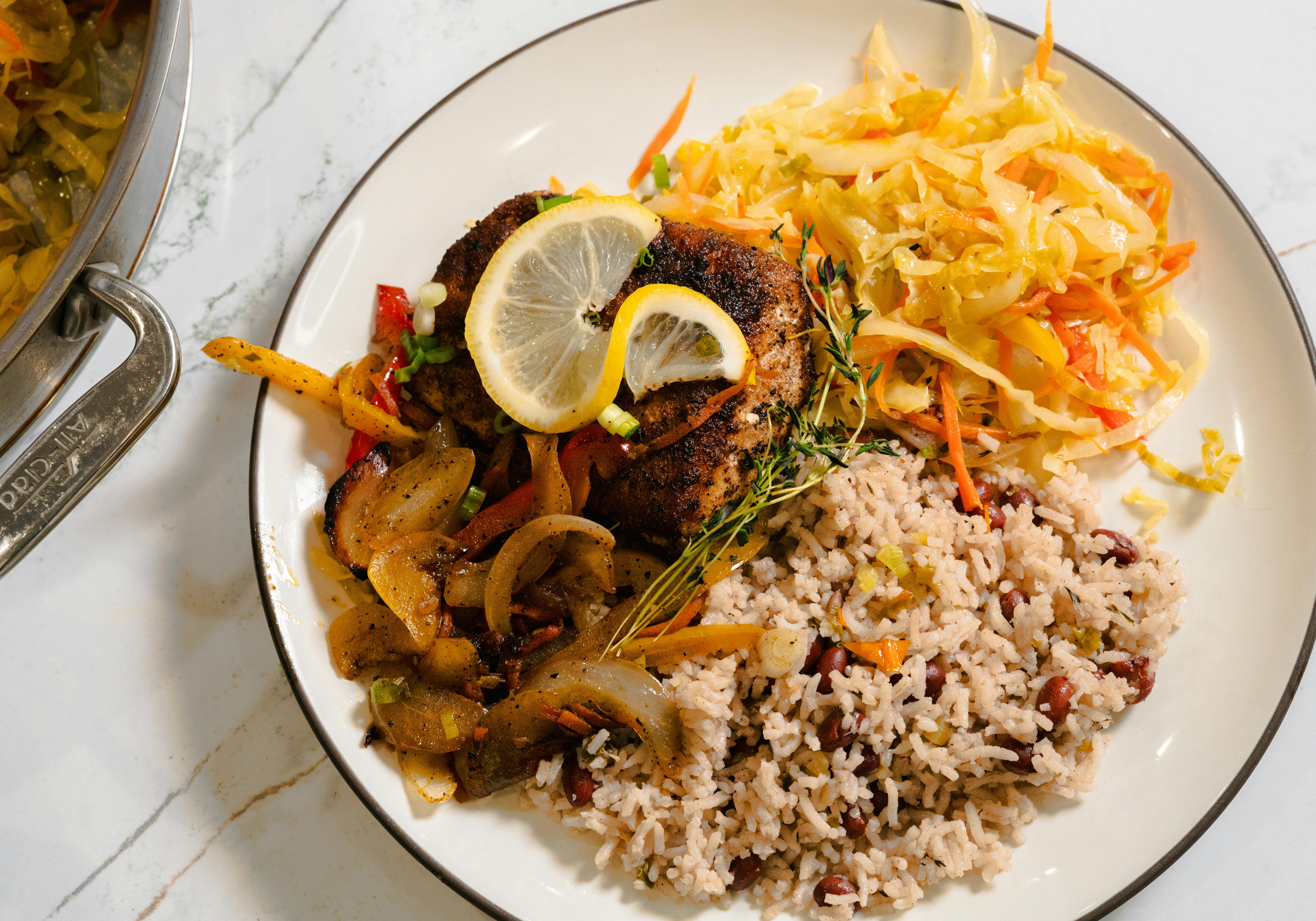
Photo: Jay Gleaton / Pexels
Jamaican
Escovitch Fish
The diets react (see scores below)
Common Ingredients
- snapper
- vinegar
- onion
- carrot
- scotch bonnet
- bell pepper
- allspice
- garlic
Specific recipes may vary.
Incompatible with 3 of 11 diets
Diet Ratings
Escovitch Fish is built around snapper, which is an excellent keto protein — low in carbs and high in quality. The marinade uses vinegar (essentially zero carbs), garlic, scotch bonnet, and allspice, all of which are fine in typical quantities. The concern lies in the vegetable garnish: carrots are a higher-carb vegetable (roughly 6g net carbs per medium carrot), and bell peppers add moderate carbs (~4g net per half cup). Onions also contribute some carbs. Together, if consumed in traditional escovitch portions (generous vegetable topping), these could push a serving toward 10-15g net carbs, which is manageable within a keto day but requires mindfulness. The dish is typically not breaded or fried in batter, which keeps it far more keto-compatible than many fish preparations. With portion control on the vegetable topping — particularly minimizing carrots — this dish can fit within daily keto limits. There is no added sugar in the traditional recipe, though some modern versions may add a touch of sugar to the pickle, which would warrant extra caution.
Strict keto practitioners may flag carrots outright as a avoid-list vegetable regardless of portion, and would recommend omitting them entirely or substituting with cucumber or zucchini to bring the dish firmly into the approve category.
Escovitch Fish is a traditional Jamaican dish built around snapper, a fish and therefore an animal product. Fish is unambiguously excluded from a vegan diet. While the remaining ingredients — vinegar, onion, carrot, scotch bonnet, bell pepper, allspice, and garlic — are all plant-based, the primary protein and defining ingredient of the dish is non-vegan. There is no meaningful debate within the vegan community about whether fish is acceptable.
Escovitch Fish is built on a foundation of whole, unprocessed paleo-friendly ingredients. Snapper is an excellent lean fish fully aligned with paleo principles. Onion, carrot, scotch bonnet, bell pepper, and garlic are all vegetables available to hunter-gatherers. Allspice is a natural spice with no paleo concerns. The main point of consideration is vinegar — most commonly distilled white or cider vinegar — which is a fermented, processed product. Apple cider vinegar is generally accepted in the paleo community (it appears in many paleo recipes), while distilled white vinegar is more debated due to its high processing level. Assuming apple cider or natural vinegar is used, this dish is largely paleo-compliant. Traditional preparation also typically involves frying in oil — the type of oil used (seed oil vs. coconut/avocado oil) would significantly affect the verdict, but since no frying oil is listed in the ingredients, we evaluate what is provided. Overall, this is a clean, whole-food dish with strong paleo credentials.
Strict Cordain-school paleo practitioners may flag vinegar — particularly distilled white vinegar — as a processed product not available to Paleolithic humans. Additionally, if the fish is pan-fried in a seed oil (canola, sunflower) as is common in traditional Jamaican preparation, that oil would push the dish toward 'caution' or 'avoid.'
Escovitch Fish is built around whole snapper, a lean fish rich in omega-3s, which aligns closely with the Mediterranean diet's recommendation for fish 2-3 times per week. The accompanying escabeche-style marinade of vinegar, onion, carrot, bell pepper, garlic, and allspice consists almost entirely of vegetables and whole spices — all strongly encouraged in the Mediterranean pattern. The dish is minimally processed, free of refined grains, added sugars, and unhealthy fats. The primary concern is the preparation method: traditional escovitch involves frying the snapper before marinating, which is less ideal than baking or grilling. If fried in a neutral oil or a small amount of olive oil, it remains acceptable, but frying does reduce alignment with core Mediterranean principles.
Some Mediterranean diet purists would lower the score due to the traditional deep-frying of the snapper, noting that Mediterranean fish preparations favor grilling, baking, or poaching. However, the escabeche technique (acid marinade over cooked fish) does have direct parallels in Spanish and Southern Italian Mediterranean cooking traditions, lending it cultural legitimacy within the broader diet framework.
Escovitch Fish is fundamentally incompatible with the carnivore diet. While the snapper itself is a perfectly acceptable carnivore protein, the dish is defined by its escovitch marinade and vegetable medley. Onion, carrot, scotch bonnet pepper, bell pepper, allspice, and garlic are all plant-derived and strictly excluded from the carnivore diet. Vinegar, while not plant-flesh, is a fermented plant product and excluded by most carnivore practitioners. The vegetables are not incidental garnish — they are structural components of the dish that cannot be removed without fundamentally changing it. This dish scores a 2 rather than 1 only because the snapper base is carnivore-compliant, but as prepared, it is an avoid.
Escovitch Fish as described contains only Whole30-compliant ingredients. Snapper is a whole fish (protein), vinegar is explicitly allowed (non-malt varieties such as white or cane vinegar commonly used in Jamaican escovitch are compliant), and all vegetables and seasonings — onion, carrot, scotch bonnet, bell pepper, allspice, and garlic — are natural, whole-food ingredients that are fully permitted. There are no excluded ingredients such as sugar, grains, legumes, dairy, or disallowed additives in this dish as listed.
Escovitch Fish contains multiple high-FODMAP ingredients that make it unsuitable during the elimination phase. Onion is one of the highest-FODMAP foods tested by Monash University, containing significant fructans even in small amounts. Garlic is similarly high in fructans and must be avoided entirely during elimination. Together, these two ingredients alone disqualify the dish. The snapper itself is low-FODMAP (plain fish contains no FODMAPs), and vinegar, carrot (in small servings), bell pepper, scotch bonnet, and allspice are generally low-FODMAP. However, the foundational aromatics — onion and garlic — are central to Escovitch Fish and cannot be omitted without fundamentally altering the dish. The pickled preparation may slightly reduce FODMAP content in the vegetables due to the acidic environment, but this effect is minimal and not sufficient to make the dish safe during elimination.
Escovitch Fish aligns well with DASH diet principles. Snapper is a lean white fish rich in protein and low in saturated fat — exactly the type of protein DASH emphasizes. The pickling base of vinegar with onion, carrot, bell pepper, garlic, and allspice contributes vegetables, fiber, potassium, and antioxidants with virtually no sodium from the ingredients themselves. The dish is naturally low in saturated fat and provides the lean protein and vegetable density DASH promotes. The main consideration is preparation: traditional recipes sometimes involve shallow or deep frying the fish before marinating, which adds oil and potentially less heart-favorable fats. If baked or lightly pan-seared in a small amount of vegetable oil, the dish scores very well. Salt added during preparation is the other variable — DASH compliance depends on keeping added salt minimal. Scotch bonnet provides capsaicin with no sodium impact. Overall, the ingredient profile is strongly DASH-compatible, but frying method introduces some caution.
NIH DASH guidelines straightforwardly endorse lean fish and vegetables, which form the backbone of this dish. However, some DASH-oriented clinicians note that traditional deep-fried preparation introduces excess total fat and oxidized oils, and would recommend approving only the baked or grilled version rather than the fried preparation commonly served in Jamaican cuisine.
Escovitch Fish is an excellent Zone Diet-compatible dish. The primary protein is snapper, a lean white fish that is ideal for Zone meals — low in saturated fat, rich in omega-3s, and easily portioned to ~25g protein per serving. The escovitch marinade and vegetable medley (onion, carrot, bell pepper, garlic, scotch bonnet) are all low-glycemic, polyphenol-rich vegetables that count toward the Zone's recommended 8 vegetable servings per day. Vinegar and allspice are negligible in macronutrient terms and actually support Zone principles — vinegar can help blunt glycemic response, and polyphenol-rich spices align with Sears' anti-inflammatory focus. The dish is naturally low in fat, so a small addition of olive oil or avocado would complete the Zone block structure by providing monounsaturated fat. Traditional preparation often involves frying the snapper, which adds fat — if pan-fried in olive oil this remains Zone-friendly, but deep-frying in seed oils would reduce the score. Assuming minimal oil or olive oil preparation, this dish maps cleanly onto a Zone protein block (fish) plus favorable carbohydrate blocks (colorful low-GI vegetables), needing only a fat source to complete the 40/30/30 ratio.
Escovitch Fish is a strong anti-inflammatory dish overall. Snapper is a lean white fish providing quality protein and some omega-3 fatty acids (though lower than fatty fish like salmon, it still contributes beneficially). The vegetable-forward marinade — onion, carrot, bell pepper, and scotch bonnet — delivers antioxidants, carotenoids, and vitamin C, all associated with reduced inflammatory markers. Garlic is well-established as anti-inflammatory due to allicin and organosulfur compounds. Scotch bonnet peppers are rich in capsaicin, which research links to reduced inflammation and NF-κB pathway inhibition. Allspice contains eugenol, a polyphenol with documented anti-inflammatory properties. Vinegar as the pickling medium is benign from an inflammatory standpoint and adds no problematic ingredients. The dish contains no refined sugars, trans fats, processed additives, or inflammatory seed oils in its traditional preparation. The one mild caveat is that snapper, as a white fish, provides less omega-3 than fatty fish — but it is not pro-inflammatory, and the cumulative profile of the dish is decidedly anti-inflammatory.
Escovitch fish is traditionally made with fried snapper — the fish is deep-fried before being marinated in the vinegar-based escovitch sauce with onions, carrots, scotch bonnet, bell pepper, allspice, and garlic. The snapper itself is an excellent lean protein source, and the vegetable-rich vinegar marinade adds fiber, micronutrients, and very little fat. However, the traditional frying step is a significant concern for GLP-1 patients: high fat content from frying worsens nausea, bloating, and reflux, and fried foods are explicitly in the avoid category. The scotch bonnet pepper is one of the hottest peppers used in cooking and is very likely to worsen GLP-1-associated reflux and GI irritation. These two factors prevent an approve rating despite the dish's otherwise strong nutritional profile. If the fish is baked or grilled rather than fried, and the scotch bonnet is omitted or used in a very small amount, this dish could score 7-8 — it would deliver high lean protein, anti-inflammatory omega-3s, fiber from vegetables, and a low-calorie acidic marinade that aids palatability in small portions.
Some GLP-1-focused dietitians note that scotch bonnet tolerance is highly individual — patients with no prior reflux history and stable GI side effects may tolerate small amounts well, and the vinegar-based pickling liquid may actually support gastric comfort for some. The frying concern is more consistently agreed upon, though a minority of clinicians focus primarily on total fat content per serving rather than cooking method, and a lightly fried small portion of snapper may fall within acceptable fat ranges.
*See how scores were generated at our methodology page.
Nutritional profile
Six traits that cut across every diet.
Fiber & Plants
How much whole-plant food and fiber it delivers.
Healthy Fats
The quality of its fats (unsaturated, omega-3).
Whole / Unprocessed
How close it is to its natural, unprocessed form.
Gut Gentle
How easy it is on digestion (low FODMAP, few irritants).
Low Glycemic
How little it spikes your blood sugar.
Protein Density
How much protein it packs per calorie.
Controversy Index
Higher controversy = more disagreement between diets.
Diet-Specific Tips
 Keto — 5/10
View tips
- Snapper is zero-carb, high-quality protein — strongly keto-friendly
- Carrots are the primary carb concern (~6g net carbs each) and should be minimized
- Bell peppers and onions add moderate carbs that accumulate with generous servings
- Vinegar-based marinade is essentially carb-free and keto-safe
- No grains, breading, or added sugars in the traditional preparation
- Dish is portion-manageable — reduce vegetable topping to stay well within carb limits
 Paleo — 8/10
View tips
- Snapper is a fully paleo-approved whole fish
- All vegetables (onion, carrot, bell pepper, scotch bonnet, garlic) are paleo-compliant
- Allspice is a natural, unprocessed spice — paleo approved
- Vinegar is the primary gray-area ingredient; apple cider vinegar is widely accepted in paleo, distilled white vinegar is more debated
- Frying oil not listed but traditionally a seed oil is used — a potential hidden non-paleo element
- No grains, legumes, dairy, or refined sugars present
 Mediterranean — 8/10
View tips
- Snapper is an excellent lean fish source, core to the Mediterranean diet
- Vegetable-heavy accompaniment (onion, carrot, bell pepper, garlic) strongly approved
- Vinegar-based marinade is low-calorie and free of added sugars
- Traditional preparation involves frying, which is less ideal than grilling or baking
- No refined grains, processed ingredients, or added sugars
- Allspice and scotch bonnet are whole spices with no dietary concerns
- Strong parallels to Spanish and Italian escabeche traditions within Mediterranean cuisine
 Whole30 — 5/10
View tips
- Snapper is a compliant whole-food protein
- Vinegar is explicitly allowed on Whole30 (non-malt varieties)
- All vegetables (onion, carrot, scotch bonnet, bell pepper, garlic) are fully compliant
- Allspice is a natural spice with no exclusions
- No sugar, grains, legumes, or dairy present
- Traditional escovitch may sometimes include sugar in the pickling liquid — label or recipe verification recommended if using a pre-made marinade
 DASH — 8/10
View tips
- Snapper is a lean, low-saturated-fat protein strongly endorsed by DASH
- Vinegar-based marinade adds negligible sodium
- Vegetables (onion, carrot, bell pepper, garlic) provide potassium, fiber, and magnesium
- Traditional frying preparation adds oil — baked or pan-seared versions are more DASH-compliant
- No added sugars, processed ingredients, or tropical oils in the core recipe
- Salt control during preparation is key to meeting DASH sodium targets
- Scotch bonnet pepper is DASH-neutral — adds flavor without sodium
 Zone — 8/10
View tips
- Snapper is a lean, omega-3-rich fish — ideal Zone protein source
- Bell pepper, onion, carrot, and garlic are all favorable low-glycemic Zone carbohydrates
- Vinegar may help moderate glycemic response and is a negligible macronutrient
- Scotch bonnet and allspice contribute polyphenols consistent with Sears' anti-inflammatory focus
- No high-glycemic carbohydrates or added sugars in the ingredient list
- Fat source depends on cooking method — olive oil preparation is Zone-ideal; deep-frying in seed oils would reduce Zone compatibility
- Dish needs a complementary fat source (avocado, olive oil drizzle) to complete the 40/30/30 block ratio
 Anti-Inflammatory — 8/10
View tips
- Snapper provides lean protein with moderate omega-3 content — lower than fatty fish but not pro-inflammatory
- Scotch bonnet peppers rich in capsaicin, a well-researched anti-inflammatory compound
- Garlic contains allicin and organosulfur compounds that reduce CRP and inflammatory cytokines
- Bell pepper and carrot contribute carotenoids, vitamin C, and antioxidants
- Allspice provides eugenol, a polyphenol with anti-inflammatory properties
- Onion supplies quercetin, a flavonoid with anti-inflammatory activity
- Vinegar-based pickling medium adds no inflammatory ingredients
- No refined sugars, trans fats, seed oils, or processed additives in traditional preparation
 GLP-1 Friendly — 5/10
View tips
- Traditional preparation involves deep frying, which significantly increases fat content and is poorly tolerated on GLP-1 medications
- Snapper is a lean, high-quality protein and an excellent base ingredient for GLP-1 patients
- Scotch bonnet is an extremely hot pepper that is likely to worsen GLP-1-associated reflux, nausea, and GI irritation
- Vinegar-based marinade is low-calorie and low-fat — a positive element
- Vegetable escovitch sauce (onion, carrot, bell pepper) adds fiber, micronutrients, and hydration support
- Dish is highly preparation-dependent — baked or grilled version would score significantly higher
- Allspice and garlic are well-tolerated and pose no GLP-1 concerns
- Small portion of the marinated vegetables alone could be a beneficial side component