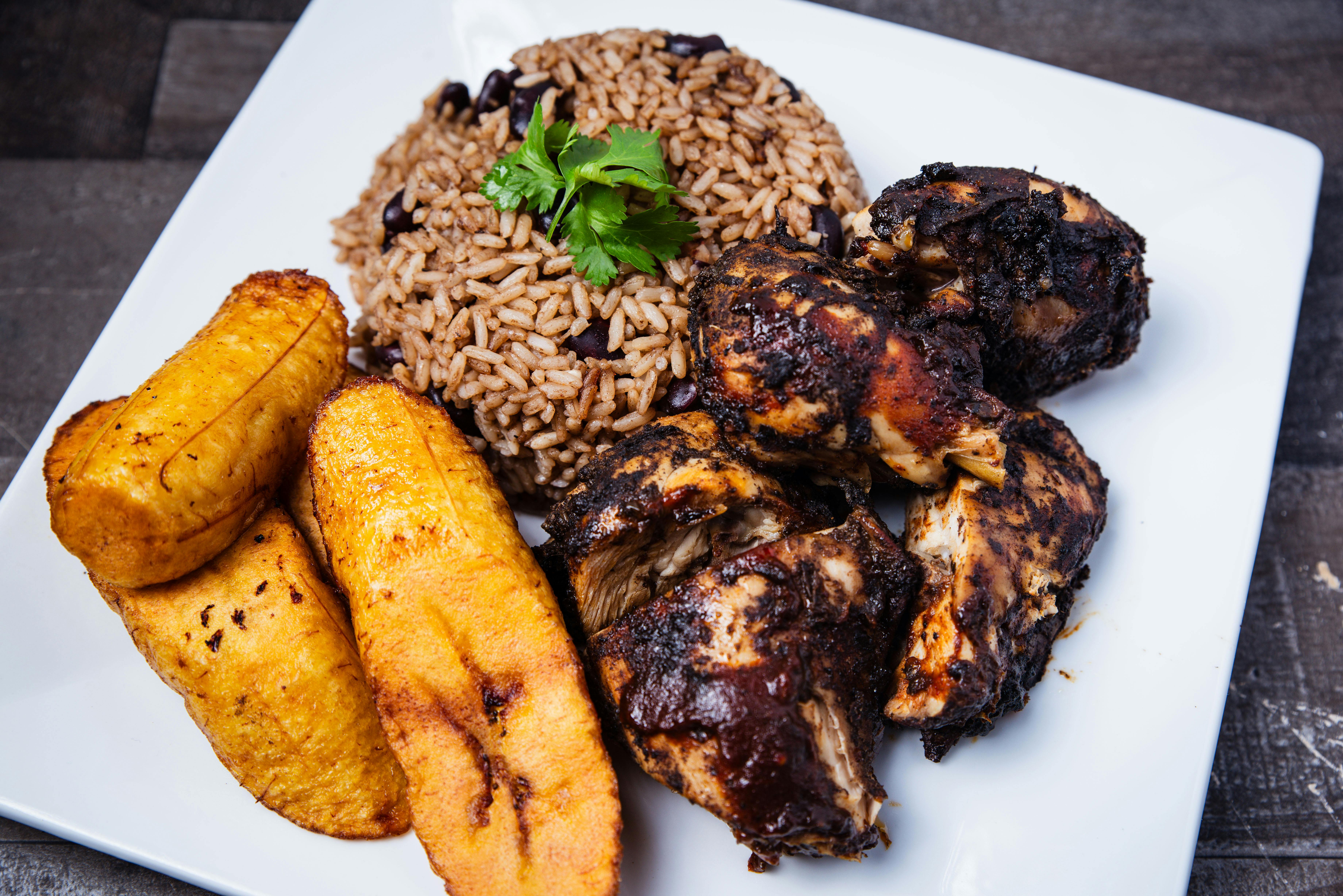
Jamaican
Jerk Chicken
The diets react (see scores below)
Common Ingredients
- chicken
- scotch bonnet peppers
- allspice
- thyme
- scallions
- garlic
- ginger
- soy sauce
- brown sugar
Specific recipes may vary.
Incompatible with 5 of 11 diets
Diet Ratings
Jerk chicken is fundamentally a high-protein, flavorful dish built around chicken, which is keto-compatible. However, the traditional marinade includes brown sugar, which is a direct source of added sugar and carbs. The amount used in a standard jerk marinade (typically 1-2 tablespoons for a whole batch) distributes across servings, so carb impact per portion may be moderate (roughly 3-6g net carbs per serving from the marinade). Soy sauce adds minimal carbs. The spices and aromatics (scotch bonnet, allspice, thyme, scallions, garlic, ginger) are generally fine in small amounts. The dish lands in caution territory: the brown sugar is a keto concern, but the per-serving impact may be manageable within a daily 20-50g net carb budget. Strict keto followers should request sugar-free jerk seasoning or substitute the brown sugar with erythritol/monk fruit.
Strict keto practitioners argue that any added sugar — even in small marinade quantities — is incompatible with keto principles, as it introduces a glycemic trigger and sets a precedent for sugar tolerance. They would classify this as avoid and recommend only sugar-free jerk preparations.
Jerk Chicken contains chicken as its primary protein, which is poultry — a direct animal product explicitly excluded under all vegan dietary frameworks. There is no ambiguity here: no vegan organization or school of thought considers poultry acceptable. The remaining ingredients (scotch bonnet peppers, allspice, thyme, scallions, garlic, ginger, soy sauce, brown sugar) are all plant-based, but the inclusion of chicken makes this dish entirely incompatible with a vegan diet.
Jerk Chicken as traditionally prepared contains two clear paleo violations: soy sauce (a soy-based, heavily processed condiment derived from a legume) and brown sugar (refined sugar). These are not minor or debated ingredients — both are unambiguously excluded under all mainstream paleo frameworks. The base of the dish — chicken, scotch bonnet peppers, allspice, thyme, scallions, garlic, and ginger — is entirely paleo-compliant and excellent. However, soy sauce and brown sugar are foundational to authentic jerk seasoning, not optional garnishes, making the dish as described non-compliant. A paleo adaptation is straightforward: substitute coconut aminos for soy sauce and omit or replace brown sugar with a small amount of raw honey or medjool dates.
Jerk chicken is built around poultry, which the Mediterranean diet places in the moderate/acceptable category (a few servings per week). The spice blend—scotch bonnet peppers, allspice, thyme, scallions, garlic, and ginger—is rich in aromatic, plant-based ingredients that align well with Mediterranean flavor principles emphasizing herbs and vegetables. However, two ingredients raise concerns: soy sauce is a processed condiment high in sodium that has no place in traditional Mediterranean eating, and brown sugar adds refined sweetener, also discouraged. These ingredients pull the dish away from Mediterranean ideals even if the protein base is acceptable. Overall, jerk chicken can fit occasionally if portions are moderate and the marinade's sugar and soy sauce content is minimal, but it is not a Mediterranean staple.
Some modern Mediterranean diet practitioners argue that the abundant use of anti-inflammatory spices and aromatics (garlic, ginger, thyme, peppers) partially compensates for the non-traditional marinade components, and that lean poultry prepared with herb-forward seasoning broadly fits the spirit of the diet even when the specific spices differ from regional norms. Traditional Mediterranean cuisine from North African countries similarly uses bold spice blends on poultry, lending some credence to a more permissive interpretation.
Jerk Chicken is heavily incompatible with the carnivore diet. While chicken itself is an animal product, this dish is laden with numerous plant-based ingredients and processed additives. Scotch bonnet peppers, allspice, thyme, scallions, garlic, and ginger are all plant-derived and excluded on carnivore. Soy sauce is a processed, plant-based (soybean) condiment and is entirely off-limits. Brown sugar is a refined carbohydrate with zero place in carnivore eating. The chicken alone would be acceptable, but the marinade and seasoning profile of jerk chicken makes this dish fundamentally incompatible with carnivore principles. Only the plain chicken component salvages any points at all.
Jerk Chicken as listed contains two clearly excluded ingredients: soy sauce (a soy-based product, which is a legume and explicitly banned on Whole30) and brown sugar (an added sugar, also explicitly excluded). While the core ingredients — chicken, scotch bonnet peppers, allspice, thyme, scallions, garlic, and ginger — are all Whole30-compliant, the presence of even one excluded ingredient disqualifies the dish as written. A Whole30-compliant version is achievable by substituting coconut aminos for soy sauce and omitting the brown sugar (or using a compliant fruit juice for a touch of sweetness).
Jerk chicken as traditionally prepared contains multiple high-FODMAP ingredients that make it unsuitable during the elimination phase. Garlic is one of the highest-FODMAP foods tested by Monash University, containing significant fructans even in small amounts. Scallions (green onions) — when the white bulb portion is used — are also high in fructans, though the green tops are low-FODMAP. Traditional jerk seasoning almost always includes both garlic and the bulb of scallions as foundational flavor components. Soy sauce, while used in small quantities, contains wheat (fructans) in regular formulations — tamari or gluten-free soy sauce would be required as a substitute. The remaining ingredients (chicken, scotch bonnet peppers, allspice, thyme, ginger, brown sugar) are individually low-FODMAP and pose no concern. However, the combination of garlic and likely full scallions makes this dish high-FODMAP in its standard form. A modified version using garlic-infused oil instead of garlic cloves, only the green tops of scallions, and tamari/gluten-free soy sauce could be made low-FODMAP.
Jerk chicken is built around lean poultry (chicken), which is a core DASH-approved protein. The spice blend—scotch bonnet peppers, allspice, thyme, scallions, garlic, and ginger—is rich in flavor without adding significant sodium, saturated fat, or sugar, and these aromatics align well with DASH principles. However, soy sauce is a significant concern: a standard jerk marinade can contribute 600–1,000mg or more of sodium per serving from soy sauce alone, pushing the dish toward or beyond DASH sodium thresholds. Brown sugar adds modest amounts of refined sugar, which DASH advises limiting. The combination of these two ingredients prevents a full approval. If low-sodium soy sauce were substituted and sugar minimized, this dish could easily score 7–8 and warrant approval. As commonly prepared, it sits in the caution range—acceptable in moderation for DASH followers but requiring portion awareness and ideally a sodium-reduced preparation.
NIH DASH guidelines flag high-sodium condiments like soy sauce as problematic and would place a standard jerk marinade in the caution-to-avoid zone for sodium. However, some DASH-oriented clinicians note that the overall nutrient profile of jerk chicken—lean protein, anti-inflammatory spices, no saturated fat—is strongly aligned with DASH goals, and that a simple swap to low-sodium tamari or coconut aminos resolves the sodium issue entirely, making this dish functionally compliant.
Jerk chicken is fundamentally a lean protein dish — chicken is one of the most Zone-favorable proteins available. The marinade ingredients (scotch bonnet peppers, allspice, thyme, scallions, garlic, ginger) are all Zone-friendly aromatics and spices with negligible macro impact. Soy sauce adds minimal carbs. The main Zone concern is the brown sugar in the marinade: while the actual sugar absorbed per serving is small (marinade quantities spread across multiple portions), it is a high-glycemic carbohydrate that Sears would classify as 'unfavorable.' In practice, the sugar contribution per serving is modest enough that this dish can easily anchor a Zone meal — pair with a large low-glycemic vegetable side and a small portion of monounsaturated fat (e.g., a few olives or sliced avocado) to complete the block structure. The dish has no added fat in the base recipe, which means the fat block must come from accompaniments. Skin-on vs. skinless chicken also matters: skinless keeps it fully Zone-favorable for protein lean-ness. The anti-inflammatory spice profile (ginger, garlic, thyme) aligns well with Sears' later polyphenol-forward recommendations.
Strict Zone practitioners following early Sears texts might flag the brown sugar as an 'unfavorable' carbohydrate and caution that traditional jerk preparations with skin-on chicken introduce more saturated fat than ideal. However, Sears' later writings (The OmegaRx Zone, The Zone Diet) place greater emphasis on overall anti-inflammatory food patterns, under which the polyphenol-rich spice blend and lean chicken protein would be viewed very favorably — potentially pushing this dish toward a score of 8.
Jerk chicken presents a genuinely mixed anti-inflammatory profile. On the positive side, the dish is built around lean poultry (a 'moderate' protein in anti-inflammatory frameworks), and the spice blend is exceptionally rich in anti-inflammatory compounds. Allspice contains eugenol, a potent anti-inflammatory compound comparable to clove. Scotch bonnet peppers are extremely high in capsaicin, which has well-documented anti-inflammatory effects and suppresses NF-κB signaling. Thyme, garlic, and ginger are all emphasized anti-inflammatory herbs and spices — ginger contains gingerols and shogaols that inhibit inflammatory cytokines, and garlic's allicin compounds reduce CRP. Scallions provide quercetin and other flavonoids. The counterweights are notable: soy sauce adds significant sodium (chronic high sodium intake can drive inflammation) and is a processed condiment, though small quantities are unlikely to be problematic. Brown sugar introduces added sugar, which is a pro-inflammatory concern — though the quantity in a marinade is typically modest per serving. The cooking method matters significantly: traditional jerk involves grilling or smoking over wood, which can introduce advanced glycation end products (AGEs) and polycyclic aromatic hydrocarbons (PAHs) at the char, both of which promote inflammation. Overall, the herb-and-spice foundation is impressive from an anti-inflammatory standpoint, and the lean protein is appropriate, but the added sugar, processed soy sauce, and likely cooking method (high-heat grilling/charring) collectively prevent a full approval.
Some anti-inflammatory practitioners would score this higher, arguing that the capsaicin and polyphenol load from the spice blend meaningfully outweighs the small amounts of sugar and sodium in a marinade — Dr. Weil's framework emphasizes chili peppers, garlic, ginger, and thyme as anti-inflammatory staples, and a dish rich in all four deserves credit. Conversely, those following stricter anti-inflammatory or autoimmune-adjacent protocols (e.g., AIP) would flag nightshade peppers, soy sauce (processed, contains wheat in many versions), and charred/smoked meat as concerns, potentially rating this lower.
Jerk chicken offers a solid protein foundation from lean chicken, which is a GLP-1-friendly base. However, the inclusion of scotch bonnet peppers — one of the hottest peppers commonly used in cooking — is a meaningful concern. GLP-1 medications slow gastric emptying, meaning very spicy food lingers in the stomach longer and has more prolonged contact with the GI tract, increasing the risk of nausea, reflux, heartburn, and stomach irritation. The small amount of brown sugar in the marinade is a minor concern given that most caramelizes or burns off during cooking, but it adds minimal nutritional value. Soy sauce contributes high sodium, which matters for patients managing blood pressure alongside GLP-1 therapy. The remaining spices (allspice, thyme, scallions, garlic, ginger) are GLP-1-neutral to mildly beneficial — ginger in particular has some evidence for reducing nausea. If prepared with skinless chicken breast or thighs (skin removed), fat content is manageable. The dish scores well on protein density but the scotch bonnet heat level is the primary disqualifier from a full approve.
Some GLP-1-focused dietitians would approve jerk chicken outright if the patient has an established spice tolerance and no active GI side effects, arguing that the lean protein benefit outweighs the spice risk for tolerant individuals. Others maintain that any very spicy preparation should default to caution for all GLP-1 patients given slowed gastric emptying, regardless of prior spice tolerance, because medication-altered GI motility changes how even experienced spice eaters respond.
*See how scores were generated at our methodology page.
Nutritional profile
Six traits that cut across every diet.
Fiber & Plants
How much whole-plant food and fiber it delivers.
Healthy Fats
The quality of its fats (unsaturated, omega-3).
Whole / Unprocessed
How close it is to its natural, unprocessed form.
Gut Gentle
How easy it is on digestion (low FODMAP, few irritants).
Low Glycemic
How little it spikes your blood sugar.
Protein Density
How much protein it packs per calorie.
Controversy Index
Higher controversy = more disagreement between diets.
Diet-Specific Tips
 Keto — 5/10
View tips
- Brown sugar in marinade adds net carbs and is a direct added sugar — a keto red flag
- Per-serving carb load from marinade is moderate, likely 3-6g net carbs, manageable for lazy keto
- Chicken is an excellent lean protein source, fully keto-compatible
- Soy sauce contributes minimal carbs per serving
- Aromatics (scotch bonnet, garlic, ginger, scallions) add small carb amounts but are acceptable in typical serving sizes
- Easy to modify: substitute brown sugar with keto-friendly sweetener for a fully approved dish
 Mediterranean — 5/10
View tips
- Chicken is an acceptable moderate-frequency protein in the Mediterranean diet
- Rich use of herbs, aromatics, and peppers aligns with plant-forward flavoring principles
- Soy sauce is a processed, high-sodium ingredient not consistent with Mediterranean traditions
- Brown sugar adds refined sweetener, contradicting Mediterranean dietary principles
- Non-Mediterranean cuisine origin means ingredients and preparation diverge from core guidelines
- Could be improved by substituting soy sauce with a small amount of olive oil-based marinade and reducing sugar
 DASH — 5/10
View tips
- Lean chicken is a DASH-approved protein source
- Soy sauce is a high-sodium ingredient that can contribute 600–1,000mg+ sodium per serving
- Brown sugar adds refined sugar, which DASH advises limiting
- Spices (allspice, thyme, scotch bonnet, garlic, ginger, scallions) are DASH-friendly and sodium-free
- No saturated fat or tropical oils in the ingredient list
- Low-sodium soy sauce substitution would significantly improve DASH compatibility
- Portion size of marinade vs. final absorbed sodium matters for real-world impact
 Zone — 7/10
View tips
- Chicken is a premier Zone lean protein source — ideal for meeting the 30% protein target
- Brown sugar in marinade is a high-glycemic 'unfavorable' carb per Sears, though per-serving absorption is low
- No fat source included in the dish — requires Zone-compatible fat accompaniment (avocado, olive oil) to complete the block ratio
- Spice profile (ginger, garlic, scotch bonnet, thyme) is rich in polyphenols, aligning with Sears' anti-inflammatory emphasis
- Skinless preparation keeps saturated fat low and protein lean
- Pairs naturally with favorable Zone carbs: grilled vegetables, salad greens, or a small portion of black beans
 Anti-Inflammatory — 6/10
View tips
- Lean poultry protein — appropriate for anti-inflammatory eating
- Scotch bonnet peppers: very high capsaicin, potent anti-inflammatory and NF-κB inhibitor
- Allspice (eugenol): anti-inflammatory comparable to clove
- Ginger and garlic: strong anti-inflammatory herbs with clinical research support
- Thyme: anti-inflammatory polyphenols including rosmarinic acid
- Brown sugar: added sugar is pro-inflammatory, though marinade quantities are typically small per serving
- Soy sauce: processed, high sodium, modestly pro-inflammatory in excess
- High-heat grilling/smoking: potential for AGEs and PAHs from char, which promote inflammation
 GLP-1 Friendly — 5/10
View tips
- High protein from chicken — strong GLP-1 positive
- Scotch bonnet peppers are very high heat (100,000–350,000 Scoville) — significant reflux and nausea risk with slowed gastric emptying
- Skin-on vs. skin-off preparation critically affects fat content
- Brown sugar minimal concern if used in small marinade quantities
- High sodium from soy sauce — relevant for cardiovascular comorbidities common in GLP-1 patients
- Ginger mildly beneficial for nausea
- No fiber-contributing ingredients — would need fiber-rich sides to meet daily targets
- Spice tolerance may be reduced on GLP-1 medications even in patients with prior high-spice tolerance