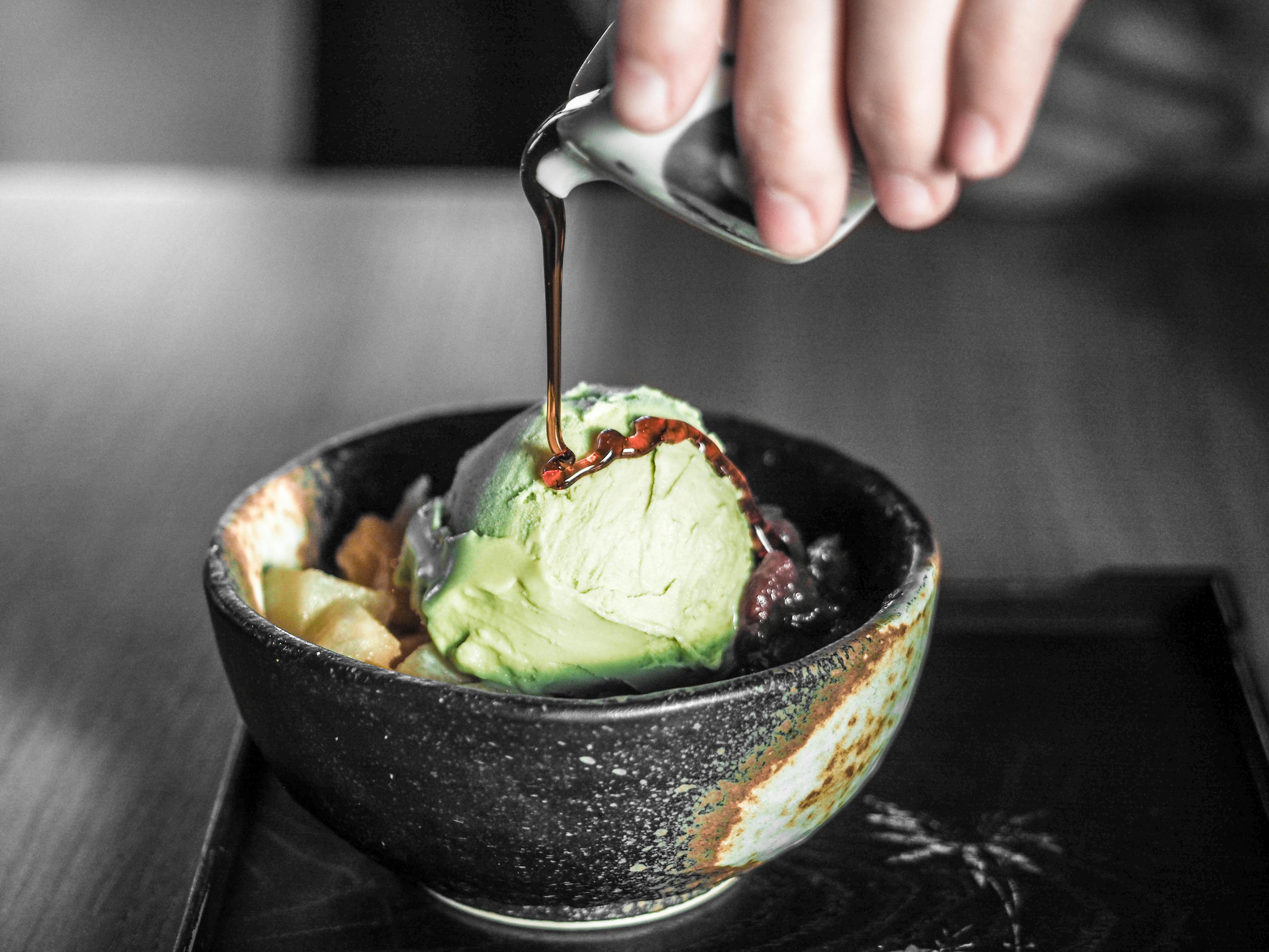
The diets react (see scores below)
Common Ingredients
- agar jelly
- red bean paste
- fruit
- mochi
- black sugar syrup
- peas
- water
Specific recipes may vary.
Incompatible with 6 of 11 diets
Diet Ratings
Anmitsu is fundamentally incompatible with a ketogenic diet. Nearly every ingredient is a major source of net carbs or sugar. Red bean paste (anko) is extremely high in carbohydrates and sugar. Mochi is made from glutinous rice, a grain with very high starch content. Black sugar syrup is pure sugar. Fruit adds additional natural sugars and carbs. Even the green peas contribute meaningful carbohydrates. The only keto-neutral ingredient is agar jelly and water. A single serving of Anmitsu could easily contain 60-100g of net carbs, far exceeding the entire daily keto allowance. There is no meaningful way to modify this dish to make it keto-compatible while retaining its identity.
Anmitsu as listed here is fully plant-based. Agar jelly is derived from seaweed (a vegan-friendly alternative to gelatin), red bean paste (anko) is typically made from azuki beans and sugar, mochi is made from glutinous rice, black sugar syrup is plant-derived, peas and fruit are whole plant foods, and water is neutral. All listed ingredients are free of animal products. However, traditional anmitsu is commonly served with or contains shiratama dango that may include dairy, or is topped with ice cream (cream anmitsu / kurimu anmitsu), and honey is sometimes used as a sweetener in some preparations. The version as listed avoids these pitfalls and scores well as a whole-food-leaning plant-based dessert.
Some ethical vegans flag that mochi and red bean paste from certain Japanese producers may use equipment shared with dairy or egg products, or that refined white sugar processed with bone char is an animal-derived input — though whole-food plant-based advocates do not universally apply the bone-char concern, and it does not constitute an ingredient.
Anmitsu contains multiple non-paleo ingredients that make it clearly incompatible with the paleolithic diet. Red bean paste is a legume product — legumes are explicitly excluded from paleo. Mochi is made from glutinous rice, a grain, which is entirely excluded. Black sugar syrup is refined/processed sugar, also excluded. Peas are legumes and excluded. Agar jelly, while derived from seaweed, is a heavily processed product that contradicts paleo principles. The only paleo-friendly component is the fruit. With four to five core ingredients directly violating paleo rules, this dish is firmly in the 'avoid' category with high confidence.
Anmitsu contains several Mediterranean-compatible elements (agar jelly from seaweed, legumes in the form of red bean paste and peas, fresh fruit) alongside problematic components. Black sugar syrup represents added sugar, which Mediterranean guidelines minimize, and mochi is a refined grain product. The fruit and legume content provide redeeming nutritional value, but the added sugar syrup and refined mochi drag the score into caution territory. This is not a staple Mediterranean food, but occasional consumption is not severely at odds with the diet's principles given its plant-based nature and lack of saturated fat or processed meat.
Some Mediterranean diet interpreters might rate this more favorably, noting it is entirely plant-based with no saturated fat, and that legumes and fruit are core foods — the sugar content is modest compared to Western desserts. Conversely, stricter modern clinical guidelines (e.g., PREDIMED-aligned) would flag the added black sugar syrup and refined mochi as reasons to avoid entirely, even as an occasional treat.
Anmitsu is entirely plant-based and incompatible with the carnivore diet. Every single ingredient — agar jelly (seaweed-derived gelatin substitute), red bean paste (legume), fruit, mochi (rice cake), black sugar syrup (sugar), peas (legume), and water — is either plant-derived or a processed sugar product. There is no animal product whatsoever in this dish. This is a complete violation of every tier of the carnivore diet, including the most lenient versions.
Anmitsu contains multiple Whole30-excluded ingredients. Red bean paste is made from azuki beans, which are legumes and explicitly excluded from Whole30. Mochi is made from glutinous rice (a grain), also excluded. Black sugar syrup is added sugar, which is excluded. These are not edge cases — they are clear violations of core Whole30 rules. Even if the agar jelly, fruit, peas (likely green peas, which unlike green beans/snap peas are not excepted), and water are fine on their own, the dish as a whole is thoroughly non-compliant.
Anmitsu contains multiple high-FODMAP ingredients that make it unsuitable during the elimination phase. Red bean paste (anko) is made from adzuki beans, which are high in GOS (galacto-oligosaccharides) and fructans — a significant FODMAP trigger even in small servings. Mochi is made from glutinous rice flour and is generally low-FODMAP on its own, but many commercial preparations contain added ingredients. The peas (green peas) are high-FODMAP above 10 peas per Monash, and standard anmitsu servings typically exceed this threshold. Black sugar syrup (kuromitsu) is made from unrefined brown sugar; while pure sugar is low-FODMAP, kuromitsu can contain molasses-level fructan concentrations and excess fructose depending on preparation. Fruit varies by type — many tropical fruits used in anmitsu (e.g., peach, lychee, apple) are high-FODMAP polyol or excess fructose sources. Agar jelly itself is low-FODMAP. However, the combination of red bean paste and peas alone is sufficient to classify this dish as high-FODMAP at any standard serving.
Anmitsu is a Japanese dessert combining agar jelly, red bean paste, fruit, mochi, black sugar syrup, and green peas. Several components align well with DASH principles: agar jelly is low in sodium and calorie-light, fresh fruit provides potassium and fiber, green peas contribute fiber and plant protein, and red bean paste offers fiber and plant-based nutrients. However, black sugar syrup adds significant added sugar, mochi contributes refined carbohydrates, and red bean paste (anko) is typically prepared with substantial sugar. The overall dish is a sugar-forward dessert. DASH guidelines emphasize limiting sweets and added sugars, placing this in the 'occasional treat' category — acceptable in small portions but not a core DASH food. Sodium is low, saturated fat is negligible, and no processed meats or tropical oils are present, which keeps it from the 'avoid' category. The added sugar load and refined carbohydrates from mochi and syrup are the primary limiting factors.
NIH DASH guidelines broadly recommend limiting sweets and added sugars without specifying maximum thresholds for individual desserts; some DASH-oriented dietitians argue that low-sodium, low-saturated-fat desserts like anmitsu can fit within the DASH plan's allowance of 'up to 5 sweets per week,' particularly given the beneficial fiber and plant nutrients from red beans and fruit. However, more conservative interpretations emphasize that the combined sugar load from syrup, anko, and mochi makes this a treat to limit significantly.
Anmitsu is a Japanese dessert composed almost entirely of high-glycemic, high-sugar carbohydrates with virtually no protein or fat. The black sugar syrup is essentially pure sugar, the mochi (glutinous rice cake) has a very high glycemic index, and the red bean paste (anko) is typically heavily sweetened. The agar jelly and peas provide minimal nutritional substance. The dish has no lean protein component and no meaningful fat, making it structurally impossible to build into a Zone-balanced block meal — it is all carbohydrate, and predominantly high-glycemic carbohydrate at that. The 40/30/30 ratio cannot be achieved by portioning adjustments since the missing macronutrients (protein and fat) are absent entirely, not just over-represented. This isn't a case of an 'unfavorable' carb needing careful portioning — it's a pure sugar dessert with no Zone-compatible macronutrient foundation. It would spike insulin dramatically and provides none of the anti-inflammatory polyphenol benefit that Sears emphasizes as the Zone's secondary goal.
Anmitsu is a traditional Japanese dessert with a mixed anti-inflammatory profile. On the positive side, agar jelly is a fiber-rich seaweed-derived ingredient with prebiotic potential; red bean paste (anko) provides legume-based fiber, polyphenols, and plant protein — beans and legumes are emphasized in anti-inflammatory frameworks; fresh fruit contributes antioxidants, vitamins, and flavonoids; green peas add fiber and plant-based nutrients. However, black sugar syrup (kuromitsu) adds meaningful amounts of sugar — even though black sugar retains some minerals and molasses-like compounds compared to refined white sugar, it is still an added sugar that can drive glycemic spikes and inflammatory responses when consumed regularly. Mochi (glutinous rice) is a refined, high-glycemic starch with minimal fiber or micronutrients, fitting the 'refined carbohydrates' category to limit. The overall dish is not heavily processed, contains no trans fats, seed oils, or artificial additives, and features several genuinely anti-inflammatory components. As an occasional treat — consistent with the Japanese dietary tradition of modest portion sweets — it is acceptable. Regular consumption would be less consistent with anti-inflammatory principles due to added sugar and refined starch load.
Some anti-inflammatory practitioners would rate this more favorably, noting that traditional Japanese desserts like anmitsu are relatively low in fat, free of trans fats and artificial additives, and served in small portions — and that the red bean and fruit components provide meaningful phytonutrients. Others following stricter anti-inflammatory or low-glycemic protocols would push this toward 'avoid' due to the combined sugar load from kuromitsu syrup and high-glycemic mochi, arguing that any significant added sugar is pro-inflammatory regardless of cultural context.
Anmitsu is a Japanese dessert composed primarily of agar jelly, red bean paste (anko), fruit, mochi, green peas, and black sugar syrup (kuromitsu). It is low in fat and relatively low in calories compared to Western desserts, which is a modest positive for GLP-1 patients. The agar jelly contributes some fiber and has high water content, aiding hydration and digestion. Red bean paste and peas provide small amounts of plant-based protein and fiber. However, the dish has no meaningful protein source — a critical shortfall given that protein is the top dietary priority for GLP-1 patients. The black sugar syrup adds significant simple sugars, and mochi (glutinous rice) is a refined, low-fiber, high-glycemic carbohydrate that digests slowly due to its dense, sticky texture — potentially problematic given that GLP-1 medications already slow gastric emptying. The overall nutritional profile is dominated by carbohydrates and sugar with minimal protein or fiber density per calorie. As an occasional small-portion treat it is not disqualifying, but it offers little of nutritional value that GLP-1 patients need most.
Some GLP-1-focused dietitians note that traditional Japanese sweets like anmitsu are far preferable to Western desserts due to lower fat content and less processed sugar overall, and may be acceptable as an infrequent small treat in a protein-adequate diet. Others flag the mochi component specifically as a GI risk due to its sticky, slow-digesting texture in the context of already-slowed gastric emptying, and would advise skipping it or avoiding the dish entirely during high-side-effect periods.
*See how scores were generated at our methodology page.
Nutritional profile
Six traits that cut across every diet.
Fiber & Plants
How much whole-plant food and fiber it delivers.
Healthy Fats
The quality of its fats (unsaturated, omega-3).
Whole / Unprocessed
How close it is to its natural, unprocessed form.
Gut Gentle
How easy it is on digestion (low FODMAP, few irritants).
Low Glycemic
How little it spikes your blood sugar.
Protein Density
How much protein it packs per calorie.
Controversy Index
Higher controversy = more disagreement between diets.
Diet-Specific Tips
 Vegan — 8/10
View tips
- Agar jelly is seaweed-derived, a fully vegan alternative to gelatin
- Red bean paste (anko) is plant-based: azuki beans and sugar
- Mochi is made from glutinous rice — no animal ingredients as listed
- Black sugar syrup is plant-derived
- No dairy, eggs, honey, or animal-derived additives in the listed ingredients
- Traditional anmitsu variants (cream anmitsu) add ice cream — not present here
- Bone-char sugar processing is a minority concern within vegan discourse
 Mediterranean — 4/10
View tips
- Added black sugar syrup contributes significant simple sugars, contradicting Mediterranean minimization of added sugars
- Mochi is a refined grain product, not aligned with whole grain emphasis
- Red bean paste and peas provide beneficial legume content, a Mediterranean staple
- Fresh fruit is a core Mediterranean food component
- Agar jelly is plant-derived and neutral/positive
- No saturated fat, red meat, or highly processed ingredients present
- Entirely plant-based dish with no animal products
 DASH — 5/10
View tips
- High added sugar from black sugar syrup and sweetened red bean paste
- Mochi contributes refined carbohydrates with low nutritional density
- Fruit provides DASH-friendly potassium and fiber
- Red beans/green peas offer plant protein and fiber
- Very low sodium — favorable for DASH
- No saturated fat or tropical oils — favorable
- Qualifies as a DASH 'sweets' allowance item, not a core food group
 Anti-Inflammatory — 5/10
View tips
- Red bean paste: legume-based, fiber-rich, polyphenol-containing — anti-inflammatory positive
- Agar jelly: seaweed-derived, prebiotic fiber — mildly anti-inflammatory
- Fresh fruit: antioxidants, vitamins, flavonoids — anti-inflammatory positive
- Black sugar syrup (kuromitsu): added sugar, glycemic spike risk — pro-inflammatory concern
- Mochi (glutinous rice): refined, high-glycemic starch, minimal fiber — neutral to mildly pro-inflammatory
- No trans fats, seed oils, or artificial additives — favorable
- Overall sugar load moderate; acceptable as occasional treat, not daily staple
 GLP-1 Friendly — 4/10
View tips
- Negligible protein content — fails the #1 GLP-1 dietary priority
- Black sugar syrup adds significant simple sugars — empty calories
- Mochi is a refined, sticky, high-glycemic carbohydrate that may worsen delayed gastric emptying
- Agar jelly has high water content — mild hydration benefit
- Red bean paste and peas contribute modest fiber and trace plant protein
- Low fat profile is a relative positive compared to typical Western desserts
- Small portion friendliness is acceptable but nutritional return per bite is poor