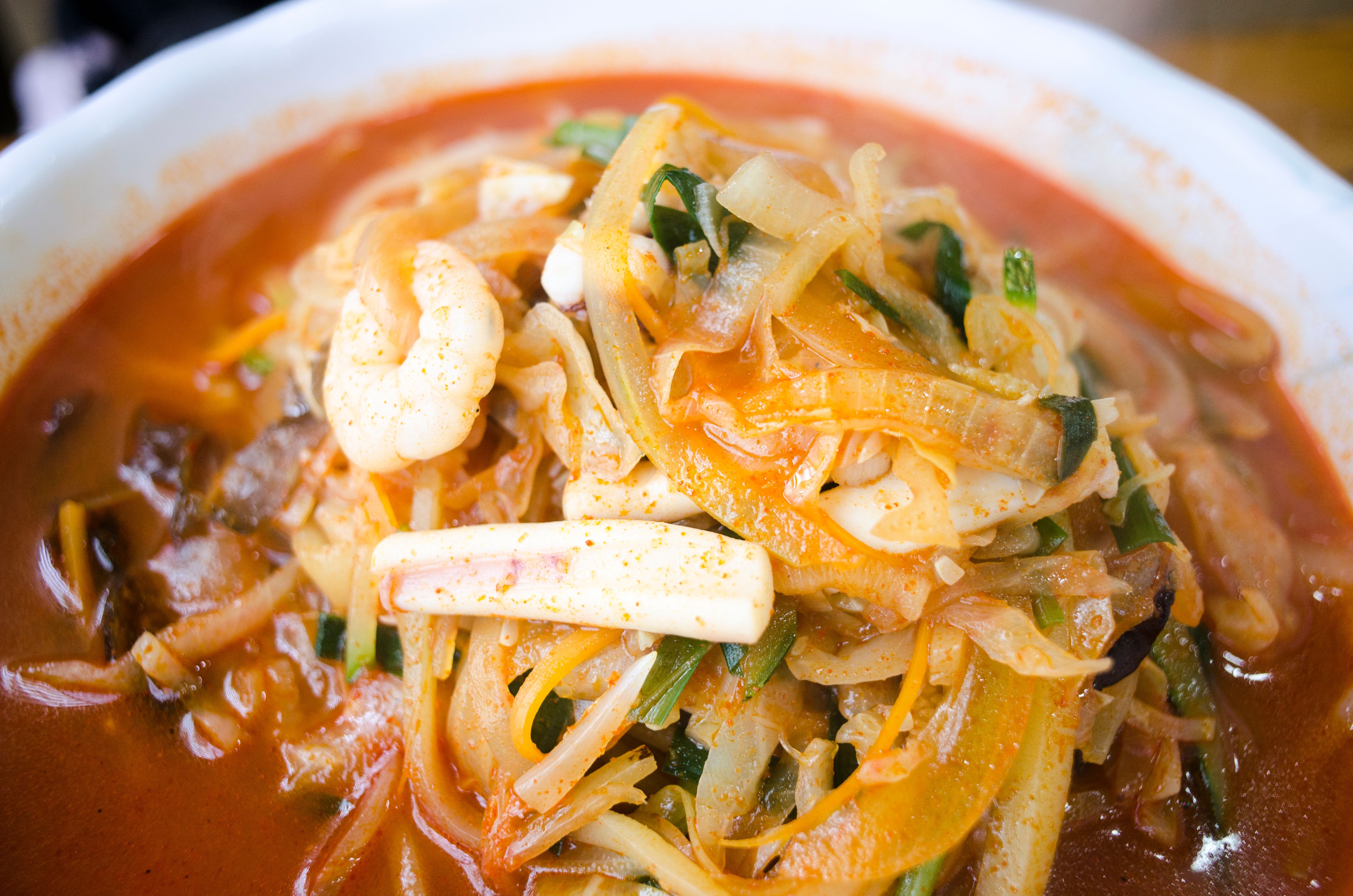
The diets react (see scores below)
Common Ingredients
- ramen noodles
- pork
- shrimp
- squid
- cabbage
- fish cake
- pork broth
- bean sprouts
Specific recipes may vary.
Incompatible with 8 of 11 diets
Diet Ratings
Champon is fundamentally incompatible with ketogenic eating. The primary base is ramen noodles, which are wheat-based and deliver approximately 50-70g of net carbs per serving on their own — far exceeding the entire daily keto allowance. Fish cake (surimi) also contains added starch and sugar. While the proteins (pork, shrimp, squid) and the broth are keto-friendly, and the vegetables (cabbage, bean sprouts) are relatively low-carb, the noodles and fish cake make this dish impossible to fit into ketosis in any standard serving. There is no meaningful portion adjustment that would make the noodle-based dish acceptable — removing the noodles would make it a fundamentally different dish.
Champon contains multiple animal products that are strictly excluded from a vegan diet. The dish includes pork (meat), shrimp (seafood), squid (seafood), fish cake (fish-derived processed product), and pork broth (animal-based stock). Every protein source and the base broth are derived from animals, making this dish entirely incompatible with vegan dietary principles. There is no ambiguity here — this dish is comprehensively non-vegan.
Champon is fundamentally incompatible with the paleo diet. The dish is built on ramen noodles, which are wheat-based and one of the clearest non-paleo ingredients. Fish cake (kamaboko) is a processed food product, typically containing additives, starch fillers, and preservatives. Bean sprouts are derived from mung beans, which are legumes. While the proteins — pork, shrimp, and squid — are fully paleo-approved, and cabbage and pork broth are acceptable, these compliant elements are outweighed by multiple core violations. No meaningful adaptation short of replacing the noodles, fish cake, and bean sprouts would make this dish paleo.
Champon is a Japanese noodle soup that conflicts with Mediterranean diet principles on multiple fronts. The dish combines refined ramen noodles (not whole grain), pork (red meat, which is limited to a few times per month), pork broth (high in saturated fat, sodium), and fish cake (a processed seafood product). While shrimp, squid, cabbage, and bean sprouts are positive elements aligned with the Mediterranean diet, they are outweighed by the problematic components. The refined noodle base, pork content, and processed fish cake make this dish a poor fit overall. The seafood elements (shrimp, squid) are genuinely Mediterranean-friendly, but they cannot redeem the dish's structural reliance on refined grains, red/processed meat, and a fatty pork broth.
Champon is fundamentally incompatible with the carnivore diet. While it contains acceptable carnivore ingredients (pork, shrimp, squid, pork broth), the dish is built around ramen noodles — a grain-based food that is strictly excluded. It also contains cabbage and bean sprouts (plant foods), and fish cake which typically contains starch fillers and plant-based additives. The majority of the dish's bulk and character comes from plant-derived or processed non-carnivore ingredients, making it a clear avoid.
Champon contains ramen noodles, which are a wheat-based grain product — a category explicitly excluded on the Whole30. Additionally, fish cake (kamaboko) typically contains starch fillers and other non-compliant additives. The dish is fundamentally built around noodles, making it incompatible with the Whole30 program regardless of the otherwise compliant proteins (pork, shrimp, squid) and vegetables (cabbage, bean sprouts).
Champon contains multiple high-FODMAP ingredients that make it unsuitable during the elimination phase. The primary concern is ramen noodles, which are wheat-based and therefore high in fructans — a major FODMAP trigger. Additionally, traditional pork broth for champon is commonly made with onion and garlic as base aromatics, both of which are high-fructan ingredients. Fish cake (kamaboko/narutomaki) often contains wheat starch or additives that add to the fructan load. While the proteins (pork, shrimp, squid) are inherently low-FODMAP, and cabbage and bean sprouts are low-FODMAP at standard servings, the combination of wheat noodles and onion/garlic-laden broth makes this dish essentially unavoidable in terms of FODMAP exposure. There is no realistic way to make a standard champon low-FODMAP without fundamentally substituting core ingredients.
Champon is a Nagasaki-style ramen dish that is fundamentally incompatible with DASH diet principles in its standard form. The combination of pork broth (very high sodium), regular ramen noodles (high sodium, refined carbohydrates), fish cake (kamaboko — heavily processed, high sodium), and pork as a protein source creates a sodium load that can easily exceed 2,000–3,000mg per serving alone — surpassing the entire DASH daily sodium limit in a single meal. Pork broth used in ramen-style soups is typically rich in saturated fat as well. Fish cake is a processed food DASH guidelines discourage. While the dish does contain DASH-friendly components — shrimp, squid, cabbage, and bean sprouts are genuinely positive elements — these are overwhelmed by the high-sodium, high-saturated-fat base. The lean seafood and vegetables are insufficient to redeem the overall nutritional profile for DASH purposes.
Champon is a Nagasaki-style ramen dish with a mixed Zone profile. On the positive side, it contains lean proteins (shrimp, squid) and Zone-favorable vegetables (cabbage, bean sprouts), which contribute low-glycemic carbs and good fiber. However, the dish is dominated by ramen noodles, which are a refined, high-glycemic carbohydrate that Zone categorizes as 'unfavorable.' The noodle portion in a standard bowl of champon would far exceed the 1 carb block (9g net carbs) ideal for Zone balance, likely delivering 60-80g of net carbs — roughly 7-9 carb blocks — which would demand an enormous compensating protein portion. The pork component adds saturated fat, as does the pork broth base. Fish cake (kamaboko) contains moderate protein but also additives and some starch. The overall macro ratio skews heavily carbohydrate with insufficient lean protein and the wrong fat profile to hit 40/30/30 as served. As a restaurant dish, portion control is difficult. It can be adapted toward Zone by eating only a fraction of the noodles, emphasizing the seafood and vegetables, but as typically served it falls well into 'caution' territory.
Champon is a Nagasaki-style ramen dish with a mixed anti-inflammatory profile. On the positive side, it contains shrimp and squid (lean seafood with some omega-3s and anti-inflammatory minerals like selenium and zinc), cabbage (a cruciferous vegetable with antioxidants and sulforaphane), and bean sprouts (fiber, vitamin C). These ingredients support an anti-inflammatory eating pattern. However, several elements temper the overall assessment: ramen noodles are refined carbohydrates with little fiber, contributing to glycemic load; pork (especially in a rich broth) introduces saturated fat; fish cake (kamaboko) is a processed food typically containing additives, starch, and sodium; and pork broth, while not inherently harmful, is often high in sodium and saturated fat. The dish is not heavily processed overall and does include meaningful anti-inflammatory seafood and vegetables, but the refined noodles, processed fish cake, and fatty pork components prevent a full approval. As a restaurant or home-cooked dish, quality of ingredients matters considerably — homemade with whole ingredients would rate higher than a packaged or restaurant version.
Some anti-inflammatory practitioners, particularly those following stricter protocols, would flag the refined ramen noodles and processed fish cake more strongly, potentially rating this dish lower (avoid territory) due to refined carbohydrate load and food additives. Conversely, those aligned with Dr. Weil's more flexible approach might emphasize the seafood diversity and cruciferous vegetables as meaningful positives, viewing the dish as broadly acceptable in the context of an otherwise healthy diet.
Champon is a Nagasaki-style ramen dish that offers a mixed nutritional profile for GLP-1 patients. On the positive side, it contains multiple protein sources — shrimp, squid, pork, and fish cake — which collectively can deliver a meaningful protein load, along with fiber-contributing vegetables like cabbage and bean sprouts. The soup base also supports hydration. However, several factors raise concern: the ramen noodles are refined carbohydrates with low fiber and nutrient density per calorie; pork broth is typically high in sodium and saturated fat; pork itself adds saturated fat; and fish cake (kamaboko) is a processed ingredient that may contain added starch, sodium, and fillers. The combination of fatty broth, pork, and refined noodles in a single bowl can be heavy on the stomach, potentially worsening GLP-1 side effects like nausea, bloating, and reflux due to slowed gastric emptying. The overall fat and sodium content of the dish is difficult to control in a standard restaurant preparation.
Some GLP-1-aware dietitians may view champon more favorably as a protein-rich, vegetable-inclusive soup that supports hydration and satiety — particularly if portioned small and the noodle quantity is reduced. Others would flag the pork fat content in the broth and the refined noodles as meaningful drawbacks that could worsen GI tolerance, especially in patients still adjusting to the medication.
*See how scores were generated at our methodology page.
Nutritional profile
Six traits that cut across every diet.
Fiber & Plants
How much whole-plant food and fiber it delivers.
Healthy Fats
The quality of its fats (unsaturated, omega-3).
Whole / Unprocessed
How close it is to its natural, unprocessed form.
Gut Gentle
How easy it is on digestion (low FODMAP, few irritants).
Low Glycemic
How little it spikes your blood sugar.
Protein Density
How much protein it packs per calorie.
Controversy Index
Higher controversy = more disagreement between diets.
Diet-Specific Tips
 Zone — 4/10
View tips
- Ramen noodles are a refined, high-glycemic 'unfavorable' carbohydrate that dominates the dish's carb profile
- Standard serving likely delivers 7-9 carb blocks of noodles, far exceeding Zone balance
- Shrimp and squid are lean, Zone-favorable proteins
- Cabbage and bean sprouts are low-glycemic, Zone-approved vegetables
- Pork adds saturated fat, which Zone advises limiting
- Pork broth may contain added sodium and fat
- Fish cake introduces minor starch and processed ingredients
- Dish could be partially Zone-adapted by reducing noodle portion and emphasizing seafood/vegetables
 Anti-Inflammatory — 5/10
View tips
- Shrimp and squid provide lean protein with some anti-inflammatory omega-3s and selenium
- Cabbage and bean sprouts add cruciferous antioxidants and fiber
- Ramen noodles are refined carbohydrates with high glycemic impact and minimal fiber
- Fish cake is a processed ingredient with potential additives and high sodium
- Pork contributes saturated fat, particularly in a rich broth preparation
- Overall sodium content is likely high, which can contribute to systemic inflammation
- Dish quality varies significantly between homemade and commercial/restaurant preparations
 GLP-1 Friendly — 5/10
View tips
- Multiple lean seafood proteins (shrimp, squid) are GLP-1-friendly
- Pork adds saturated fat, which may worsen nausea and bloating
- Ramen noodles are refined carbohydrates with low fiber and low nutrient density per calorie
- Pork-based broth is typically high in sodium and saturated fat
- Cabbage and bean sprouts contribute fiber and micronutrients
- Fish cake is a processed ingredient with added starch and sodium
- Large bowl format may be challenging for reduced-appetite GLP-1 patients
- Soup base supports hydration, which is a positive for GLP-1 patients