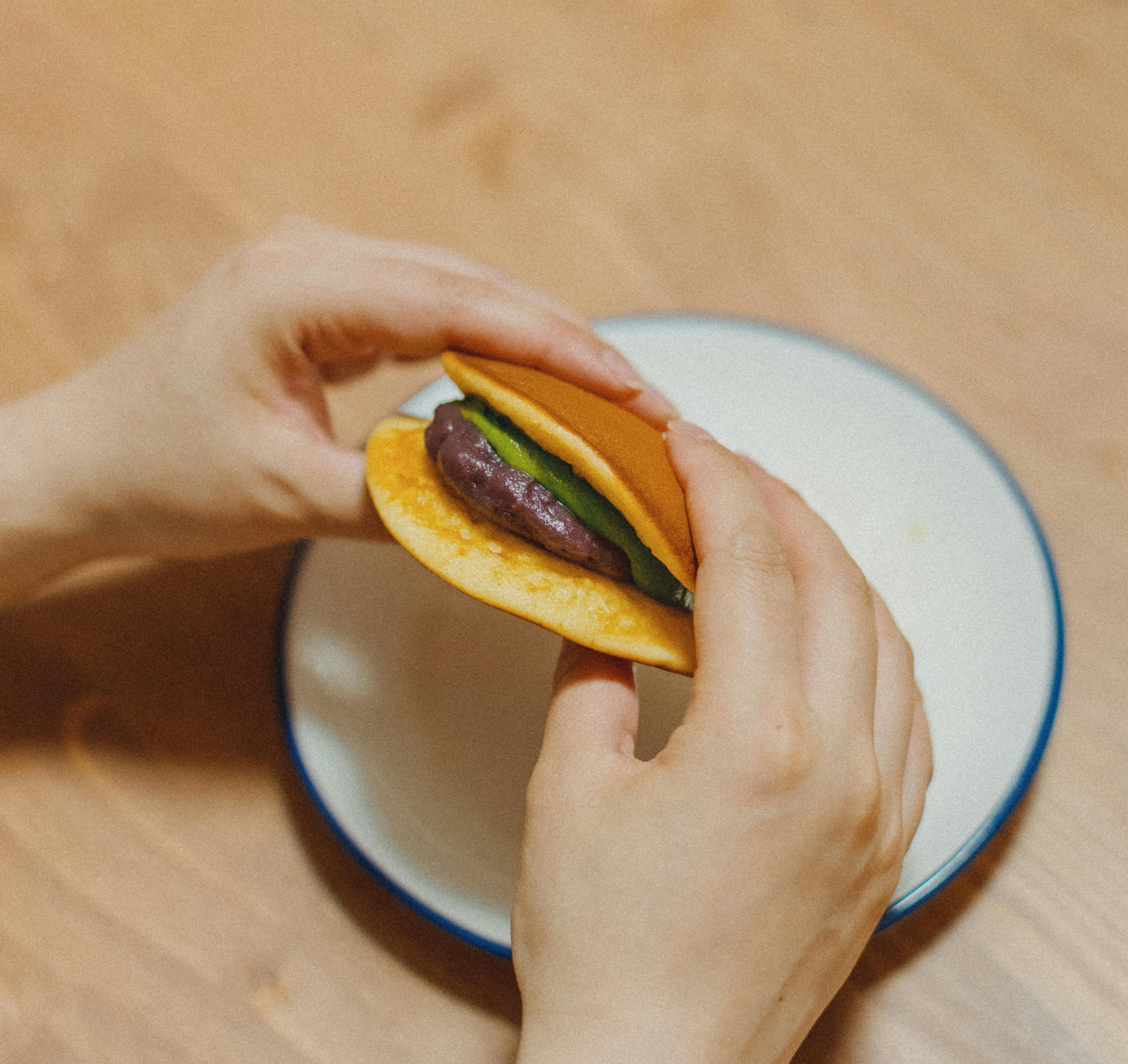
The diets react (see scores below)
Common Ingredients
- flour
- eggs
- sugar
- honey
- baking powder
- red bean paste
- mirin
Specific recipes may vary.
Incompatible with 10 of 11 diets
Diet Ratings
Dorayaki is fundamentally incompatible with a ketogenic diet. It consists of two wheat flour pancakes filled with sweet red bean paste, and virtually every ingredient is a keto disqualifier. Flour provides high-glycemic starch, sugar and honey are pure added sugars, mirin adds more sugar, and red bean paste (anko) is loaded with both starch and sugar. A single dorayaki typically contains 50-70g of net carbs, which alone exceeds the entire daily keto carb budget. There is no meaningful way to consume this food within ketogenic parameters.
Dorayaki contains multiple clear animal-derived ingredients: eggs (used in the pancake batter) and honey (used for sweetness and moisture in the batter). Both are unambiguously excluded under standard vegan definitions. Mirin is plant-based (fermented rice wine), flour, sugar, baking powder, and red bean paste are typically plant-based, but the presence of eggs alone is sufficient to disqualify this dish, with honey as a further disqualifying ingredient for the vast majority of vegans. This is not a borderline case — eggs are a core animal product with no debate within vegan discourse.
Dorayaki is a Japanese sweet consisting of two pancakes made with wheat flour and filled with sweetened red bean paste. It contains multiple paleo-prohibited ingredients: wheat flour (a grain) forms the base of the pancakes, red bean paste is made from azuki beans (a legume), refined sugar is used throughout, and baking powder is a processed leavening agent. Even the permitted ingredients — eggs and honey — cannot redeem a dish so fundamentally built on non-paleo staples. This is one of the clearest possible 'avoid' verdicts with near-universal consensus in the paleo community.
Dorayaki is a Japanese sweet confection that significantly contradicts Mediterranean diet principles. It is built on refined white flour and contains substantial added sugars from multiple sources (sugar, honey, mirin, and sweetened red bean paste). While eggs and honey appear in Mediterranean cooking, here they serve a dessert vehicle that is primarily refined grain and added sugar — two categories the Mediterranean diet explicitly minimizes. The dish has no olive oil, no whole grains, no vegetables or legumes in a beneficial sense (the red bean paste is heavily sweetened, negating the legume benefit), and no meaningful Mediterranean-aligned nutrients. It is a processed sweet snack with no traditional or regional connection to Mediterranean food culture.
Dorayaki is a Japanese sweet snack consisting almost entirely of plant-based and processed ingredients. Flour (grain), sugar (processed), red bean paste (legume), mirin (rice-based alcohol/sugar), and baking powder are all strictly prohibited on the carnivore diet. While eggs and honey appear in the ingredient list, they are minor components in a dish that is fundamentally grain- and legume-based. This food is incompatible with carnivore principles at every level — it contains grains, legumes, refined sugar, and plant-derived sweeteners. There is no meaningful animal-derived nutrition here that would redeem it.
Dorayaki contains multiple excluded ingredients that make it clearly non-compliant with Whole30. Flour (a grain) is excluded, sugar is excluded as an added sweetener, honey is excluded as an added sweetener, red bean paste is made from adzuki beans (legumes, excluded), and mirin is an alcoholic rice wine (contains both alcohol and rice/grains, both excluded). Additionally, dorayaki is a classic example of the pancake-style baked good that Rule 4 explicitly prohibits — it is literally a pancake sandwich. Even if one or more ingredients were swapped out, the dish itself falls into the 'no recreating baked goods/junk food' category.
Dorayaki contains multiple high-FODMAP ingredients that make it unsuitable during the elimination phase. Wheat flour is high in fructans, which are a key FODMAP trigger. Red bean paste (anko) is made from adzuki beans, which are high in GOS (galacto-oligosaccharides) — a significant FODMAP category. Honey is high in excess fructose and is explicitly listed as high-FODMAP by Monash University. Mirin contains sugars that can contribute to FODMAP load. The combination of fructans (wheat), GOS (red bean paste), and excess fructose (honey) makes this a triple-FODMAP-hit food with no realistic portion size that would bring it into safe territory during elimination.
Dorayaki is a Japanese sweet snack consisting of two pancake-like patties made from refined flour, eggs, sugar, honey, and mirin, filled with sweet red bean paste (anko). From a DASH perspective, this food is problematic primarily due to its high added sugar content — sugar, honey, mirin, and sweetened red bean paste all contribute significant amounts of added sugar. The refined white flour provides minimal fiber. While individual ingredients like eggs and red bean paste (as a legume base) have some nutritional merit, the overall product as commonly consumed is a high-sugar, refined-carbohydrate confection. DASH guidelines explicitly limit sweets and foods high in added sugars, and dorayaki squarely falls into the 'sweets' category that DASH recommends limiting to 5 or fewer servings per week — and even then, the serving should be small. The combination of multiple sugar sources (granulated sugar, honey, mirin, and sweetened bean paste) makes this a poor fit for regular DASH consumption.
Dorayaki is a Japanese sweet snack consisting of two fluffy pancakes (made from refined white flour, sugar, honey, and mirin) sandwiched around a sweet red bean paste filling. From a Zone Diet perspective, this is essentially a high-glycemic dessert with almost no redeeming macronutrient balance. The primary ingredients are refined flour and multiple sugar sources (white sugar, honey, mirin, and sweetened red bean paste), creating a massive carbohydrate spike with negligible protein and minimal fat. There is no lean protein source, no monounsaturated fat, and no low-glycemic carbohydrates. Eggs are present but in small quantity relative to the overall carbohydrate load. The 40/30/30 ratio would be practically impossible to achieve with this food as a component — it is overwhelmingly carbohydrate-dominant and those carbohydrates are high-glycemic. Even with heroic portioning, the refined flour and layered sugar sources (honey, sugar, mirin, sweetened bean paste) make this nearly impossible to incorporate into a Zone meal without completely disrupting insulin balance. This is exactly the type of food Dr. Sears identifies as promoting unfavorable eicosanoid production through insulin spikes.
Dorayaki is a traditional Japanese sweet consisting of two fluffy pancakes made from refined wheat flour, eggs, sugar, honey, and baking powder, sandwiched around a sweet red bean (anko) paste, with mirin adding additional sweetness. From an anti-inflammatory perspective, the dish is a mixed bag. On the negative side, it is built on a refined carbohydrate base (white flour) with significant added sugars from granulated sugar, honey, and mirin — all of which can spike blood glucose and promote inflammatory markers like CRP when consumed regularly or in large amounts. Refined grains lack the fiber and phytonutrients of whole grains that support an anti-inflammatory response. On the positive side, the red bean paste (azuki beans) is genuinely anti-inflammatory — azuki beans are rich in polyphenols, anthocyanins, fiber, and plant protein, and legumes are explicitly emphasized in anti-inflammatory frameworks. Eggs contribute choline and some anti-inflammatory nutrients. Honey in small culinary amounts has minor antioxidant properties, though this is outweighed by its sugar load in a dessert context. Overall, dorayaki functions as a sweet snack treat: the red bean filling is its best anti-inflammatory feature, but it is embedded in a refined-flour, high-sugar delivery vehicle that makes it a moderate-to-poor fit for anti-inflammatory eating. Acceptable occasionally as a less-processed alternative to many Western pastries, but not a food to eat regularly on an anti-inflammatory plan.
Dorayaki is a Japanese sweet snack consisting of two fluffy pancakes made from refined flour, eggs, sugar, honey, and baking powder, filled with sweet red bean paste (anko) sweetened further with sugar and mirin. While it contains eggs and red bean paste (which has some fiber and plant protein), the overall profile is dominated by refined carbohydrates and added sugars. It offers very little protein per serving (roughly 4-6g), minimal fiber relative to its sugar load, and represents the archetypal 'empty calorie' snack that is counterproductive for GLP-1 patients. The high sugar content can spike blood glucose and contribute to energy crashes. Red bean paste does provide modest fiber and protein compared to other sweet fillings, but not enough to meaningfully offset the refined grain and sugar load. With reduced appetite on GLP-1 medications, consuming a dorayaki means displacing nutritionally dense foods that support protein targets, muscle preservation, and digestive health.
*See how scores were generated at our methodology page.
Nutritional profile
Six traits that cut across every diet.
Fiber & Plants
How much whole-plant food and fiber it delivers.
Healthy Fats
The quality of its fats (unsaturated, omega-3).
Whole / Unprocessed
How close it is to its natural, unprocessed form.
Gut Gentle
How easy it is on digestion (low FODMAP, few irritants).
Low Glycemic
How little it spikes your blood sugar.
Protein Density
How much protein it packs per calorie.
Controversy Index
Higher controversy = more disagreement between diets.
Diet-Specific Tips
 Anti-Inflammatory — 4/10
View tips
- Refined wheat flour base is pro-inflammatory — lacks fiber and phytonutrients of whole grains
- High added sugar content from sugar, honey, and mirin promotes glycemic spikes and inflammatory markers
- Red bean (azuki) paste is a genuine anti-inflammatory ingredient — rich in anthocyanins, polyphenols, and fiber
- Legumes (beans) are explicitly emphasized in Dr. Weil's Anti-Inflammatory Food Pyramid
- Eggs contribute modest anti-inflammatory nutrients (choline, selenium)
- Mirin adds further refined sugar load
- Relatively low in saturated fat and contains no trans fats or artificial additives — cleaner than many Western pastries
- Not suitable for regular consumption on an anti-inflammatory diet but acceptable as an occasional treat