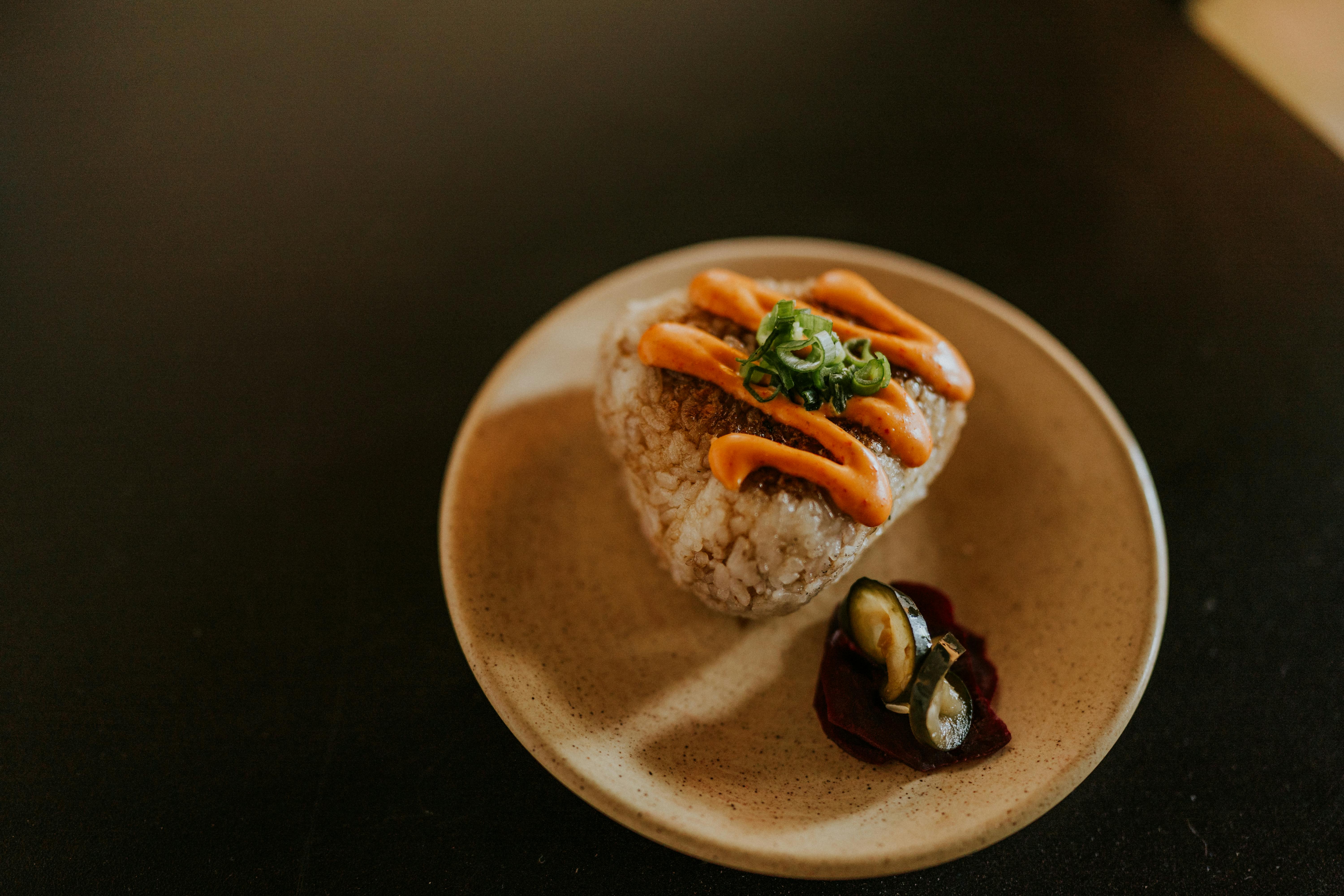
Photo: Amar Preciado / Pexels
The diets react (see scores below)
Common Ingredients
- rice
- nori
- umeboshi
- salmon
- salt
- bonito flakes
- soy sauce
Specific recipes may vary.
Incompatible with 5 of 11 diets
Diet Ratings
Onigiri is fundamentally incompatible with a ketogenic diet. The primary ingredient is white rice, a refined starchy grain that is among the highest net-carb foods possible. A single standard onigiri contains approximately 30-40g of net carbs from rice alone, which can single-handedly exhaust or exceed the entire daily keto carb budget. The remaining ingredients (nori, salmon, bonito flakes, soy sauce, umeboshi) are either keto-neutral or minimally problematic, but they cannot offset the disqualifying carb load from the rice base. There is no meaningful portion size of onigiri that would fit within ketogenic macros.
This onigiri contains multiple animal-derived ingredients that make it clearly incompatible with a vegan diet. Salmon is a fish (animal product), and bonito flakes (katsuobushi) are dried, fermented tuna — also an animal product. Both are direct disqualifiers under any vegan framework. The base ingredients (rice, nori, umeboshi, salt, soy sauce) are plant-based, but the presence of two distinct animal proteins renders this dish non-vegan without modification.
Onigiri is fundamentally incompatible with the paleo diet. The primary ingredient is white rice, a grain that is excluded under strict paleo guidelines. Beyond the rice, soy sauce contains both soy (a legume) and wheat (a grain), making it doubly non-paleo. Salt is also listed as an added ingredient, which is discouraged. While a few individual ingredients are paleo-friendly — salmon is an excellent paleo protein, nori (dried seaweed) is approved, bonito flakes are acceptable, and umeboshi (pickled plum) is borderline — the dish as a whole is built on a grain foundation and seasoned with a legume-based sauce, making it firmly in the avoid category.
Onigiri is a mixed picture from a Mediterranean diet perspective. The salmon and nori are positives — fatty fish is encouraged 2-3 times weekly, and seaweed is a nutrient-dense sea vegetable. Bonito flakes also add fish-based nutrition. However, the base is white refined rice, which contradicts the Mediterranean preference for whole grains. Soy sauce adds significant sodium with minimal nutritional benefit. Umeboshi (pickled plum) is a fermented, plant-based food, which is broadly compatible in spirit though not traditional. There is no olive oil, legumes, or other Mediterranean staples. Overall, the dish is not harmful but is built around refined starch and lacks the hallmarks of a Mediterranean snack (e.g., whole grains, olive oil, vegetables, legumes).
Some Mediterranean diet practitioners take a permissive view of white rice, noting its long history in traditional Cretan and Greek island cuisines where it is consumed in moderation. Under this interpretation, onigiri's salmon and seaweed content could tip the balance toward acceptable, particularly when portion size is modest.
Onigiri is fundamentally incompatible with the carnivore diet. The dish is built on rice, a grain that is entirely excluded from carnivore eating. The majority of its ingredients are plant-derived: rice (grain), nori (seaweed/algae), umeboshi (pickled plum — fruit), and soy sauce (fermented soy/wheat — legume and grain). While salmon and bonito flakes are carnivore-approved animal foods, they are minor components embedded in a predominantly plant-based snack. There is no version of onigiri that can be made carnivore-compliant without completely deconstructing it into a different dish entirely.
Onigiri contains two excluded ingredients: (1) rice, which is a grain explicitly banned on Whole30, and (2) soy sauce, which is a soy-based product (legume) and typically contains wheat (grain). Either of these alone would disqualify the dish. Additionally, even if those ingredients were substituted, forming rice into a shaped snack ball would likely fall under the spirit of the 'no recreating junk food/comfort food' rule. Umeboshi (pickled plum) and nori (seaweed) are compliant, as are salmon and bonito flakes, but the foundational ingredient — rice — makes this dish entirely off-limits.
Onigiri is primarily white rice, which is definitively low-FODMAP. Nori (dried seaweed) is low-FODMAP. Salmon is a protein with no FODMAPs. Salt is FODMAP-free. Bonito flakes are low-FODMAP. The two ingredients requiring attention are umeboshi and soy sauce. Umeboshi (pickled plum) is a stone fruit product — plums are high-FODMAP due to sorbitol (a polyol), and while umeboshi is used in small quantities per onigiri (typically 1 small plum or ~10g), the sorbitol content remains a concern during strict elimination. Soy sauce in small amounts (1-2 tablespoons) is considered low-FODMAP by Monash, as wheat-based soy sauce contains only trace fructans at typical serving sizes. The combination of umeboshi's polyol content and the moderate overall serving make this a caution rather than an avoid — the rice base is safe, but umeboshi is problematic for those sensitive to polyols.
Monash University has not specifically tested umeboshi, and clinical FODMAP practitioners often advise avoiding all stone fruit derivatives during elimination due to sorbitol content. Some practitioners may rate traditional umeboshi onigiri as an avoid during strict elimination, while salmon or bonito-only fillings would be fully approved.
Onigiri contains a mix of DASH-friendly and DASH-problematic ingredients. White rice is a refined grain, which DASH de-emphasizes in favor of whole grains, though it is not categorically excluded. Nori is a low-calorie, mineral-rich sea vegetable that aligns well with DASH. Salmon is an excellent lean protein source rich in omega-3s and potassium, strongly supported by DASH. However, the sodium burden in this dish is significant: umeboshi (pickled plum) is extremely high in sodium, often containing 600–900mg per single plum; soy sauce adds another 800–1,000mg per tablespoon; and added salt during preparation compounds this further. Bonito flakes are relatively low in sodium but add modest amounts. A single onigiri could easily contain 700–1,200mg of sodium depending on filling and seasoning, which is a substantial portion of even the standard DASH limit of 2,300mg/day and far exceeds the low-sodium DASH threshold of 1,500mg/day for one snack item. The dish is not inherently incompatible with DASH principles in structure (grain + lean protein + vegetable wrapper), but the traditional preparation makes it a high-sodium food that requires significant modification to fit DASH guidelines.
NIH DASH guidelines clearly flag high-sodium condiments like soy sauce and pickled foods like umeboshi as problematic. However, some DASH-oriented nutritionists note that if low-sodium soy sauce is substituted, umeboshi is omitted or replaced with plain salmon, and salt is minimized, onigiri can become a reasonable DASH-compatible snack — the underlying structure of whole food ingredients and lean fish aligns with DASH principles even if traditional preparation does not.
Onigiri is primarily a white rice-based snack, which is a high-glycemic, 'unfavorable' carbohydrate in Zone terminology. A typical onigiri contains roughly 30-40g of net carbs from white rice alone, with very little protein (salmon and bonito flakes are present but in small amounts) and minimal fat. This creates a heavily carb-skewed macronutrient profile that is nearly the opposite of the 40/30/30 Zone target — you'd be looking at something closer to 75-80% carbs, 15-20% protein, and under 5% fat. The beneficial ingredients (salmon for omega-3s, nori for polyphenols and minerals, umeboshi for antioxidants) are present but in token quantities insufficient to balance the Zone ratio. Soy sauce adds sodium but negligible macros. To incorporate onigiri into a Zone meal, one would need to treat it as a partial carb block only and pair it with substantial lean protein and monounsaturated fat on the side — but even then, the white rice itself is an 'unfavorable' high-glycemic carb source. It scores a 4 rather than lower because it does contain some lean protein from salmon and bonito flakes, and the overall caloric density is moderate, making small portions theoretically workable as a carb block in a broader Zone meal.
Onigiri presents a mixed anti-inflammatory profile. On the positive side, salmon is an excellent source of omega-3 fatty acids (EPA and DHA), which are among the most potent anti-inflammatory nutrients. Nori (seaweed) contributes iodine, antioxidants, and a small amount of omega-3s. Bonito flakes (katsuobushi) provide additional lean protein and some omega-3s. Umeboshi (pickled plum) offers polyphenols and traditionally regarded digestive benefits, though it is very high in sodium. The core ingredient — white rice — is the main concern from an anti-inflammatory standpoint. White rice is a refined, high-glycemic carbohydrate that lacks the fiber and nutrients of whole grains, and regular consumption of refined carbohydrates is associated with elevated inflammatory markers. Soy sauce adds meaningful sodium, and the overall sodium load between umeboshi, soy sauce, and salt is significant, which is a secondary concern. The salmon filling partially redeems the dish, but the white rice base keeps it from scoring higher. As a traditional whole-food preparation with no processed additives or trans fats, it is far preferable to most processed snacks, and the omega-3 contribution from salmon is genuine.
Some anti-inflammatory nutrition practitioners, particularly those drawing on traditional Japanese dietary patterns (associated with longevity and low chronic disease rates), argue that white rice in the context of a largely plant-rich, fish-forward diet is not a meaningful inflammatory driver and should not be penalized heavily. Dr. Weil and others distinguish between refined grains as a staple vs. an occasional component of an otherwise anti-inflammatory meal. Conversely, stricter anti-inflammatory and low-glycemic protocols would rate white rice poorly regardless of context due to its glycemic index and lack of fiber.
Onigiri with salmon is a mixed picture for GLP-1 patients. The salmon filling provides meaningful omega-3 fats and some protein, nori adds micronutrients and a small fiber contribution, and umeboshi offers probiotic-adjacent benefits. However, the dominant ingredient is white rice — a refined carbohydrate with low fiber, moderate glycemic impact, and minimal protein density per calorie. A standard onigiri (roughly 100–120g) delivers approximately 3–6g protein and under 1g fiber, falling well short of the 15–30g per-meal protein target. On the positive side, it is easy to digest, low in fat, small in portion size, and unlikely to worsen GLP-1 GI side effects. Soy sauce adds sodium, which is worth noting for patients monitoring intake, but is not a disqualifying concern at typical quantities. As an occasional snack paired with a higher-protein item (e.g., edamame, cottage cheese, a protein shake), it is acceptable. As a standalone meal or primary protein source, it falls short of GLP-1 dietary priorities.
Some GLP-1-focused RDs view onigiri favorably as a small, easily tolerated, low-fat snack that supports portion control and digestibility — particularly on high-nausea days when patients struggle to eat anything substantial. Others caution that relying on refined rice-based foods reinforces low-protein, low-fiber eating patterns that undermine muscle preservation during rapid weight loss.
*See how scores were generated at our methodology page.
Nutritional profile
Six traits that cut across every diet.
Fiber & Plants
How much whole-plant food and fiber it delivers.
Healthy Fats
The quality of its fats (unsaturated, omega-3).
Whole / Unprocessed
How close it is to its natural, unprocessed form.
Gut Gentle
How easy it is on digestion (low FODMAP, few irritants).
Low Glycemic
How little it spikes your blood sugar.
Protein Density
How much protein it packs per calorie.
Controversy Index
Higher controversy = more disagreement between diets.
Diet-Specific Tips
 Mediterranean — 5/10
View tips
- White rice is a refined grain, not aligned with Mediterranean whole-grain preference
- Salmon is an excellent source of omega-3 fatty acids, strongly encouraged
- Nori provides iodine and micronutrients from the sea, broadly plant-compatible
- Soy sauce contributes high sodium, not a Mediterranean ingredient
- No olive oil, legumes, or vegetables present
- Bonito flakes add additional fish-based nutrition
- Fermented umeboshi aligns loosely with Mediterranean appreciation for fermented foods
 Low-FODMAP — 5/10
View tips
- White rice is low-FODMAP and forms the bulk of the dish — safe
- Umeboshi (pickled plum) is a stone fruit high in sorbitol (polyol) — the primary FODMAP concern
- Soy sauce is low-FODMAP at small servings per Monash (≤2 tbsp), but wheat-containing
- Nori, salmon, bonito flakes, and salt are all FODMAP-free
- Filling choice is critical — salmon/bonito onigiri would score higher than umeboshi onigiri
- Umeboshi is not specifically tested by Monash; sorbitol risk inferred from plum FODMAP data
 DASH — 4/10
View tips
- Umeboshi is extremely high in sodium (600–900mg per plum), a major DASH concern
- Soy sauce adds 800–1,000mg sodium per tablespoon, compounding sodium load
- White rice is a refined grain; DASH emphasizes whole grains over refined
- Salmon is DASH-approved lean protein rich in omega-3 fatty acids and potassium
- Nori is a nutrient-dense sea vegetable compatible with DASH
- Total sodium per onigiri in traditional preparation likely exceeds 700–1,200mg, problematic for DASH
- Low-sodium modifications (omit umeboshi, use low-sodium soy sauce, reduce salt) would improve DASH compatibility significantly
 Zone — 4/10
View tips
- White rice is a high-glycemic 'unfavorable' carbohydrate in Zone methodology — primary macro concern
- Macronutrient ratio is heavily carb-skewed (~75-80% carbs), far from the 40/30/30 Zone target
- Salmon and bonito flakes provide lean protein and omega-3s but in insufficient quantities to balance the ratio
- Nori contributes polyphenols and minerals, aligning with Sears' anti-inflammatory focus
- Umeboshi provides antioxidant polyphenols but negligible macro contribution
- Could serve as a partial carb block in a larger Zone meal but not a standalone Zone-balanced snack
 Anti-Inflammatory — 5/10
View tips
- White rice is a refined, high-glycemic carbohydrate — the primary anti-inflammatory concern
- Salmon provides beneficial omega-3 fatty acids (EPA/DHA), a strong anti-inflammatory asset
- Nori contributes antioxidants and trace omega-3s
- High overall sodium content from umeboshi, soy sauce, and added salt
- No trans fats, artificial additives, or processed ingredients
- Bonito flakes are a lean, minimally processed protein source
- Whole-food preparation consistent with traditional Japanese dietary patterns
 GLP-1 Friendly — 5/10
View tips
- Low protein per serving (~3–6g) — well below the 15–30g per meal target
- White rice is a refined carbohydrate with low fiber and moderate glycemic impact
- Salmon filling provides omega-3 fats and partial protein contribution
- Easy to digest — low fat, soft texture, gentle on slowed gastric emptying
- Small portion size is GLP-1 compatible
- Nori adds micronutrients; umeboshi adds sodium and negligible nutrition
- High sodium from soy sauce and umeboshi — relevant for some patients
- Acceptable as a snack only when paired with a high-protein food; insufficient as a standalone meal