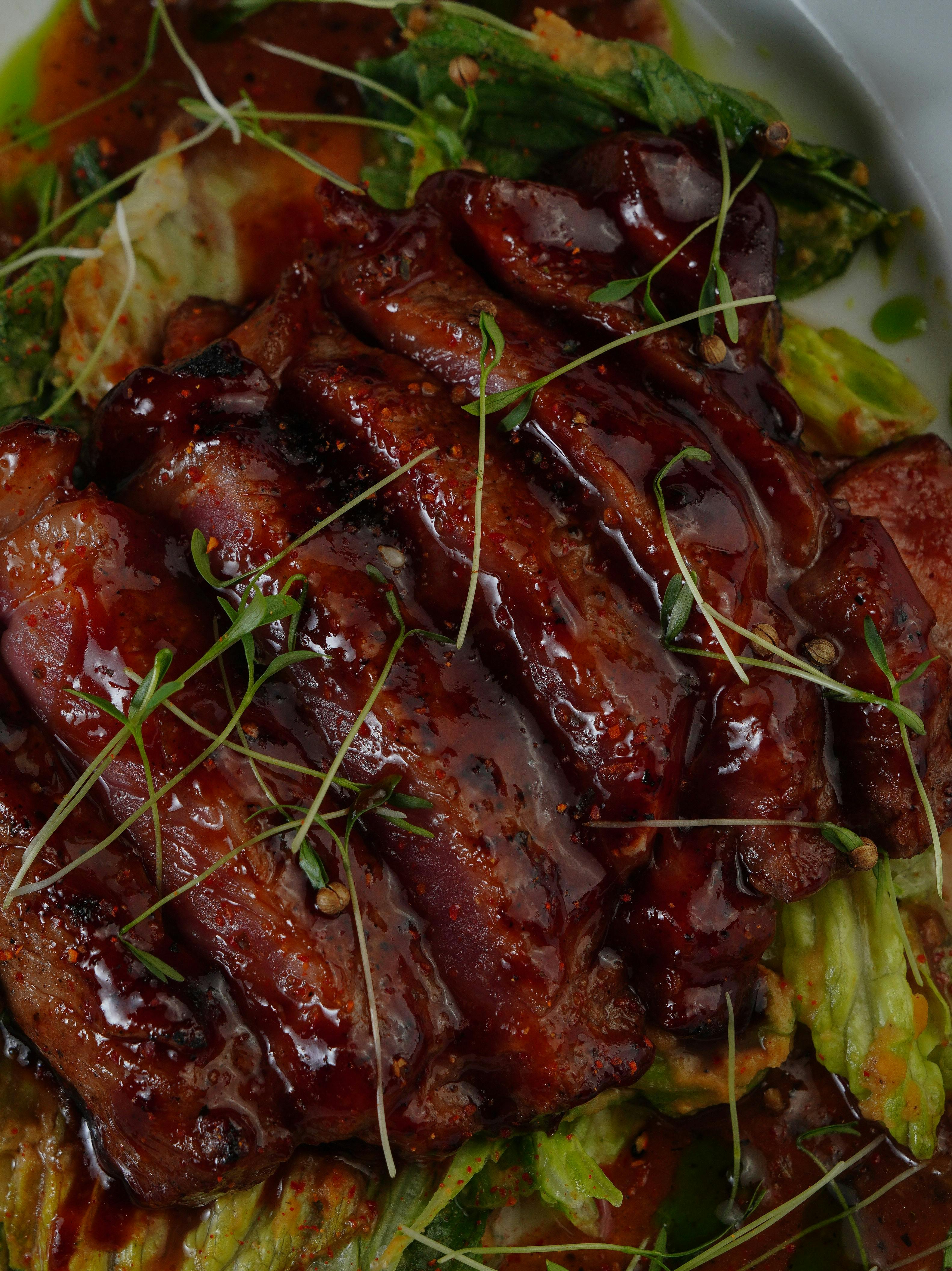
The diets react (see scores below)
Common Ingredients
- pork belly
- soy sauce
- brown sugar
- awamori
- ginger
- dashi
- mirin
Specific recipes may vary.
Incompatible with 10 of 11 diets
Diet Ratings
Rafute is an Okinawan braised pork belly dish that is fundamentally incompatible with ketogenic eating due to its core sweetening ingredients. While pork belly itself is an excellent keto protein and fat source, the recipe relies heavily on brown sugar and mirin — both significant sources of sugar and carbohydrates. Brown sugar is pure sucrose, and mirin (sweet rice wine) contains approximately 8-14g of sugar per tablespoon. Together with soy sauce (small carb contribution) and awamori (alcohol, which can impair ketosis), the braising liquid creates a high-sugar glaze that permeates the pork during the long cooking process. A standard serving would likely deliver 15-30g of net carbs from sugar alone, easily threatening or exceeding daily keto limits in a single dish. This is not a matter of portion control — the sugar is integral to the dish's character and cannot be meaningfully reduced without fundamentally changing Rafute into a different recipe.
Rafute is an Okinawan braised pork belly dish. Pork belly is a direct animal product (flesh/fat from a pig), making this dish entirely incompatible with a vegan diet. There is no ambiguity here — pork is meat and is excluded under all definitions of veganism. Additionally, dashi in traditional Japanese cooking is typically made from katsuobushi (dried bonito fish flakes) or niboshi (dried sardines), adding a second animal-derived ingredient. The remaining ingredients (soy sauce, brown sugar, awamori, ginger, mirin) are plant-based, but the primary protein and likely the dashi are animal products.
Rafute is an Okinawan braised pork belly dish that contains multiple non-paleo ingredients. Soy sauce is a fermented soy (legume) and wheat-based condiment — excluded on both counts. Brown sugar is refined sugar, strictly excluded from paleo. Mirin is a sweet rice wine, making it grain-derived and sugar-laden. Dashi, while often fish-based (acceptable), commercially prepared dashi frequently contains soy and additives. Awamori is a distilled rice spirit — grain-derived alcohol. While pork belly itself is paleo-approved and ginger is fine, the majority of the flavor-building ingredients are firmly excluded. This dish cannot be considered paleo-compatible without a near-total reformulation.
Rafute is an Okinawan braised pork belly dish that fundamentally conflicts with Mediterranean diet principles on multiple levels. Pork belly is a fatty red/processed meat high in saturated fat, which the Mediterranean diet limits to a few times per month at most. The dish is also loaded with added sugars (brown sugar, mirin) and soy sauce (high sodium, processed condiment), none of which are staples of the Mediterranean dietary pattern. There is no olive oil, no vegetables, no legumes, and no plant-forward components. The cooking method concentrates saturated fat rather than reducing it. This dish represents nearly everything the Mediterranean diet advises against: fatty red meat as the centerpiece, significant added sugars, and heavily processed condiments.
Rafute is an Okinawan braised pork belly dish that is fundamentally incompatible with the carnivore diet. While pork belly itself is an excellent carnivore-approved cut (fatty, animal-derived), the dish is heavily seasoned with multiple plant-derived and processed ingredients. Soy sauce is a fermented plant product (soybeans and wheat), brown sugar is a refined carbohydrate, mirin contains sugar and rice, awamori is a grain-based distilled spirit, ginger is a plant root, and dashi (unless made purely from bonito/fish) typically contains kombu seaweed. The combination of sugar, soy, grain-derived alcohol, and plant seasonings makes this dish entirely off-limits on a carnivore protocol. The pork belly base cannot be separated from the marinade/braise in a meaningful way — the dish is defined by these non-carnivore ingredients.
Rafute contains multiple Whole30-excluded ingredients. Soy sauce is a soy product (legume-derived), which is explicitly excluded. Brown sugar is an added sugar, also explicitly excluded. Awamori is an Okinawan distilled rice liquor — both alcohol and a grain-based product, both excluded categories. Mirin is a sweet rice wine containing both alcohol and sugar, also excluded. Dashi may contain soy sauce or other non-compliant additives depending on preparation. This dish fails on at least four separate Whole30 exclusion rules and cannot be made compliant without fundamentally changing its character.
Rafute is an Okinawan braised pork belly dish. Most individual ingredients are low-FODMAP: pork belly is safe, soy sauce is low-FODMAP in standard amounts (up to 2 tablespoons per Monash), ginger is low-FODMAP at typical culinary doses, and awamori (Okinawan distilled spirit) is essentially FODMAP-free as an alcohol distillate. The primary concerns are brown sugar (low-FODMAP at small servings but used in moderate-to-large quantities in this dish), mirin (Monash rates it as low-FODMAP at 2 tablespoons, but accumulation in a sauce-heavy braise is a concern), and dashi. Standard dashi made from kombu and bonito flakes is generally considered low-FODMAP, though kombu in large quantities may contribute some GOS. The dish is braised and the sauce is absorbed, meaning FODMAP compounds from sugar and mirin concentrate rather than being discarded. At a typical restaurant portion with rich braising sauce, cumulative FODMAP load from mirin and brown sugar could become problematic. A careful home-prepared version with controlled sugar/mirin quantities eaten in a moderate serving would likely be tolerable, but restaurant portions carry real risk of exceeding thresholds.
Monash University rates soy sauce and mirin as low-FODMAP at standard culinary amounts, suggesting this dish could be approved in a careful home preparation. However, clinical FODMAP practitioners often caution against dishes where multiple moderate-FODMAP ingredients accumulate in a concentrated braise or glaze, as the stacking effect may exceed individual thresholds even if each ingredient appears 'safe' in isolation.
Rafute is an Okinawan braised pork belly dish that conflicts with DASH diet principles on multiple levels. Pork belly is one of the fattiest cuts of meat available, extremely high in saturated fat and total fat — directly contrary to DASH guidelines which limit saturated fat and red/fatty meats. Soy sauce is a major sodium contributor, with just 1 tablespoon containing approximately 900-1,000mg sodium, pushing a single serving well toward or beyond the DASH daily sodium ceiling of 1,500-2,300mg. Brown sugar and mirin add significant amounts of added sugar, another category DASH limits. The combination of high saturated fat from pork belly, high sodium from soy sauce and dashi, and added sugars from mirin and brown sugar makes this dish incompatible with DASH dietary goals. There is no meaningful pathway to make traditional Rafute DASH-compliant without fundamentally altering the dish, as the fat comes from the core protein choice (pork belly) rather than a removable additive.
Rafute is an Okinawan braised pork belly dish that presents multiple serious Zone Diet conflicts. Pork belly is one of the fattiest cuts of pork, with a very high ratio of saturated fat to protein — the opposite of what Zone prescribes for its lean protein blocks. The braising liquid compounds the problem: brown sugar and mirin are high-glycemic sweeteners that spike insulin, awamori (Okinawan rice spirit) adds further sugar load, and soy sauce contributes sodium with minimal Zone benefit. The macronutrient profile is essentially high-fat, high-glycemic-carb with relatively modest lean protein — a near-perfect inversion of the Zone 40/30/30 ratio. There is no practical portion size at which this dish can be incorporated into a Zone meal without catastrophically distorting the block balance: the fat blocks from pork belly alone would vastly exceed the 1.5g/block allowance, and the sugary braising sauce provides unfavorable, insulin-spiking carbohydrates rather than low-glycemic vegetables. Zone practitioners would need to avoid this dish or fully reconstruct it with a leaner cut (pork tenderloin) and eliminate the added sugars.
Rafute is an Okinawan braised pork belly dish with a strongly pro-inflammatory nutritional profile. Pork belly is one of the fattiest cuts of pork, very high in saturated fat, which is in the 'limit to avoid' category on anti-inflammatory frameworks. The dish is braised with brown sugar and mirin, both of which are sources of added sugar, contributing meaningfully to the dish's glycemic and inflammatory load. Awamori (an Okinawan distilled spirit) is alcohol other than red wine, which anti-inflammatory guidelines recommend avoiding. Soy sauce adds sodium but is relatively neutral. The positive elements — ginger (a genuine anti-inflammatory spice with gingerols), dashi (typically kombu/bonito, mildly beneficial), and ginger — are present in small flavoring quantities and cannot offset the dominant pro-inflammatory drivers: high saturated fat from pork belly, added sugars, and alcohol. The dish's preparation method (long braising in sugar, mirin, and awamori) concentrates these inflammatory inputs. While Okinawan longevity studies are sometimes cited in relation to traditional pork consumption, those findings reflect whole dietary patterns over a lifetime, not individual dish assessments, and do not override the dish's clear profile against anti-inflammatory criteria.
Rafute is an Okinawan braised pork belly dish that is fundamentally incompatible with GLP-1 dietary guidelines. Pork belly is one of the highest-fat cuts of meat available, with a typical serving delivering 30-50g of fat — predominantly saturated — and relatively modest protein per calorie. The braising process renders some fat out but the meat remains extremely fatty by nature. The sauce includes brown sugar and mirin, adding a significant refined sugar load with minimal nutritional benefit. Awamori (Okinawan distilled spirit) is alcohol, which is empty calories. The high fat content is virtually guaranteed to worsen GLP-1 side effects including nausea, bloating, delayed gastric emptying discomfort, and reflux — high-fat meals are among the most commonly reported triggers for severe GI distress on semaglutide and tirzepatide. While ginger and dashi contribute minor anti-nausea and nutrient benefits, they do not meaningfully offset the core problems. This dish fails on fat content, sugar content, alcohol in preparation, and GLP-1 side effect risk simultaneously.
*See how scores were generated at our methodology page.
Nutritional profile
Six traits that cut across every diet.
Fiber & Plants
How much whole-plant food and fiber it delivers.
Healthy Fats
The quality of its fats (unsaturated, omega-3).
Whole / Unprocessed
How close it is to its natural, unprocessed form.
Gut Gentle
How easy it is on digestion (low FODMAP, few irritants).
Low Glycemic
How little it spikes your blood sugar.
Protein Density
How much protein it packs per calorie.
Controversy Index
Higher controversy = more disagreement between diets.
Diet-Specific Tips
 Low-FODMAP — 5/10
View tips
- Pork belly is FODMAP-free and safe
- Brown sugar used in larger braising quantities may approach fructose threshold
- Mirin is low-FODMAP at ≤2 tbsp but a slow braise concentrates the sauce
- Soy sauce is low-FODMAP at standard amounts
- Ginger is low-FODMAP at culinary doses
- Dashi (kombu/bonito) is generally low-FODMAP in typical amounts
- No garlic or onion listed — a major positive for this dish
- Cumulative FODMAP stacking from sweet braising sauce is the primary concern