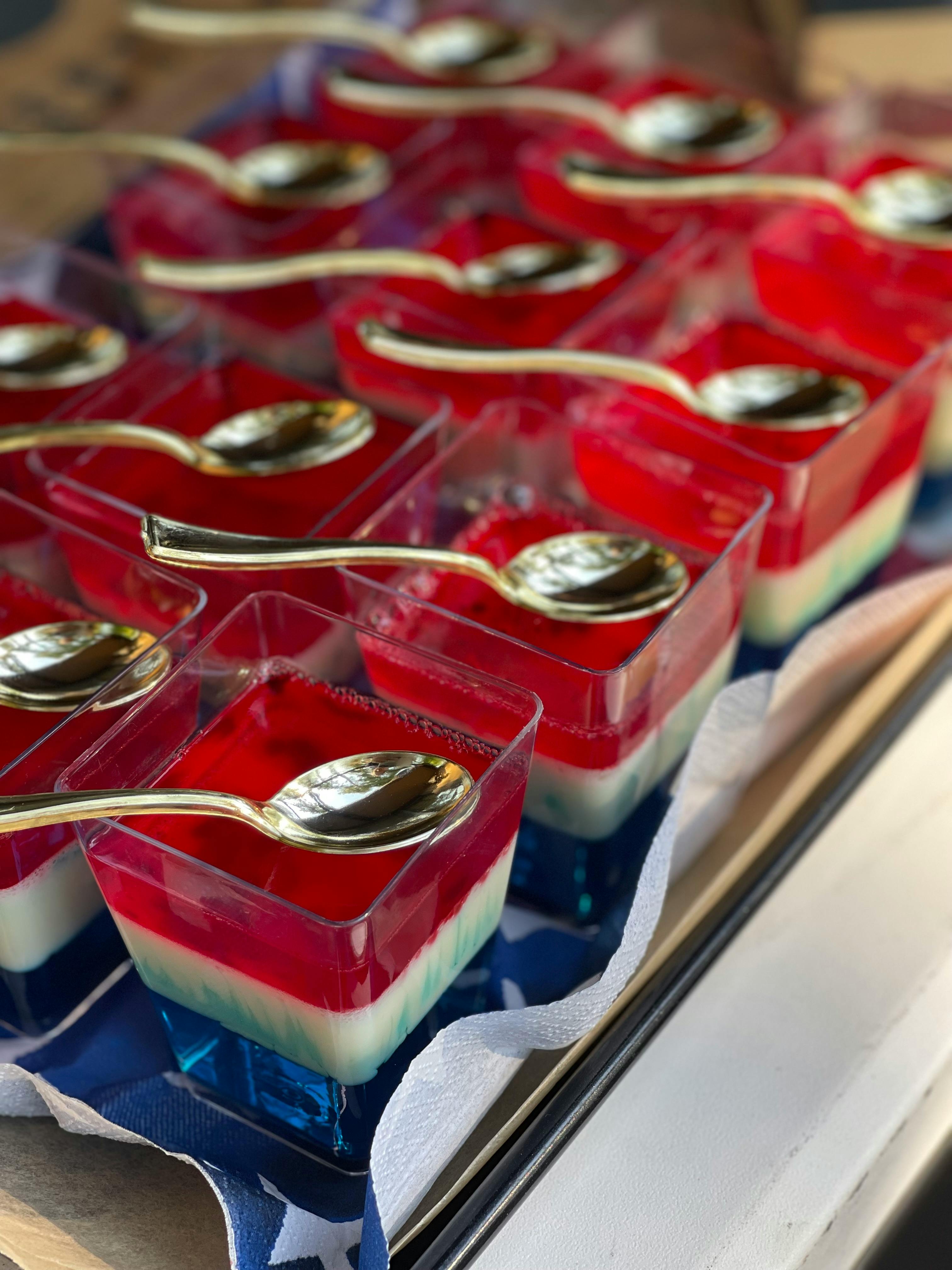
Photo: Keverne Denahan / Pexels
The diets react (see scores below)
Common Ingredients
- gelatin
- sugar
- water
- food coloring
- fruit juice or flavoring
Specific recipes may vary.
Incompatible with 8 of 11 diets
Diet Ratings
Standard Jell-O contains sugar as its second ingredient, contributing approximately 17-19g of net carbs per serving (half-cup). This added sugar directly spikes blood glucose and disrupts ketosis, making regular Jell-O incompatible with a ketogenic diet. The gelatin base itself is keto-friendly, but the sugar loading negates any benefit entirely.
Some lazy keto or flexible keto practitioners point to sugar-free Jell-O (made with aspartame or sucralose) as a perfectly acceptable keto treat with near-zero net carbs, and may argue the dish should be rated on that common variant. However, the standard sugar-containing formulation evaluated here remains firmly off-limits.
Jell-O contains gelatin as its primary structural ingredient, which is derived from boiled animal bones, connective tissue, and hides — typically from pigs or cattle. Gelatin is unambiguously an animal-derived product and is excluded from all vegan diets. There is no meaningful debate about this within the vegan community. Vegan alternatives exist (agar-agar, carrageenan, konjac-based gels) that can replicate the texture, but standard Jell-O as formulated is not vegan-compatible.
Jell-O is a processed food containing refined sugar, artificial food coloring, and artificial flavorings — all of which are explicitly excluded from the paleo diet. While gelatin itself is technically paleo-friendly (derived from animal collagen), the overall product is a highly processed commercial food that would never have existed in the Paleolithic era. The refined sugar alone disqualifies it, and the artificial additives and colorings compound the issue. Even if fruit juice or natural flavoring were used, the refined sugar and food coloring make this a clear avoid.
Jell-O is a highly processed American snack with no place in the Mediterranean diet. It is composed primarily of added sugar, artificial flavors, food colorings, and gelatin — an animal-derived processed ingredient. It offers virtually no nutritional value: no fiber, no healthy fats, no whole grains, no vegetables or legumes. The Mediterranean diet strongly discourages added sugars and ultra-processed foods, and Jell-O exemplifies both. It is not traditional to any Mediterranean cuisine and contradicts the diet's foundational emphasis on whole, minimally processed, plant-forward foods.
Jell-O is disqualified from the carnivore diet on multiple fronts. While gelatin itself is an animal-derived ingredient (collagen from animal bones and connective tissue), the commercial Jell-O formulation contains sugar, artificial or fruit-based flavorings, and synthetic food coloring — all of which are non-animal, processed additives that violate carnivore principles. Sugar alone is an automatic disqualifier. The fruit juice or flavoring component introduces plant-derived compounds. This is a heavily processed snack product with no meaningful nutritional value on the carnivore framework. Plain, unflavored gelatin dissolved in bone broth would be an entirely different and acceptable food — but Jell-O as a commercial product is not carnivore-compatible in any tier of the diet.
Jell-O contains added sugar as a primary ingredient, which is explicitly excluded on the Whole30 program. Added sugar (real or artificial) is one of the core eliminated categories for the full 30 days, and sugar is the second ingredient in standard Jell-O. While gelatin itself is compliant and fruit juice could be a compliant flavoring, the added sugar disqualifies this product entirely. There is no commonly available version of Jell-O that omits sugar — sugar-free Jell-O uses artificial sweeteners, which are also excluded. Jell-O as it commonly exists is not Whole30 compatible.
Plain Jell-O gelatin dessert is generally considered low-FODMAP in standard servings. Gelatin itself is FODMAP-free, sugar (sucrose) is low-FODMAP, and water and food coloring are non-issues. However, the ingredient 'fruit juice or flavoring' introduces ambiguity. Commercial Jell-O products typically use artificial flavors and small amounts of fruit juice, which at typical serving sizes (half-cup, ~130g) are generally within low-FODMAP thresholds. The main concern is that some flavors may use high-FODMAP fruit juices (apple, mango, pear) or the product may contain polyol-based sweeteners in sugar-free versions. Sugar-free Jell-O in particular often contains sorbitol or mannitol, which are high-FODMAP polyols and must be avoided. Standard (non-sugar-free) Jell-O flavors like strawberry, raspberry, or lime are generally safe at a standard serving, but this cannot be guaranteed across all flavors and formulations without checking labels.
Monash University has not specifically tested commercial Jell-O products, so there is reliance on ingredient-level analysis. Clinical FODMAP practitioners generally consider standard sugar-sweetened Jell-O acceptable during elimination, but advise always checking labels for polyol sweeteners (sorbitol, mannitol, xylitol) in sugar-free versions, which would make the product high-FODMAP and unsuitable during elimination phase.
Jell-O is a sugary, processed snack with added sugar as a primary ingredient and minimal nutritional value. DASH guidelines explicitly limit added sugars and sweets, placing Jell-O in the 'limit' category alongside candy and desserts. However, it is low in sodium, contains no saturated fat, no cholesterol, and is very low in calories per serving (~80 calories, ~19g sugar for standard serving). It is not a DASH-emphasized food due to its added sugar content and lack of beneficial nutrients (fiber, potassium, calcium, magnesium), but it is not categorically prohibited the way high-sodium or high-saturated-fat foods are. DASH allows up to 5 servings of sweets per week, so occasional Jell-O fits within that allowance. Sugar-free Jell-O (made with artificial sweeteners) would score higher under DASH since it eliminates the added sugar concern entirely.
Standard Jell-O is essentially sugar water with gelatin and artificial flavoring — it provides almost no nutritional value from a Zone perspective. It is pure high-glycemic simple sugar with no meaningful protein, no fat, and no fiber to slow glycemic response. A single serving (85g prepared) delivers roughly 19g of sugar and virtually zero protein or beneficial fat, making it essentially impossible to incorporate as a Zone block without severely disrupting the 40/30/30 ratio. It contributes to insulin spikes, offers no polyphenols or omega-3s, and is exactly the kind of nutritionally empty processed food Dr. Sears warns against. The only scenario where it avoids a score of 1 is that sugar-free Jell-O exists as a variant and the gelatin itself (a protein source) is a minor redeeming structural element — but as described with sugar, this is a near-pure glycemic load with no Zone-compatible function.
Jell-O is a highly processed dessert product with virtually no redeeming anti-inflammatory properties. Its primary ingredients are gelatin (a processed collagen derivative with no meaningful anti-inflammatory benefit at snack serving levels), added sugar (a key driver of inflammatory markers like CRP and IL-6), artificial food colorings (synthetic additives linked to inflammatory and hypersensitivity responses), and artificial fruit flavorings rather than actual fruit. The added sugar content alone disqualifies it under anti-inflammatory principles — refined sugars promote insulin spikes, feed pro-inflammatory pathways, and are explicitly in the 'avoid' or 'strictly limit' category across all major anti-inflammatory frameworks including Dr. Weil's pyramid and the IF Rating system. There are no omega-3s, antioxidants, polyphenols, fiber, or other anti-inflammatory compounds present. Gelatin itself is sometimes discussed in functional medicine contexts for gut health, but the processed, sugar-laden form in Jell-O negates any such benefit. This is a textbook example of a processed food with added sugar and artificial additives — exactly what anti-inflammatory eating aims to minimize.
Regular Jell-O is nutritionally sparse — it provides essentially no protein, no fiber, and very few micronutrients, making it a poor use of the reduced caloric budget GLP-1 patients have. However, it is not actively harmful in the way fried or high-fat foods are. It is easy to digest, very low in fat, gentle on the stomach, and its high water content supports hydration — a real benefit given GLP-1s suppress thirst. The sugar content (~17g per standard serving) is a drawback but is not extreme. It is soft-textured and small-portion friendly. In practice, GLP-1 clinicians sometimes permit regular Jell-O as a transitional food for patients struggling with nausea or severe appetite suppression, where getting any calories and fluids in is the immediate goal. Sugar-free Jell-O (sweetened with aspartame or sucralose) reduces the sugar concern but introduces artificial sweetener considerations. Overall, Jell-O is an occasional, situational food — not a staple and not a snack to reach for when appetite is present and a protein-rich option is available.
Some GLP-1-focused dietitians tolerate regular Jell-O as a temporary comfort or recovery food during high-nausea periods, prioritizing tolerability over nutrient density in that short window. Others firmly oppose it as an empty-calorie habit that displaces higher-quality foods and reinforces low-protein snacking patterns — particularly problematic given how critical every eating opportunity is for meeting protein targets on a reduced-calorie intake.
*See how scores were generated at our methodology page.
Nutritional profile
Six traits that cut across every diet.
Fiber & Plants
How much whole-plant food and fiber it delivers.
Healthy Fats
The quality of its fats (unsaturated, omega-3).
Whole / Unprocessed
How close it is to its natural, unprocessed form.
Gut Gentle
How easy it is on digestion (low FODMAP, few irritants).
Low Glycemic
How little it spikes your blood sugar.
Protein Density
How much protein it packs per calorie.
Controversy Index
Higher controversy = more disagreement between diets.
Diet-Specific Tips
 Low-FODMAP — 6/10
View tips
- Gelatin is FODMAP-free and safe
- Sucrose (table sugar) is low-FODMAP
- Sugar-free versions with sorbitol/mannitol must be avoided — high-FODMAP polyols
- Fruit juice or flavoring varies by product; high-FODMAP fruit bases (apple, pear, mango) are a risk
- Standard flavors (strawberry, lime, raspberry) are generally safe at half-cup serving
- Label checking is essential due to formulation variability
 DASH — 4/10
View tips
- High in added sugar (~19g per serving), which DASH guidelines explicitly limit
- No saturated fat, no cholesterol, very low sodium — not harmful in those dimensions
- Provides no DASH-beneficial nutrients: no fiber, minimal potassium, calcium, or magnesium
- DASH permits up to 5 sweets servings/week, so occasional consumption is acceptable
- Sugar-free versions score higher by eliminating the primary DASH concern
- Heavily processed with artificial colorings and flavorings, not aligned with whole-food DASH emphasis
 GLP-1 Friendly — 4/10
View tips
- Zero protein — no contribution to the 100–120g daily protein target
- Zero dietary fiber — does not support digestion or constipation prevention
- High water content — supports hydration, a genuine GLP-1 benefit
- Low fat — does not worsen nausea, bloating, or reflux
- Easy to digest — appropriate during GI side effect flares
- ~17g sugar per standard serving — moderate concern, not extreme
- Nutrient density is very low — poor use of limited caloric budget
- Sugar-free version reduces sugar concern but adds artificial sweetener variability
- Acceptable situationally (nausea, transition phases), not as a regular snack