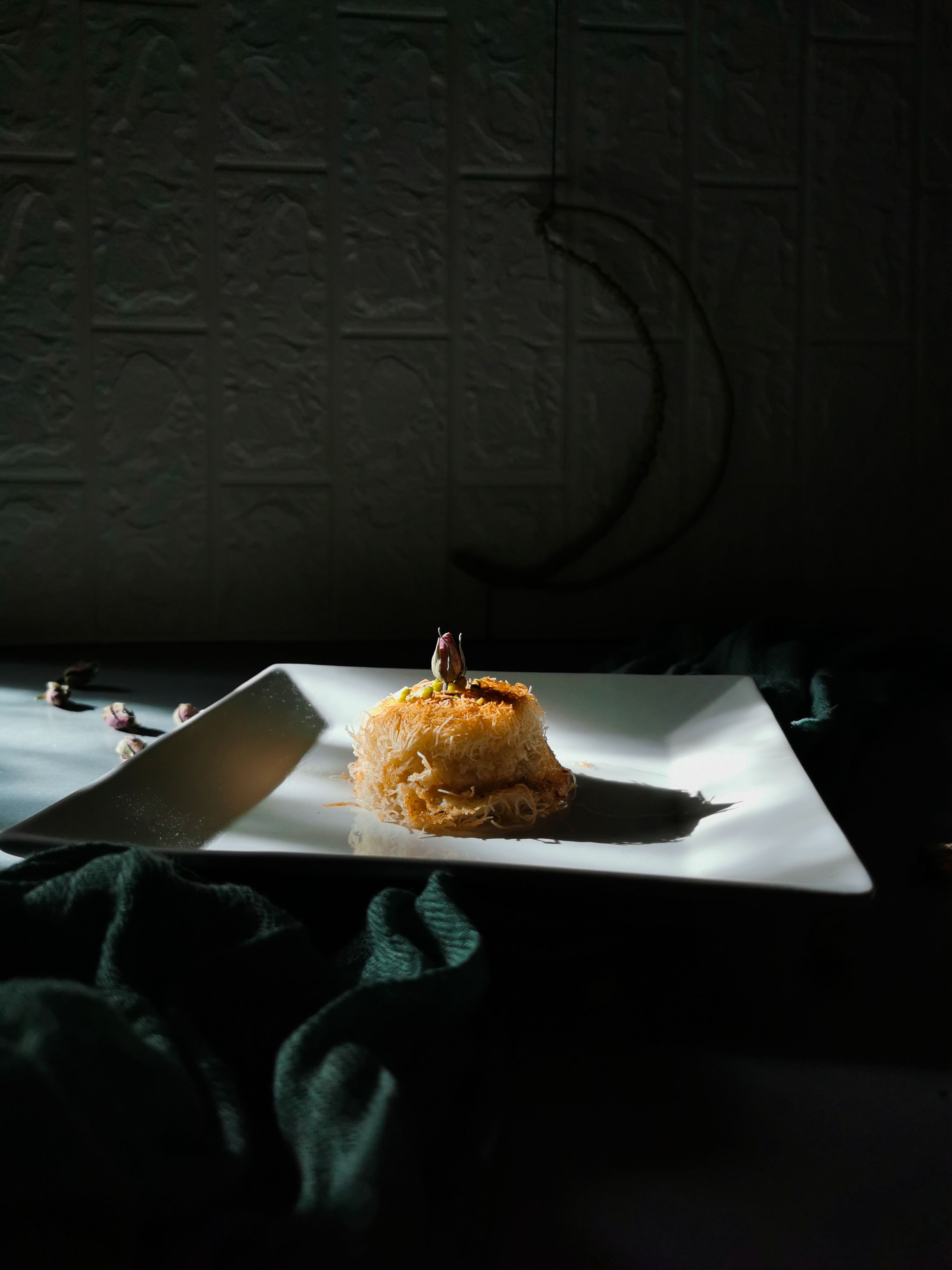
The diets react (see scores below)
Common Ingredients
- shredded phyllo pastry
- walnuts
- pistachios
- butter
- sugar
- water
- honey
- cinnamon
- cloves
Specific recipes may vary.
Incompatible with 11 of 11 diets
Diet Ratings
Kadayif is fundamentally incompatible with a ketogenic diet. The dish is built on shredded phyllo pastry, which is a wheat-based grain product with extremely high net carbs. This is compounded by a sugar syrup made from sugar, water, and honey — all of which are pure carbohydrates and disqualify the dish outright. Even a small single serving would almost certainly exceed the entire daily net carb allowance of 20-50g. While walnuts, pistachios, butter, and spices like cinnamon and cloves are individually keto-friendly, they are overwhelmed by the dominant high-carb and high-sugar components. There is no portion size that makes this dish compatible with maintaining ketosis.
Kadayif contains two clear animal-derived ingredients: butter (dairy) and honey (an animal product excluded by the Vegan Society and most major vegan organizations). Either ingredient alone would disqualify the dish under standard vegan criteria. The base — shredded phyllo pastry, nuts, sugar, spices — is plant-based, but the traditional recipe is not vegan-compliant as listed. A vegan version is achievable by substituting vegan margarine or coconut oil for butter and agave syrup or maple syrup for honey.
A minority of plant-based eaters who include honey in their diet (arguing bees are not meaningfully harmed by responsible beekeeping) would still consider this dish non-vegan due to the butter; however, if they also accept honey, they might approve a butter-substituted version. No mainstream vegan organization would consider the traditional recipe vegan.
Kadayif is fundamentally incompatible with the paleo diet. The base ingredient — shredded phyllo pastry — is made from wheat flour, a grain that is strictly excluded from paleo. Refined sugar is also a core ingredient, which is explicitly banned. Butter is a dairy product, excluded under strict paleo rules. These three non-negotiable violations make this dish impossible to approve or even place in the caution category, regardless of the paleo-friendly nuts (walnuts, pistachios), honey, cinnamon, and cloves also present. The dish is a heavily processed, grain-and-sugar-based dessert with no meaningful paleo adaptation pathway without completely reconstructing it.
Kadayif is a traditional Turkish dessert made from shredded phyllo pastry soaked in sugar syrup and butter, with nuts as a filling. While it contains Mediterranean-friendly ingredients like walnuts, pistachios, honey, and cinnamon, the dish is dominated by refined white flour (shredded phyllo), large amounts of added sugar (sugar syrup), and butter as the primary fat rather than olive oil. This combination of refined grains, high added sugar, and saturated fat directly contradicts core Mediterranean diet principles. The nuts offer some nutritional value, but their benefits are overwhelmed by the overall composition. This is an occasional indulgence at best, not a regular snack by any Mediterranean diet standard.
Some Mediterranean diet scholars note that traditional Eastern Mediterranean and Levantine culinary cultures have always included nut-and-honey-based sweets as part of festive and moderate sweet consumption, and that the presence of nutrient-dense nuts, honey, and spices gives such desserts a marginally better profile than purely industrial confections. Consumed very rarely and in small portions, such traditional sweets may be culturally consistent with a broad Mediterranean lifestyle interpretation.
Kadayif is entirely plant-based and heavily processed, containing shredded phyllo pastry (wheat flour), walnuts, pistachios, sugar, honey, cinnamon, and cloves. Every single ingredient except butter is excluded on the carnivore diet. The dish is essentially a grain-based dessert loaded with plant foods, sugar, and nuts — a direct violation of all carnivore principles. Even the small amount of butter cannot redeem this food.
Kadayif contains multiple excluded ingredients that make it clearly non-compliant with Whole30. First, shredded phyllo pastry is a wheat-based grain product, which is explicitly excluded from the program. Second, sugar is a direct excluded ingredient (added sugar). Third, honey is considered an added sugar and is excluded. Even setting aside the spirit-of-the-program concerns, the dish is also a classic baked/dessert pastry — the exact type of item Whole30 prohibits recreating even with compliant ingredients. There is no path to making this dish Whole30-compliant, as its foundational ingredients (phyllo/wheat, sugar, honey) are all excluded.
Kadayif is a Turkish dessert made from shredded phyllo (kataifi) pastry, which is a wheat-based product high in fructans — the primary FODMAP concern here. A standard serving of kadayif would deliver a significant dose of wheat-based fructans, making it unsuitable during the elimination phase. Additionally, honey is high in excess fructose and is a clear FODMAP trigger at any meaningful amount; it is used both in the syrup and potentially as a topping. Walnuts are low-FODMAP at a standard serving (~10 walnut halves), and pistachios are high-FODMAP even at moderate servings (>10 nuts per Monash). Butter and sugar are low-FODMAP. Cinnamon is low-FODMAP; cloves are low-FODMAP at typical culinary doses. The combination of high-fructan wheat pastry, high-fructose honey, and high-FODMAP pistachios makes kadayif unsuitable during the FODMAP elimination phase at any standard serving size.
Some FODMAP practitioners note that the amount of honey in a small single-serve portion of kadayif syrup may be borderline, and Monash University rates small amounts of honey (<1 tsp) as low-FODMAP — however, the wheat-based phyllo pastry alone is sufficient reason to avoid this dish during elimination, regardless of the honey quantity. The pistachio content further compounds the concern.
Kadayif is a traditional Turkish dessert made from shredded phyllo pastry soaked in a sugar syrup (sugar, water, honey) and filled with nuts (walnuts, pistachios), with butter as the primary fat. This dish is fundamentally incompatible with DASH diet principles. It is high in added sugars from both the sugar syrup and honey, high in saturated fat from butter (used generously to coat the pastry), and is a refined-carbohydrate-dominant food with minimal fiber or micronutrient value relative to its caloric density. DASH guidelines explicitly limit sweets, added sugars, and saturated fats. While walnuts and pistachios are DASH-friendly in isolation, they are present in a context that negates their benefits. The overall dish represents a high-calorie, high-sugar, high-saturated-fat confection that sits squarely in the 'limit' category of the DASH eating plan.
Kadayif is a Turkish dessert built almost entirely on Zone-unfavorable ingredients. The base is shredded phyllo pastry — a refined, high-glycemic carbohydrate with negligible fiber, meaning nearly all carbs are net carbs that spike blood sugar rapidly. It is soaked in a sugar-water-honey syrup, adding pure high-glycemic sugars with zero nutritional value. The dish contains no lean protein whatsoever, making it impossible to construct a Zone-balanced 40/30/30 block from this food alone or even as a primary component. The fat content comes largely from butter (saturated fat), which Zone discourages, though the walnuts and pistachios provide some monounsaturated and omega-3 benefit. The macronutrient profile is overwhelmingly carbohydrate-and-fat dominant with near-zero protein, the opposite of Zone targets. Even with careful portioning, the sugar syrup and refined pastry create a glycemic load that is fundamentally incompatible with Zone principles. This is one of the clearest 'avoid' cases in Zone methodology — a dessert engineered from multiple simultaneous Zone violations: refined high-GI carbs, added sugar, saturated fat, and no protein anchor.
Kadayif is a traditional Turkish dessert made from shredded phyllo pastry soaked in a sugar syrup (sugar + water + honey), filled with walnuts and/or pistachios, and baked with butter. While it contains genuinely anti-inflammatory components — walnuts are rich in omega-3 ALA, pistachios provide polyphenols and healthy fats, cinnamon and cloves are potent anti-inflammatory spices, and honey has some antioxidant properties — these positives are decisively outweighed by the dish's overall composition. The base is refined white flour (shredded phyllo), which is a refined carbohydrate with a high glycemic index. The dish is heavily sweetened with both refined sugar syrup and honey, creating a very high sugar load that drives insulin spikes and promotes inflammatory markers like CRP and IL-6. Butter is the primary fat vehicle, contributing saturated fat, which anti-inflammatory guidelines recommend limiting. The ratio of nuts and spices to refined carbohydrates and sugar is quite low — they are flavoring agents in a sugar-and-starch-dominant dessert. In totality, Kadayif is a high-sugar, high-refined-carbohydrate, high-saturated-fat confection that is directly at odds with anti-inflammatory dietary principles. Occasional consumption as a treat is not catastrophic, but it cannot be rated above 'avoid' given its core ingredients.
Kadayif is a Turkish dessert made primarily of shredded phyllo pastry soaked in sugar syrup with honey, filled with nuts, and cooked in butter. It is essentially the opposite of what GLP-1 patients need: high in refined carbohydrates and sugar (phyllo dough, sugar syrup, honey), high in saturated fat (butter), and provides negligible protein and minimal fiber relative to its calorie load. The sugar syrup base means rapid blood sugar spikes, which counteracts GLP-1's glucose-stabilizing benefits. The richness and fat content are likely to worsen GLP-1 side effects including nausea, bloating, and reflux due to slowed gastric emptying. While walnuts and pistachios offer some healthy fats and trace protein, their contribution is overwhelmed by the sugar and butter in a standard serving. This is a textbook empty-calorie, high-fat, high-sugar food that scores poorly on every GLP-1 dietary priority: protein density, fiber, digestibility, and nutrient density per calorie.
*See how scores were generated at our methodology page.
Nutritional profile
Six traits that cut across every diet.
Fiber & Plants
How much whole-plant food and fiber it delivers.
Healthy Fats
The quality of its fats (unsaturated, omega-3).
Whole / Unprocessed
How close it is to its natural, unprocessed form.
Gut Gentle
How easy it is on digestion (low FODMAP, few irritants).
Low Glycemic
How little it spikes your blood sugar.
Protein Density
How much protein it packs per calorie.
Controversy Index
Higher controversy = more disagreement between diets.