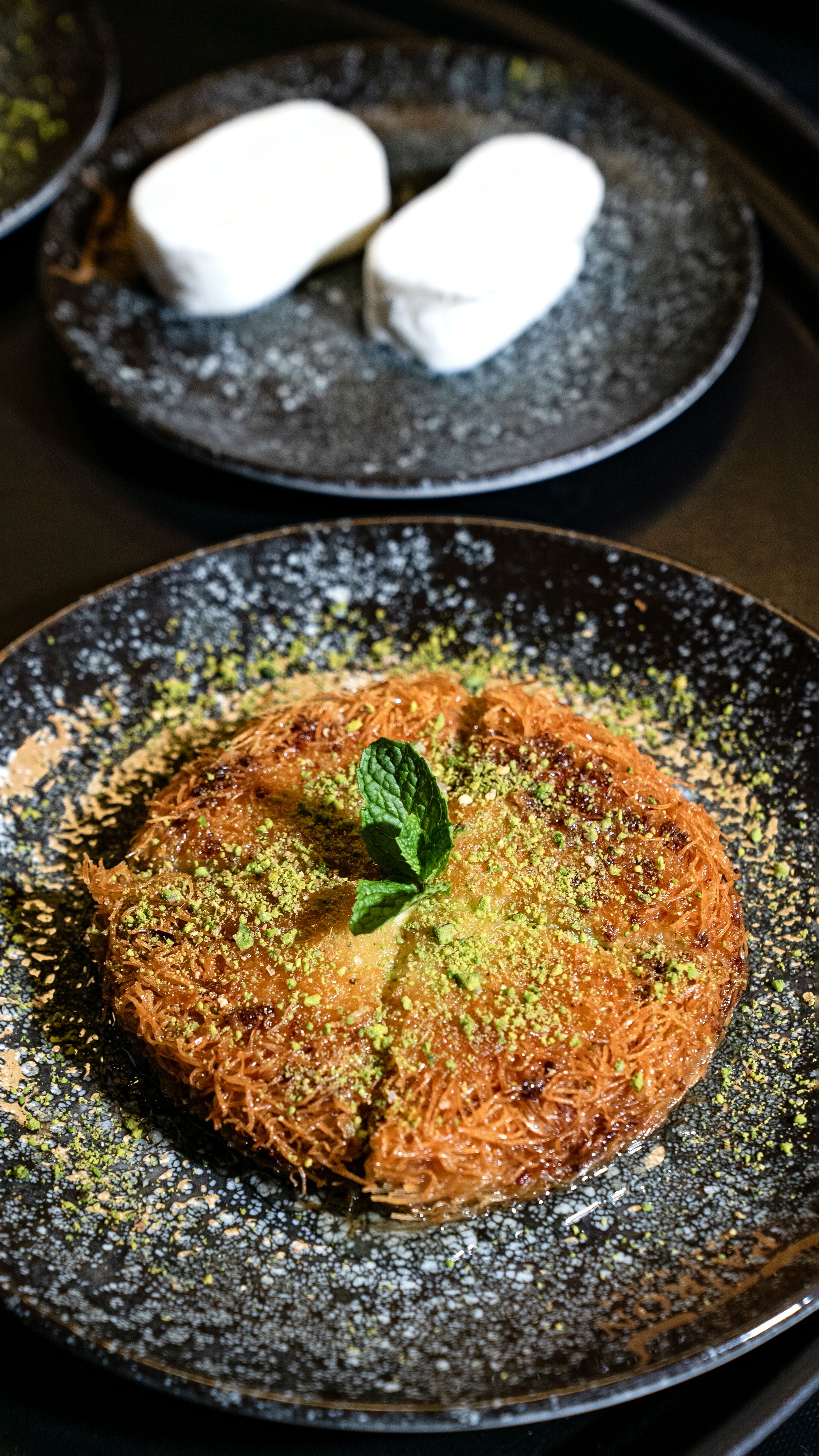
Photo: Mohamed Olwy / Pexels
The diets react (see scores below)
Common Ingredients
- phyllo pastry
- cheese
- butter
- sugar
- water
- rose water
- pistachios
Specific recipes may vary.
Incompatible with 11 of 11 diets
Diet Ratings
Kanafeh is a traditional Levantine dessert that is fundamentally incompatible with a ketogenic diet. It is built on shredded pastry (kataifi), which is a wheat-based dough loaded with refined carbohydrates. The dish is heavily sweetened with a sugar syrup made from sugar and water, providing a massive hit of simple sugars. While it contains some keto-friendly components — ghee is an excellent keto fat, white cheese provides protein and fat, and pistachios are relatively low-carb — these positives are completely overwhelmed by the grain-based pastry and sugar syrup. A single standard serving of kanafeh can contain 60–90g of net carbohydrates, which alone exceeds the entire daily carb allowance for maintaining ketosis. There is no realistic portion size that would make this dish compatible with keto.
Kanafeh contains multiple animal-derived ingredients that make it entirely incompatible with a vegan diet. White cheese (typically Nabulsi, Akkawi, or ricotta) is a dairy product, and ghee is clarified butter — also a dairy product. Both are directly derived from animal milk. There is no ambiguity here: this is a dairy-forward dessert at its core, and no vegan substitution has been made in this traditional formulation.
Kanafeh is fundamentally incompatible with the Paleolithic diet. The dish contains multiple non-paleo ingredients: shredded pastry (wheat-based, a grain), white cheese (dairy), and refined sugar — all of which are explicitly excluded. Ghee occupies a gray area, and rosewater and pistachios are paleo-acceptable, but the core structural and sweetening components of this dish are strictly off-limits. No reasonable paleo interpretation could accommodate a wheat-pastry-and-cheese dessert soaked in sugar syrup.
Kanafeh is a traditional Levantine dessert made with shredded pastry (refined grain), white cheese, ghee (saturated animal fat rather than olive oil), and a heavy sugar syrup. While it contains pistachios and dairy — both of which have some place in the Mediterranean diet — the dish is dominated by added sugar, refined/processed pastry dough, and ghee as the primary fat. This combination of high sugar content and refined carbohydrates directly contradicts Mediterranean diet principles, which minimize added sugars and refined grains. Ghee replaces the canonical olive oil fat source. As an occasional cultural indulgence it might be acceptable, but as a scored dietary item it falls into the 'avoid' category.
Some Mediterranean diet authorities acknowledge that traditional sweets from Levantine and broader Mediterranean cultures (including baklava, kanafeh, and similar pastries) hold a legitimate cultural role and are consumed sparingly during celebrations or as rare treats. From this perspective, rigid exclusion ignores the social and cultural dimensions of the Mediterranean dietary pattern as described by UNESCO and researchers like Ancel Keys, who documented sweets as part of festive eating in the region.
Kanafeh is a Levantine dessert that is fundamentally incompatible with the carnivore diet. It consists primarily of shredded pastry (wheat-based, a grain and therefore plant-derived), sugar (processed plant-derived sweetener), rosewater (plant-derived flavoring), and pistachios (nuts, plant-derived). While it does contain white cheese and ghee, which are animal-derived dairy products, these are minor components surrounded by multiple prohibited plant-based and processed ingredients. No amount of dairy inclusion makes this dish acceptable on any tier of the carnivore diet. This is a high-carbohydrate, plant-heavy dessert with virtually no carnivore-compatible profile.
Kanafeh contains multiple Whole30-excluded ingredients. The shredded pastry (kataifi) is a wheat-based dough, making it a grain product that is explicitly excluded. White cheese (typically an unsalted fresh cheese like Akkawi or Nabulsi) is dairy, which is excluded — ghee is the only dairy exception on Whole30. Sugar is an added sugar, also explicitly excluded. These three core ingredients alone make this dish entirely incompatible with Whole30, regardless of the compliant elements (ghee, rosewater, pistachios).
Kanafeh is a traditional Levantine dessert that contains multiple high-FODMAP ingredients. The shredded pastry (kataifi/kadayif) is made from wheat flour, which is high in fructans — a key FODMAP to avoid during the elimination phase. The white cheese used (typically Akkawi, Nabulsi, or similar fresh cheeses) is high in lactose, making it unsuitable for the elimination phase. Pistachios, while low-FODMAP at very small portions (around 10 kernels per Monash), are typically used in larger garnish quantities in kanafeh and become high-FODMAP at standard servings due to GOS and fructans. Sugar, ghee, water, and rosewater are low-FODMAP, but the combination of wheat-based pastry and high-lactose cheese makes this dish clearly unsuitable during the FODMAP elimination phase regardless of portion size.
Kanafeh is a traditional Levantine dessert made from shredded pastry (kataifi), white cheese (often full-fat), ghee (clarified butter high in saturated fat), and a generous sugar syrup. This combination is fundamentally incompatible with DASH diet principles: ghee is high in saturated fat, which DASH explicitly limits; the sugar syrup adds significant amounts of added sugar and refined carbohydrates; the shredded pastry is a refined grain product providing little fiber or micronutrients; and the white cheese used (such as Nabulsi or Akkawi) is often full-fat dairy rather than the low-fat or fat-free dairy DASH recommends. The dish is calorie-dense, high in saturated fat, and high in added sugars — three of the key nutritional concerns DASH targets. While pistachios as a garnish are DASH-friendly, they appear in small amounts and do not offset the overall profile. Kanafeh falls squarely in the category of sweets that DASH limits to 5 or fewer servings per week, and even then, it would represent a poor-quality choice within that allowance due to its saturated fat content from ghee and full-fat cheese.
Kanafeh is a Levantine dessert made from shredded pastry (kadaifi/kataifi dough), white cheese, ghee, and a heavy sugar syrup flavored with rosewater, typically garnished with pistachios. From a Zone Diet perspective, this dish is deeply problematic across virtually every macro category. The base is refined wheat pastry — a high-glycemic carbohydrate with negligible fiber, making it an 'unfavorable' carb in Zone terminology. The sugar syrup adds a massive glycemic spike with zero nutritional value — pure high-glycemic carbohydrate. The fat source is ghee (clarified butter), which is saturated fat, not the preferred monounsaturated fat of the Zone. The dairy cheese, while providing some protein, is typically a full-fat white cheese (like Nabulsi or Akkawi), contributing saturated fat rather than lean protein. The ratio across the dish is wildly skewed: very high in refined/high-glycemic carbohydrates, moderate-high in saturated fat, and relatively low in lean protein. There is no practical way to portion this dish into a Zone-balanced block meal — the carbohydrate load from the syrup and pastry alone would overwhelm any reasonable block count, and the fat profile is incompatible with Zone fat guidelines. The pistachios are the only Zone-favorable ingredient (monounsaturated fat, some protein), but they are present only as a garnish. This is one of the rare foods that genuinely earns an 'avoid' rating under Zone methodology.
Kanafeh is a traditional Levantine dessert with a strongly pro-inflammatory nutritional profile by anti-inflammatory diet standards. Its core components — shredded pastry (kataifi), ghee, sugar, and white cheese — combine refined carbohydrates, saturated fat, and significant added sugar in a single serving. The shredded pastry is a refined grain product offering little fiber or nutritional value. Ghee is pure clarified butterfat, high in saturated fat, which anti-inflammatory frameworks recommend limiting. The sugar syrup (sugar + water + rosewater) delivers a concentrated hit of added sugar, which directly elevates inflammatory markers like CRP and IL-6. White cheese (typically akkawi or mozzarella-style) is a full-fat dairy product, categorized as moderate-to-limit in anti-inflammatory protocols. The only redeeming ingredient is pistachios, which offer healthy fats, polyphenols, and antioxidants — but they typically appear in small quantities as a garnish. Rosewater has negligible nutritional impact at culinary doses. As an occasional treat this dish is culturally meaningful, but its dominant profile — refined starch + saturated fat + high sugar — is a textbook pro-inflammatory combination. It does not align with anti-inflammatory dietary principles.
Kanafeh is a Levantine dessert made from shredded pastry (kataifi) soaked in a sugar syrup, layered with white cheese, and saturated with ghee, finished with pistachios and rosewater. It is fundamentally incompatible with GLP-1 dietary priorities across nearly every dimension. The primary caloric load comes from refined pastry, sugar syrup, and ghee — delivering high sugar, high saturated fat, and negligible fiber in a single serving. The cheese provides modest protein but is heavily outweighed by the surrounding high-fat, high-sugar matrix. Ghee is a concentrated saturated fat that can worsen GLP-1-associated nausea, bloating, and reflux. The sugar syrup represents exactly the kind of empty, rapidly absorbed carbohydrate that destabilizes blood sugar and crowds out nutrient-dense calories in an already-reduced appetite window. The shredded pastry is a refined grain with no meaningful fiber contribution. Pistachios add a small amount of healthy fat and protein but are a garnish-level quantity and do not redeem the dish. This is a high-calorie, low-protein, low-fiber, high-fat, high-sugar preparation that is poorly tolerated by GLP-1 patients and offers minimal nutritional return per calorie consumed.
*See how scores were generated at our methodology page.
Nutritional profile
Six traits that cut across every diet.
Fiber & Plants
How much whole-plant food and fiber it delivers.
Healthy Fats
The quality of its fats (unsaturated, omega-3).
Whole / Unprocessed
How close it is to its natural, unprocessed form.
Gut Gentle
How easy it is on digestion (low FODMAP, few irritants).
Low Glycemic
How little it spikes your blood sugar.
Protein Density
How much protein it packs per calorie.
Controversy Index
Higher controversy = more disagreement between diets.