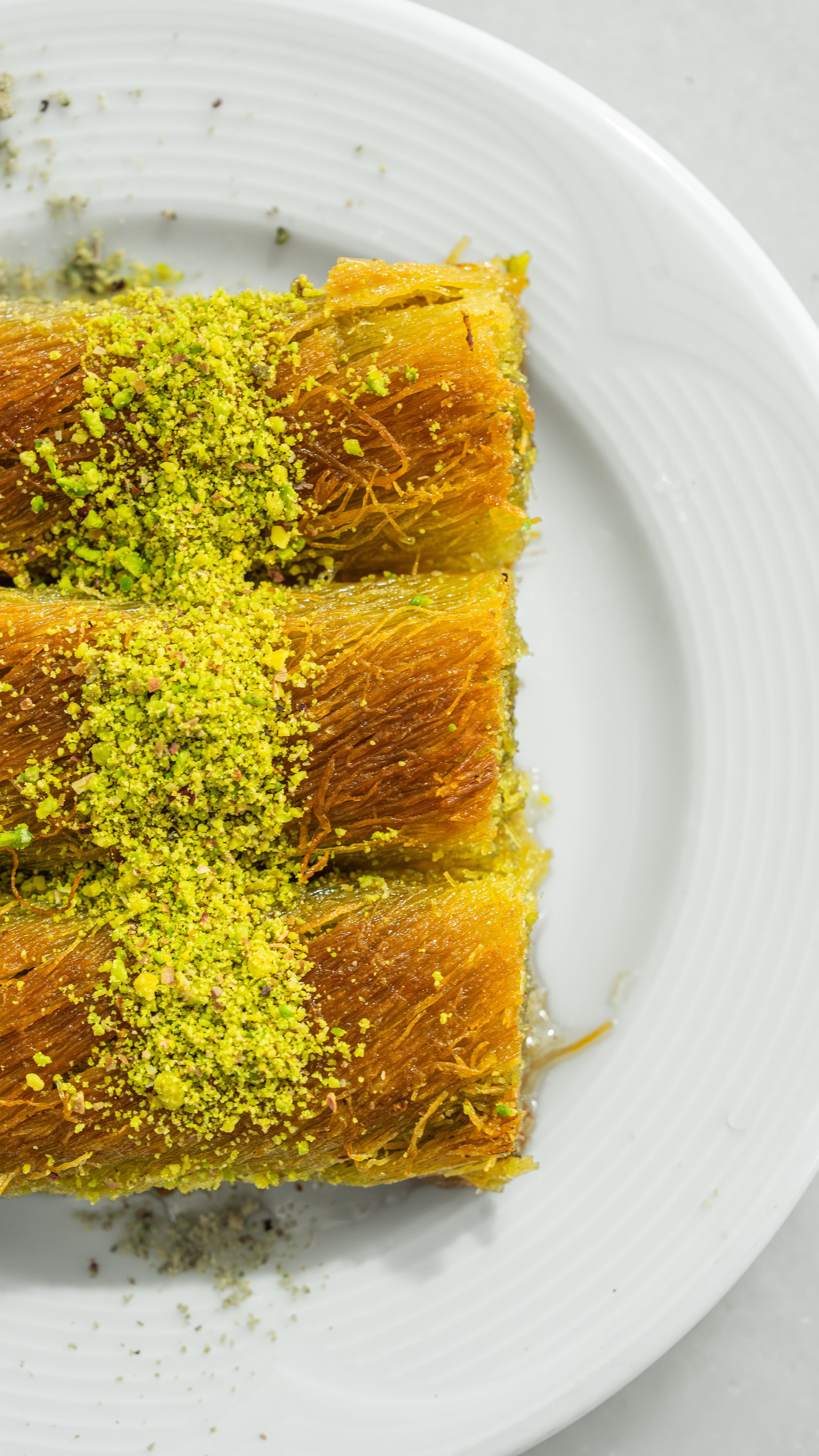
Photo: mehmetakifarts / Pexels
The diets react (see scores below)
Common Ingredients
- phyllo pastry
- walnuts
- pistachios
- honey
- butter
- cinnamon
- sugar
- water
Specific recipes may vary.
Incompatible with 11 of 11 diets
Diet Ratings
Kataifi is fundamentally incompatible with a ketogenic diet. The dish is built on shredded phyllo pastry, which is a refined wheat grain product loaded with high-glycemic carbohydrates. Beyond the pastry itself, the recipe calls for both honey and sugar as sweeteners, compounding the carbohydrate load massively. A single serving would easily contain 40-60g or more of net carbs, obliterating the entire daily keto carb budget. While walnuts and pistachios are individually keto-friendly, and butter and cinnamon are acceptable, these ingredients are overwhelmed by the dominant carb sources. There is no meaningful modification that could make this dish keto-compatible while retaining its essential character.
Kataifi contains two clear animal-derived ingredients: butter (dairy) and honey (animal product per mainstream vegan organizations). Butter alone is sufficient to make this dish non-vegan under any definition. Honey adds a second disqualifying ingredient according to the Vegan Society and most vegan advocacy groups. The nuts, cinnamon, sugar, and water are fully plant-based, and the phyllo pastry is often (though not always) vegan in its base form. However, the combination of butter and honey places this dish firmly in avoid territory. A vegan version could be made by substituting vegan butter/margarine and maple syrup or agave nectar for honey.
A minority of plant-based eaters who accept honey as a permissible ingredient (arguing bees are not harmed in honey production) would still need to address the butter — though plant-based health advocates who permit honey would substitute vegan butter and consider a modified version acceptable. No mainstream vegan organization would approve the standard recipe.
Kataifi is fundamentally incompatible with the paleo diet. The defining ingredient is phyllo/kataifi pastry, which is made from wheat flour — a grain that is categorically excluded from paleo. Beyond the pastry, the dish contains refined white sugar (not paleo), and butter (dairy, excluded under strict paleo). While walnuts, pistachios, honey, and cinnamon are paleo-compatible ingredients, the core structural components of this dessert are non-paleo. This dish cannot be made paleo-compliant without a complete reconstruction that bears no resemblance to the original.
Kataifi is a traditional Greek shredded phyllo pastry dessert loaded with added sugars (honey, sugar syrup), refined grains (phyllo/shredded pastry), and butter as the primary fat — all of which conflict with core Mediterranean diet principles. While walnuts and pistachios are genuinely Mediterranean-approved ingredients, and honey is a more natural sweetener, they are overwhelmed by the refined carbohydrate base, significant added sugars, and butter rather than olive oil. This is a festive treat, not a dietary staple, and represents exactly the category of high-sugar, refined-grain confections the Mediterranean diet advises minimizing.
Some Mediterranean diet scholars note that traditional Greek sweets like kataifi, baklava, and galaktoboureko have been part of Mediterranean food culture for centuries, consumed in small portions on special occasions. The Oldways Mediterranean Diet Pyramid acknowledges that sweets and desserts made with natural ingredients like honey and nuts can be enjoyed occasionally without violating the spirit of the diet — the key is infrequency and portion control.
Kataifi is entirely incompatible with the carnivore diet. Every single ingredient except butter is plant-derived or heavily processed: phyllo pastry is a grain-based product (wheat flour), walnuts and pistachios are nuts, cinnamon is a plant spice, sugar is a refined plant-derived sweetener, and water with honey round out a fully plant-based and sugar-laden profile. Even the butter, the one animal-derived ingredient, is a minor component in a dessert that is otherwise a carnivore's complete exclusion list. There is no meaningful animal protein or animal fat content. This is a traditional Greek pastry dessert with zero place in any tier of the carnivore diet.
Kataifi contains multiple excluded ingredients that make it clearly non-compliant with Whole30. Phyllo pastry is made from wheat flour, a grain that is explicitly excluded. Butter (regular, not ghee) is dairy and excluded. Sugar is an added sugar and excluded. Honey is also an added sugar and excluded. Even setting aside the spirit-of-the-program concerns about recreating pastry/dessert items, the ingredient list alone contains at least four separate Whole30 violations. There is no compliant version of this dish possible without fundamentally changing what it is.
Kataifi contains multiple high-FODMAP ingredients that make it unsuitable during the elimination phase. Phyllo/kataifi pastry is wheat-based, making it high in fructans — a primary FODMAP concern. Honey is high in excess fructose and is explicitly listed as high-FODMAP by Monash University; it is used generously in traditional kataifi syrup. Pistachios are high-FODMAP above a very small serving (approximately 10 kernels per Monash), and a standard kataifi portion would likely contain more. Walnuts are low-FODMAP at around 10 walnut halves (30g), so they are less of a concern in moderate amounts. Butter, cinnamon, sugar, and water are all low-FODMAP. However, the combination of wheat-based pastry, honey syrup, and pistachios creates stacked high-FODMAP loads across multiple FODMAP classes (fructans from wheat, excess fructose from honey, GOS/fructans from pistachios), making this dish unsuitable even in small portions during elimination.
Kataifi is a Greek pastry made from shredded phyllo dough soaked in sugar syrup with honey, and filled with butter-roasted nuts. While it contains some DASH-friendly components (walnuts and pistachios provide beneficial fats, magnesium, and fiber; cinnamon is neutral), the overall nutritional profile is incompatible with DASH principles. The dish is high in added sugars (honey, sugar syrup), high in saturated fat from generous amounts of butter, and is calorie-dense with minimal nutritional benefit per serving. DASH explicitly limits sweets, added sugars, and saturated fats. The nuts are a positive element but are far outweighed by the sugar and butter content that defines this dessert. Even occasional consumption should be strictly portion-controlled.
Kataifi is a Greek pastry made from shredded phyllo dough soaked in a sugar-honey syrup, with nut filling and butter. It is essentially a dessert confection dominated by high-glycemic carbohydrates (refined white flour phyllo, sugar, honey syrup) and saturated fat (butter), with virtually no lean protein and negligible fiber to moderate glycemic impact. The macro profile is radically skewed away from the 40/30/30 Zone ratio — it is overwhelmingly carbohydrate and fat with near-zero protein. The carbs present are high-glycemic (refined flour + sugar + honey), exactly what the Zone Diet classifies as 'unfavorable' or outright discourages. While walnuts and pistachios contribute some monounsaturated and polyunsaturated fats along with trace protein, they are insufficient to redeem the dish's macro imbalance. There is no realistic portioning strategy that allows Kataifi to fit a Zone block meal without completely distorting the ratio. It lacks lean protein, lacks low-glycemic carbs, and is built on sugar and refined starch. This places it firmly in the 'avoid' category alongside other pure-sugar confections.
Kataifi is a traditional Greek pastry made from shredded phyllo dough soaked in a sugar syrup (honey, sugar, water) and filled with nuts, then baked in butter. While it contains genuinely anti-inflammatory ingredients — walnuts (omega-3 ALA), pistachios (polyphenols, healthy fats), cinnamon (anti-inflammatory compounds), and honey (antioxidants) — these benefits are largely overwhelmed by the dish's overall composition. The dominant ingredients by caloric weight are refined white flour (phyllo), butter (saturated fat), and a heavy sugar syrup. The refined carbohydrate load from phyllo causes rapid blood glucose spikes, promoting pro-inflammatory cytokine release. Butter contributes significant saturated fat, which at high quantities has been linked to elevated inflammatory markers. The syrup combines both added sugar and honey in large quantities, far exceeding the modest amounts in which honey might be considered neutral-to-beneficial. Cinnamon and the nuts are genuine positives, but they function as minor components within a pro-inflammatory dessert matrix. As an occasional indulgence this is less catastrophic than, say, a heavily processed snack food, but as a regular dietary item it clearly conflicts with anti-inflammatory principles.
Kataifi is a shredded phyllo pastry dessert soaked in honey syrup and filled with butter-roasted nuts. It is essentially a concentrated source of refined carbohydrates, added sugars, and saturated fat with negligible protein and minimal fiber relative to its caloric load. The combination of butter-soaked pastry and a heavy honey-sugar syrup creates exactly the kind of high-fat, high-sugar, low-nutrient-density food that is counterproductive for GLP-1 patients. The high sugar content causes rapid blood glucose spikes — the opposite of the glycemic stabilization GLP-1 medications support. The butter contributes saturated fat, which worsens nausea, bloating, and reflux — known GLP-1 side effects. Walnuts and pistachios do offer some unsaturated fats and trace nutrients, but in this preparation they are encased in refined pastry and syrup, and the quantities are too small relative to the sugar and fat load to meaningfully redeem the dish. With dramatically reduced appetite on GLP-1s, every calorie needs to deliver protein, fiber, or essential micronutrients — Kataifi delivers almost none of these.
*See how scores were generated at our methodology page.
Nutritional profile
Six traits that cut across every diet.
Fiber & Plants
How much whole-plant food and fiber it delivers.
Healthy Fats
The quality of its fats (unsaturated, omega-3).
Whole / Unprocessed
How close it is to its natural, unprocessed form.
Gut Gentle
How easy it is on digestion (low FODMAP, few irritants).
Low Glycemic
How little it spikes your blood sugar.
Protein Density
How much protein it packs per calorie.
Controversy Index
Higher controversy = more disagreement between diets.