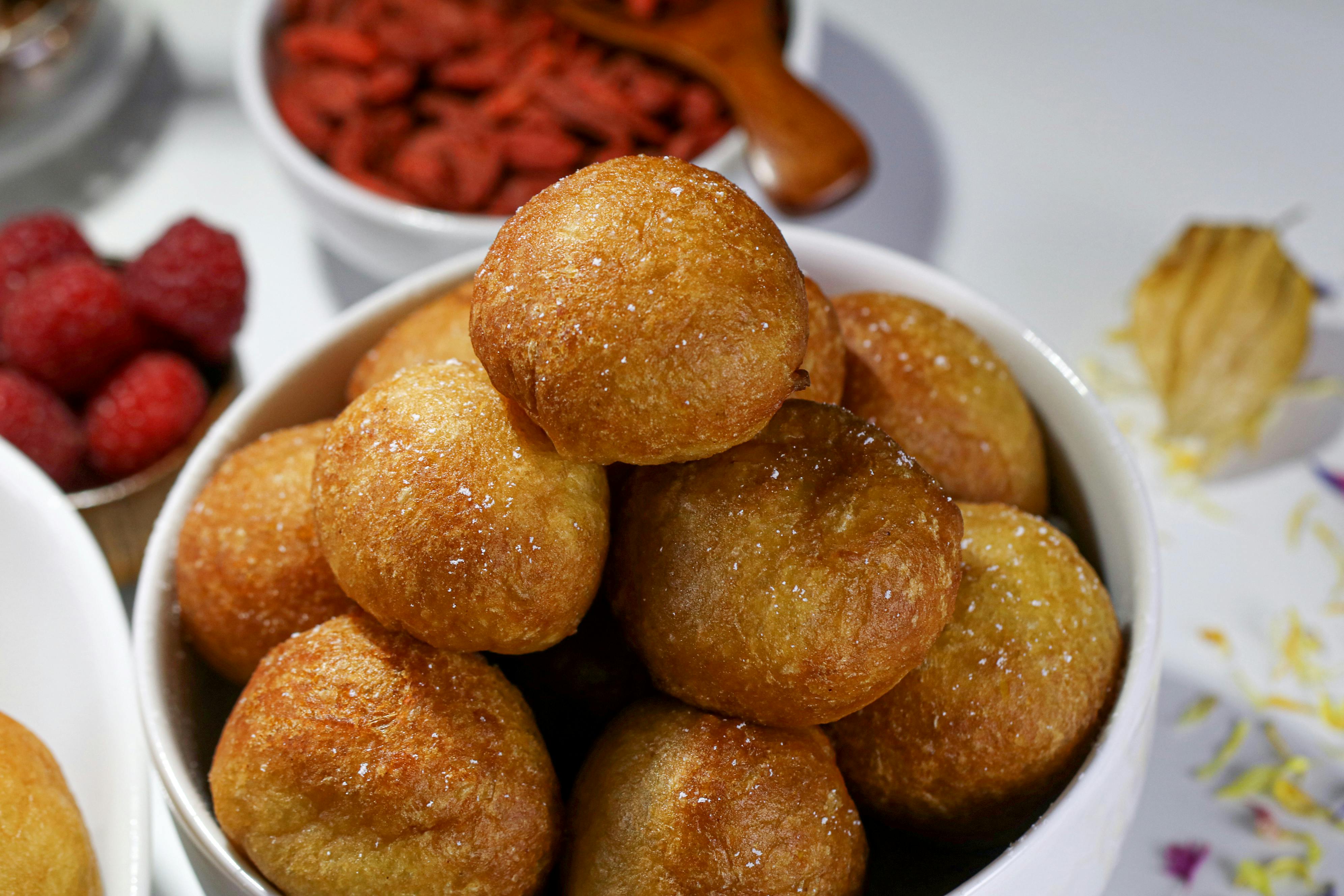
Photo: Keesha's Kitchen / Pexels
The diets react (see scores below)
Common Ingredients
- flour
- coconut milk
- sugar
- cardamom
- yeast
- salt
- oil
Specific recipes may vary.
Incompatible with 9 of 11 diets
Diet Ratings
Mandazi is a deep-fried East African doughnut made primarily from wheat flour and sugar, making it fundamentally incompatible with a ketogenic diet. Flour (wheat) is a high-carb grain, and sugar is a direct disqualifier. A single mandazi contains approximately 20-30g of net carbs, which can single-handedly exceed or max out the entire daily keto carb allowance. There is no meaningful way to consume this food within ketogenic guidelines in its traditional form.
Mandazi is a traditional East African fried dough snack. This version uses entirely plant-based ingredients: flour, coconut milk (a plant-based dairy alternative), sugar, cardamom, yeast, salt, and oil. There are no animal products or animal-derived ingredients present. Coconut milk is a whole-food plant ingredient that makes this naturally vegan-friendly. The dish is mildly processed (fried dough) but not industrially ultra-processed, keeping the score reasonably high. Note that some traditional Mandazi recipes include eggs or cow's milk — those versions would not be vegan — but the ingredient list provided here is fully compliant.
Mandazi is a deep-fried East African doughnut that is fundamentally incompatible with the paleo diet. The primary ingredient is wheat flour, a grain that is explicitly excluded from paleo. Additionally, refined sugar and added salt are non-paleo, and the oil used for frying is almost certainly a seed or vegetable oil. Yeast, while not inherently non-paleo, is irrelevant here given the multiple disqualifying ingredients. Coconut milk and cardamom are the only paleo-compliant components. This dish is essentially a processed grain product with multiple paleo violations stacked together.
Mandazi is a deep-fried dough snack made primarily from refined white flour and sugar, fried in oil (typically not olive oil). It is essentially a fried doughnut, which directly contradicts core Mediterranean diet principles: refined grains are discouraged, added sugar should be minimal, and deep frying (especially in non-olive oil) is not a recommended cooking method. Coconut milk, while plant-based, is high in saturated fat and is not a traditional Mediterranean ingredient. The dish offers little nutritional value aligned with Mediterranean principles — no vegetables, legumes, whole grains, or healthy fats — and is a processed, fried, sugary snack category that Mediterranean dietary guidelines explicitly limit.
Mandazi is a Kenyan fried dough snack made entirely from plant-based ingredients: flour (grain), coconut milk (plant), sugar (plant-derived sweetener), cardamom (spice), yeast, and oil (plant-based). There are zero animal-derived ingredients. Every single component violates carnivore diet rules — grains, plant milks, sugar, spices, and plant oils are all explicitly excluded. This is one of the clearest possible avoid ratings with no ambiguity whatsoever.
Mandazi contains multiple excluded ingredients that make it incompatible with Whole30. First, flour (wheat) is a grain and explicitly excluded. Second, sugar is an added sweetener, also explicitly excluded. Beyond the ingredient violations, Mandazi is a fried dough/bread — a baked good that falls squarely into the category of foods Whole30 prohibits even when made with compliant ingredients (the 'no recreating baked goods' rule). This dish fails on multiple fronts simultaneously.
Mandazi is a deep-fried East African doughnut made primarily with wheat flour, which is the dominant and problematic ingredient here. Wheat flour is high in fructans, a key FODMAP, and is clearly rated as high-FODMAP by Monash University. A standard serving of mandazi involves a meaningful amount of wheat flour per piece, well exceeding any safe fructan threshold. Coconut milk can be low-FODMAP at small portions (up to 1/2 cup per Monash), but in the context of an already high-FODMAP dish, this is irrelevant. Sugar, cardamom, salt, yeast, and oil are generally low-FODMAP and not concerns. The primary disqualifying ingredient is plain wheat flour, which makes this dish unsuitable during the elimination phase regardless of portion size.
Mandazi is a deep-fried East African doughnut made with refined white flour, coconut milk, sugar, and oil. This combination presents multiple DASH diet concerns: (1) Coconut milk is high in saturated fat from tropical oils, which DASH explicitly limits. (2) The dish is deep-fried, adding significant total fat and likely increasing saturated fat content depending on the frying oil used. (3) Refined white flour provides minimal fiber, potassium, magnesium, or calcium — nutrients DASH emphasizes. (4) Added sugar contributes to the sweets/sugary foods category that DASH limits. (5) Salt is added, contributing to sodium intake. The overall nutritional profile — refined carbohydrates, tropical saturated fat, added sugar, deep-fried preparation, and minimal micronutrient density — places this firmly in the 'avoid' category for DASH adherence.
Mandazi is a deep-fried East African doughnut made primarily from refined white flour, sugar, and oil — a combination that is highly problematic from a Zone Diet perspective. The macronutrient profile is dominated by high-glycemic carbohydrates (refined flour + sugar) with essentially no lean protein and predominantly saturated fat from coconut milk and frying oil. This is nearly the opposite of the Zone's 40/30/30 target. There is no meaningful protein block contribution, the carbohydrate load is high-glycemic and insulin-spiking, and the fat profile skews saturated rather than monounsaturated. While Zone is ratio-based rather than exclusion-based, Mandazi's structure offers no realistic path to Zone balance as a snack — you cannot add enough lean protein or swap enough ingredients to rescue the core glycemic and fat quality issues without fundamentally changing the dish. It scores a 2 rather than 1 only because it is not pure sugar/soda and could theoretically be consumed in a very tiny portion alongside Zone-favorable foods, though this would make it a trivial garnish rather than a meaningful snack.
Mandazi is a East African fried dough snack with a mixed anti-inflammatory profile. The primary ingredient is refined white flour, which is a refined carbohydrate that can spike blood sugar and contribute to low-grade inflammation when consumed regularly. Added sugar further compounds this concern. The frying oil (typically a neutral seed oil or vegetable oil) introduces potential omega-6 concerns depending on which oil is used, and frying itself can generate oxidation products. On the positive side, cardamom is a notable anti-inflammatory spice containing antioxidants and compounds that may reduce inflammatory markers. Coconut milk contributes some medium-chain triglycerides (MCTs), though its saturated fat content is a point of caution — it is less inflammatory than animal saturated fats but still moderate in the anti-inflammatory framework. Yeast-leavened dough is preferable to chemically leavened versions. Overall, Mandazi is a treat food — the refined carbohydrates, sugar, and frying make it a food to enjoy occasionally rather than regularly on an anti-inflammatory diet. It is not a strongly pro-inflammatory food like processed junk food, but it lacks meaningful anti-inflammatory benefits beyond the cardamom.
Mandazi is a deep-fried East African doughnut made from refined white flour, coconut milk, sugar, and oil. It is nutritionally problematic for GLP-1 patients on multiple fronts: it is fried (high fat, difficult to digest, worsens nausea and reflux), made from refined flour (low fiber, high glycemic), contains added sugar (empty calories), and provides virtually no protein. Coconut milk adds saturated fat. With reduced appetite on GLP-1 medications, every calorie needs to deliver protein, fiber, and micronutrients — mandazi delivers almost none of these. The combination of high fat and high refined carbohydrates is precisely the profile most likely to trigger GLP-1 side effects including nausea, bloating, and gastric discomfort. This is a poor use of the limited caloric budget GLP-1 patients have.
*See how scores were generated at our methodology page.
Nutritional profile
Six traits that cut across every diet.
Fiber & Plants
How much whole-plant food and fiber it delivers.
Healthy Fats
The quality of its fats (unsaturated, omega-3).
Whole / Unprocessed
How close it is to its natural, unprocessed form.
Gut Gentle
How easy it is on digestion (low FODMAP, few irritants).
Low Glycemic
How little it spikes your blood sugar.
Protein Density
How much protein it packs per calorie.
Controversy Index
Higher controversy = more disagreement between diets.
Diet-Specific Tips
 Vegan — 7/10
View tips
- All ingredients are fully plant-based
- Coconut milk replaces dairy milk, making this naturally vegan
- No eggs, which are sometimes used in traditional Mandazi recipes
- Fried dough is moderately processed but not ultra-processed
- Yeast is a fungus, not an animal product, and is universally accepted as vegan
- Sugar source unspecified — some refined white sugars use bone char in processing, though this is a minor concern most vegans do not act on
 Anti-Inflammatory — 4/10
View tips
- Refined white flour — refined carbohydrate, pro-inflammatory in excess
- Added sugar — contributes to glycemic load and low-grade inflammation
- Fried preparation — oxidation products and high omega-6 exposure depending on oil used
- Cardamom — anti-inflammatory spice with antioxidant properties
- Coconut milk — contains MCTs but also saturated fat; neutral to mildly cautious in anti-inflammatory context
- No significant anti-inflammatory nutrients (omega-3s, polyphenols, fiber) present