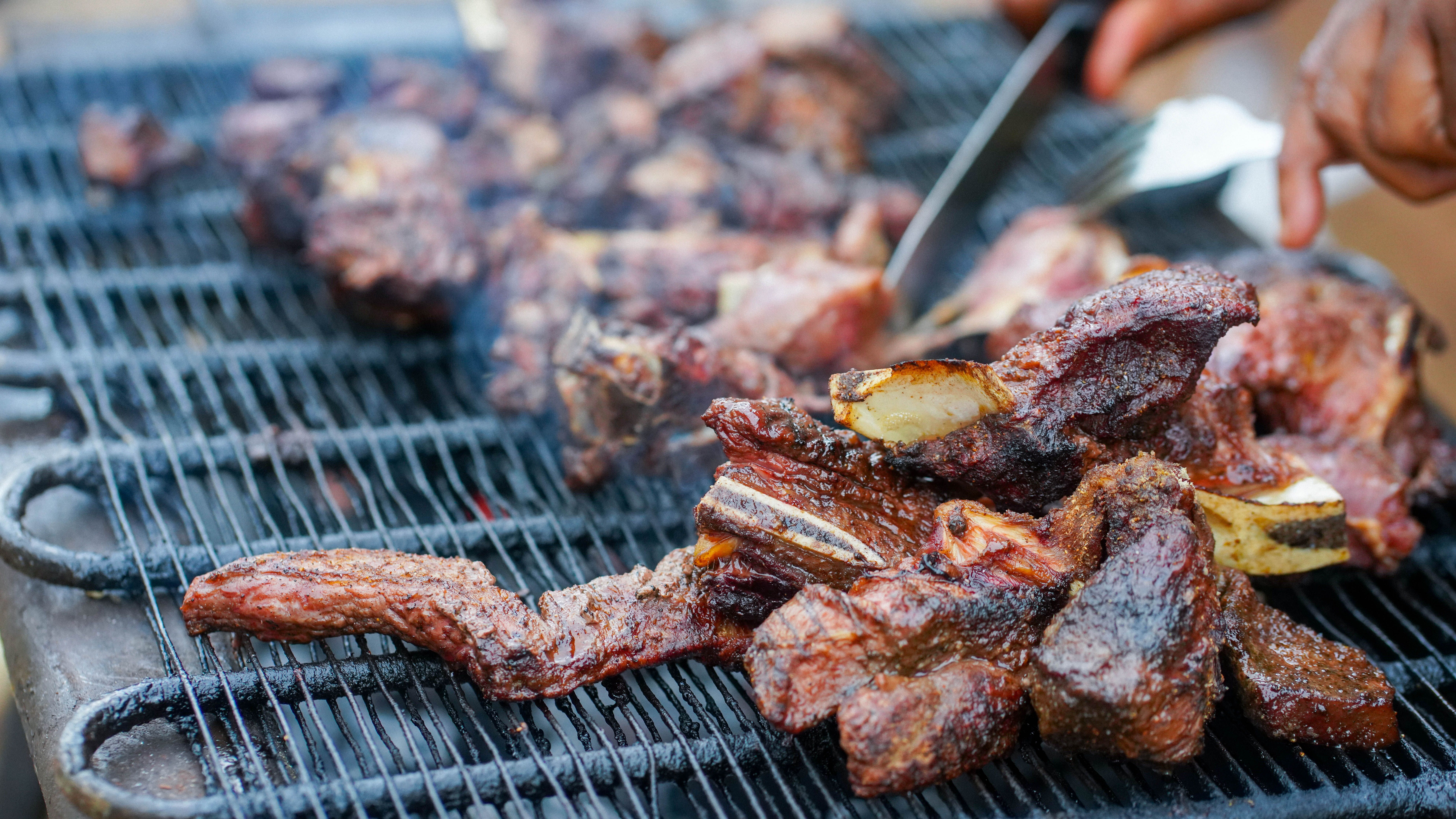
Photo: Michael Mwase / Pexels
Kenyan
Nyama Choma
The diets react (see scores below)
Common Ingredients
- goat meat
- salt
- lemon
- garlic
- onion
- chili
- black pepper
Specific recipes may vary.
Incompatible with 4 of 11 diets
Diet Ratings
Nyama Choma is essentially grilled or roasted goat meat seasoned with minimal, keto-friendly ingredients. Goat meat is a lean-to-moderate fat protein source with zero carbohydrates. The seasoning — salt, lemon juice (minimal carbs in the small quantity used), garlic, onion (small amount as seasoning), chili, and black pepper — contributes negligible net carbs overall. The dish is whole, unprocessed, and free of grains, added sugars, or starchy components. Net carbs for a standard serving are well under 5g, making this highly compatible with ketogenic macros. The only minor consideration is that goat is leaner than ideal keto proteins (like lamb or beef with higher fat content), so pairing with a fat source would optimize the macro ratio, but the dish itself is unambiguously keto-friendly.
Nyama Choma is a traditional Kenyan grilled meat dish whose primary and defining ingredient is goat meat, a direct animal product. This makes it categorically incompatible with a vegan diet under any interpretation. The remaining ingredients (salt, lemon, garlic, onion, chili, black pepper) are all plant-based, but the presence of goat meat as the core protein renders the dish entirely off-limits for vegans.
Nyama Choma is a simple East African grilled goat dish whose core ingredient — goat meat — is unambiguously paleo-approved. Garlic, onion, chili, lemon, and black pepper are all whole, unprocessed plant foods available to hunter-gatherers and fully compatible with paleo principles. The single problematic ingredient is salt, which is explicitly excluded under strict paleo rules (added salt is considered a non-ancestral, processed seasoning by Cordain and most paleo authorities). In practice, salt is the only thing preventing a full approval here, so the dish scores in the upper caution range rather than avoid.
Many modern paleo practitioners and frameworks (e.g., Mark Sisson's Primal Blueprint, Whole30) treat small amounts of sea salt or mineral salt as acceptable, arguing that ancestral humans had access to natural salt sources and that unrefined salt carries trace minerals. Under this more lenient interpretation, Nyama Choma would comfortably score an 8–9 approval.
Nyama Choma is a grilled red meat dish with goat as the primary protein. Red meat is explicitly limited in the Mediterranean diet to a few times per month at most. While the accompanying seasonings (lemon, garlic, onion, chili, black pepper) are fully Mediterranean-compatible, the dish is centered on a substantial portion of red meat, which contradicts core Mediterranean dietary principles. The preparation is clean and unprocessed — no refined grains, added sugars, or industrial fats — which prevents the lowest possible score, but the red meat base remains the dominant concern.
Some Mediterranean diet researchers note that goat is a leaner red meat historically consumed in parts of the Mediterranean (particularly Greece, southern Italy, and North Africa), and occasional consumption in small portions may be acceptable within a traditional framework. The Oldways Mediterranean Diet Pyramid acknowledges goat as part of traditional regional practice, suggesting a monthly rather than absolute exclusion.
Nyama Choma features goat meat as its base — an excellent ruminant protein that would ordinarily score highly on the carnivore diet. However, the marinade includes multiple plant-derived ingredients: lemon (fruit), garlic (allium vegetable), onion (allium vegetable), chili (nightshade), and black pepper (spice). All of these are excluded from carnivore. Salt is the only acceptable seasoning here. The dish as prepared cannot be approved in its traditional form. A carnivore-compliant version would be simply goat meat with salt only.
Some carnivore-adjacent practitioners, particularly those following Paul Saladino's more relaxed 'animal-based' framework or who use minimal spices pragmatically, might tolerate small amounts of salt and pepper or brief lemon use and still consider the dish close enough to compliant, especially given the ruminant meat base. However, strict carnivore authorities like Shawn Baker would exclude all plant seasonings including garlic, onion, chili, and lemon without exception.
Nyama Choma is a traditional East African grilled meat dish consisting entirely of Whole30-compliant ingredients. Goat meat is a whole animal protein explicitly allowed on the program. Salt, lemon, garlic, onion, chili, and black pepper are all natural seasonings, aromatics, or fruits that are fully compatible with Whole30 rules. There are no excluded ingredients — no added sugars, grains, legumes, dairy, alcohol, or any other prohibited substances. This dish is a straightforward, unprocessed preparation of meat with whole-food seasonings.
Nyama Choma as traditionally prepared contains two high-FODMAP ingredients that are non-negotiable triggers during the elimination phase: garlic and onion. Both are among the highest-fructan foods tested by Monash University, and even small amounts used as a marinade or rub can deliver significant FODMAP load. The base protein — plain grilled goat meat — is inherently low-FODMAP (all plain unseasoned meats are free of FODMAPs), and the remaining ingredients (salt, lemon juice, chili, black pepper) are low-FODMAP. However, garlic and onion are categorically high-FODMAP at any culinary quantity and cannot be reduced to a 'safe' portion within a realistic serving of this dish. Unless the recipe is specifically modified to omit garlic and onion (substituting garlic-infused oil and the green tops of spring onions), this dish is unsuitable during the elimination phase.
Nyama Choma is grilled goat meat seasoned with salt, lemon, garlic, onion, chili, and black pepper. Goat meat is a lean red meat — leaner than beef and comparable to chicken in fat content — which places it in a gray area for DASH. DASH guidelines explicitly limit red meat due to saturated fat and cholesterol concerns, favoring poultry, fish, beans, and nuts as primary proteins. However, goat is notably lower in saturated fat than most other red meats (approximately 0.8g saturated fat per 3oz cooked vs. 3g for beef), which some DASH-oriented clinicians find acceptable in moderation. The marinade ingredients (lemon, garlic, onion, chili, black pepper) are all DASH-friendly and add potassium-rich aromatics. The primary concern is added salt, which can be substantial in traditional preparation; sodium content depends heavily on how liberally salt is used. As commonly prepared, salt is rubbed generously into the meat, potentially pushing sodium toward or beyond DASH limits for a single serving. Occasional, portion-controlled consumption with minimal salt aligns better with DASH principles.
NIH DASH guidelines categorize all red meat (including goat) as a food to limit, recommending no more than 6oz of lean meat, poultry, or fish per day with a preference away from red meat. However, updated clinical interpretations note that goat's exceptionally low saturated fat profile (~40% less than chicken thigh) leads some DASH-oriented dietitians to treat it more like lean poultry, allowing moderate inclusion especially when prepared with heart-healthy spices rather than high-sodium sauces.
Nyama Choma is grilled goat meat seasoned with salt, lemon, garlic, onion, chili, and black pepper — a relatively clean, minimally processed preparation. From a Zone perspective, the protein source (goat) is leaner than beef but not as lean as skinless chicken or fish. Goat meat contains moderate saturated fat, which the Zone Diet discourages in favor of lean proteins. The dish as prepared is essentially a pure protein source with negligible carbohydrates and minimal fat from cooking, meaning it cannot stand alone as a Zone-balanced meal without accompanying low-glycemic carbohydrate and monounsaturated fat blocks. The seasonings (lemon, garlic, onion, chili, black pepper) are all Zone-favorable and anti-inflammatory. Portioned correctly (~3 oz / ~85g cooked, yielding ~25g protein), Nyama Choma can serve as the protein block in a Zone meal — but it needs to be paired with colorful vegetables and a monounsaturated fat source (e.g., avocado, olive oil) to complete the 40/30/30 ratio. The caution rating reflects the moderately elevated saturated fat content of goat versus ideal Zone proteins, and the structural imbalance of the dish as served (protein-dominant, nearly zero carbs or fat blocks).
Some Zone practitioners and Sears' later anti-inflammatory writings (notably 'The Zone Diet' updated editions and 'Toxic Fat') take a more nuanced view of saturated fat, acknowledging that lean red meats including goat can fit into a Zone framework, especially given goat's favorable omega-6 to omega-3 ratio compared to beef. In this context, Nyama Choma's clean ingredient list and grilled (not fried) preparation might earn a higher score of 6-7, particularly when the meal is built out with Zone-favorable sides.
Nyama Choma is grilled goat meat seasoned with salt, lemon, garlic, onion, chili, and black pepper — a relatively clean preparation by processed food standards. Goat meat is a lean red meat with a favorable fat profile compared to beef or lamb; it is lower in total fat, saturated fat, and calories, and contains some omega-3s, though not in quantities comparable to fatty fish. The marinade and seasoning are a genuine anti-inflammatory asset: garlic and chili pepper carry anti-inflammatory polyphenols and organosulfur compounds, lemon provides vitamin C and flavonoids, and black pepper contains piperine which has demonstrated anti-inflammatory activity in research. There are no processed ingredients, seed oils, refined carbohydrates, or additives. However, goat is still red meat, and anti-inflammatory guidelines broadly advise limiting red meat due to saturated fat content, heme iron, and its association with elevated inflammatory markers (CRP, IL-6) with frequent consumption. The grilling method can also produce heterocyclic amines (HCAs) and polycyclic aromatic hydrocarbons (PAHs), which are pro-inflammatory compounds formed at high temperatures. Occasional consumption of this dish — particularly with the anti-inflammatory seasoning profile — is reasonable and compatible with an anti-inflammatory eating pattern, but regular or large-portion consumption of grilled red meat is discouraged.
Some anti-inflammatory researchers, including those in the ancestral or paleo-adjacent camp, argue that lean, minimally processed red meats like goat — especially from grass-fed animals — are not inherently pro-inflammatory and may even support anti-inflammatory outcomes due to conjugated linoleic acid (CLA) and zinc content. Dr. Weil's framework categorizes red meat as 'limit' rather than 'avoid,' acknowledging occasional inclusion, whereas stricter plant-forward anti-inflammatory protocols would rate any red meat more negatively regardless of preparation quality.
Nyama Choma is Kenyan-style roasted or grilled goat meat, seasoned simply with salt, lemon, garlic, onion, chili, and black pepper. Goat is a lean red meat relative to beef or lamb — it is high in protein and lower in saturated fat than most red meats, which works in its favor for GLP-1 patients. A 100g serving of goat provides roughly 27g of protein with moderate fat. The grilling method is a positive: no added oil, no frying, and the marinade ingredients (lemon, garlic, onion) are digestively neutral to beneficial. However, goat is still red meat with saturated fat, which places it in a cautious category under GLP-1 dietary guidance. The chili may cause mild GI irritation in sensitive patients, particularly those experiencing nausea or reflux. The dish is also typically served in large bone-in pieces, making portion control harder. No fiber is present in the dish itself, so pairing with vegetables or legumes is strongly recommended. Overall this is a better red meat choice than fatty cuts or processed meats, but it sits firmly in the caution tier rather than approve.
Some GLP-1-focused dietitians view lean goat as an acceptable protein source comparable to chicken thighs, particularly given its lower fat profile versus other red meats, and may rate it more favorably for patients who tolerate it well. Others apply a blanket caution to all red meat for GLP-1 patients due to slower gastric emptying making heavier proteins harder to tolerate, and the saturated fat contribution at typical serving sizes.
*See how scores were generated at our methodology page.
Nutritional profile
Six traits that cut across every diet.
Fiber & Plants
How much whole-plant food and fiber it delivers.
Healthy Fats
The quality of its fats (unsaturated, omega-3).
Whole / Unprocessed
How close it is to its natural, unprocessed form.
Gut Gentle
How easy it is on digestion (low FODMAP, few irritants).
Low Glycemic
How little it spikes your blood sugar.
Protein Density
How much protein it packs per calorie.
Controversy Index
Higher controversy = more disagreement between diets.
Diet-Specific Tips
 Keto — 9/10
View tips
- Goat meat is zero-carb and a clean, unprocessed protein source
- All seasonings (salt, lemon, garlic, onion, chili, black pepper) contribute minimal net carbs in typical quantities
- No grains, added sugars, or starchy ingredients
- Whole, unprocessed preparation aligns with keto food quality standards
- Goat is leaner than optimal keto proteins; fat intake may need supplementing from other meal components
- Net carbs per serving estimated under 3-5g
 Paleo — 6/10
View tips
- Goat meat is a clean, unprocessed animal protein — fully paleo approved
- Lemon, garlic, onion, chili, and black pepper are all whole paleo-compliant seasonings
- Salt is the sole non-compliant ingredient under strict Cordain-school paleo rules
- Salt inclusion lowers the score from approve to upper caution
- Dish is otherwise minimally processed and closely aligned with ancestral eating patterns
- Lenient modern paleo frameworks often permit unrefined salt, making this borderline
 Whole30 — 10/10
View tips
- Goat meat is a whole, unprocessed animal protein — fully allowed
- Salt is explicitly permitted on Whole30
- Lemon is a whole fruit — fully compliant
- Garlic, onion, and chili are whole vegetables — fully compliant
- Black pepper is a natural spice — fully compliant
- No excluded ingredients present
- Simple, unprocessed preparation aligns perfectly with Whole30 principles
 DASH — 5/10
View tips
- Goat is red meat, which DASH guidelines advise limiting
- Goat is notably lean with low saturated fat compared to other red meats
- High variable sodium from salt rub — a key DASH concern
- No processed ingredients, added sugars, or tropical oils
- DASH-friendly aromatics: garlic, onion, lemon, chili, black pepper
- Portion size critical — 3oz serving far more DASH-compatible than large cuts
- Grilling preparation avoids added fats, which is favorable
 Zone — 5/10
View tips
- Goat meat is leaner than beef but still carries moderate saturated fat — not an ideal Zone protein source
- Dish is nearly pure protein with almost no carbohydrates or fat blocks — cannot function as a Zone meal without sides
- Clean, minimally processed preparation with anti-inflammatory seasonings (lemon, garlic, chili) is Zone-positive
- Grilling method avoids added seed oils or trans fats — consistent with Zone anti-inflammatory principles
- Must be paired with low-glycemic vegetables and monounsaturated fat to achieve 40/30/30 ratio
- Goat has a relatively favorable omega-6:omega-3 profile compared to conventional beef
 Anti-Inflammatory — 5/10
View tips
- Goat meat is a lean red meat — lower saturated fat than beef or lamb, but still classified as red meat under anti-inflammatory guidelines
- Anti-inflammatory seasoning profile: garlic (organosulfur compounds), chili pepper (capsaicin), black pepper (piperine), lemon (vitamin C, flavonoids)
- No processed ingredients, seed oils, refined carbohydrates, or artificial additives
- Grilling at high heat can produce HCAs and PAHs — pro-inflammatory cooking byproducts
- Appropriate as an occasional meal; frequent red meat consumption is associated with elevated CRP and IL-6
- Lean preparation with no butter, cream, or high-fat dairy additions
 GLP-1 Friendly — 5/10
View tips
- Goat is a lean red meat — lower saturated fat than beef or lamb, but still a red meat requiring moderation
- High protein content (~27g per 100g) supports the #1 GLP-1 dietary priority
- Grilled preparation avoids added fat from frying — a meaningful positive
- Chili in the marinade may irritate GI tract in patients experiencing nausea or reflux
- No fiber in the dish — pairing with legumes or vegetables is essential
- Bone-in serving style makes portion control more difficult
- Saturated fat content, even if moderate, is a concern under GLP-1 low-fat guidelines