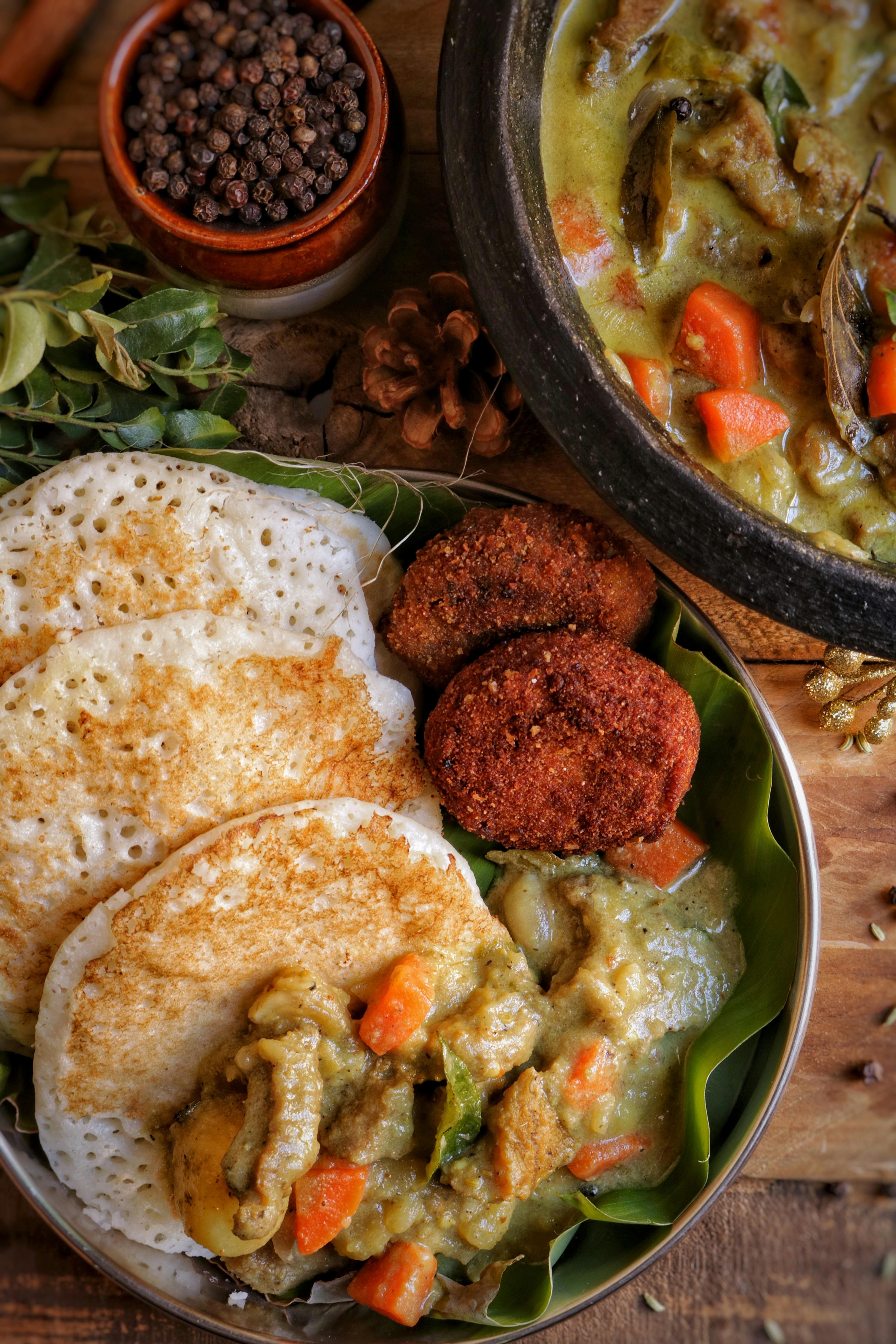
Photo: Saveurs Secretes / Pexels
Indian
Appam with Stew
The diets react (see scores below)
Common Ingredients
- rice
- coconut milk
- yeast
- potato
- carrot
- green chili
- ginger
- curry leaves
Specific recipes may vary.
Incompatible with 5 of 11 diets
Diet Ratings
Appam with Stew is fundamentally incompatible with a ketogenic diet. Appam is made from fermented rice batter, which is a high-carb grain — a single appam can contain 20-30g of net carbs on its own, easily blowing the entire daily keto carb budget. The stew compounds the problem with potato and carrot, both starchy/high-carb vegetables. Potato in particular is one of the most keto-incompatible vegetables, with roughly 15-17g net carbs per 100g. While coconut milk, green chili, ginger, and curry leaves are keto-friendly components, they cannot offset the dominant high-carb ingredients. This dish is built on a foundation of grains and starchy vegetables — two categories with zero tolerance in ketogenic eating.
Appam with Stew as described is entirely plant-based. Appam (rice hoppers) are made from fermented rice batter leavened with yeast — no eggs or dairy required. The stew uses coconut milk as its base, which is a whole-food plant ingredient, combined with potato, carrot, green chili, ginger, and curry leaves — all vegetables and aromatics. Traditional Kerala stew recipes often include coconut milk as the fat/liquid component, making this version naturally vegan without any substitutions needed. Every ingredient listed is whole or minimally processed plant food, earning a high score within the approve range.
Appam with Stew is fundamentally incompatible with the paleo diet. The primary component, appam, is made from rice — a grain that is explicitly excluded from paleo. Yeast, while not a grain itself, is used here as a leavening agent for a grain-based batter, making the dish processed and grain-dependent. The stew contains potato, which is debated in paleo circles, and carrot, green chili, ginger, and curry leaves, which are paleo-approved. Coconut milk is also paleo-friendly. However, rice is the dominant and defining ingredient of this dish, and no amount of paleo-approved accompaniments can offset a core grain-based component. The dish as a whole must be rated avoid.
Appam with stew is a plant-forward dish featuring vegetables (potato, carrot, green chili, ginger, curry leaves) which align well with Mediterranean principles. However, two key ingredients raise concerns: (1) White rice (refined grain) is the base of appam, which conflicts with the Mediterranean preference for whole grains. (2) Coconut milk is the primary fat source here, replacing olive oil — coconut is high in saturated fat and is not a traditional Mediterranean fat. The vegetable-rich stew component is positive, and there is no red meat, added sugars, or heavy processing. Overall, this dish sits in a moderate zone — vegetable-positive but relying on a refined grain base and a non-canonical saturated fat.
Some modern Mediterranean diet interpretations accept coconut milk sparingly as a plant-based fat, and traditional Mediterranean cuisines (e.g., parts of Southern Italy and Greece) do include white rice dishes, suggesting occasional consumption of this meal could be compatible. Strict clinical guidelines, however, would flag both the refined rice and coconut milk as departures from core principles.
Appam with Stew is entirely plant-based and directly contradicts every tier of the carnivore diet. Appam is made from rice (a grain) fermented with yeast and coconut milk (a plant-derived liquid). The stew contains potato and carrot (starchy vegetables), green chili and ginger (plant spices/roots), curry leaves (plant herb), and more coconut milk. There is not a single animal-derived ingredient in this dish. All components — grains, plant milks, vegetables, spices, and herbs — are explicitly excluded under carnivore diet rules at every level, including the most lenient 'animal-based' approaches.
Appam is a fermented rice crepe/pancake made primarily from rice, which is an excluded grain on Whole30. Even if the stew itself (coconut milk, potato, carrot, green chili, ginger, curry leaves) contains only compliant ingredients, the appam component is disqualifying on two separate grounds: (1) rice is an excluded grain, and (2) appam is explicitly the type of pancake/crepe that falls under the 'no recreating baked goods/junk food' rule — Whole30 specifically lists pancakes and crepes as prohibited even when made with compliant ingredients. The combination cannot be made Whole30-compliant as presented.
Appam with stew contains several individually manageable ingredients, but the combination creates practical FODMAP concerns. Rice (appam base) is low-FODMAP and safe. Coconut milk is low-FODMAP at small servings (up to 1/2 cup per Monash), but becomes high-FODMAP at larger amounts due to sorbitol — and stew recipes typically use generous quantities. Yeast is low-FODMAP in small amounts used for fermentation. Potato is low-FODMAP at a standard serving (up to 1 medium potato). Carrot is low-FODMAP and safe. Green chili is low-FODMAP in small amounts. Ginger is low-FODMAP at standard culinary amounts (up to 1 teaspoon fresh). Curry leaves are low-FODMAP in small culinary quantities. The primary concern is coconut milk quantity — traditional Kerala stew often uses 1–2 cups or more, which would push the dish into high-FODMAP territory due to sorbitol content. Additionally, some stew recipes include onion or garlic not listed here, but based on listed ingredients only, the dish is borderline. Portion control of both coconut milk quantity in preparation and overall serving size is essential.
Monash University rates coconut milk as low-FODMAP at 1/2 cup (125ml) per serving, but many clinical FODMAP practitioners caution that traditional Indian stew preparations use significantly more coconut milk, making it difficult to stay within safe thresholds in a real-world serving. The cumulative FODMAP load from multiple moderate-risk ingredients (coconut milk, ginger, chili) also raises concern for sensitive individuals during strict elimination.
Appam with Stew is a traditional South Indian breakfast with several DASH-compatible elements (vegetables like potato and carrot, anti-inflammatory spices like ginger and curry leaves) but is notably challenged by the use of coconut milk, which is high in saturated fat from a tropical oil source — a category explicitly limited by DASH guidelines. The appam itself is made from white rice (refined grain), which is less preferred than whole grains under DASH. The vegetable stew component is positive: potatoes provide potassium, carrots provide fiber and micronutrients, and the dish is inherently low in sodium if prepared without added salt. However, full-fat coconut milk can significantly raise saturated fat content. The dish has no lean protein or low-fat dairy, missing key DASH pillars. Overall it is acceptable in moderation, particularly if light coconut milk is used and portion size is controlled.
NIH DASH guidelines explicitly limit saturated fat and tropical oils like coconut, making full-fat coconut milk a concern. However, updated clinical interpretations note that the medium-chain triglycerides (MCTs) in coconut milk may have a different metabolic profile than long-chain saturated fats, and some DASH-oriented dietitians permit moderate coconut milk use when overall saturated fat intake is within limits — especially in cultural dietary contexts where substitution may be impractical.
Appam with Stew is highly problematic for the Zone Diet on multiple fronts. The dish is carbohydrate-dominated with no meaningful lean protein source. Appam is made from fermented rice batter — white rice is a high-glycemic, unfavorable carb in Zone terminology that spikes insulin. The stew contains potato, another food Dr. Sears explicitly lists as unfavorable and high-glycemic. Coconut milk adds significant saturated fat with no lean protein to accompany it. The dish has essentially no Zone-favorable protein, making it nearly impossible to construct a 40/30/30 block ratio from this meal alone. The carbohydrate load comes almost entirely from high-glycemic, unfavorable sources (white rice, potato), and the fat profile is dominated by saturated fat from coconut milk rather than monounsaturated sources. While carrots, green chili, ginger, and curry leaves are Zone-friendly ingredients, they are minor players here. This is one of the rare cases where a dish scores low because its foundational macronutrient structure — high-GI carbs, saturated fat, no protein — is antithetical to Zone principles and cannot be easily corrected by portioning alone.
Appam with Stew is a traditional South Indian breakfast with a mixed anti-inflammatory profile. On the positive side, the dish contains several genuinely anti-inflammatory ingredients: ginger is well-established for its gingerol content which reduces inflammatory markers; curry leaves contain antioxidants and flavonoids; green chili provides capsaicin with anti-inflammatory properties; and carrots offer beta-carotene and carotenoids. Coconut milk, while high in saturated fat (medium-chain triglycerides from lauric acid), occupies a debated middle ground — it is not universally condemned in anti-inflammatory frameworks, though it should be used in moderation due to saturated fat content. The main concerns are the refined white rice base of the appam (a fermented rice crepe), which is a refined carbohydrate with a high glycemic index that can spike blood sugar and promote inflammatory responses when eaten regularly. Fermentation of the batter (using yeast) does modestly improve digestibility and may introduce some beneficial organic acids, but does not significantly redeem the refined carbohydrate load. Potatoes are a starchy vegetable with moderate glycemic impact. Overall, the dish is not aggressively pro-inflammatory — it lacks trans fats, added sugars, seed oils, or processed additives — but the refined rice base and coconut milk fat content prevent an approval rating. For an anti-inflammatory diet, this is an occasional acceptable choice, particularly if portion-controlled and paired with more protein and fiber.
Some anti-inflammatory practitioners and Autoimmune Protocol (AIP) advocates raise concerns about nightshade-adjacent fermented grains and coconut milk's saturated fat load, while Dr. Weil's framework is more permissive of traditional whole-food preparations like fermented rice dishes, viewing fermentation as a net positive. Additionally, mainstream nutrition increasingly recognizes that medium-chain triglycerides (MCTs) in coconut milk may not behave like long-chain saturated fats in terms of inflammatory impact, creating genuine expert disagreement about this ingredient.
Appam with vegetable stew is a traditional South Indian breakfast with mixed GLP-1 compatibility. Appam is made from fermented rice batter, making it a refined carbohydrate with minimal protein and low fiber — a poor nutritional profile for GLP-1 patients who need every calorie to count. The fermentation does improve digestibility slightly. The stew contains vegetables (potato, carrot) providing some fiber and micronutrients, but potato is a starchy, high-glycemic vegetable that adds carbohydrate load with little protein. Coconut milk is the most concerning ingredient — it is high in saturated fat, which can worsen GLP-1 side effects including nausea, bloating, and reflux due to slowed gastric emptying. Green chili and ginger are generally tolerable in moderate amounts and ginger may actually help with nausea, but green chili could aggravate reflux in sensitive patients. The dish has no meaningful protein source, which is a significant gap given the 15-30g per meal target. Overall, this meal is low protein, moderate-to-high in refined carbohydrates, and contains saturated fat from coconut milk — making it a poor standalone breakfast for GLP-1 patients without significant modification (e.g., adding eggs, tofu, or lean chicken to the stew, and using light coconut milk).
Some GLP-1-focused dietitians working with South Asian patients may rate this more favorably, noting that the small, soft appam portions are naturally GLP-1 friendly in size and the fermented base is easy to digest — a meaningful advantage for patients with significant GI side effects. However, the consensus concern remains the absence of protein and the saturated fat content of full-fat coconut milk, which most obesity medicine RDs would flag as a priority issue at breakfast.
*See how scores were generated at our methodology page.
Nutritional profile
Six traits that cut across every diet.
Fiber & Plants
How much whole-plant food and fiber it delivers.
Healthy Fats
The quality of its fats (unsaturated, omega-3).
Whole / Unprocessed
How close it is to its natural, unprocessed form.
Gut Gentle
How easy it is on digestion (low FODMAP, few irritants).
Low Glycemic
How little it spikes your blood sugar.
Protein Density
How much protein it packs per calorie.
Controversy Index
Higher controversy = more disagreement between diets.
Diet-Specific Tips
 Vegan — 9/10
View tips
- Rice and yeast form a fully plant-based fermented batter for appam
- Coconut milk replaces dairy as the stew base — no animal-derived cream involved
- All stew vegetables (potato, carrot, green chili, ginger, curry leaves) are plant-based
- No animal products, by-products, or derivatives present in any listed ingredient
- Whole-food, minimally processed ingredients across the dish elevate the score
- Note: traditional non-vegan versions of Kerala stew may include chicken or mutton — this listed version contains neither
 Mediterranean — 5/10
View tips
- White rice is a refined grain — Mediterranean guidelines prefer whole grains
- Coconut milk is high in saturated fat and not a traditional Mediterranean fat source
- Vegetables (potato, carrot, ginger, green chili, curry leaves) are positive Mediterranean elements
- No red meat, processed ingredients, or added sugars
- No olive oil present — the canonical Mediterranean fat is absent
- Plant-based dish overall, but fat and grain profile are non-Mediterranean
 Low-FODMAP — 5/10
View tips
- Coconut milk is the primary FODMAP risk — low-FODMAP only up to 1/2 cup; traditional stew uses much more
- Rice (appam base) is low-FODMAP and safe
- Potato and carrot are low-FODMAP at standard servings
- Ginger is low-FODMAP at culinary amounts (≤1 tsp fresh)
- Curry leaves are low-FODMAP in small culinary quantities
- No onion or garlic listed — avoids the highest-risk fructan sources
- Cumulative FODMAP load from multiple ingredients may be problematic even if each is individually borderline safe
 DASH — 5/10
View tips
- Coconut milk is high in saturated fat from a tropical oil, which DASH guidelines explicitly limit
- White rice (refined grain) is less preferred than whole grains under DASH
- Vegetables (potato, carrot) contribute potassium and fiber, supporting DASH goals
- Low inherent sodium if prepared without added salt — DASH-friendly in this regard
- No lean protein or low-fat dairy, missing key DASH nutritional pillars
- Spices (ginger, green chili, curry leaves) are DASH-compatible and add flavor without sodium
- Using light or reduced-fat coconut milk would improve the DASH score meaningfully
 Anti-Inflammatory — 5/10
View tips
- Refined white rice base has high glycemic index — pro-inflammatory in excess
- Fermentation of batter modestly improves digestibility but doesn't offset refined carb load
- Ginger is a well-established anti-inflammatory ingredient (gingerols)
- Curry leaves provide antioxidant flavonoids
- Green chili contributes capsaicin with anti-inflammatory properties
- Coconut milk is high in saturated fat (lauric acid) — debated in anti-inflammatory context
- Carrots provide beta-carotene and carotenoids
- No trans fats, seed oils, added sugars, or artificial additives — a positive
- Overall traditional whole-food preparation with no processed ingredients
 GLP-1 Friendly — 4/10
View tips
- No significant protein source — fails the 15-30g per meal protein target
- Refined rice carbohydrate base with low fiber density
- Coconut milk is high in saturated fat, likely to worsen nausea and bloating
- Potato adds glycemic load with minimal nutritional payoff per calorie
- Fermented batter improves digestibility — a mild positive for GI-sensitive patients
- Small, soft portions are naturally suited to reduced appetite on GLP-1s
- Green chili may worsen reflux in sensitive individuals
- Ginger has mild anti-nausea properties — a minor benefit
- Easily modified: adding eggs or tofu to stew and using light coconut milk would significantly improve GLP-1 compatibility