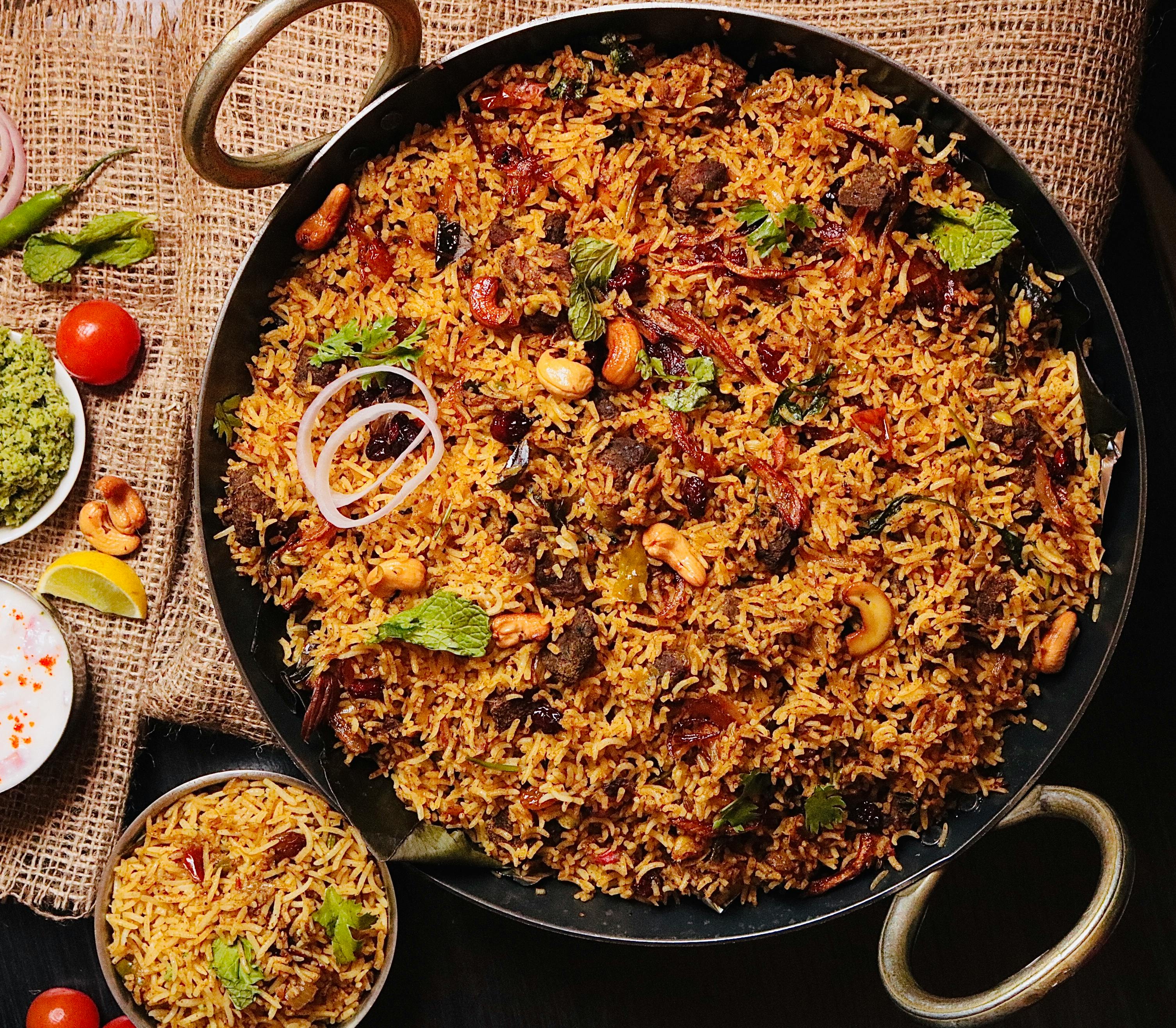
Photo: Saveurs Secretes / Pexels
Indian
Malabar Biryani
The diets react (see scores below)
Common Ingredients
- kaima rice
- chicken
- onion
- tomato
- yogurt
- ginger
- garlic
- cashews
- garam masala
- coriander
Specific recipes may vary.
Incompatible with 6 of 11 diets
Diet Ratings
Malabar Biryani is built on kaima rice, a short-grain aromatic rice that is the dish's defining ingredient. Rice is a high-glycemic grain delivering roughly 45g of net carbs per cooked cup, making even a modest single serving capable of exceeding the entire daily keto carb budget. The dish is fundamentally rice-centric — the protein and spices are secondary elements. Additional carb contributors include onion, tomato, cashews (higher in carbs among nuts), and yogurt, which compound the total. There is no practical way to make this dish keto-compatible without removing the rice, at which point it ceases to be biryani.
Malabar Biryani contains multiple animal-derived ingredients that make it entirely incompatible with a vegan diet. Chicken is a direct animal product (poultry), and yogurt is a dairy product derived from animal milk. Both are explicitly excluded under vegan dietary rules. The remaining ingredients — kaima rice, onion, tomato, ginger, garlic, cashews, garam masala, and coriander — are all plant-based, but the presence of chicken and yogurt as core components of this dish makes it an unambiguous avoid.
Malabar Biryani is fundamentally incompatible with the paleo diet. The dish is built on kaima rice, a short-grain rice variety that is a grain and strictly excluded from paleo. Yogurt is a dairy product, also excluded. These two ingredients are structural and non-negotiable components of the dish — without them, it is no longer a biryani. The remaining ingredients (chicken, onion, tomato, ginger, garlic, cashews, garam masala, coriander) are individually paleo-compatible, but they cannot redeem a dish whose core components are explicitly off-limits. The overall dish must be rated avoid.
Malabar Biryani contains several Mediterranean-compatible elements: chicken (acceptable in moderation), yogurt (moderate dairy is fine), aromatics like onion, tomato, ginger, and garlic (all encouraged), and cashews (nuts are a Mediterranean staple). However, kaima rice is a refined short-grain white rice rather than a whole grain, which conflicts with Mediterranean whole-grain preferences. The dish is cooked in ghee or oil not specified as olive oil, and garam masala is not traditional but not problematic. The overall profile — poultry with vegetables, legume-adjacent nuts, and dairy — fits the 'moderate' category, but the refined white rice and likely ghee-based cooking fat reduce its score. This is an acceptable occasional meal but not a Mediterranean staple.
Some Mediterranean diet researchers argue that white rice has long been part of traditional Southern European diets (e.g., Spanish arroz, Italian risotto) and can be included in moderation; under this view, kaima rice is not a disqualifying factor, and the dish's vegetable and protein profile could push it toward a soft approval.
Malabar Biryani is fundamentally incompatible with the carnivore diet. While it does contain chicken, which is an acceptable animal protein, the dish is built around kaima rice (a grain and major carbohydrate source), and includes numerous plant-based ingredients: onion, tomato, ginger, garlic, cashews, garam masala (a blend of plant spices), and coriander. Yogurt is the only other animal-derived ingredient, but it is a minor component. The foundational structure of biryani is a grain-based dish — rice is the primary ingredient by volume and purpose. The overwhelming majority of ingredients are plant-derived and explicitly excluded from the carnivore diet. No modification short of complete deconstruction would make this dish carnivore-compatible.
Malabar Biryani contains two clearly excluded ingredients: kaima rice (a grain, explicitly excluded on Whole30) and yogurt (a dairy product, explicitly excluded on Whole30). Either of these alone would disqualify the dish, and together they make it firmly non-compliant. There is no workaround — rice and dairy are categorically banned for the 30-day program with no exceptions.
Malabar Biryani contains multiple high-FODMAP ingredients that make it unsuitable during the elimination phase. Garlic is one of the highest-FODMAP foods known (fructans), and onion is similarly high in fructans — both are consistently rated as 'avoid' by Monash University at any standard serving. Yogurt contributes lactose (high-FODMAP unless lactose-free), and cashews are high-FODMAP above ~10 nuts, but are typically used generously in this dish. Kaima rice (a short-grain rice variety common in Kerala biryani) is itself low-FODMAP, as is plain chicken. Tomato is low-FODMAP at standard servings, ginger is low-FODMAP in culinary quantities, and garam masala spice blend is generally low-FODMAP. Coriander (fresh herb) is low-FODMAP. However, the combination of garlic, onion, yogurt, and cashews in quantities typical of this dish creates an unavoidable high-FODMAP load. There is no realistic way to make a traditional Malabar Biryani low-FODMAP without fundamentally altering the recipe by omitting garlic and onion, substituting lactose-free yogurt, and limiting cashews to a very small quantity.
Malabar Biryani contains several DASH-compatible ingredients — chicken (lean protein), tomato, onion, yogurt, ginger, garlic, and coriander are all consistent with DASH principles. However, the dish presents a few concerns. Kaima rice is a refined short-grain white rice, not a whole grain, which is less preferred under DASH. Cashews add healthy unsaturated fats and magnesium (DASH-positive) but are calorie-dense and require portion control. The overall sodium content is moderate to high depending on preparation, as restaurant or traditional versions often include significant added salt and ghee. Garam masala itself is low sodium, but biryani as typically prepared tends to be salt-heavy. Full-fat yogurt may be used in traditional preparation, which is a mild concern under standard DASH guidelines. With home preparation using low-fat yogurt, limited salt, modest ghee, and portion-controlled cashews, this dish can be made reasonably DASH-compatible. As typically consumed, it earns a moderate 'caution' rating.
NIH DASH guidelines emphasize whole grains over refined rice and specify low-fat dairy; however, updated clinical interpretations note that full-fat yogurt may not adversely affect cardiovascular outcomes, and the spice-forward, vegetable-inclusive nature of this dish aligns better with DASH than many other rice-based entrées when sodium is controlled during home preparation.
Malabar Biryani presents a mixed Zone profile. On the positive side, it contains lean chicken (a favorable Zone protein), yogurt (acceptable low-fat dairy protein/fat source), tomato, onion, ginger, and garlic (low-glycemic, polyphenol-rich vegetables that Sears would favor). The spices like garam masala and coriander add anti-inflammatory polyphenols with no glycemic impact. However, the dominant carbohydrate source — kaima rice (a short-grain fragrant rice) — is a high-glycemic refined grain, which is categorically 'unfavorable' in Zone terminology. This creates a significant macro imbalance: the dish is heavily carbohydrate-dominant in a high-GI form, making it very difficult to hit the 40/30/30 ratio without dramatically reducing the rice portion. Cashews add mostly monounsaturated fat (Zone-friendly) but also carry carbohydrate load and calories. To Zone-balance a serving, one would need to take a very small rice portion (perhaps 1/3 cup cooked), ensure a palm-sized chicken serving (~3 oz), and account for cashews carefully. The dish is not impossible to incorporate into Zone eating, but the traditional serving size is highly carbohydrate-heavy and glycemically unfavorable, pushing this firmly into 'caution' territory.
Some Zone practitioners, particularly those following Sears' later writings that emphasize overall anti-inflammatory dietary patterns, might argue that if kaima rice is portioned to a single block (~9g net carbs, roughly 1/4 cup cooked), the biryani's rich array of vegetables, spices, and lean chicken can make it a workable Zone meal. The polyphenol content from onions, tomatoes, ginger, garlic, and aromatic spices aligns with Sears' OmegaRx Zone and anti-inflammatory dietary focus, partially offsetting the glycemic concerns of the rice.
Malabar Biryani is a mixed dish from an anti-inflammatory perspective. On the positive side, it contains several beneficial ingredients: ginger and garlic are well-established anti-inflammatory spices with research supporting their ability to reduce CRP and other inflammatory markers. Garam masala typically includes turmeric, cumin, coriander, and cloves — all of which carry meaningful anti-inflammatory properties. Coriander (likely both the herb and spice) adds polyphenols. Onions and tomatoes provide quercetin and lycopene respectively, both associated with reduced inflammation. Yogurt, if low-fat or moderate-fat, is acceptable in the anti-inflammatory framework and provides probiotics. Chicken is a lean protein that falls in the 'moderate' category. Cashews, while higher in omega-6 than walnuts or almonds, still offer monounsaturated fats and some beneficial minerals. The primary concern is kaima rice (a short-grain white rice used in Kerala biryanis), which is a refined carbohydrate — white rice has a higher glycemic index and lacks the fiber of whole grains, which can promote a modest pro-inflammatory response at scale. The cooking method (typically dum cooking with layered frying of onions, often in oil of unspecified type) and possible added ghee introduce additional saturated fat considerations. Overall, this is a nutrient-dense dish with strong spice-driven anti-inflammatory potential, tempered by refined white rice and the potential for saturated fat from cooking fats.
Some anti-inflammatory practitioners, particularly those aligned with Dr. Andrew Weil's pyramid, would view this dish more favorably given its rich spice profile — garam masala, ginger, and garlic collectively represent a strong anti-inflammatory spice base that may offset the refined carbohydrate load. Conversely, low-glycemic and autoimmune protocol advocates would flag white rice and nightshade ingredients (tomato) as problematic, and the AIP protocol would also exclude yogurt and cashews, pushing this dish toward 'avoid' for sensitive individuals.
Malabar Biryani is a nutrient-mixed dish with meaningful protein from chicken and some probiotic benefit from yogurt, but several factors lower its GLP-1 friendliness. Kaima (Jeerakasala) rice is a short-grain, refined white rice with low fiber content, contributing fast-digesting simple carbohydrates with minimal nutritional density per calorie. Cashews add unsaturated fat but also significant calorie load in a dish where appetite is already suppressed — easy to overconsume relative to caloric budget. Traditional Malabar Biryani is cooked with a moderate amount of ghee or oil, which increases saturated fat load and can worsen nausea, bloating, and reflux — core GLP-1 side effects. Garam masala and the spice blend, while not extremely hot, can still trigger reflux or nausea in GLP-1 patients with heightened GI sensitivity due to slowed gastric emptying. On the positive side, chicken provides quality lean protein, yogurt adds protein and supports digestibility, and aromatics like ginger and garlic have anti-nausea and anti-inflammatory properties that may partially offset GI discomfort. In a small, protein-forward portion (emphasizing chicken, minimizing rice), this dish can be acceptable, but the standard restaurant or home serving is rice-heavy, fat-moderate, and low-fiber — a pattern that does not optimize GLP-1 dietary goals.
Some GLP-1-focused dietitians accept biryani-style dishes as a culturally appropriate protein vehicle and note that yogurt-marinated chicken improves digestibility and protein quality; they recommend simply reducing portion size and rice ratio. Others flag that the combination of fat, refined starch, and warming spices creates a high gastric-emptying burden that predictably worsens nausea and reflux in GLP-1 patients, particularly in the early dose-escalation phase.
*See how scores were generated at our methodology page.
Nutritional profile
Six traits that cut across every diet.
Fiber & Plants
How much whole-plant food and fiber it delivers.
Healthy Fats
The quality of its fats (unsaturated, omega-3).
Whole / Unprocessed
How close it is to its natural, unprocessed form.
Gut Gentle
How easy it is on digestion (low FODMAP, few irritants).
Low Glycemic
How little it spikes your blood sugar.
Protein Density
How much protein it packs per calorie.
Controversy Index
Higher controversy = more disagreement between diets.
Diet-Specific Tips
 Mediterranean — 5/10
View tips
- Chicken is an acceptable moderate protein in Mediterranean diet
- Kaima rice is a refined white grain, not a whole grain — not ideal
- Yogurt, onion, tomato, garlic, ginger are all Mediterranean-compatible
- Cashews provide healthy fats and align with nut consumption guidelines
- Likely cooked with ghee rather than olive oil, not aligned with primary fat principles
- No red meat, no added sugars, no highly processed ingredients
 DASH — 5/10
View tips
- Kaima rice is refined white rice, not a whole grain — less preferred under DASH
- Chicken provides lean protein, consistent with DASH guidelines
- Yogurt is DASH-compatible if low-fat; traditional recipes may use full-fat
- Cashews contribute heart-healthy fats and magnesium but are calorie-dense
- Sodium content is a key concern — restaurant/traditional preparations tend to be high in salt
- Vegetables (onion, tomato, garlic, ginger) and spices add potassium and antioxidants with negligible sodium
- Ghee or oil used in preparation adds saturated fat; amount varies widely by recipe
- Portion control is important due to caloric density of this dish
 Zone — 4/10
View tips
- Kaima rice is a high-glycemic refined grain — classified as 'unfavorable' carbohydrate in Zone terminology
- Chicken is a lean, favorable Zone protein source
- Yogurt contributes acceptable protein and fat if low-fat variety is used
- Cashews provide mostly monounsaturated fat (Zone-friendly) but add additional carbohydrate load
- Onion, tomato, ginger, garlic are low-glycemic, polyphenol-rich — favorable Zone vegetables
- Traditional serving sizes are rice-heavy, creating a severely carbohydrate-skewed macro ratio
- Dish requires significant rice portion reduction to approach 40/30/30 balance
- Spices (garam masala, coriander) contribute anti-inflammatory polyphenols with no glycemic penalty
 Anti-Inflammatory — 6/10
View tips
- Ginger and garlic: well-researched anti-inflammatory compounds (gingerols, allicin)
- Garam masala spice blend: likely includes turmeric and cumin with anti-inflammatory polyphenols
- Kaima white rice: refined carbohydrate, higher glycemic index, lacks whole grain fiber
- Chicken: lean protein, anti-inflammatory framework 'moderate' category
- Yogurt: probiotic benefit, acceptable in moderation; full-fat version would be a concern
- Onion and tomato: quercetin and lycopene — anti-inflammatory antioxidants
- Cashews: higher omega-6 than preferred nuts but contain beneficial monounsaturated fats
- Cooking fat type unspecified: ghee (common in biryani) adds saturated fat load
 GLP-1 Friendly — 5/10
View tips
- Chicken provides quality lean protein supporting the 15-30g per meal target
- Kaima rice is a low-fiber refined grain, contributing empty starch calories
- Cashews add calorie density with limited protein return — portion-sensitive
- Traditional preparation typically includes ghee or oil, raising saturated fat load
- Garam masala and spice blend may trigger reflux or nausea due to slowed gastric emptying
- Yogurt marinade improves protein quality and aids partial digestibility
- Ginger in the recipe has documented anti-nausea properties beneficial for GLP-1 side effects
- Standard serving is rice-heavy and low-fiber, misaligning with GLP-1 dietary priorities
- Small, chicken-forward portion with reduced rice is meaningfully more GLP-1 appropriate