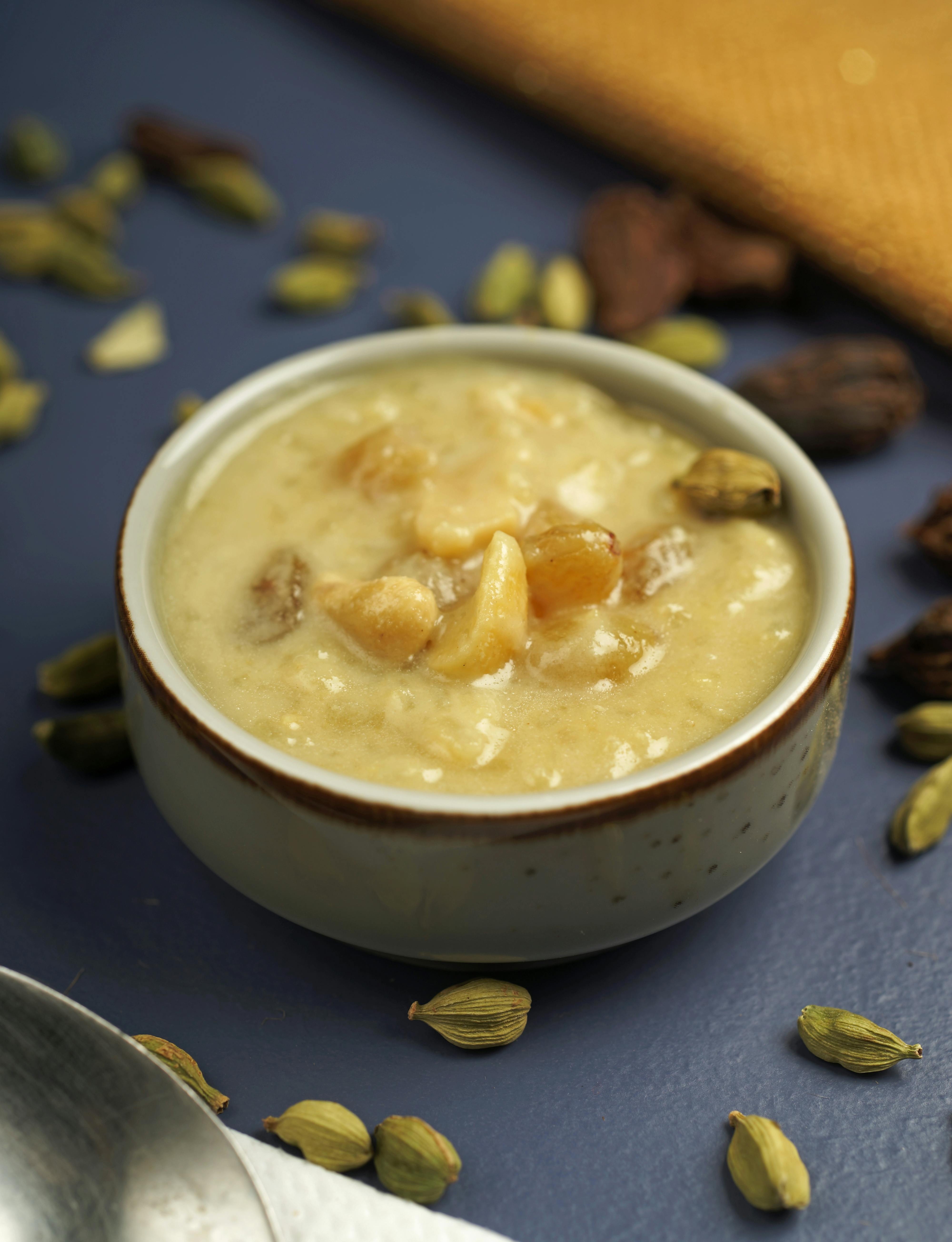
Photo: Deep Dasgupta / Pexels
Indian
Palada Payasam
The diets react (see scores below)
Common Ingredients
- rice ada
- milk
- sugar
- cardamom
- ghee
- cashews
- raisins
Specific recipes may vary.
Incompatible with 11 of 11 diets
Diet Ratings
Palada Payasam is fundamentally incompatible with a ketogenic diet. Its primary ingredient, rice ada (flattened rice), is a grain-based product loaded with starch and high net carbs. Combined with large quantities of added sugar and the natural sugars in milk, this dessert delivers an extremely high carbohydrate load — likely 60-100g+ net carbs per serving — which would instantly break ketosis. Raisins add further sugar and carbs. The only keto-friendly components are ghee and cardamom, but they are far outweighed by the multiple high-carb, high-sugar ingredients. This dish has no realistic portion size that would make it keto-compatible.
Palada Payasam contains multiple animal-derived ingredients that disqualify it from a vegan diet. Milk is a dairy product and a direct animal secretion. Ghee is clarified butter, also a dairy product. Both are unambiguously non-vegan. The remaining ingredients — rice ada (flattened rice sheets), sugar, cardamom, cashews, and raisins — are plant-based, but the presence of milk and ghee makes this dish incompatible with veganism. A vegan adaptation could substitute full-fat coconut milk or other plant milks for dairy milk, and use coconut oil or vegan butter in place of ghee.
Palada Payasam is fundamentally incompatible with the Paleo diet. Rice ada (flattened rice flakes) is a grain-based ingredient, making it a clear violation. Milk is dairy, which is excluded from Paleo. Sugar is refined and explicitly prohibited. These three core ingredients are all on the avoid list, making this dish essentially a triple violation. The only Paleo-friendly elements are cardamom (a spice), cashews (a nut), and raisins (dried fruit). Ghee occupies a gray area but is irrelevant given the other violations. This is a traditional Indian rice and milk pudding — its entire foundation is built on non-Paleo ingredients.
Palada Payasam is a Kerala dessert made primarily of refined rice ada (processed rice flakes), whole milk cooked down with large amounts of added sugar, and ghee. This combination directly contradicts core Mediterranean diet principles: refined grains rather than whole grains, significant added sugar, saturated fat from ghee instead of olive oil, and high-calorie dairy used as a base rather than as a condiment. While cashews and raisins are present, they are minor components overwhelmed by the problematic ingredients. The dish is essentially a sweet, refined-carbohydrate and high-saturated-fat dessert with no redeeming Mediterranean alignment beyond small amounts of nuts.
Palada Payasam is a traditional Kerala rice pudding dessert that is fundamentally incompatible with the carnivore diet. The dish is dominated by plant-based and processed ingredients: rice ada (processed rice flakes), sugar, cardamom (a plant spice), cashews (nuts), and raisins (dried fruit). While it does contain milk and ghee — which are animal-derived — these are minor components in a dish that is otherwise entirely plant-based and sugar-laden. The primary base is a grain product, sweetened with sugar, spiced with cardamom, and garnished with nuts and raisins — all of which are explicitly excluded on carnivore. Even the most lenient 'animal-based' practitioners who include some dairy would not consume this dish due to the grain, sugar, nuts, dried fruit, and plant spices. There is no meaningful animal protein present. This dish scores a 1 as it represents nearly the antithesis of carnivore eating.
Palada Payasam contains multiple excluded ingredients that make it clearly non-compliant with Whole30. Rice ada (rice flakes/pasta) is a grain product and grains are excluded. Sugar is an added sugar, which is explicitly excluded. Milk is dairy, also excluded. These are three independent, clear violations of core Whole30 rules. While ghee is the one allowed dairy exception, and cardamom, cashews, and raisins are compliant, the dish cannot be made Whole30-compatible without fundamentally changing its nature.
Palada Payasam is a traditional Kerala milk pudding with multiple high-FODMAP ingredients. Milk is high in lactose and is used in large quantities as the base of this dish — a standard serving would contain a significant lactose load, making it problematic during elimination phase. Raisins are high-FODMAP at typical serving sizes (Monash rates raisins as high-FODMAP at 1 tablespoon/13g due to excess fructose and fructans). Cashews are high-FODMAP above 10 nuts (approximately 15g), and in a garnished payasam, the quantity often exceeds this threshold. Rice ada (flattened rice flakes) itself is generally low-FODMAP, and sugar, ghee, and cardamom are also low-FODMAP. However, the combination of large amounts of lactose-rich milk and raisins makes this dish unsuitable during the elimination phase. Even with lactose-free milk substituted, the raisins and potentially excess cashews remain problematic.
Palada Payasam is a traditional Kerala dessert/sweet made with rice ada (refined rice flakes), full-fat milk, and significant amounts of added sugar, ghee, and garnishes like cashews and raisins. This dish conflicts with multiple core DASH principles simultaneously: (1) It uses full-fat dairy (whole milk), which DASH explicitly limits in favor of fat-free or low-fat dairy; (2) Ghee is a saturated fat-heavy ingredient — a tropical/animal fat that DASH discourages; (3) The high added sugar content from generous amounts of sugar directly violates DASH's restriction on sweets and added sugars; (4) Refined rice ada lacks the fiber benefits of whole grains that DASH emphasizes; (5) The overall caloric density and macronutrient profile (high saturated fat + high sugar) are counterproductive to the diet's cardiovascular and blood pressure goals. While cashews and raisins individually have some DASH-compatible properties, their positive contribution is overwhelmed by the dish's other components. Even consumed as an occasional snack, the combination of multiple restricted ingredients makes this a poor fit for the DASH eating plan.
Palada Payasam is a Kerala rice pudding dessert that is fundamentally incompatible with Zone Diet principles. The dish is built on three major Zone-unfavorable components: rice ada (refined/processed rice flakes, high glycemic), sugar (pure high-glycemic carbohydrate), and raisins (classified as 'unfavorable' high-sugar fruit in Zone). The macronutrient profile is heavily skewed — this is essentially a high-carbohydrate, high-fat dessert with virtually no lean protein. There is no lean protein source to anchor the 40/30/30 ratio. Ghee is saturated fat, not monounsaturated. Cashews provide some fat but also add more carbohydrates. The combination of refined starch + added sugar + raisins creates a severe glycemic spike, exactly what the Zone Diet is designed to prevent. Even in very small portions, this dish cannot form a Zone-balanced snack because there is no protein block to pair it with — adding protein separately would create an odd combination, not a cohesive Zone snack. This represents one of the clearest 'avoid' cases in Zone terminology.
Palada Payasam is a traditional Kerala rice pudding dessert that is heavily pro-inflammatory from an anti-inflammatory diet perspective. The dish is dominated by refined carbohydrates (rice ada, a processed rice flake), significant added sugar, full-fat milk, and ghee — all ingredients that anti-inflammatory frameworks either limit or avoid. Rice ada is a refined, processed rice product with a high glycemic load, which drives insulin spikes and promotes inflammatory markers like CRP and IL-6. Added sugar is one of the most consistently pro-inflammatory dietary components in the research literature. Full-fat dairy (whole milk) contributes saturated fat, and ghee is pure clarified butter — a concentrated source of saturated fat that anti-inflammatory protocols recommend limiting. Cashews add some beneficial fats but are relatively high in omega-6 compared to omega-3. Cardamom is the only meaningfully anti-inflammatory ingredient, offering modest antioxidant polyphenols, but it is present in trace cooking quantities and cannot offset the inflammatory load of the other ingredients. Raisins add natural sugars, further increasing the glycemic burden. Overall, this dish exemplifies the type of high-sugar, refined carbohydrate, full-fat dairy preparation that anti-inflammatory eating specifically cautions against.
Palada Payasam is a traditional Kerala rice pudding made with rice ada (refined rice flakes), full-fat milk, and significant added sugar, finished with ghee-fried cashews and raisins. It is nutritionally misaligned with nearly every GLP-1 dietary priority. It is very high in sugar (primary caloric driver), high in refined carbohydrates with no meaningful fiber, high in saturated fat from ghee and full-fat milk, and provides virtually no protein. As a snack, it delivers empty calories in a concentrated, sweet, easily overeaten form. The high sugar content risks blood sugar spikes, the ghee and full-fat dairy increase saturated fat load, and the refined rice ada contributes rapid-digesting starch with no fiber benefit. Additionally, the sweetness and palatable fat-sugar combination may blunt the appetite-suppressing benefits of GLP-1 medications. There is no realistic portion size that makes this dish appropriate for regular consumption on a GLP-1 regimen.
*See how scores were generated at our methodology page.
Nutritional profile
Six traits that cut across every diet.
Fiber & Plants
How much whole-plant food and fiber it delivers.
Healthy Fats
The quality of its fats (unsaturated, omega-3).
Whole / Unprocessed
How close it is to its natural, unprocessed form.
Gut Gentle
How easy it is on digestion (low FODMAP, few irritants).
Low Glycemic
How little it spikes your blood sugar.
Protein Density
How much protein it packs per calorie.
Controversy Index
Higher controversy = more disagreement between diets.