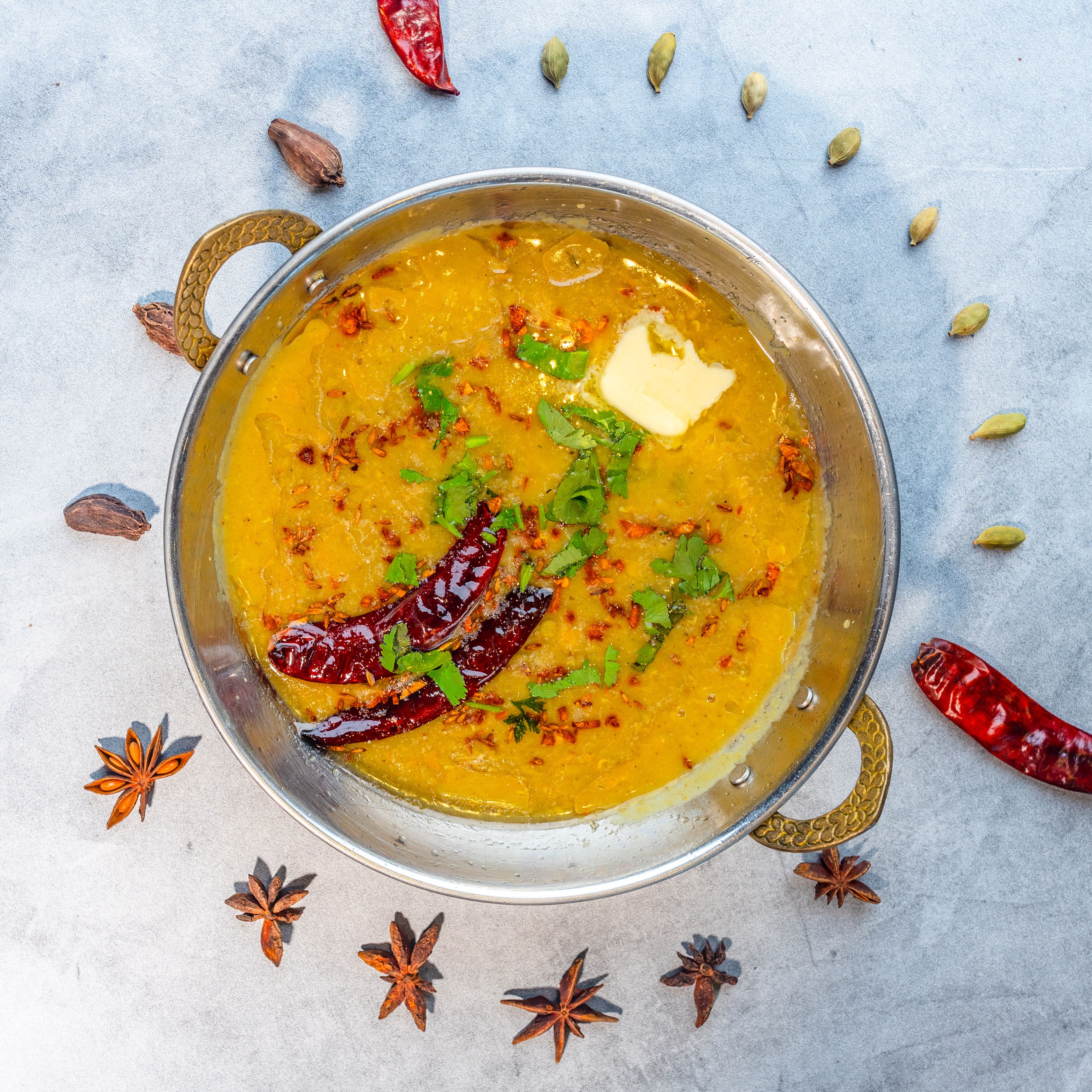
Photo: Nosh Caterers / Pexels
Indian
Parippu Curry
The diets react (see scores below)
Common Ingredients
- moong dal
- coconut
- turmeric
- green chili
- mustard seeds
- curry leaves
- garlic
- coconut oil
Specific recipes may vary.
Incompatible with 5 of 11 diets
Diet Ratings
Parippu Curry is centered on moong dal (split mung lentils), which is the primary ingredient and a significant source of net carbohydrates. A standard serving of cooked moong dal (approximately 100g) contains roughly 15-17g of net carbs, and a typical curry portion could easily provide 30g+ of net carbs — potentially consuming or exceeding the entire daily keto carb allowance in a single side dish. While the supporting ingredients are keto-friendly (coconut oil, coconut, turmeric, green chili, mustard seeds, curry leaves, garlic), they cannot offset the high carb load from the lentils. Lentils are legumes and are generally incompatible with ketogenic eating due to their starch content, despite having moderate fiber. This dish would very likely disrupt ketosis even in a small portion.
Some lazy keto or targeted keto practitioners argue that a very small portion (2-3 tablespoons) of lentil-based dishes could fit within a flexible 50g daily carb ceiling, especially when paired with strict low-carb meals for the rest of the day. They point to the fiber content of moong dal as partially offsetting net carbs compared to other starches.
Parippu Curry is a traditional South Indian/Sri Lankan lentil dish made entirely from whole plant-based ingredients. Moong dal (split mung beans) provides the protein base, while coconut, coconut oil, turmeric, green chili, mustard seeds, curry leaves, and garlic are all unambiguously plant-derived. There are no animal products, animal-derived ingredients, or ethically contested components in this dish. The reliance on whole foods — legumes, fresh aromatics, spices, and minimally processed coconut — places this at the high end of the approval scale from both a strict vegan and a whole-food plant-based perspective.
Parippu Curry is fundamentally built on moong dal (split mung beans), a legume that is explicitly excluded from the paleo diet. Legumes are avoided due to their high lectin and phytic acid content, which are considered anti-nutrients that impair digestion and nutrient absorption. Despite the otherwise paleo-compatible supporting ingredients — coconut, turmeric, green chili, mustard seeds, curry leaves, garlic, and coconut oil — the primary ingredient is a hard disqualifier. There is no version of this dish that can be considered paleo-compliant without fundamentally changing what it is.
Parippu Curry is a nutrient-dense, plant-forward lentil dish with excellent Mediterranean alignment in its core components: moong dal (legumes are a staple), turmeric, green chili, garlic, mustard seeds, and curry leaves are all whole-food spices and aromatics fully compatible with Mediterranean principles. The primary concerns are coconut and coconut oil. Coconut oil is high in saturated fat and is not a traditional Mediterranean fat — extra virgin olive oil is the canonical primary fat. Whole coconut flesh similarly adds saturated fat not characteristic of the Mediterranean dietary pattern. However, the dish's legume base, absence of red meat, refined grains, or added sugars, and its whole-food composition make it substantially aligned with Mediterranean values despite the non-traditional fat source.
Some modern Mediterranean diet interpretations, particularly those emphasizing plant-based fats broadly, argue coconut oil can be included in modest amounts as a plant-derived fat, especially in culturally adapted versions of the diet. However, mainstream Mediterranean diet authorities (e.g., Oldways, PREDIMED researchers) consistently recommend olive oil as the primary fat and do not endorse coconut oil due to its saturated fat content.
Parippu Curry is entirely plant-based and incompatible with the carnivore diet. The primary protein source is moong dal (lentils), a legume that is strictly excluded on carnivore. Every single ingredient — moong dal, coconut, turmeric, green chili, mustard seeds, curry leaves, garlic, and coconut oil — is plant-derived. There are no animal products whatsoever in this dish. Legumes are among the most excluded foods in carnivore due to their antinutrients (lectins, phytates), high carbohydrate content, and plant origin. This dish represents the antithesis of carnivore eating.
Parippu Curry's primary ingredient is moong dal, which is a lentil — a legume explicitly excluded from the Whole30 program. Lentils are unambiguously on the excluded list, and unlike green beans or sugar snap peas, they have no exception. All other ingredients (coconut, turmeric, green chili, mustard seeds, curry leaves, garlic, coconut oil) are fully Whole30-compliant, but the foundational ingredient moong dal disqualifies the dish entirely.
Parippu Curry contains two high-FODMAP ingredients that make it unsuitable for the elimination phase: garlic (very high in fructans — one of the most problematic FODMAP foods even in tiny amounts) and moong dal (lentils contain significant GOS, which are high-FODMAP). Moong dal specifically: while split/hulled moong dal is lower in GOS than many other legumes, Monash University rates it as high-FODMAP at typical serving sizes consumed in a curry (e.g., a standard serving of ~1/2 cup cooked). The garlic alone is sufficient to classify this dish as 'avoid' during elimination. Coconut (in moderate amounts), turmeric, green chili, mustard seeds, curry leaves, and coconut oil are all low-FODMAP and unproblematic. However, the combination of garlic and lentils makes this dish clearly unsuitable for the elimination phase.
Parippu Curry is built around moong dal (split mung beans), which is an excellent DASH-aligned food — legumes are explicitly encouraged for their fiber, potassium, magnesium, and plant protein content. Turmeric, green chili, mustard seeds, curry leaves, and garlic are all low-sodium, nutrient-rich aromatics fully compatible with DASH principles. However, the use of both coconut and coconut oil introduces meaningful saturated fat — two ingredients that DASH guidelines explicitly caution against, as DASH limits saturated fat and specifically calls out tropical oils (coconut, palm, palm kernel) as foods to limit. Coconut flesh adds saturated fat as well, though also some fiber. The degree of concern depends on quantities: if coconut and coconut oil are used sparingly (e.g., 1 tsp coconut oil, small amount of grated coconut), the dish leans toward acceptable; if used liberally, saturated fat content becomes a significant concern. Sodium is naturally low in this dish, which is a strong positive. Overall, the dish is nutritionally valuable but the coconut oil and coconut pull it out of clear approval territory.
NIH DASH guidelines explicitly limit saturated fat and call out coconut oil as a tropical oil to avoid, placing this dish in caution territory. However, some updated DASH-oriented clinicians note that the saturated fat in coconut (largely MCTs) may have a different metabolic profile than animal saturated fat, and when coconut oil is used in small culinary quantities in an otherwise nutrient-dense legume dish, they do not categorically exclude it — particularly if the overall daily saturated fat budget remains within DASH limits.
Parippu Curry presents a mixed Zone Diet profile. Moong dal (split mung beans) is a relatively favorable legume — lower glycemic than many other lentils, rich in protein and fiber, and counts as both a carbohydrate and a vegetarian protein source in Zone block counting. However, as a vegetarian protein source, it is carbohydrate-dominant, meaning a portion sufficient to deliver meaningful protein (e.g., ~21g protein) will also carry a substantial carb load (~40-50g net carbs), making it challenging to balance within a single Zone block structure without overloading carbs. The fat profile is problematic: coconut and coconut oil are high in saturated fat (lauric acid), which Dr. Sears has historically discouraged in favor of monounsaturated fats. The spices (turmeric, mustard seeds, curry leaves, garlic, green chili) are Zone-positive — anti-inflammatory polyphenols that Sears explicitly endorses. As a side dish rather than a complete meal, it can be portioned more conservatively and paired with lean protein (e.g., grilled fish) and a salad to create a balanced Zone plate, but careful portioning is essential.
Sears' later work (The Anti-Inflammation Zone, Zone Diet updated writings) softened his stance on coconut fat somewhat, acknowledging that medium-chain triglycerides (MCTs) in coconut oil behave differently metabolically than long-chain saturated fats. Some Zone-aligned practitioners therefore treat small amounts of coconut oil as acceptable. Additionally, moong dal's relatively low glycemic index and high fiber content make it one of the more Zone-friendly legumes, and some practitioners treat it more favorably than the carb-dominant legume framing suggests.
Parippu Curry is a traditional South Indian/Sri Lankan lentil dish with a strong anti-inflammatory foundation. Moong dal (mung beans) is a highly regarded legume in anti-inflammatory nutrition — high in fiber, plant protein, folate, and antioxidants, with research linking it to reduced inflammatory markers. Turmeric is one of the most well-documented anti-inflammatory spices due to curcumin content. Garlic contains allicin and organosulfur compounds with established anti-inflammatory effects. Green chili provides capsaicin, a known anti-inflammatory compound. Mustard seeds contain omega-3 alpha-linolenic acid and glucosinolates. Curry leaves are rich in carbazole alkaloids with antioxidant properties. Coconut (flesh/milk) adds medium-chain triglycerides and some fiber. The main caveat is coconut oil, which is high in saturated fat (primarily lauric acid) — this is the key point of debate. Some anti-inflammatory authorities, including Dr. Weil, do not explicitly endorse coconut oil due to its saturated fat content, while functional medicine practitioners argue its MCT profile is metabolically distinct from long-chain saturated fats. In a typical curry preparation, the quantity of coconut oil used as a tempering base is relatively small, which limits the concern considerably. Overall, the dish is plant-forward, spice-rich, and legume-based — a strong anti-inflammatory profile with only moderate concern around coconut oil.
Most mainstream anti-inflammatory frameworks (including Dr. Weil's pyramid) treat coconut oil cautiously due to its high saturated fat content, which can raise LDL and potentially promote inflammation — placing it in the 'limit' category alongside other saturated fats. However, a significant functional medicine camp (including practitioners aligned with Ayurvedic and paleo-adjacent traditions) argues that coconut oil's lauric acid and MCT content behaves differently from animal saturated fats and may not be pro-inflammatory in moderate culinary quantities.
Parippu curry (moong dal) has meaningful strengths for GLP-1 patients: moong dal provides moderate plant protein (~7-8g per half-cup cooked) and solid fiber (~4-5g per serving), both supportive of GLP-1 dietary goals. Turmeric, garlic, curry leaves, and mustard seeds are anti-inflammatory and digestively supportive in small amounts. However, the combination of coconut (shredded or milk) and coconut oil introduces notable saturated fat, which can worsen GLP-1 side effects like nausea, bloating, and reflux. Green chili may trigger reflux or GI discomfort in sensitive patients, particularly given slowed gastric emptying. As a side dish rather than a protein anchor, it would not independently meet the 15-30g protein per meal target and needs to be paired with a higher-density protein source. The dish is nutrient-dense, easy to digest when prepared with modest fat, and fiber-rich — making it a reasonable accompaniment, but the coconut fat content warrants caution rather than full approval.
Some GLP-1-focused RDs accept coconut-based South Asian dishes as part of a balanced plate, noting that the saturated fat per serving is moderate when portioned appropriately and that the fiber and micronutrient density justify inclusion. Others caution that any significant saturated fat load meaningfully amplifies nausea and delayed gastric emptying in GLP-1 patients, particularly in the early dose-escalation phase, and recommend substituting light coconut milk or omitting coconut entirely.
*See how scores were generated at our methodology page.
Nutritional profile
Six traits that cut across every diet.
Fiber & Plants
How much whole-plant food and fiber it delivers.
Healthy Fats
The quality of its fats (unsaturated, omega-3).
Whole / Unprocessed
How close it is to its natural, unprocessed form.
Gut Gentle
How easy it is on digestion (low FODMAP, few irritants).
Low Glycemic
How little it spikes your blood sugar.
Protein Density
How much protein it packs per calorie.
Controversy Index
Higher controversy = more disagreement between diets.
Diet-Specific Tips
 Vegan — 6/10
View tips
- Moong dal is a whole plant-based legume and excellent vegan protein source
- All spices and aromatics (turmeric, mustard seeds, curry leaves, garlic, green chili) are fully plant-derived
- Coconut and coconut oil are plant-based with no animal-derived components
- No dairy, eggs, or animal-derived additives present
- Predominantly whole-food ingredients align with both strict vegan and WFPB standards
- Traditional preparation of this dish does not involve ghee or any animal fat
 Mediterranean — 6/10
View tips
- Moong dal is an excellent legume source, strongly encouraged in the Mediterranean diet
- Coconut oil is not a traditional Mediterranean fat and is high in saturated fat
- Whole coconut adds additional saturated fat atypical of the Mediterranean pattern
- All spices and aromatics (turmeric, garlic, chili, mustard seeds, curry leaves) are whole-food ingredients compatible with Mediterranean eating
- No red meat, refined grains, added sugars, or highly processed ingredients
- Dish is plant-forward and nutrient-dense overall, aligning with Mediterranean principles despite non-traditional fat source
 DASH — 5/10
View tips
- Moong dal is a DASH-recommended legume: high in fiber, potassium, and plant protein
- Coconut oil is explicitly listed by DASH/NIH as a tropical oil to limit due to high saturated fat
- Grated coconut adds additional saturated fat beyond the oil
- Dish is naturally low in sodium — a strong DASH positive
- Aromatics (turmeric, garlic, curry leaves, mustard seeds) are DASH-neutral and beneficial
- Verdict heavily dependent on quantity of coconut and coconut oil used
- Swapping coconut oil for canola or olive oil would raise the score to 7-8
 Zone — 5/10
View tips
- Moong dal is a vegetarian protein source that carries significant carbohydrate load, complicating Zone block balancing
- Moong dal has a relatively low glycemic index and high fiber content, reducing net carb impact
- Coconut and coconut oil are high in saturated fat — traditionally 'unfavorable' in Zone fat choices
- Anti-inflammatory spices (turmeric, garlic, curry leaves) are Zone-positive polyphenol sources
- As a side dish, smaller portions can be incorporated into a balanced Zone meal when paired with lean protein and monounsaturated fat
- Absence of lean protein or monounsaturated fat means this dish alone cannot constitute a balanced Zone meal
 Anti-Inflammatory — 8/10
View tips
- Moong dal is a top-tier anti-inflammatory legume — high in fiber, plant protein, and antioxidants
- Turmeric (curcumin) is one of the most research-backed anti-inflammatory spices
- Garlic and green chili provide allicin, organosulfur compounds, and capsaicin — all anti-inflammatory
- Mustard seeds contain ALA (omega-3) and glucosinolates
- Curry leaves contribute carbazole alkaloids with antioxidant activity
- Coconut oil is the primary concern — high in saturated fat, debated in anti-inflammatory contexts
- Small quantity of coconut oil typical in tempering mitigates saturated fat concern significantly
- Dish is plant-forward, whole-food, minimally processed with no refined carbs or additives
 GLP-1 Friendly — 6/10
View tips
- Moong dal provides moderate protein and good fiber — positive for GLP-1 goals
- Coconut and coconut oil contribute saturated fat that may worsen nausea and bloating
- Green chili is a potential reflux/GI irritant given slowed gastric emptying
- Anti-inflammatory spices (turmeric, garlic, curry leaves) are GLP-1 compatible
- As a side dish, protein contribution is insufficient to anchor a meal — pairing required
- Portion-sensitive: smaller servings reduce fat load and side effect risk
- Easy digestibility of moong dal is a relative advantage over heavier legumes