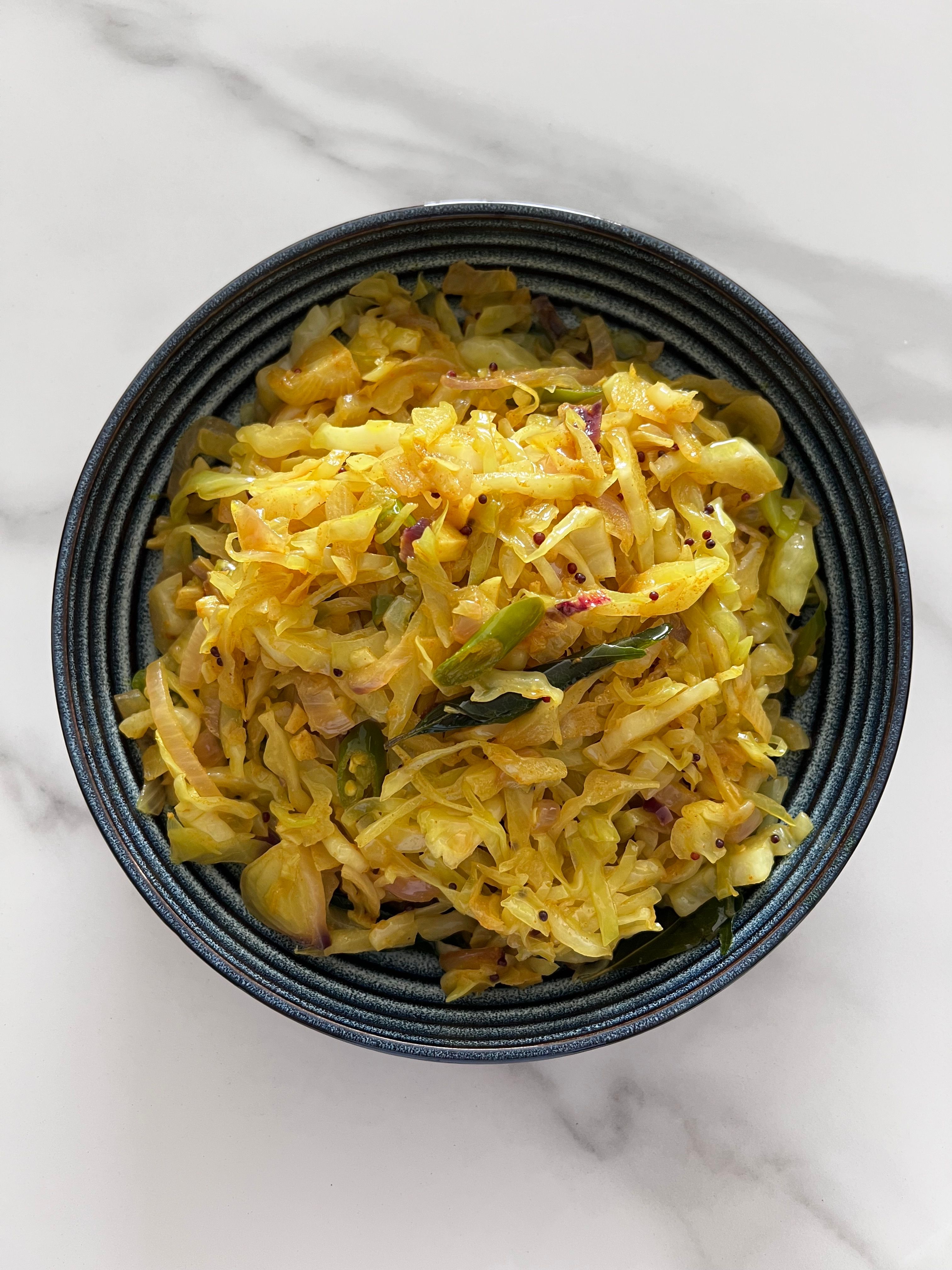
Photo: Anya Dunes / Pexels
The diets react (see scores below)
Common Ingredients
- cabbage
- grated coconut
- green chili
- mustard seeds
- turmeric
- curry leaves
- shallots
- coconut oil
Specific recipes may vary.
Incompatible with 1 of 11 diets
Diet Ratings
Thoran is a Kerala stir-fry made with cabbage, grated coconut, and aromatic spices cooked in coconut oil. Most ingredients are keto-friendly: coconut oil is an ideal keto fat, fresh coconut adds healthy fat and fiber, green chili, mustard seeds, turmeric, and curry leaves are negligible in carbs. The concern lies in the cumulative carbs: cabbage contributes ~3-4g net carbs per 100g, grated coconut adds ~6g net carbs per 50g, and shallots are higher in carbs than onions (~4-5g net carbs per 30g). A standard serving (~150-200g) could carry 8-12g net carbs, which is manageable within a keto budget but requires portion awareness. In small-to-moderate servings it fits well; larger portions or multiple servings risk pushing daily carb limits.
Some strict keto practitioners flag grated fresh coconut and shallots as borderline ingredients due to their sugar content, preferring to exclude them or substitute desiccated unsweetened coconut and minimal aromatics to keep net carbs lower per serving.
Thoran is a traditional Kerala stir-fry made entirely from plant-based ingredients. Cabbage, grated coconut, green chili, mustard seeds, turmeric, curry leaves, shallots, and coconut oil are all fully plant-derived. There are no animal products or animal-derived ingredients present. This is a whole-food, minimally processed dish that aligns excellently with vegan dietary principles. The use of coconut oil rather than ghee (which is common in some Indian cooking) keeps this dish fully vegan. It is nutritionally wholesome, rich in fiber and healthy fats from coconut.
Thoran is a Kerala-style stir-fry made with whole, unprocessed ingredients that are largely paleo-compliant. Cabbage, grated coconut, green chili, turmeric, curry leaves, and shallots are all vegetables, spices, or herbs available in nature and firmly within paleo guidelines. Coconut oil is an approved fat. The main point of debate is mustard seeds — they are seeds and generally accepted in paleo as a spice/seasoning, though some strict interpretations flag seed-based spices. The dish contains no grains, legumes, dairy, refined sugar, seed oils, or processed ingredients, making it a strong paleo choice overall.
Some strict Cordain-school practitioners raise concerns about mustard seeds used in quantity (beyond trace seasoning), as mustard belongs to the Brassica seed family. However, this is a minority position and most paleo authorities treat mustard seeds as an acceptable spice with negligible anti-nutrient impact at culinary quantities.
Thoran is a vegetable-forward dish built primarily on cabbage, shallots, and spices — all of which align well with Mediterranean diet principles emphasizing plant-based eating. The green chili, turmeric, curry leaves, and mustard seeds add flavor without any nutritional concern. However, the primary fat source is coconut oil rather than extra virgin olive oil, which is a meaningful departure from Mediterranean diet principles. Grated coconut also contributes saturated fat. The dish is otherwise whole, unprocessed, and plant-based, earning a solid but not top-tier rating.
Some modern Mediterranean diet interpreters argue that coconut oil and coconut flesh, as plant-derived fats, can fit within a broadly plant-forward eating pattern, especially since the saturated fat debate around coconut remains unsettled in nutrition science. However, mainstream Mediterranean diet authorities such as those behind the PREDIMED study and the Harvard T.H. Chan guidelines consistently identify extra virgin olive oil — not tropical oils — as the canonical fat of this dietary pattern.
Thoran is entirely plant-based with zero animal-derived ingredients. Every component — cabbage, grated coconut, green chili, mustard seeds, turmeric, curry leaves, shallots, and coconut oil — is excluded on the carnivore diet. There is no meat, fish, seafood, eggs, or animal fat present. This dish is fundamentally incompatible with carnivore principles at every level, including the most lenient interpretations.
Thoran is a traditional Kerala stir-fry made entirely from Whole30-compliant ingredients. Cabbage is an allowed vegetable, grated coconut is a natural whole food, green chili and turmeric are allowed spices, mustard seeds and curry leaves are permitted seasonings, shallots are allowed alliums, and coconut oil is an approved natural fat. Every ingredient in this dish is explicitly permitted under Whole30 rules with no excluded ingredients present.
Thoran contains several ingredients that require careful evaluation. Cabbage is low-FODMAP at 75g per serving but becomes high-FODMAP at larger serves due to excess fructose and polyols — given it's the primary bulk ingredient, portion control is essential. Grated coconut (fresh/desiccated) is low-FODMAP at around 1/2 cup (45g) per Monash. Green chili is low-FODMAP in typical cooking amounts. Mustard seeds, turmeric, and curry leaves are all low-FODMAP as used as spices/aromatics. Coconut oil is FODMAP-free. The main concern is shallots — shallots are high-FODMAP due to fructans, similar to onions, and are a meaningful ingredient in Thoran rather than just a trace flavoring. Even small amounts of shallots (one medium shallot, ~45g) are rated high-FODMAP by Monash. This elevates the dish from approve to caution, as the shallots are typically sautéed in oil and distributed throughout. If shallots are omitted or replaced with the green tops of scallions, the dish becomes much more elimination-phase friendly.
Monash University rates shallots as high-FODMAP even in small servings due to fructans, and clinical FODMAP practitioners generally advise avoiding them during the elimination phase entirely. However, some practitioners may consider that if shallots are used in very small quantities (e.g., 1 tablespoon or less per serve), the per-serving FODMAP load may be tolerable — though this is not consistent with strict elimination phase protocol.
Thoran is a vegetable-forward South Indian stir-fry with several DASH-friendly elements — cabbage is an excellent low-sodium, high-fiber vegetable, and spices like turmeric, mustard seeds, curry leaves, and green chili are nutritionally neutral or beneficial. However, two ingredients raise DASH concerns: coconut oil is a tropical oil high in saturated fat, which DASH guidelines explicitly limit; and grated coconut (fresh/dried) adds additional saturated fat and calories. The dish is otherwise low in sodium and free of added sugars or processed ingredients. The saturated fat contribution from coconut oil and grated coconut together is moderate — not extreme if portions are controlled — but enough to prevent a full 'approve' rating under strict DASH rules. If prepared with a DASH-compliant oil (e.g., canola or olive oil) and minimal coconut, the score would rise to 7-8.
NIH DASH guidelines explicitly categorize tropical oils including coconut oil as foods to limit due to their saturated fat content, placing Thoran in the caution zone. However, some updated clinical interpretations note that the medium-chain triglycerides (MCTs) in coconut and coconut oil may behave differently metabolically than long-chain saturated fats, and that the small amounts used in a vegetable dish like Thoran — combined with fiber-rich cabbage — may pose minimal cardiovascular risk in the context of an otherwise DASH-compliant diet.
Thoran is a Kerala-style stir-fry that pairs well with Zone principles in some respects but raises concerns in others. The base — cabbage — is an excellent Zone-favorable, low-glycemic vegetable, rich in polyphenols and fiber, earning strong marks as a carbohydrate source. Shallots, green chili, turmeric, curry leaves, and mustard seeds are all anti-inflammatory and Zone-friendly as flavor/polyphenol contributors. However, the fat profile is the central issue: grated coconut and coconut oil are both high in saturated fat, which Dr. Sears has historically flagged as unfavorable and pro-inflammatory in the Zone framework. The combination of two coconut-based fat sources means saturated fat load is significant. As a side dish with no protein, it also lacks the lean protein block needed to balance a Zone meal — it would need to be paired carefully with a lean protein source. The coconut fat content makes exact block portioning tricky, and the saturated fat dominance conflicts with the Zone's preference for monounsaturated fats. Used in small portions alongside lean protein, it can fit within a Zone meal, but it is not an ideal building block.
Some of Sears' later writings (particularly his anti-inflammatory work) acknowledge that medium-chain triglycerides (MCTs) in coconut — particularly lauric acid — may have a more neutral or even beneficial inflammatory profile than long-chain saturated fats. Additionally, traditional Zone practitioners in South Asian contexts may accept small amounts of coconut in a vegetable dish as an acceptable fat block, especially given the strong polyphenol and fiber benefits of the cabbage base. The anti-inflammatory herbs (turmeric, curry leaves) further support a slightly more lenient reading.
Thoran is a Kerala stir-fry with a strong anti-inflammatory foundation. Cabbage is a cruciferous vegetable rich in glucosinolates and vitamin C with documented anti-inflammatory properties. Turmeric provides curcumin, one of the most well-researched anti-inflammatory compounds in food. Curry leaves contain carbazole alkaloids and antioxidants with anti-inflammatory and antioxidant activity. Mustard seeds contain selenium and omega-3 ALA. Shallots are rich in quercetin, a potent anti-inflammatory flavonoid. Green chili contributes capsaicin, which inhibits NF-κB inflammatory pathways. The primary concern is coconut oil: it is high in saturated fat (lauric acid), which most anti-inflammatory frameworks including Dr. Weil's caution against or limit. However, coconut oil is used in moderate quantity as a cooking medium here, not consumed in excess, and some researchers argue lauric acid behaves differently from long-chain saturated fats. Grated coconut adds similar saturated fat load but also fiber and manganese. Overall, the dish's rich anti-inflammatory spice and vegetable profile outweighs the moderate coconut fat concern for most people.
Dr. Weil's Anti-Inflammatory Food Pyramid limits saturated fats including coconut oil, and the IF Rating system would penalize the combined saturated fat load from both coconut oil and grated coconut. However, a meaningful dissenting camp — including many integrative nutrition practitioners and Paleo/ancestral diet advocates — argues that coconut oil's medium-chain triglycerides (especially lauric acid) are metabolized differently and may not drive systemic inflammation in the way long-chain saturated fats do.
Thoran is a Kerala-style dry stir-fry of cabbage with grated coconut, aromatics, and coconut oil. Its strengths are meaningful: cabbage is a high-fiber, low-calorie, easy-to-digest vegetable that supports gut health and provides bulk without heaviness. The spices (turmeric, mustard seeds, curry leaves) are anti-inflammatory and well-tolerated in typical amounts. Green chili is present but usually in modest quantity in thoran, making it a borderline concern rather than a disqualifier. The core problem for GLP-1 patients is the combination of grated coconut and coconut oil — both are high in saturated fat. Grated coconut adds significant fat density per small serving, and coconut oil, while a whole food fat, is still a concentrated saturated fat source that can worsen nausea, bloating, and reflux — hallmark GLP-1 side effects. The dish has essentially no protein, which is a meaningful missed opportunity given that every meal should contribute toward the 100-120g daily protein target. As a side dish accompanying a protein-forward main, it is acceptable in small portions. Eaten alone or in large servings, it underdelivers nutritionally for GLP-1 patients. The green chili may also cause mild GI irritation in sensitive individuals, though standard thoran uses a modest amount.
Some GLP-1-focused dietitians accept coconut-based dishes in small portions, noting that the fiber from cabbage and the satiety from coconut fat may support portion control — and that the saturated fat load in a typical side-dish serving of thoran is not dramatically high in absolute grams. Others are stricter about any coconut fat given how sensitized the GI tract becomes on GLP-1 medications, particularly in the first several months of treatment.
*See how scores were generated at our methodology page.
Nutritional profile
Six traits that cut across every diet.
Fiber & Plants
How much whole-plant food and fiber it delivers.
Healthy Fats
The quality of its fats (unsaturated, omega-3).
Whole / Unprocessed
How close it is to its natural, unprocessed form.
Gut Gentle
How easy it is on digestion (low FODMAP, few irritants).
Low Glycemic
How little it spikes your blood sugar.
Protein Density
How much protein it packs per calorie.
Controversy Index
Higher controversy = more disagreement between diets.
Diet-Specific Tips
 Keto — 6/10
View tips
- Cabbage is a low-carb vegetable but contributes net carbs at scale
- Fresh grated coconut adds healthy fat but also notable net carbs (~6g per 50g)
- Shallots are higher in carbs than common onions — portion matters
- Coconut oil is an ideal keto cooking fat
- Spices (turmeric, mustard seeds, curry leaves) are keto-safe in cooking quantities
- Net carbs per serving are portion-dependent: small serving is fine, large serving may challenge limits
 Vegan — 9/10
View tips
- All ingredients are entirely plant-based
- Coconut oil used instead of ghee — no dairy present
- Whole-food preparation with minimal processing
- Grated coconut adds nutritional density and healthy fats
- Traditional Kerala cuisine naturally accommodates vegan eating
- No animal-derived flavor enhancers or additives listed
 Paleo — 8/10
View tips
- Cabbage is a paleo-approved vegetable
- Grated coconut and coconut oil are well-established paleo staples
- Green chili, turmeric, curry leaves, and shallots are all paleo-compliant herbs and aromatics
- Mustard seeds are generally accepted as a spice in paleo, though debated in strict interpretations
- No grains, legumes, dairy, refined sugar, seed oils, or processed additives present
- Traditional preparation method aligns with whole-food paleo philosophy
 Mediterranean — 6/10
View tips
- Excellent plant-based vegetable base (cabbage, shallots) aligns with Mediterranean principles
- Coconut oil is not the canonical Mediterranean fat; EVOO is strongly preferred
- Grated coconut adds saturated fat not typical of Mediterranean cuisine
- No red meat, processed ingredients, added sugars, or refined grains
- Spices and aromatics are nutritionally neutral and add health-promoting phytochemicals
- Dish is whole and unprocessed, which is strongly encouraged
 Whole30 — 9/10
View tips
- Cabbage: compliant vegetable
- Grated coconut: compliant whole food fat/fiber source
- Green chili: compliant spice/vegetable
- Mustard seeds: compliant spice
- Turmeric: compliant spice
- Curry leaves: compliant herb/seasoning
- Shallots: compliant allium vegetable
- Coconut oil: compliant natural fat
- No grains, legumes, dairy, added sugar, or other excluded ingredients
 Low-FODMAP — 5/10
View tips
- Shallots are high-FODMAP due to fructans — primary concern in this dish
- Cabbage is low-FODMAP at 75g but high-FODMAP at larger portions — portion control required
- Grated coconut is low-FODMAP at standard serving (~45g)
- Coconut oil, mustard seeds, turmeric, and curry leaves are FODMAP-safe
- Green chili is low-FODMAP in typical culinary amounts
- Dish can be made elimination-safe by substituting shallots with scallion greens
 DASH — 5/10
View tips
- Cabbage is a DASH-approved vegetable: low sodium, high fiber, rich in potassium
- Coconut oil is a tropical oil explicitly limited by DASH guidelines due to saturated fat
- Grated coconut adds additional saturated fat content
- Spices (turmeric, mustard seeds, curry leaves) are nutritionally neutral to beneficial
- No added sodium or processed ingredients — naturally very low sodium
- Small portion sizes of coconut ingredients moderate (but do not eliminate) saturated fat concern
- Substituting canola or olive oil would significantly improve DASH compatibility
 Zone — 5/10
View tips
- Cabbage is a highly favorable Zone carbohydrate — low glycemic, high fiber, polyphenol-rich
- Coconut oil and grated coconut together create a high saturated fat load, conflicting with Zone's preference for monounsaturated fats
- No protein component — must be paired with lean protein to form a Zone-balanced meal
- Turmeric, curry leaves, mustard seeds, and green chili are strongly anti-inflammatory and polyphenol-rich, aligning with Sears' later Zone evolution
- Portion control is essential — limiting coconut quantity reduces saturated fat to an acceptable Zone fat block
- Shallots are moderately higher glycemic than other alliums but used in small quantities, so minimal impact
 Anti-Inflammatory — 7/10
View tips
- Turmeric (curcumin) — strongly anti-inflammatory, reduces CRP and IL-6
- Cabbage — cruciferous vegetable with glucosinolates and antioxidants
- Curry leaves — carbazole alkaloids with antioxidant and anti-inflammatory activity
- Shallots — high quercetin content, a well-studied anti-inflammatory flavonoid
- Green chili — capsaicin inhibits NF-κB inflammatory pathway
- Mustard seeds — contain selenium and ALA omega-3
- Coconut oil — high saturated fat (lauric acid), a point of contention in anti-inflammatory frameworks
- Grated coconut — adds additional saturated fat alongside fiber and minerals
- No refined carbohydrates, added sugars, or processed ingredients
 GLP-1 Friendly — 5/10
View tips
- High fiber from cabbage supports digestion and constipation prevention — a genuine GLP-1 benefit
- Zero protein — does not contribute to the critical 100-120g daily protein target
- Grated coconut is calorie-dense and high in saturated fat, which can worsen nausea and reflux
- Coconut oil adds additional saturated fat load — two coconut-derived fat sources in one dish is a concern
- Green chili may irritate GI tract in GLP-1-sensitive patients, though typical thoran uses a modest amount
- Anti-inflammatory spices (turmeric, mustard seeds, curry leaves) are a positive factor
- Works better as a small side alongside a high-protein main than as a standalone dish
- Portion-sensitive: a small serving is more acceptable than a large one