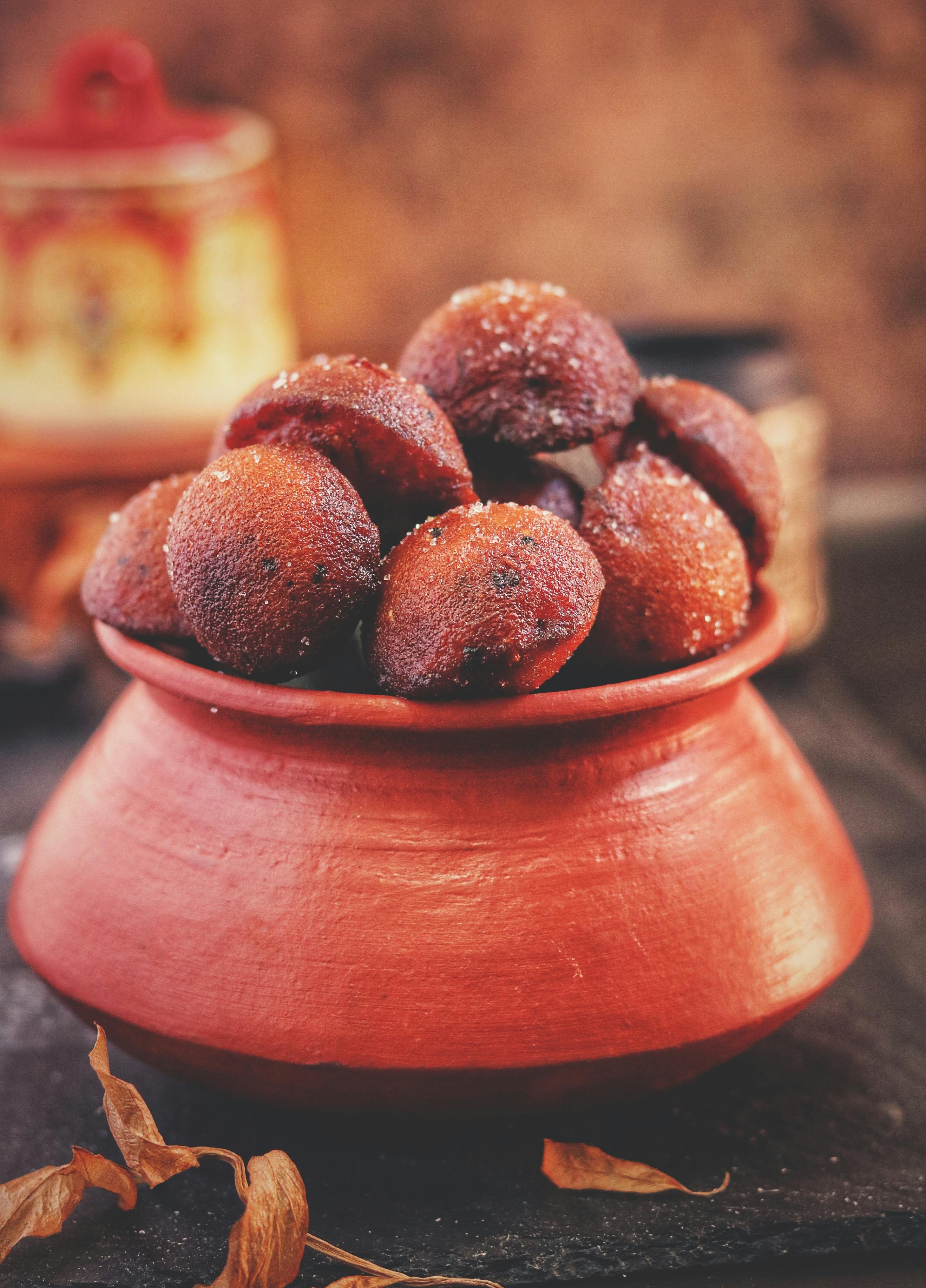
Photo: Saveurs Secretes / Pexels
The diets react (see scores below)
Common Ingredients
- rice flour
- banana
- jaggery
- coconut
- cardamom
- sesame seeds
- ghee
- baking soda
Specific recipes may vary.
Incompatible with 10 of 11 diets
Diet Ratings
Unniyappam is a traditional Kerala sweet snack that is fundamentally incompatible with ketogenic diet principles. The primary ingredients — rice flour, banana, and jaggery — are all high-carbohydrate foods that will spike blood glucose and immediately disrupt ketosis. Rice flour is a refined grain starch with approximately 76g net carbs per 100g. Jaggery is essentially unrefined cane sugar (~98% sugars). Banana is a high-sugar fruit. Together, these three ingredients alone make a single serving of unniyappam contain well over the entire daily keto carb allowance. While ghee and coconut are keto-friendly, they are minor components and cannot offset the overwhelming carbohydrate load of the other ingredients.
Unniyappam contains ghee, which is clarified butter — a dairy product derived from cow's milk and therefore not vegan. All other ingredients (rice flour, banana, jaggery, coconut, cardamom, sesame seeds, baking soda) are fully plant-based. The disqualifying ingredient is ghee, which is unambiguously animal-derived with no debate within vegan circles. A vegan version could easily be made by substituting ghee with coconut oil.
Unniyappam is a traditional Kerala sweet snack that is fundamentally incompatible with paleo principles. The primary ingredient, rice flour, is a grain and is explicitly excluded from the paleo diet. Jaggery, while unrefined, is still a concentrated sugar that falls outside strict paleo guidelines. Baking soda is a processed additive not available to Paleolithic humans. While several individual ingredients — banana, coconut, cardamom, and sesame seeds — are paleo-friendly, and ghee occupies a gray area, the dish is built on a grain-based batter and is inherently a processed, refined-carbohydrate snack. The presence of multiple non-paleo core ingredients means this dish cannot be salvaged by its compliant components.
Unniyappam is a traditional Kerala sweet snack made primarily from refined rice flour (a refined grain), jaggery (added sugar), and ghee (saturated animal fat) as the cooking medium — all of which conflict with core Mediterranean diet principles. The dish is essentially a deep-fried or pan-fried sweet dumpling, making it high in refined carbohydrates, added sugars, and saturated fat. While some ingredients like banana, coconut, cardamom, and sesame seeds have positive nutritional profiles, they are present in smaller amounts and do not offset the dominant problematic components. Ghee replaces olive oil, jaggery represents significant added sugar, and rice flour (refined) is the base — three strikes against Mediterranean principles simultaneously.
Some Mediterranean diet interpreters may acknowledge that jaggery is less processed than refined white sugar and that coconut and sesame seeds are plant-based whole foods with beneficial fats. A more lenient interpretation might classify this as 'caution' rather than 'avoid' if consumed rarely and in small portions, similar to how occasional traditional sweets are sometimes permitted in Mediterranean eating patterns.
Unniyappam is a traditional Kerala sweet snack made almost entirely from plant-based ingredients. Rice flour is a grain product, banana is a fruit, jaggery is a plant-derived sugar, coconut is a plant food, cardamom is a plant spice, and sesame seeds are plant seeds — all strictly excluded on the carnivore diet. Baking soda is a non-animal additive. The only marginally carnivore-adjacent ingredient is ghee, a dairy derivative, but it represents a tiny fraction of this dish and cannot redeem an otherwise completely plant-based snack. There is no animal protein source whatsoever. This dish is incompatible with carnivore diet principles at every level.
Unniyappam contains multiple Whole30-excluded ingredients and also violates the program's 'no recreating baked goods/junk food' rule. First, rice flour is a grain product and is explicitly excluded on Whole30. Second, jaggery is an added sugar (unrefined cane/palm sugar) and is explicitly excluded. Third, baking soda used in this context is a leavening agent for a fried snack/sweet cake, which falls squarely into the excluded category of recreated junk food/snack foods. The dish is essentially a sweet fried rice cake — analogous to a pancake or fritter — which Whole30 prohibits even with otherwise compliant ingredients. Ghee, banana, coconut, cardamom, and sesame seeds are individually compliant, but the combination of excluded ingredients (rice flour, jaggery) and the nature of the dish (recreated sweet fried snack) make this clearly non-compliant.
Unniyappam is a traditional Kerala snack made from rice flour, banana, jaggery, coconut, cardamom, sesame seeds, ghee, and baking soda. Most ingredients are individually low-FODMAP at small servings: rice flour is low-FODMAP, ghee is low-FODMAP (negligible lactose), cardamom and sesame seeds are low-FODMAP in typical culinary amounts, and small amounts of coconut are low-FODMAP. However, two ingredients create significant concern. First, banana is dose-dependent — unripe banana is low-FODMAP at around 100g (one medium unripe), but ripe banana is moderate-to-high in fructose and polyols (sorbitol) at larger serves; since ripe banana is typically used in unniyappam for sweetness and flavor, this is a notable FODMAP risk, especially when banana is a primary ingredient. Second, jaggery is concentrated cane sugar (sucrose), which is generally low-FODMAP, but some sources note variability in fructose content; it is less concerning than honey or HFCS but warrants awareness. Coconut in larger quantities (>1/2 cup shredded) can become moderate. Given that banana is a featured ingredient used in ripe form, and that a standard serving of unniyappam (2-3 pieces) may aggregate enough banana and coconut to push into moderate-FODMAP territory, caution is warranted during the elimination phase.
Monash University rates ripe banana as moderate-FODMAP (fructose and sorbitol) and advises limiting to one small (100g) ripe banana — in unniyappam, banana is distributed across multiple pieces so a single serving may stay under threshold, but clinical FODMAP practitioners often advise avoiding dishes where a high-FODMAP fruit is a primary ingredient during strict elimination, as total load is hard to quantify.
Unniyappam is a traditional Kerala sweet snack made by deep-frying batter in ghee (clarified butter). The combination of jaggery (high added sugar), coconut (saturated fat from a tropical oil), and ghee (saturated fat) makes this dish problematic for DASH. DASH explicitly limits added sugars, saturated fats, and tropical oils like coconut. Ghee is predominantly saturated fat (~65%), and coconut contributes additional saturated fat. While individual ingredients like banana, rice flour, and cardamom are DASH-friendly, the overall profile — high added sugar, high saturated fat from ghee and coconut, and deep-fried preparation — conflicts with core DASH principles. The snack is calorie-dense with limited nutritional benefits relative to its saturated fat and sugar load.
NIH DASH guidelines explicitly restrict saturated fat, added sugars, and tropical oils. However, some updated clinical interpretations note that jaggery has a lower glycemic impact than refined sugar and contains trace minerals, and that small portions of ghee may be acceptable within an otherwise DASH-compliant diet — though the coconut content and overall sugar load remain concerns even in these more flexible interpretations.
Unniyappam is a traditional Kerala sweet snack that presents multiple Zone Diet red flags simultaneously. The ingredient profile is dominated by high-glycemic, high-sugar components: rice flour (refined, high-glycemic carbohydrate), banana (unfavorable Zone carb due to high sugar content), and jaggery (concentrated sugar, essentially equivalent to refined sugar in glycemic impact). These three ingredients combine to create an extremely high-glycemic carbohydrate load with virtually no fiber to moderate the insulin response. The fat content comes primarily from ghee (saturated fat) and coconut (also high in saturated fat), neither of which aligns with the Zone's emphasis on monounsaturated fats. There is essentially zero protein, making it impossible to construct even a partial Zone block without completely restructuring the dish. As a snack, it fails the Zone requirement of maintaining the 40/30/30 ratio — it skews heavily toward carbohydrates (likely 70-80% of calories) with no lean protein counterbalance. The cardamom and sesame seeds offer minimal nutritional redemption. While Zone is ratio-based and not purely exclusionary, Unniyappam's combination of high-glycemic carbs, added sugar, saturated fat, and zero protein makes it genuinely difficult to incorporate into any Zone-balanced context.
Unniyappam is a traditional Kerala fried snack with a mixed anti-inflammatory profile. On the positive side, it contains several beneficial ingredients: banana provides potassium, resistant starch, and quercetin; cardamom is a well-regarded anti-inflammatory spice with antioxidant properties; sesame seeds offer lignans and some omega-3/omega-6 balance along with sesamin, which has shown anti-inflammatory activity; jaggery, while still a sugar, retains trace minerals and has a slightly lower glycemic impact than refined white sugar. However, the dish is primarily a refined-carbohydrate, high-sugar preparation: rice flour is a refined grain offering little fiber, and jaggery — though less processed than table sugar — is still added sugar that can spike blood glucose and contribute to inflammatory signaling when consumed regularly. Ghee is a saturated fat; while it contains butyrate (which has some anti-inflammatory gut effects) and is preferred in Ayurvedic traditions, mainstream anti-inflammatory guidance recommends limiting saturated fat. The frying process (typically deep or shallow fried in ghee or coconut oil) further increases caloric density and oxidative load. Coconut adds medium-chain triglycerides (MCTs), which have some metabolic benefits, but is also high in saturated fat — a point of contention in anti-inflammatory circles. Baking soda is a neutral leavening agent with no meaningful inflammatory impact. Overall, this is a dessert-like snack with some botanical positives but a base of refined carbs and added sugar that makes regular consumption inconsistent with anti-inflammatory principles.
Some integrative nutrition and Ayurvedic practitioners view jaggery as meaningfully superior to refined sugar due to its mineral content and lower processing, and ghee as a therapeutic fat with gut-healing and anti-inflammatory butyrate content — under this lens, Unniyappam made traditionally could be considered an acceptable occasional treat. However, mainstream anti-inflammatory nutrition (Dr. Weil's framework, IF Rating system) would still flag the refined rice flour and added sugar load as net pro-inflammatory, particularly for metabolic or autoimmune contexts.
Unniyappam is a deep-fried or pan-fried South Indian sweet snack made primarily from rice flour, banana, and jaggery, cooked in ghee. It scores poorly across nearly every GLP-1 dietary criterion. It contains negligible protein, making it essentially useless for the #1 priority of muscle preservation during weight loss. The combination of refined rice flour and jaggery creates a high-sugar, high-glycemic load with empty calories — exactly what GLP-1 patients should avoid. Ghee and coconut add significant saturated fat, which worsens nausea, bloating, and reflux — the most common GLP-1 side effects. The frying process (or heavy ghee cooking) makes it high in fat per serving. Banana provides minimal fiber in this processed form. Jaggery, while marginally more nutritious than refined sugar, is still predominantly sugar and does not meaningfully improve the nutritional profile. The dish offers very poor nutrient density per calorie for a patient eating significantly reduced volumes of food. It is also a sweet snack — a category that promotes blood sugar spikes and undermines satiety on GLP-1 medications.
*See how scores were generated at our methodology page.
Nutritional profile
Six traits that cut across every diet.
Fiber & Plants
How much whole-plant food and fiber it delivers.
Healthy Fats
The quality of its fats (unsaturated, omega-3).
Whole / Unprocessed
How close it is to its natural, unprocessed form.
Gut Gentle
How easy it is on digestion (low FODMAP, few irritants).
Low Glycemic
How little it spikes your blood sugar.
Protein Density
How much protein it packs per calorie.
Controversy Index
Higher controversy = more disagreement between diets.
Diet-Specific Tips
 Anti-Inflammatory — 4/10
View tips
- Rice flour is a refined carbohydrate with little fiber, contributing to glycemic spike and potential pro-inflammatory response
- Jaggery is added sugar — less processed than white sugar but still a significant source of simple carbohydrates
- Banana contributes quercetin and natural sugars; adds modest anti-inflammatory benefit
- Cardamom and sesame seeds offer meaningful antioxidant and anti-inflammatory compounds
- Ghee provides butyrate (gut anti-inflammatory) but is high in saturated fat, which anti-inflammatory guidelines recommend limiting
- Coconut is high in saturated fat — debated in anti-inflammatory research but generally consumed in moderation
- Fried preparation increases oxidative load and caloric density
- No omega-3 fatty acids or significant polyphenol-rich vegetables present