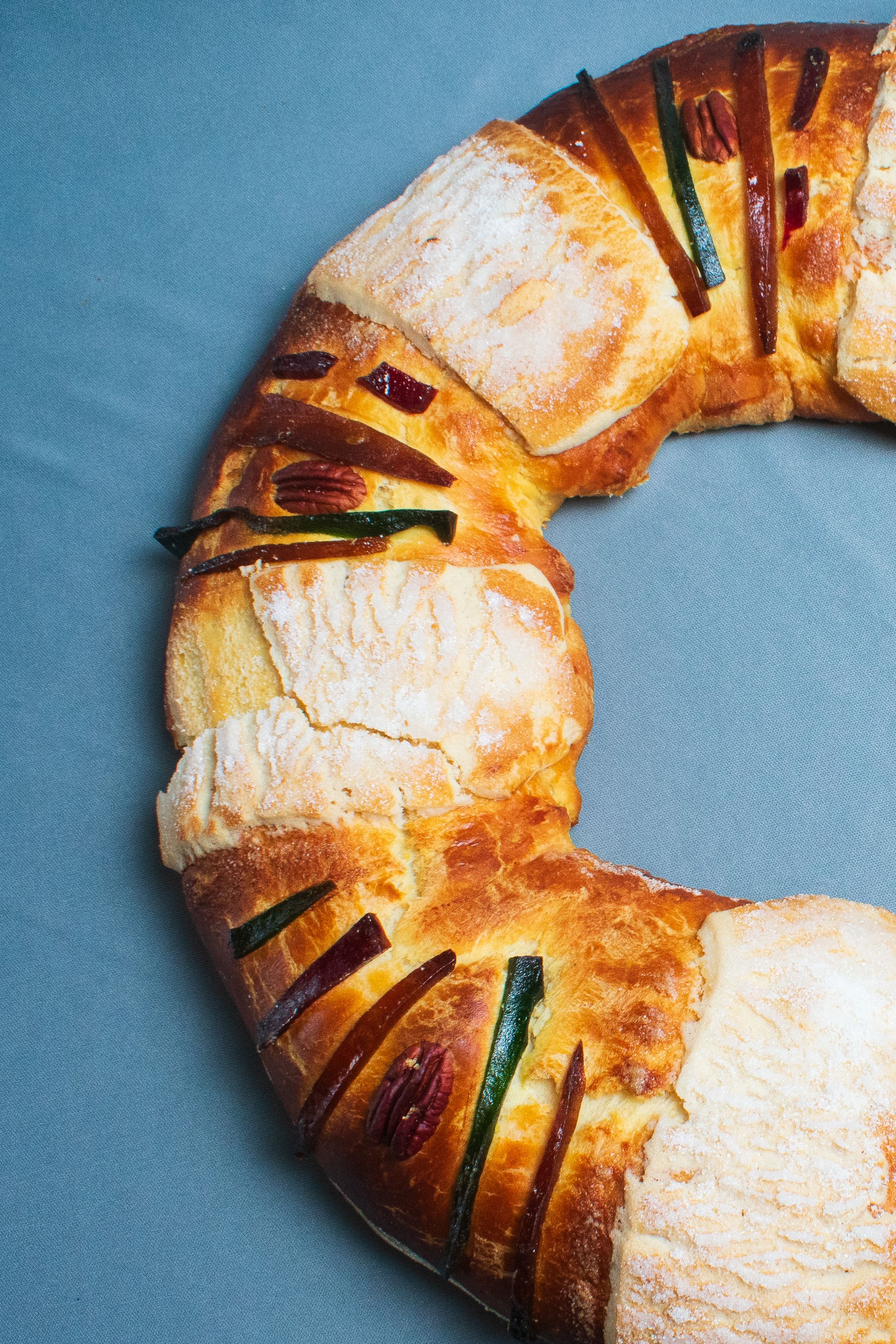
Photo: Erick Ortega / Pexels
The diets react (see scores below)
Common Ingredients
- flour
- butter
- sugar
- eggs
- milk
- yeast
- cinnamon
- vanilla
- salt
- icing
- food coloring
Specific recipes may vary.
Incompatible with 11 of 11 diets
Diet Ratings
King Cake is a traditional Mardi Gras pastry built on a foundation of wheat flour, sugar, and icing — three major ketogenic diet disqualifiers. A single slice contains an estimated 40-60g of net carbs, easily exceeding the entire daily keto limit in one serving. The yeast-leavened dough is grain-based, the sugar is both incorporated into the dough and layered on as icing, and the food coloring adds no nutritional value. There is no meaningful fat-to-carb ratio that could make this compatible with ketosis. This is one of the clearest 'avoid' cases possible.
King Cake as listed contains multiple animal-derived ingredients that disqualify it from a vegan diet. Butter is a dairy product, milk is a dairy product, and eggs are an animal product — all three are explicitly excluded under vegan rules. While the remaining ingredients (flour, sugar, yeast, cinnamon, vanilla, salt, and most food colorings) are plant-based or vegan-friendly, the presence of butter, milk, and eggs makes this dish clearly non-vegan. Vegan versions of King Cake can be made by substituting plant-based butter, non-dairy milk, and flax or chia eggs, but the traditional recipe as described here does not qualify.
King Cake is fundamentally incompatible with the paleo diet. Its core ingredients are almost entirely non-paleo: flour (wheat grain), sugar (refined), milk (dairy), yeast (processed leavening), salt (added), icing (refined sugar), and food coloring (artificial additive). While eggs, butter, cinnamon, and vanilla are borderline acceptable or partially allowed in some paleo frameworks, they cannot redeem a dish built on a foundation of wheat flour, refined sugar, and dairy. This is a highly processed, grain-based pastry with no meaningful paleo-compatible adaptation possible without completely rebuilding the recipe.
King Cake is a highly processed sweet pastry that directly contradicts Mediterranean diet principles. It is made from refined white flour, substantial amounts of butter (saturated fat rather than olive oil), added sugar, and topped with icing and food coloring. It provides negligible nutritional value, is high in refined carbohydrates and added sugars, and contains no whole grains, legumes, vegetables, or other plant-based staples. Butter replaces olive oil as the fat source, and the heavy sugar load from both the dough and icing firmly places this in the 'avoid' category. This is essentially a festive dessert cake with no meaningful alignment with Mediterranean eating patterns.
King Cake is fundamentally incompatible with the carnivore diet. It is a plant-based pastry composed almost entirely of excluded ingredients: flour (grain), sugar (processed), yeast, cinnamon (plant spice), vanilla (plant extract), icing (sugar-based), and food coloring (artificial additives). While it does contain small amounts of animal-derived ingredients (butter, eggs, milk), these are minor components in an overwhelmingly plant-based and processed product. No carnivore protocol — not even the most lenient 'animal-based' approach — would sanction a grain-and-sugar-based confection like this.
King Cake is a sweet, yeasted bread/pastry containing multiple excluded ingredients. Flour (grain), butter (dairy), sugar (added sugar), and milk (dairy) all violate Whole30 rules. Additionally, King Cake is explicitly the type of baked good the program prohibits under its 'no recreating baked goods' rule — it is a celebratory sweet bread, exactly what Whole30 aims to eliminate. Icing adds further sugar and likely dairy. There is no compliant version of this dish.
King Cake is built on a wheat flour base, making it high in fructans — the primary FODMAP concern during the elimination phase. A standard serving of King Cake (a generous slice) contains a significant quantity of wheat, which Monash University clearly rates as high-FODMAP due to fructans. Beyond the wheat base, the milk used in the enriched dough contains lactose, another FODMAP. The icing (typically a powdered sugar glaze) may seem innocuous, but the overall dish is dominated by the high-fructan wheat dough. There is no realistic serving size at which a standard slice of King Cake would be considered low-FODMAP during the elimination phase. Cinnamon and vanilla are low-FODMAP, butter and eggs are safe, and sugar is fine — but the foundational wheat dough and milk make this dish unsuitable for FODMAP elimination.
King Cake is a heavily sweetened, refined-flour pastry that conflicts with core DASH principles on multiple fronts. It is made primarily from white flour (not whole grain), butter (high in saturated fat), significant amounts of sugar, and topped with icing — all categories DASH explicitly limits. It provides minimal potassium, calcium, magnesium, or fiber relative to its caloric load. It contains no meaningful lean protein or vegetable content. The DASH diet calls for limiting sweets to 5 or fewer servings per week, and a typical slice of King Cake would consume that entire weekly allowance in one sitting due to its high sugar and saturated fat content. While eggs and milk are present, they do not redeem the overall nutritional profile of this dessert-style snack.
King Cake is essentially a sweet enriched bread heavily loaded with sugar, refined white flour, butter, and sugar-based icing — a near-perfect storm of Zone Diet unfavorable elements. The carbohydrate base is high-glycemic refined flour with added sugar and topped with more sugar icing, causing rapid blood glucose spikes followed by insulin surges — exactly what the Zone Diet is designed to prevent. There is no meaningful lean protein, no monounsaturated fat component, and no low-glycemic carbohydrates. The fat comes primarily from butter (saturated), which Zone discourages. With no protein block to balance against and carbs that are almost entirely high-glycemic, there is no practical way to portion King Cake into a Zone-balanced meal or snack. It provides nutritional emptiness from a Zone perspective: calories from sugar and refined carbs with no fiber, no omega-3s, and no polyphenols of note. Even a tiny portion would throw the 40/30/30 ratio completely out of balance given the near-zero protein content.
King Cake is a quintessential pro-inflammatory food by virtually every anti-inflammatory framework. It is built on refined white flour, white sugar, butter, and sugar icing — the exact combination of refined carbohydrates, added sugar, and saturated fat that anti-inflammatory nutrition consistently identifies as driving inflammatory markers like CRP and IL-6. The butter and full-fat milk contribute saturated fat, and the heavy sugar icing adds a significant glycemic load. The artificial food coloring (the signature purple, gold, and green) introduces synthetic additives that some research links to inflammatory responses and gut microbiome disruption. The one modestly redeeming ingredient is cinnamon, which has documented anti-inflammatory properties, but its quantity as a spice in this context is entirely insufficient to offset the dish's inflammatory burden. King Cake offers no meaningful omega-3s, antioxidants, polyphenols, or fiber. It is effectively a celebratory dessert and should be understood as such — an occasional cultural indulgence, not a food compatible with anti-inflammatory eating patterns.
King Cake is a traditional Mardi Gras sweet bread made primarily from refined flour, butter, sugar, and topped with sugary icing — a near-perfect storm of everything GLP-1 patients should avoid. It is high in refined carbohydrates and added sugar, provides virtually no protein or fiber, and contains significant saturated fat from butter. The icing adds a concentrated sugar load that can spike blood glucose rapidly. With slowed gastric emptying on GLP-1 medications, a dense, buttery, sugary pastry is likely to sit heavily in the stomach and worsen nausea, bloating, and reflux. It offers essentially zero nutritional value per calorie — the opposite of the nutrient density these patients require. Even a small portion delivers mostly empty calories with no meaningful protein, fiber, or micronutrient contribution.
*See how scores were generated at our methodology page.
Nutritional profile
Six traits that cut across every diet.
Fiber & Plants
How much whole-plant food and fiber it delivers.
Healthy Fats
The quality of its fats (unsaturated, omega-3).
Whole / Unprocessed
How close it is to its natural, unprocessed form.
Gut Gentle
How easy it is on digestion (low FODMAP, few irritants).
Low Glycemic
How little it spikes your blood sugar.
Protein Density
How much protein it packs per calorie.
Controversy Index
Higher controversy = more disagreement between diets.