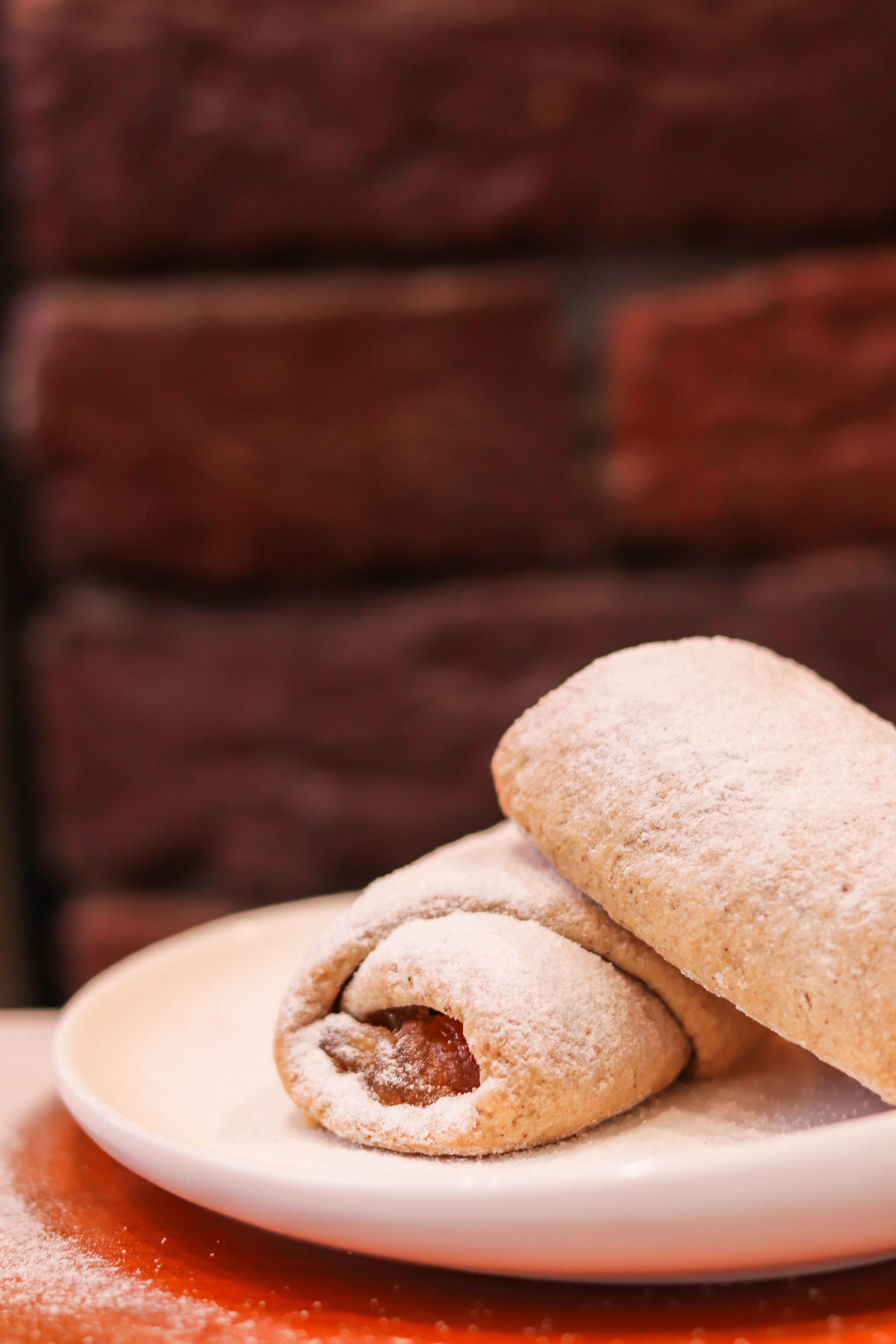
Photo: mehmetakifarts / Pexels
The diets react (see scores below)
Common Ingredients
- flour
- butter
- cream cheese
- egg
- jam
- cinnamon
- sugar
- vanilla
- salt
Specific recipes may vary.
Incompatible with 11 of 11 diets
Diet Ratings
Kolaczki are traditional Polish pastry cookies that are fundamentally incompatible with a ketogenic diet. The dough is made with wheat flour, a high-carb grain that alone disqualifies this food. Combined with sugar and jam (which is essentially concentrated fruit sugar), a single serving would contain an extremely high number of net carbs — easily 15-25g per cookie depending on size — far exceeding keto tolerances. While the butter and cream cheese contribute fat, they cannot offset the massive carbohydrate load from flour, sugar, and jam. There is no meaningful portion size at which Kolaczki could fit into a ketogenic framework without breaking ketosis.
Kolaczki contains multiple animal-derived ingredients that disqualify it from a vegan diet. Butter is a dairy product, cream cheese is a dairy product, and egg is an animal product. All three are explicitly excluded under vegan dietary rules. The remaining ingredients (flour, jam, cinnamon, sugar, vanilla, salt) are plant-based, but the presence of three distinct animal-derived ingredients makes this clearly non-vegan. A vegan version could theoretically be made using plant-based butter, vegan cream cheese, and a flax or chia egg substitute.
Kolaczki is a traditional Polish pastry cookie that is fundamentally incompatible with the Paleo diet. The recipe contains multiple non-paleo ingredients: flour (a grain product), butter and cream cheese (dairy), refined sugar, and added salt. These are not isolated gray-area ingredients — they form the structural foundation of the dish. Flour and refined sugar are among the clearest 'avoid' categories in all paleo frameworks. Dairy (butter and cream cheese) is excluded across virtually all paleo protocols. Even if jam were made from whole fruit, the surrounding ingredients make this dish wholly non-paleo. There is no meaningful paleo adaptation possible without completely reconstructing the recipe.
Kolaczki are Polish cream cheese pastries that fundamentally conflict with Mediterranean diet principles. The dough is made from refined white flour and butter (a saturated fat, not olive oil), filled with sugary jam and sweetened with added sugar. This combination represents refined grains, high saturated fat, and significant added sugar — three of the primary items the Mediterranean diet discourages. There is no redeeming plant-forward element, no whole grain, no olive oil, and no legume or vegetable component. This is a dessert/pastry from a Northern European culinary tradition that bears little resemblance to Mediterranean dietary patterns.
Kolaczki are Polish pastry cookies that are fundamentally incompatible with the carnivore diet. The dish is built entirely around plant-derived and processed ingredients: flour (grain), jam (fruit/sugar), cinnamon (plant spice), sugar, and vanilla are all explicitly excluded on carnivore. While butter, cream cheese, and egg are animal-derived, they serve only as minor supporting ingredients in what is overwhelmingly a plant-based, sugar-laden baked good. There is no meaningful animal protein or fat in a carnivore-relevant sense here. This is a confectionery snack with no place in any tier of the carnivore diet.
Kolaczki contains multiple excluded ingredients: flour (grain), butter (dairy, not ghee), cream cheese (dairy), and sugar (added sugar). Furthermore, kolaczki are Polish filled cookies — a baked good that falls squarely into the 'no recreating baked goods/junk food' rule even if one attempted to substitute compliant ingredients. This dish is not compatible with Whole30 on multiple grounds.
Kolaczki are Polish filled cookies made from a cream cheese pastry dough, filled with jam. The primary concern is the wheat flour, which is high in fructans — a major FODMAP — making this problematic during the elimination phase. Cream cheese is relatively low-lactose (it's a soft fresh cheese but lower lactose than milk or yogurt), generally considered low-FODMAP at small servings (~2 tbsp). Butter is low-FODMAP. Sugar, vanilla, cinnamon, and salt are low-FODMAP. The jam filling depends on fruit type — many jams (apricot, raspberry, strawberry) may be moderate to high FODMAP depending on quantity and fruit concentration, and some contain high-fructose corn syrup or high fruit pulp concentrations. The dominant issue is the wheat flour in the pastry, which makes the base of this cookie high in fructans at any realistic serving size. Even one or two cookies would involve a meaningful amount of wheat flour per piece. This dish cannot be made low-FODMAP without substituting gluten-free flour.
Monash University rates cream cheese as low-FODMAP at servings up to 2 tablespoons; some FODMAP practitioners note that the cream cheese component is not the issue here and that gluten-free flour substitution would make a modified version potentially acceptable. However, traditional kolaczki with wheat flour should be avoided during elimination regardless of cream cheese status.
Kolaczki are Polish cream cheese pastry cookies made with a butter-and-cream-cheese dough filled with jam, and they are poorly suited to the DASH diet. The ingredient list is dominated by saturated fat sources (butter and cream cheese, which is a full-fat dairy product), refined white flour (not whole grain), and significant added sugar (jam, sugar, vanilla sugar). DASH explicitly limits saturated fat, full-fat dairy, refined grains, and added sweets. The combination of high saturated fat from butter and cream cheese, refined carbohydrates, and added sugars places this firmly in the 'avoid' category. There is negligible fiber, potassium, magnesium, or calcium in forms that DASH emphasizes. As a sweet pastry snack, it represents exactly the category of foods DASH de-emphasizes.
Kolaczki are Polish cream cheese pastries made primarily from refined white flour, butter, cream cheese, jam, and sugar — a combination that is fundamentally incompatible with Zone Diet principles. The macronutrient profile is dominated by high-glycemic refined carbohydrates (white flour, jam, sugar) and saturated fat (butter, cream cheese), with virtually no lean protein. This means the 40/30/30 ratio cannot be achieved even with careful portioning — the carb fraction is high-glycemic and the fat fraction is saturated-heavy, both unfavorable in Zone terminology. There is no meaningful lean protein source to anchor a Zone block. The jam and added sugar spike the glycemic load further. Even eating a very small portion would contribute negligible Zone-compatible nutrition while delivering a glycemic and inflammatory hit that Sears explicitly discourages. This is not a food that can be portioned into any Zone meal structure in a meaningful way — it is a dessert pastry built entirely from Zone's 'unfavorable' and 'avoid' categories stacked together.
Kolaczki are traditional Polish cream cheese pastry cookies with a profile that is largely pro-inflammatory by anti-inflammatory diet standards. The base is refined white flour, which is a refined carbohydrate with a high glycemic load that can spike blood sugar and promote inflammatory markers. Butter is a saturated fat that anti-inflammatory guidelines recommend limiting, and in this recipe it is a primary structural ingredient. Cream cheese is full-fat dairy, also flagged as a food to limit. Added sugar appears both in the dough and the jam filling, and jam is typically high in refined sugar or high-fructose corn syrup depending on brand. The only redemptive elements are trace cinnamon, which has genuine anti-inflammatory polyphenol content, and vanilla, but these are present in negligible amounts relative to the rest of the ingredient profile. There are no omega-3 sources, no meaningful antioxidant load, no fiber-rich whole grains, and no vegetables or legumes. This is a classic indulgent pastry with very little to recommend it from an anti-inflammatory perspective.
Kolaczki are traditional Polish butter-cream cheese pastries filled with jam. The ingredient profile is deeply problematic for GLP-1 patients: the dough is built on refined flour (low fiber, rapidly digested refined carb), butter (high saturated fat), and cream cheese (high fat), with a jam filling that adds concentrated sugar. There is virtually no protein, no meaningful fiber, and the calorie load per small cookie comes almost entirely from saturated fat and simple sugars. The high fat content is likely to worsen GLP-1 side effects including nausea, bloating, and reflux. The sugar spike with no protein or fiber buffer is counterproductive to blood sugar management. These are empty-calorie, nutrient-poor servings that offer nothing a GLP-1 patient needs and several things that will make their experience worse.
*See how scores were generated at our methodology page.
Nutritional profile
Six traits that cut across every diet.
Fiber & Plants
How much whole-plant food and fiber it delivers.
Healthy Fats
The quality of its fats (unsaturated, omega-3).
Whole / Unprocessed
How close it is to its natural, unprocessed form.
Gut Gentle
How easy it is on digestion (low FODMAP, few irritants).
Low Glycemic
How little it spikes your blood sugar.
Protein Density
How much protein it packs per calorie.
Controversy Index
Higher controversy = more disagreement between diets.