Photo: Theodore Nguyen / Pexels
The diets react (see scores below)
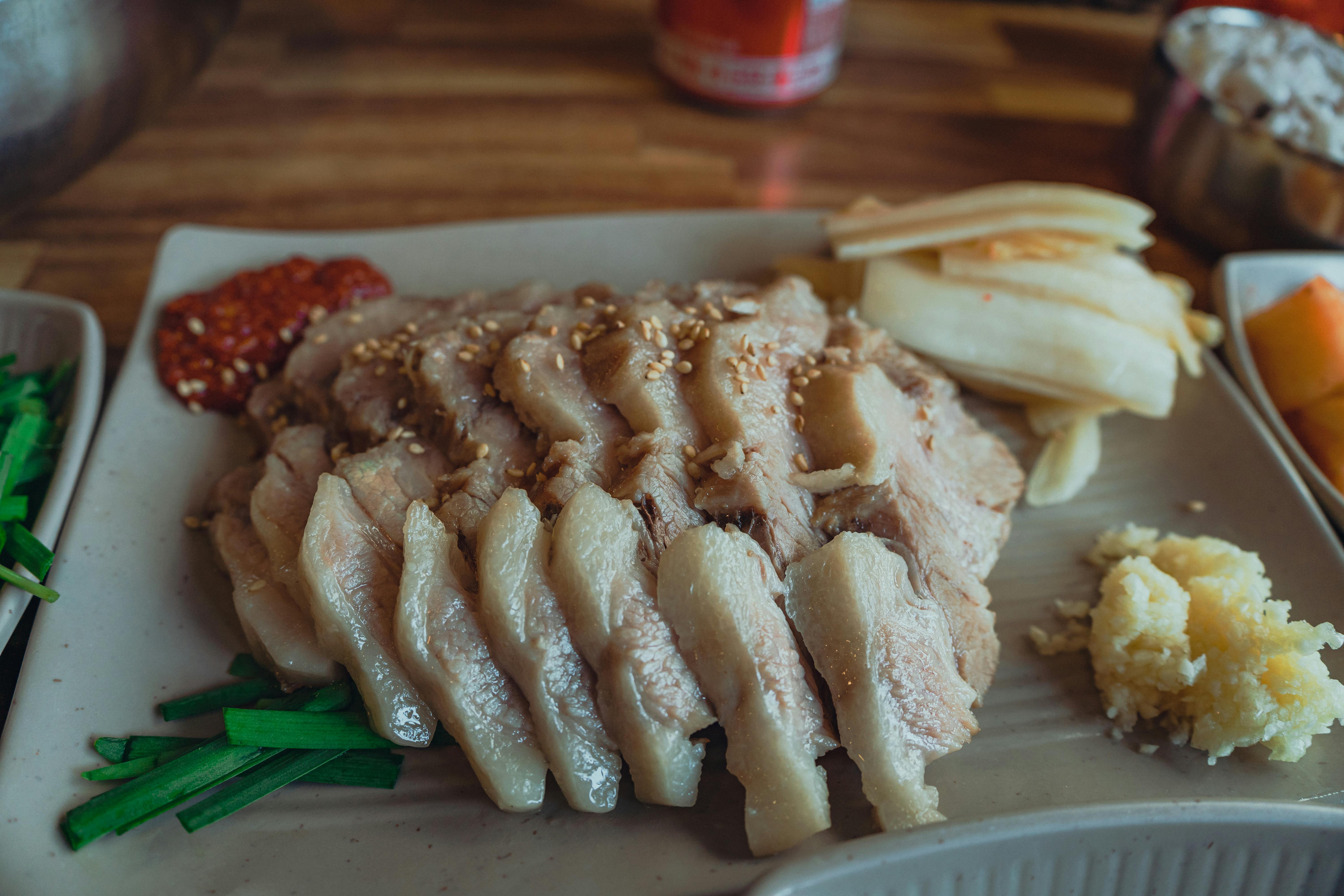
Common Ingredients
- pork belly
- napa cabbage
- garlic
- ginger
- salted shrimp
- radish
- gochugaru
- doenjang
Specific recipes may vary.
Incompatible with 8 of 11 diets
Diet Ratings
Bossam is centered on pork belly, one of the most keto-friendly proteins due to its high fat content. However, the dish is traditionally served with accompaniments that add moderate carb load. Napa cabbage wraps are low-carb and fine in moderation. The concern lies in doenjang (fermented soybean paste), which contains moderate carbs, and gochugaru (Korean red pepper flakes), which adds minor carbs. Salted shrimp (saeujeot) is generally low-carb. Radish adds a small net carb contribution. The overall carb load depends heavily on portion sizes of the condiments and how much doenjang-based sauce or kimchi-style accompaniments are used. A moderate serving with careful condiment control is manageable within keto macros, but traditional full portions with generous doenjang paste and radish sides could push net carbs toward the upper limit.
Strict keto practitioners may flag doenjang as problematic due to its soybean base and moderate carb content, and some warn that fermented pastes can contain hidden sugars or starches added during commercial production, making this a dish to avoid entirely rather than portion-control.
Bossam contains multiple animal products that make it entirely incompatible with a vegan diet. The primary protein is pork belly, a direct animal product. Salted shrimp (saeujeot), used in the accompanying kimchi or dipping sauces, is a seafood-derived ingredient. Doenjang (fermented soybean paste) is plant-based, as are the vegetables and spices, but the dish's core components — pork and shrimp — are unambiguously animal-derived. There is no vegan version of traditional bossam; it is defined by its boiled pork preparation.
Bossam contains several non-paleo ingredients that make it incompatible with the diet. Doenjang is a fermented soybean paste, placing it firmly in the legume category — a clear paleo exclusion. Salted shrimp (saeujeot) is a heavily salted, fermented condiment that violates the no-added-salt and processed foods rules. While pork belly, napa cabbage, garlic, ginger, radish, and gochugaru are paleo-compatible, the doenjang alone is a disqualifying ingredient as soy is explicitly excluded. The dish as traditionally prepared cannot be considered paleo-compliant.
Bossam is centered on pork belly, one of the fattiest cuts of red meat, which the Mediterranean diet restricts to only a few times per month. Pork belly is high in saturated fat and contradicts the diet's emphasis on plant-based foods and olive oil as the primary fat source. While the dish does include beneficial vegetables (napa cabbage, radish, garlic, ginger) and fermented components (doenjang, salted shrimp) that align partially with Mediterranean principles, the primary protein and fat source is a large portion of fatty red meat. The accompanying fermented shrimp paste also introduces high sodium, which is not characteristic of the Mediterranean dietary pattern. The vegetable accompaniments are insufficient to offset the core incompatibility of pork belly as the main component.
Bossam is fundamentally incompatible with the carnivore diet. While the pork belly itself is an excellent carnivore food (fatty, minimally processed), the dish is served with and defined by its accompaniments: napa cabbage (plant), garlic (plant), ginger (plant), radish (plant), gochugaru (chili flakes — plant), and doenjang (fermented soybean paste — plant). Salted shrimp is the only other animal-derived ingredient. The dish cannot be meaningfully separated from its plant-based wrapping and condiment components — eating only the pork belly would no longer constitute Bossam as a dish. The presence of doenjang (a legume-derived fermented paste) and gochugaru (a nightshade spice) are particularly problematic from a carnivore standpoint.
Bossam contains doenjang (Korean fermented soybean paste), which is a soy-based legume product and is explicitly excluded on Whole30. Soy in all forms — including fermented soy pastes like doenjang and miso — is prohibited. Additionally, salted shrimp (saeujeot) used in the kimchi/ssam components is generally fermented and may contain added sugars or other non-compliant additives depending on the brand. The core protein (pork belly) is compliant, as are the vegetables (napa cabbage, radish), aromatics (garlic, ginger), and gochugaru (pure chili flakes). However, the doenjang alone disqualifies the dish as traditionally prepared. A Whole30-compliant version would need to eliminate the doenjang entirely and use carefully label-checked salted shrimp with no added sugar.
Bossam contains multiple high-FODMAP ingredients that make it unsuitable during the elimination phase. Garlic is one of the highest-FODMAP foods (fructans) and is used as a core seasoning/cooking ingredient. Doenjang (fermented soybean paste) is high in GOS and fructans from soybeans and is a primary flavoring. Salted shrimp (saeujeot) used in the accompanying kimchi-style preparations typically contains fermented ingredients that may pose issues, and gochugaru while low-FODMAP itself is often a minor concern. Napa cabbage is low-FODMAP at small servings (75g), and plain pork belly is low-FODMAP. Radish is low-FODMAP at standard servings. Ginger is low-FODMAP. However, the combination of garlic and doenjang as essential, non-negotiable components of authentic Bossam makes this dish high-FODMAP overall. These ingredients cannot be reduced to trace amounts without fundamentally altering the dish.
Bossam is fundamentally incompatible with DASH diet principles on multiple fronts. Pork belly is one of the highest saturated fat and total fat cuts of meat available, directly contradicting DASH's explicit guidance to limit saturated fat and red/fatty meats. The accompanying condiments — salted shrimp (saeu-jeot) and doenjang (fermented soybean paste) — are extremely high in sodium, easily pushing a single serving well above the standard DASH daily sodium ceiling of 2,300mg, let alone the stricter 1,500mg target. While some ingredients like napa cabbage, radish, garlic, ginger, and gochugaru are DASH-friendly vegetables and spices, they do not offset the core issues of high saturated fat from pork belly and very high sodium from the fermented/salted condiments that are structurally essential to the dish. DASH guidelines explicitly call for lean meats and low-sodium preparations; this dish violates both principles simultaneously.
Bossam is a traditional Korean boiled pork belly dish served with napa cabbage wraps, fermented accompaniments (doenjang, salted shrimp), and spicy radish. The primary Zone concern is pork belly itself — it is a high-fat cut with significant saturated fat content, making it an 'unfavorable' protein in Zone terminology. Dr. Sears consistently recommends lean proteins (skinless chicken, fish, lean cuts) and limits saturated fat. However, pork belly is not nutritionally empty — it does provide substantial protein alongside the fat. The carbohydrate components (napa cabbage, radish, garlic, ginger) are excellent low-glycemic, high-fiber, polyphenol-rich vegetables that align perfectly with Zone principles. Gochugaru (Korean chili flakes) and doenjang (fermented soybean paste) add polyphenol and probiotic value. The structural issue is the fat ratio: pork belly is roughly 50-60% fat by calories, which skews far beyond the 30% fat target and delivers too much saturated fat. To make this Zone-compatible, one would need to trim visible fat aggressively and control portion size significantly — perhaps 2-3 oz of lean pork only. The fermented/vegetable components actually make this more Zone-friendly than many other pork belly dishes, but the core protein source remains problematic without significant modification.
Some Zone practitioners and later Sears writings (The Mediterranean Zone, 2014) show greater flexibility toward animal fats when accompanied by high polyphenol, anti-inflammatory foods — which this dish has in abundance (fermented vegetables, gochugaru, garlic, ginger). A practitioner following the later Sears framework might argue that a small, fat-trimmed portion of bossam with generous vegetable wraps can fit reasonably within Zone blocks, pushing the score closer to 5-6.
Bossam is a Korean boiled pork belly dish served with fermented and fresh vegetables. The ingredient profile is mixed from an anti-inflammatory standpoint. On the positive side, garlic and ginger are well-established anti-inflammatory spices with documented effects on inflammatory markers. Gochugaru (Korean red pepper flakes) contains capsaicin, which has anti-inflammatory properties. Napa cabbage and radish are cruciferous/brassica vegetables rich in antioxidants and fiber. Doenjang (fermented soybean paste) is a whole soy fermented food — explicitly emphasized in the anti-inflammatory framework — with probiotic and isoflavone benefits. Salted shrimp (saeujeot) adds fermented seafood with some omega-3s. However, the primary protein is pork belly, which is high in saturated fat and falls squarely in the 'limit' category of anti-inflammatory guidelines. The high saturated fat content can elevate pro-inflammatory markers and unfavorably shift omega-6:omega-3 ratios. The overall dish is therefore a balance of genuinely anti-inflammatory components (fermented foods, spices, vegetables) against a fatty red/processed meat base. Occasional consumption is reasonable, but regular intake of the saturated fat load from pork belly is problematic for an anti-inflammatory dietary pattern.
Some anti-inflammatory researchers note that pork belly, while high in saturated fat, also contains oleic acid (a monounsaturated fat associated with anti-inflammatory effects) and that the fermented accompaniments (doenjang, salted shrimp) may modulate the inflammatory response; traditional Korean dietary patterns that include fermented foods alongside pork show favorable metabolic outcomes in some observational studies. However, mainstream anti-inflammatory frameworks including Dr. Weil's pyramid clearly place high-fat pork in the 'limit' category, and the high saturated fat content is difficult to reconcile with anti-inflammatory principles.
Bossam's primary protein is pork belly, one of the fattiest cuts of pork available, with a typical serving delivering 30–45g of fat (much of it saturated) alongside only modest protein. GLP-1 patients are especially vulnerable to high-fat meals because slowed gastric emptying means fatty food lingers in the stomach far longer, significantly worsening nausea, bloating, and reflux. The supporting ingredients are genuinely positive — napa cabbage and radish add fiber, water content, and easy digestibility; garlic and ginger are gut-supportive; doenjang provides some fermented protein. However, these cannot offset the dominant issue of pork belly's fat load. Gochugaru and salted shrimp add spice and very high sodium, both of which can aggravate GI side effects. The dish is also portion-sensitive: even a small serving of pork belly delivers a substantial fat hit. Traditional Bossam preparation involves boiling rather than frying, which is a mild point in its favor compared to fried pork preparations, but the intrinsic fat content of the cut remains the disqualifying factor for GLP-1 patients.
Some GLP-1-focused dietitians note that Bossam's boiled preparation and vegetable wrapping make it meaningfully better than fried or braised pork belly preparations, and that patients with higher fat tolerance or on lower doses may manage a small portion without significant GI distress. The disagreement centers on whether preparation method and portion control can rehabilitate a fundamentally high-saturated-fat protein source, with most obesity medicine RDs landing on the side of substituting a leaner pork cut (loin or tenderloin) instead.
*See how scores were generated at our methodology page.
Nutritional profile
Six traits that cut across every diet.
Fiber & Plants
How much whole-plant food and fiber it delivers.
Healthy Fats
The quality of its fats (unsaturated, omega-3).
Whole / Unprocessed
How close it is to its natural, unprocessed form.
Gut Gentle
How easy it is on digestion (low FODMAP, few irritants).
Low Glycemic
How little it spikes your blood sugar.
Protein Density
How much protein it packs per calorie.
Controversy Index
Higher controversy = more disagreement between diets.
Diet-Specific Tips
 Keto — 5/10
View tips
- Pork belly is high-fat and ideal for keto
- Doenjang (fermented soybean paste) contributes moderate net carbs
- Napa cabbage wraps are low net-carb and acceptable
- Gochugaru adds minor carbs but is used in small quantities
- Salted shrimp is low-carb
- Radish contributes small net carbs per serving
- Overall carb load is portion-dependent — condiment quantities are critical
- No grains or added sugars in the base dish
 Zone — 4/10
View tips
- Pork belly is high in saturated fat, making it an unfavorable Zone protein source
- Napa cabbage and radish are ideal low-glycemic Zone carbohydrates
- Doenjang and salted shrimp are fermented, polyphenol-rich condiments aligned with anti-inflammatory Zone principles
- Gochugaru adds polyphenols without meaningful carbohydrate load
- Fat content of pork belly skews the 40/30/30 macro ratio significantly toward fat
- Aggressive fat trimming and small portion size (2-3 oz) required to approach Zone compliance
- No high-glycemic carbohydrates present — vegetable carb profile is exemplary
 Anti-Inflammatory — 4/10
View tips
- Pork belly is high in saturated fat — categorized as 'limit' in anti-inflammatory frameworks
- Doenjang (fermented soy paste) is a strongly approved whole soy fermented food with probiotic and isoflavone benefits
- Garlic and ginger are well-documented anti-inflammatory spices
- Gochugaru contains capsaicin with anti-inflammatory properties
- Napa cabbage and radish contribute antioxidants and prebiotic fiber
- Salted shrimp adds fermented seafood with minor omega-3 contribution
- Overall dish balances anti-inflammatory accompaniments against a pro-inflammatory fatty meat base