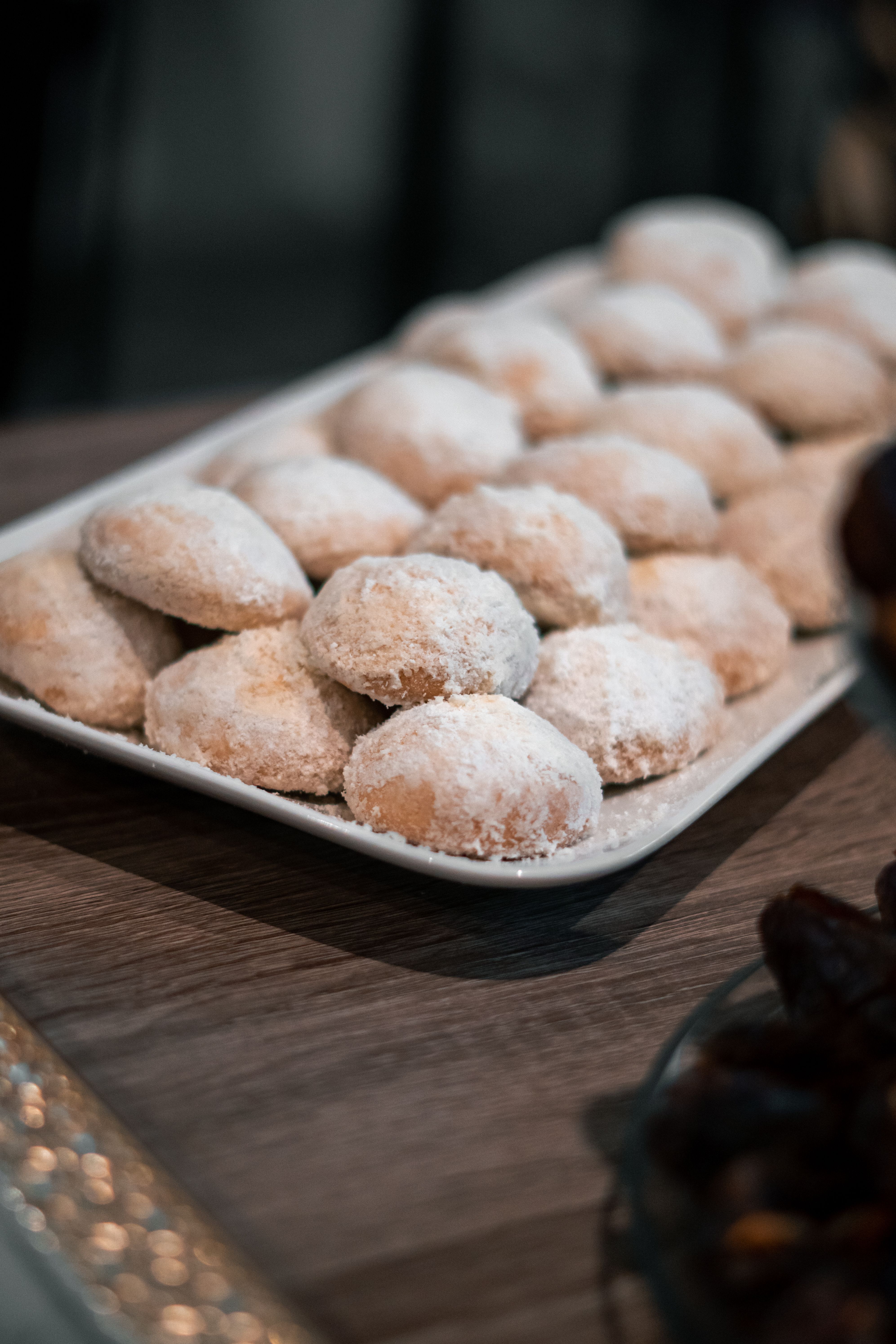
Photo: Hasan Gulec / Pexels
The diets react (see scores below)
Common Ingredients
- butter
- powdered sugar
- egg yolk
- brandy
- vanilla
- flour
- baking powder
- clove
- salt
Specific recipes may vary.
Incompatible with 11 of 11 diets
Diet Ratings
Kourabiedes are traditional Greek shortbread cookies built on two foundational keto-incompatible ingredients: wheat flour and powdered sugar. Flour is a high-glycemic grain product that will spike blood sugar and disrupt ketosis, while powdered sugar is pure refined sugar. Together these two ingredients make up the bulk of the cookie's carbohydrate content, delivering a very high net carb load per serving — likely 15-25g net carbs per cookie. Although the recipe does contain butter (a keto-friendly fat) and egg yolk, these cannot offset the dominant anti-keto ingredients. There is no realistic portion size that makes this food compatible with ketosis.
Kourabiedes are traditional Greek shortbread cookies that contain multiple animal-derived ingredients. Butter is a dairy product, and egg yolk is an animal product — both are explicitly excluded under vegan dietary rules. The remaining ingredients (brandy, vanilla, flour, baking powder, clove, salt, powdered sugar) are plant-based, but the presence of butter and egg yolk makes this dish clearly non-vegan. Vegan versions of kourabiedes can be made by substituting vegan butter (e.g., coconut oil or plant-based margarine) and omitting or replacing the egg yolk with a flax egg or aquafaba, but the traditional recipe as listed is not vegan-compatible.
Kourabiedes are Greek shortbread cookies that are fundamentally incompatible with the paleo diet. The dish contains multiple non-paleo ingredients: flour (wheat grain, strictly excluded), butter (dairy, excluded), powdered sugar (refined sugar, excluded), baking powder (processed additive, excluded), and salt (added salt, excluded). These are not minor or debatable ingredients — they form the structural base of the recipe. There is no meaningful paleo substitution that would preserve the dish's identity. Brandy, vanilla, egg yolk, and clove are the only ingredients that could pass paleo scrutiny, but they are minor components in an otherwise entirely non-compliant recipe.
Kourabiedes are traditional Greek butter cookies made primarily with butter (saturated fat), powdered sugar (added sugar), and refined white flour — three ingredients that directly contradict Mediterranean diet principles. Butter replaces olive oil as the fat source, powdered sugar adds significant refined sugar, and white flour is a refined grain. While egg yolk and brandy are minor concerns, the foundational ingredients make this a highly processed, sugar-rich confection with no meaningful plant-forward nutrition. It scores very low on Mediterranean diet alignment.
As a culturally embedded Greek festive food (traditionally served at Christmas and weddings), some Mediterranean diet scholars argue that Kourabiedes consumed occasionally as part of a celebratory social context reflect the diet's emphasis on food culture and conviviality. Traditional Greek dietary patterns did include such sweets in very small, infrequent quantities tied to specific occasions, and some regional analyses of the Cretan diet acknowledge the presence of such pastries within an otherwise healthy dietary pattern.
Kourabiedes are Greek shortbread cookies that are fundamentally incompatible with the carnivore diet. While butter and egg yolk are animal-derived, the dish is primarily composed of plant-based ingredients: flour (grain), powdered sugar (plant-derived sweetener), vanilla (plant extract), baking powder (plant-derived leavening), and clove (plant spice). This is a baked good — a category entirely excluded from the carnivore diet. The small amount of animal-derived ingredients does not redeem the dish; it remains a high-carbohydrate, grain-based confection with sugar as a primary component.
Kourabiedes are Greek shortbread cookies that violate Whole30 on multiple fronts. First, butter (not ghee or clarified butter) is an excluded dairy product. Second, powdered sugar is an added sugar, explicitly excluded. Third, flour makes this a grain-based food. Fourth, even if all ingredients were somehow made compliant, Whole30 Rule 4 explicitly prohibits recreating baked goods and cookies — Kourabiedes are a classic cookie/biscuit, which is a named excluded food type. This dish fails both the ingredient rules and the spirit of the program.
Kourabiedes are Greek shortbread cookies made primarily with wheat flour, which is the dominant ingredient and the primary FODMAP concern. Wheat flour is high in fructans, a key FODMAP that must be strictly avoided during the elimination phase. A standard serving of kourabiedes (1-2 cookies) would contain a significant amount of wheat flour, well exceeding the safe fructan threshold. The remaining ingredients are generally low-FODMAP: butter is low-FODMAP (fat, not water-soluble FODMAPs), powdered sugar is low-FODMAP in moderate amounts, egg yolk is low-FODMAP, brandy in small culinary amounts is generally tolerated, vanilla extract is low-FODMAP, baking powder is low-FODMAP, cloves in small culinary amounts are low-FODMAP, and salt is FODMAP-free. However, the wheat flour alone disqualifies this dish during the elimination phase. There is no realistic way to consume a standard portion of kourabiedes without exceeding the fructan threshold, as wheat flour is the structural base of the cookie.
Kourabiedes are Greek butter shortbread cookies that are fundamentally incompatible with DASH diet principles. Butter is the primary ingredient, contributing high levels of saturated fat — a category DASH explicitly limits. The dish is also high in powdered sugar (added sugar), refined white flour (no fiber, not a whole grain), and provides essentially no potassium, magnesium, calcium, or fiber. These cookies are a classic example of a sweet baked good that DASH directly advises limiting: high saturated fat, high added sugar, refined carbohydrates, and no meaningful micronutrient contribution toward DASH targets. Even occasional consumption should be strictly portion-controlled.
Kourabiedes are Greek butter cookies that are fundamentally incompatible with Zone Diet principles. The macronutrient profile is dominated by refined carbohydrates (white flour, powdered sugar) and saturated fat (butter), with virtually no lean protein and no favorable carbohydrate sources. The 40/30/30 ratio is impossible to approach — these cookies are roughly 50-60% carbs (from high-glycemic refined flour and pure sugar), 35-45% saturated fat, and near-zero protein. Powdered sugar and white flour are among the highest-glycemic ingredients in Zone methodology, and butter is a primary saturated fat that Zone explicitly limits. There is no lean protein component, no monounsaturated fat, no fiber, and no polyphenol-rich vegetables or low-GI carbohydrates. Even consuming a single small cookie would deliver a significant glycemic spike with no protein or fiber to buffer it. As a standalone snack with no protein block and no favorable carbohydrate, this food cannot be incorporated into Zone balance without pairing it with substantial amounts of other foods that would make the cookie portion nutritionally insignificant anyway. This is a classic unfavorable Zone food: high-glycemic, high-saturated-fat, protein-absent, and nutritionally empty by Zone standards.
Kourabiedes are traditional Greek butter cookies that are fundamentally at odds with anti-inflammatory eating principles. The dominant ingredients — butter and powdered sugar — are precisely what the anti-inflammatory framework flags as problematic. Butter is high in saturated fat, which at excessive intake is associated with elevated inflammatory markers (CRP, IL-6). Powdered sugar (refined sugar) is a primary driver of inflammation, spiking blood glucose and promoting pro-inflammatory cytokine release. Refined white flour (the base of the dough) is a refined carbohydrate with minimal fiber or nutrient density, contributing to glycemic load. The egg yolk is the least concerning ingredient — it provides some choline and fat-soluble nutrients — and the trace amounts of clove (which contains eugenol, a documented anti-inflammatory compound) and vanilla offer negligible benefit given the small quantities used as flavoring. Brandy adds alcohol, which outside of moderate red wine is in the 'limit' category. There is no meaningful source of omega-3s, antioxidants, polyphenols, or fiber in this dish. As a treat eaten very occasionally, a single cookie won't derail health, but the dish as formulated is structurally pro-inflammatory.
Kourabiedes are traditional Greek butter shortbread cookies made primarily from butter, powdered sugar, and flour — a combination that delivers high saturated fat, high refined sugar, and high refined carbohydrates with virtually no protein, no fiber, and no meaningful micronutrient value. This is the definition of empty calories, which is especially counterproductive for GLP-1 patients whose reduced appetite means every bite must count nutritionally. The high fat content (from butter) is likely to worsen GLP-1 side effects including nausea, bloating, and reflux. The brandy adds a small alcohol component. There is no redeeming nutritional feature that would justify including this in a GLP-1-friendly diet.
*See how scores were generated at our methodology page.
Nutritional profile
Six traits that cut across every diet.
Fiber & Plants
How much whole-plant food and fiber it delivers.
Healthy Fats
The quality of its fats (unsaturated, omega-3).
Whole / Unprocessed
How close it is to its natural, unprocessed form.
Gut Gentle
How easy it is on digestion (low FODMAP, few irritants).
Low Glycemic
How little it spikes your blood sugar.
Protein Density
How much protein it packs per calorie.
Controversy Index
Higher controversy = more disagreement between diets.