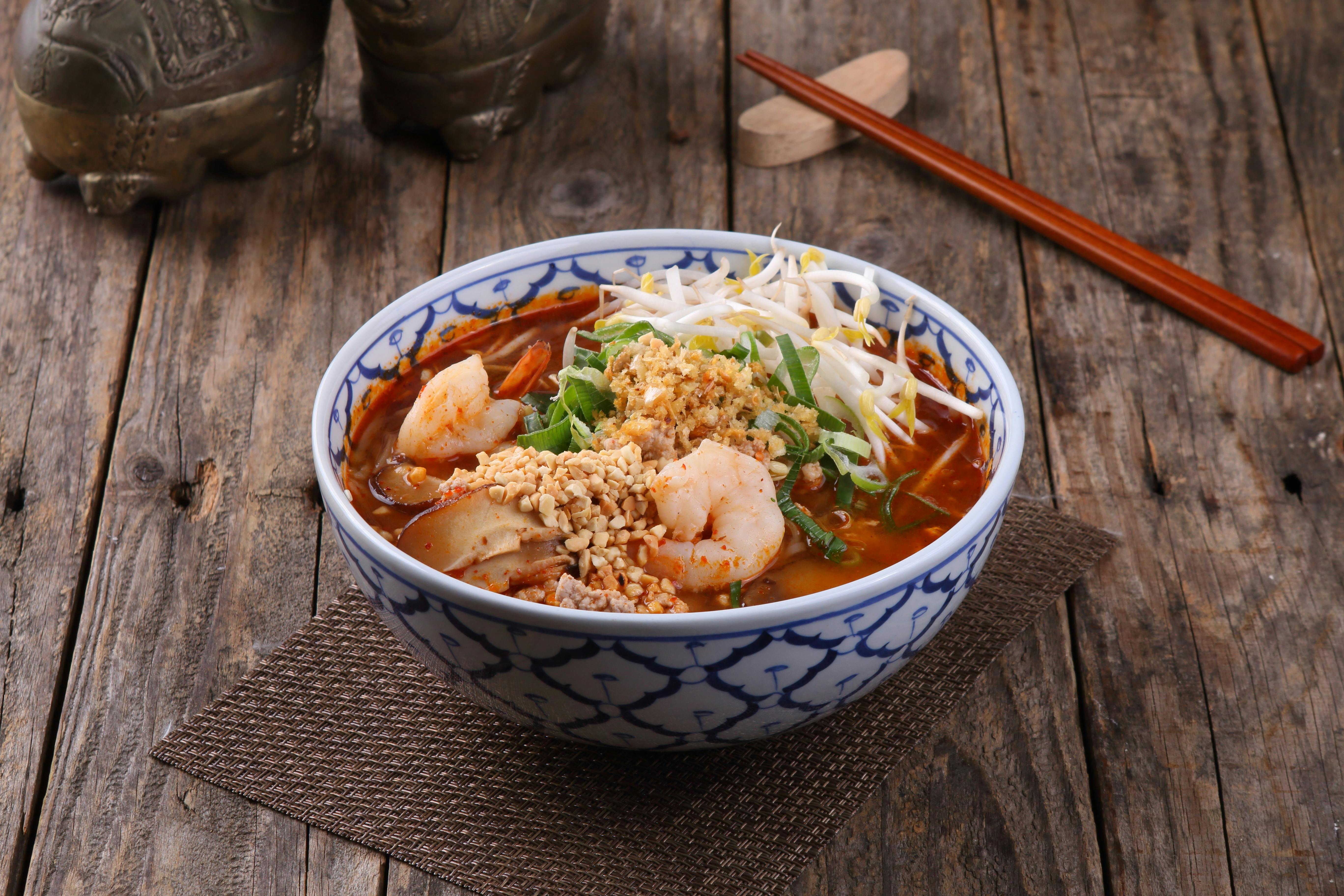
The diets react (see scores below)
Common Ingredients
- rice vermicelli
- chicken
- coconut milk
- chili
- lemongrass
- galangal
- kaffir lime leaves
- padaek
- banana blossom
- bean sprouts
Specific recipes may vary.
Incompatible with 6 of 11 diets
Diet Ratings
Khao Poon is fundamentally built on rice vermicelli, a refined grain noodle with extremely high net carbs (approximately 40-45g per 100g, and a standard serving typically contains 150-200g cooked noodles). This alone blows the daily keto carb budget in a single dish. While several other ingredients are keto-friendly — coconut milk is an excellent high-fat ingredient, chicken provides quality protein, and aromatics like lemongrass, galangal, kaffir lime leaves, and chili are used in small quantities — the rice vermicelli base is non-negotiable in this dish and makes it incompatible with ketosis. Banana blossom and bean sprouts also add moderate carbs on top of the noodles. The dish cannot be rescued by portion control, as even a small serving of rice vermicelli would consume most or all of the daily carb allowance.
Khao Poon as listed contains multiple animal-derived ingredients that disqualify it from a vegan diet. Chicken is an animal product and the primary protein source. Padaek (Lao fermented fish paste) is a fish-derived condiment central to authentic Khao Poon flavor. These two ingredients alone make this dish firmly non-vegan. The remaining ingredients — rice vermicelli, coconut milk, chili, lemongrass, galangal, kaffir lime leaves, banana blossom, and bean sprouts — are all plant-based and would be fully vegan-compliant in isolation.
Khao Poon contains multiple non-paleo ingredients that disqualify it. Rice vermicelli is a grain-based noodle (rice is a grain) and is a core, non-negotiable component of the dish. Bean sprouts come from mung beans, which are legumes. Padaek (Lao fermented fish paste/sauce) is a heavily processed, fermented condiment typically containing added salt and other additives. These three ingredients — a grain staple, a legume, and a processed condiment — make this dish clearly incompatible with paleo guidelines. The remaining ingredients (chicken, coconut milk, chili, lemongrass, galangal, kaffir lime leaves, banana blossom) are paleo-friendly, but the foundational non-compliant ingredients cannot simply be removed without fundamentally changing the dish.
Khao Poon is a Lao coconut milk-based noodle soup with several components that create a mixed Mediterranean diet profile. On the positive side, chicken is an acceptable moderate-consumption protein, and many ingredients like lemongrass, galangal, kaffir lime, chili, banana blossom, and bean sprouts are plant-based and nutrient-rich. However, this dish departs from Mediterranean principles in two significant ways: (1) coconut milk is high in saturated fat and is not a traditional Mediterranean fat source — olive oil is the canonical fat; (2) rice vermicelli is a refined grain product, and while rice-based noodles are not as problematic as white bread, they lack the fiber and nutrients of whole grains emphasized in Mediterranean eating. Padaek (fermented fish paste) adds sodium but also provides some fermented food benefits. The overall dish is not highly processed and is built around whole foods, but the coconut milk and refined noodles prevent a full approval.
Some modern Mediterranean diet interpreters accept coconut milk in small quantities as a plant-derived fat with culinary value, and traditional Southeast Asian diets share commonalities with the Mediterranean pattern in their emphasis on vegetables, legumes, and fish. From this view, the dish's plant-forward composition and lean protein could push it toward a higher score, particularly if coconut milk is used in modest amounts.
Khao Poon is almost entirely incompatible with the carnivore diet. The dish is built on a plant-heavy foundation: rice vermicelli (a grain-based noodle) is the primary carbohydrate base, banana blossom and bean sprouts are plant foods, and the aromatic base of lemongrass, galangal, kaffir lime leaves, and chili are all plant-derived spices and herbs. Coconut milk is a plant-derived fat source. Padaek (Lao fermented fish paste) is the only animal-derived ingredient besides the chicken itself. While chicken is carnivore-permissible, it is completely overwhelmed by the volume and centrality of plant ingredients in this dish. There is no meaningful way to consume this soup as presented within any tier of the carnivore diet.
Khao Poon contains rice vermicelli, which is a grain-based noodle (rice is an excluded grain on Whole30). This is a hard disqualifier. Additionally, padaek (Lao fermented fish paste/sauce) often contains added ingredients that may be non-compliant, though the primary issue here is the rice vermicelli. The remaining ingredients — chicken, coconut milk, chili, lemongrass, galangal, kaffir lime leaves, banana blossom, and bean sprouts — are all Whole30-compliant on their own. However, because rice vermicelli is a core structural component of this dish and falls squarely into the excluded grains category (rice), the dish as traditionally prepared cannot be considered Whole30-compatible. It also arguably falls under the 'no noodles/pasta' rule even if the noodle were made from a compliant ingredient.
Khao Poon is a Lao coconut curry noodle soup with several ingredients that require careful FODMAP assessment. Rice vermicelli is low-FODMAP and safe. Chicken is low-FODMAP. Coconut milk is low-FODMAP at 1/2 cup (125ml) but becomes high-FODMAP at larger servings due to polyols (sorbitol) — in a soup dish, the quantity consumed could easily exceed the safe threshold. Chili, lemongrass, galangal, and kaffir lime leaves are all low-FODMAP aromatics and safe as used in cooking. Padaek (fermented fish paste/sauce) is the most significant concern: it is a fermented condiment whose FODMAP status has not been clearly established by Monash, though most fish sauces are low-FODMAP at small amounts. Banana blossom is a moderate concern — Monash has limited data on banana blossom specifically, but it is a plant-based ingredient that may contain oligosaccharides; some practitioners advise caution. Bean sprouts (mung bean sprouts) are low-FODMAP at 1 cup (104g) per Monash, so they are generally safe. The dish's main risks are the quantity of coconut milk used (likely high in a soup base) and the uncertainty around padaek and banana blossom, making this a caution-level dish during the elimination phase.
Monash University rates coconut milk as low-FODMAP only at 1/2 cup, but a soup like Khao Poon typically uses it as the primary broth base, meaning a standard bowl likely exceeds this threshold. Additionally, banana blossom lacks robust Monash testing data, and clinical FODMAP practitioners often advise avoiding untested fermented condiments like padaek during strict elimination due to unpredictable FODMAP content.
Khao Poon is a Lao coconut milk-based vermicelli soup with several DASH-compatible ingredients (lean chicken, lemongrass, galangal, kaffir lime leaves, banana blossom, bean sprouts) but two significant concerns pull it away from DASH-friendly territory. First, coconut milk is high in saturated fat, which DASH explicitly limits — a typical serving of Khao Poon can contain a substantial portion of this. Second, padaek (fermented fish paste/sauce) is very high in sodium and is a core flavoring agent in this dish, creating a meaningful sodium burden that conflicts with DASH's 1,500–2,300mg/day limit. The rice vermicelli is refined rather than whole grain, adding another minor strike. On the positive side, the dish offers lean protein from chicken, fiber and phytonutrients from the aromatic herbs and vegetables, and bean sprouts add a low-calorie nutrient boost. With modifications — reduced coconut milk (or light coconut milk), low-sodium fish sauce substituted for padaek, and portion control — this dish could be made more DASH-compatible, but as traditionally prepared it warrants caution.
NIH DASH guidelines clearly flag saturated fat (coconut milk) and high sodium (padaek) as problematic. However, some updated clinical interpretations note that the overall vegetable and herb richness of Khao Poon, combined with a moderate serving size and the use of light coconut milk, may make occasional consumption acceptable within an otherwise well-adherent DASH pattern — particularly for non-hypertensive individuals on the standard 2,300mg sodium threshold.
Khao Poon is a flavorful Lao coconut curry noodle soup that presents a mixed Zone Diet profile. The dish has genuine Zone-friendly elements: chicken is a lean protein that fits well as a Zone protein block, and aromatics like lemongrass, galangal, kaffir lime leaves, and chili contribute polyphenols and anti-inflammatory compounds that Sears would appreciate. Bean sprouts and banana blossom are low-glycemic vegetables that function as favorable Zone carb blocks. However, two ingredients create Zone challenges: (1) Rice vermicelli is a refined, high-glycemic carbohydrate — a classic 'unfavorable' Zone carb that can spike insulin response and disrupt the 40/30/30 ratio if portioned generously, as is traditional. (2) Coconut milk contributes significant saturated fat, which runs counter to the Zone's emphasis on monounsaturated fats; additionally, it skews the fat macro heavily, making the 30% fat target harder to calibrate without displacing protein or carb blocks. Padaek (fermented fish paste) adds sodium but negligible macro impact. The dish is not a Zone disaster — the protein anchor is solid and the vegetable components are favorable — but traditional portion sizes of noodles and the richness of coconut milk make it difficult to hit Zone ratios without deliberate modification (smaller noodle portion, light coconut milk, extra vegetables).
Some Zone practitioners in Sears' later anti-inflammatory framework (Toxic Fat, The Mediterranean Zone) take a more nuanced view of coconut milk. While early Zone writings strictly limited saturated fat, Sears' later work acknowledges that medium-chain triglycerides (MCTs) in coconut milk have a different metabolic profile than long-chain saturated fats. Under this lens, moderate coconut milk use is less problematic, potentially raising the dish's Zone compatibility. Additionally, if rice vermicelli portions are kept to one carb block (roughly 15g net carbs / ~1/3 cup cooked), the noodle concern is substantially reduced, which some practitioners argue makes this dish more approvable than a strict 'caution' suggests.
Khao Poon is a complex Lao curry-laksa soup with a notably mixed anti-inflammatory profile. On the positive side, lemongrass, galangal, chili, and kaffir lime leaves are all anti-inflammatory aromatics with bioactive compounds (gingerols/galangin analogs, capsaicin, limonene) that reduce inflammatory markers. Bean sprouts and banana blossom add fiber and antioxidants. Chicken is a lean protein broadly acceptable in anti-inflammatory frameworks. However, coconut milk is a significant source of saturated fat (lauric acid), which is contested in anti-inflammatory nutrition — traditional protocols flag saturated fat as potentially pro-inflammatory, though some researchers argue medium-chain triglycerides in coconut are metabolically distinct. Padaek (fermented fish paste) is high in sodium and contains additives/fermentation byproducts; fermented foods can support gut health, but highly salted/processed fish pastes are a mixed signal. Rice vermicelli is a refined carbohydrate with minimal fiber, offering little anti-inflammatory benefit and raising the glycemic load of the dish. The dish is not inherently problematic but the refined carb base plus coconut milk saturation tips it into 'caution' territory rather than 'approve.'
Dr. Weil's framework and traditional anti-inflammatory nutrition caution against saturated fats in coconut milk and refined carbohydrates in rice vermicelli, which pulls this dish down. However, proponents of ancestral and whole-food-based eating (including some paleo and AIP-adjacent practitioners) argue that full-fat coconut milk is a health-neutral to beneficial fat source distinct from land-animal saturated fats, and that minimally processed rice noodles are preferable to wheat-based alternatives — in this view, the dish's rich aromatic and anti-inflammatory spice profile could earn a more favorable rating.
Khao Poon is a flavorful Lao coconut milk-based rice vermicelli soup with chicken as the primary protein. It has meaningful positives for GLP-1 patients — chicken provides lean protein, the broth is hydrating, and vegetables like bean sprouts and banana blossom add fiber and micronutrients. Aromatic ingredients (lemongrass, galangal, kaffir lime leaves) are GI-neutral in typical soup quantities. However, coconut milk is a significant concern: it is high in saturated fat, which can worsen GLP-1 side effects including nausea, bloating, and reflux due to slowed gastric emptying. Padaek (fermented fish paste) is very high in sodium, which may contribute to water retention and is worth flagging. Rice vermicelli is a refined carbohydrate with low fiber and low protein density, diluting the nutritional value per calorie at a time when every bite must count. Chili in the broth may be moderate to significant depending on preparation and could irritate some GLP-1 patients prone to reflux or nausea. The dish is not disqualifying — a smaller, broth-forward portion with more chicken and less noodle, and made with light coconut milk or reduced coconut milk volume, could be a reasonable meal. But as typically prepared, the saturated fat load and refined noodle base make this a caution-tier dish rather than an approve.
Some GLP-1-focused dietitians may rate this more favorably if the patient tolerates coconut milk well individually and the dish is consumed in small portions — the warming broth, hydration, and real-food ingredients are genuinely superior to many processed alternatives. Others in the obesity medicine community would flag coconut milk more firmly as a consistent GI trigger and recommend avoiding it regardless of portion size, especially in the first several months on the medication.
*See how scores were generated at our methodology page.
Nutritional profile
Six traits that cut across every diet.
Fiber & Plants
How much whole-plant food and fiber it delivers.
Healthy Fats
The quality of its fats (unsaturated, omega-3).
Whole / Unprocessed
How close it is to its natural, unprocessed form.
Gut Gentle
How easy it is on digestion (low FODMAP, few irritants).
Low Glycemic
How little it spikes your blood sugar.
Protein Density
How much protein it packs per calorie.
Controversy Index
Higher controversy = more disagreement between diets.
Diet-Specific Tips
 Mediterranean — 4/10
View tips
- Chicken is an acceptable moderate-consumption protein under Mediterranean guidelines
- Coconut milk is high in saturated fat and not a traditional Mediterranean fat source
- Rice vermicelli is a refined grain, not a whole grain
- Abundant plant-based ingredients: banana blossom, bean sprouts, lemongrass, chili, kaffir lime
- Padaek adds sodium but is a fermented whole food ingredient
- Dish is minimally processed and built on whole-food components
- No olive oil, legumes, or whole grains present
 DASH — 4/10
View tips
- Coconut milk is high in saturated fat, which DASH explicitly limits
- Padaek (fermented fish paste) is very high in sodium, conflicting with DASH sodium targets
- Lean chicken is a DASH-approved protein source
- Bean sprouts and banana blossom add DASH-friendly vegetables and fiber
- Rice vermicelli is refined, not whole grain — a minor negative
- Aromatic herbs (lemongrass, galangal, kaffir lime leaves) are low-calorie and nutrient-supportive
- Light coconut milk and low-sodium fish sauce substitutions would significantly improve DASH compatibility
 Zone — 5/10
View tips
- Rice vermicelli is a refined, high-glycemic 'unfavorable' Zone carbohydrate that can disrupt the 40% carb ratio if not carefully portioned
- Coconut milk is high in saturated fat, conflicting with the Zone's monounsaturated fat preference and complicating the 30% fat target
- Chicken is an ideal lean Zone protein source (~7g per block), the strongest Zone-positive element
- Bean sprouts and banana blossom are low-glycemic, favorable Zone carb sources that support the vegetable-forward carb strategy
- Aromatics (lemongrass, galangal, kaffir lime leaves, chili) contribute polyphenols and anti-inflammatory compounds aligned with Sears' later Zone refinements
- Traditional serving sizes of this dish likely deliver too many noodle-based carb blocks and too much fat from coconut milk to hit 40/30/30 without modification
- Dish is rescuable for Zone eating with portion control: reduce noodles, use light coconut milk, increase vegetable components
 Anti-Inflammatory — 5/10
View tips
- Anti-inflammatory aromatics: lemongrass, galangal, chili, kaffir lime leaves — strong positive
- Lean protein (chicken) — acceptable/neutral
- Coconut milk: high in saturated fat; contested in anti-inflammatory research
- Rice vermicelli: refined carbohydrate, high glycemic load, minimal fiber — negative
- Padaek (fermented fish paste): high sodium, fermented gut-health potential — mixed
- Bean sprouts and banana blossom: fiber and antioxidants — positive
- Overall dish is nutrient-dense with real anti-inflammatory spices but undermined by refined carb base and coconut saturated fat volume
 GLP-1 Friendly — 5/10
View tips
- Coconut milk is high in saturated fat and a likely GI irritant for GLP-1 patients
- Rice vermicelli is a refined carbohydrate with low fiber and minimal protein density
- Chicken provides lean protein but total protein per serving depends heavily on chicken-to-noodle ratio
- Bean sprouts and banana blossom add modest fiber and micronutrient value
- Padaek is very high in sodium
- Chili content may worsen nausea or reflux in sensitive GLP-1 patients
- Broth base supports hydration
- Dish is portion-sensitive — a small, broth-heavy, noodle-light serving improves the rating