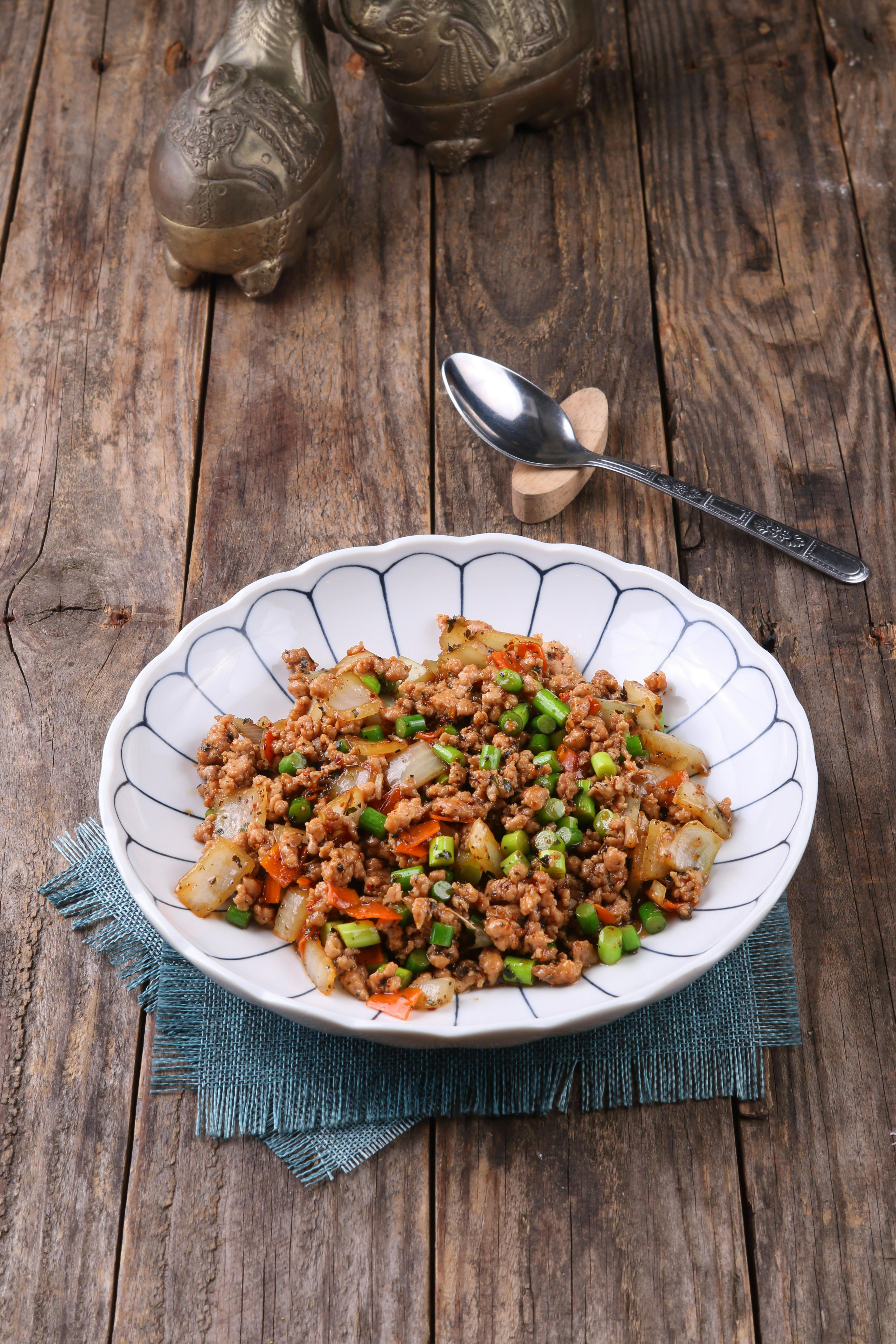
The diets react (see scores below)
Common Ingredients
- minced pork
- toasted rice powder
- lime
- fish sauce
- chili
- shallots
- mint
- cilantro
- scallions
- padaek
Specific recipes may vary.
Incompatible with 6 of 11 diets
Diet Ratings
Larb is primarily minced pork with herbs and aromatics, which are keto-friendly. However, the traditional inclusion of toasted rice powder (khao khua) is the key concern — it is used as a thickener and flavor agent and adds starchy carbs to the dish. A typical serving may contain 5-15g of net carbs depending on rice powder quantity and portion size of shallots and lime juice. The herb base (mint, cilantro, scallions) and protein (pork) are excellent for keto. Fish sauce and padaek (fermented fish paste) add negligible carbs. With portion control or by omitting/reducing the rice powder, larb can fit keto well. As traditionally prepared, it sits in caution territory.
Some lazy keto and flexible keto practitioners argue that the small amount of rice powder used in a single serving (typically 1-2 teaspoons) contributes only 2-4g net carbs and is negligible within a 20-50g daily budget, effectively approving traditional larb in normal portions. Strict keto adherents, however, reject any grain-derived ingredient entirely regardless of quantity.
Larb as described contains multiple animal-derived ingredients that make it incompatible with a vegan diet. Minced pork is the primary protein — a direct animal product. Fish sauce is a fermented fish-based condiment, and padaek (Lao fermented fish paste) is also an animal-derived ingredient. There are no plant-based substitutions in this listing. The herbs and aromatics (lime, chili, shallots, mint, cilantro, scallions) are vegan, and toasted rice powder is plant-based, but the dish as a whole is firmly non-vegan due to pork, fish sauce, and padaek.
Larb contains three non-paleo ingredients that are hard to work around. Toasted rice powder is a defining component of the dish and is a grain product — strictly excluded from paleo. Fish sauce typically contains added salt and often preservatives, making it a processed condiment. Padaek (fermented fish paste) is a heavily fermented, salted, processed condiment that would also be excluded. The base ingredients — minced pork, lime, chili, shallots, mint, cilantro, and scallions — are all paleo-approved, but the disqualifying ingredients are structural to the dish's identity, not optional garnishes. A paleo-adapted version would need to omit the rice powder entirely and substitute or eliminate the fish sauce and padaek, which would fundamentally change the dish.
Larb's primary protein is minced pork, which is red meat — limited to a few times per month in Mediterranean diet guidelines. While the dish has many Mediterranean-friendly elements (fresh herbs like mint, cilantro, scallions; lime juice; chili; shallots), the pork base and fermented fish paste (padaek) push it into 'avoid' territory. The toasted rice powder is a refined grain component with minimal nutritional contribution. The herb-forward, acid-dressed salad format is conceptually compatible with Mediterranean principles, but the red meat centerpiece contradicts core guidelines. Fish sauce is a processed condiment not traditional to Mediterranean cuisine, and padaek (fermented fish paste) is similarly outside the tradition, though fermented foods in moderation are not strictly prohibited.
Some Mediterranean diet interpreters would score this higher (caution range) given the abundant fresh herbs, lime-based dressing, and relatively lean nature of minced pork — arguing that a small portion of pork occasionally fits within the 'few times per month' allowance, especially when the overall dish is herb-dense and low in added fats. The absence of olive oil and the fermented fish condiments remain non-traditional regardless.
Larb is fundamentally incompatible with the carnivore diet despite containing pork and fish sauce as animal-derived components. The dish is built around numerous plant-based ingredients: toasted rice powder (a grain), lime (fruit), chili (plant), shallots (vegetable), mint (herb), cilantro (herb), scallions (vegetable), and padaek (fermented fish paste that, while fish-based, is typically mixed with rice bran or other plant additives). The toasted rice powder alone — a core structural ingredient in larb — immediately disqualifies this dish, as grains are strictly excluded. The herb and allium base (mint, cilantro, shallots, scallions) adds multiple plant compounds. While the minced pork and fish sauce are carnivore-approved components, they are minority ingredients in a dish whose identity is defined by plant-based seasonings and a grain thickener. This is clearly a plant-heavy salad dish that cannot be adapted to carnivore without ceasing to be larb.
Larb is largely Whole30-friendly — minced pork, lime, fish sauce, chili, shallots, mint, cilantro, and scallions are all compliant. However, two ingredients raise concerns. First, toasted rice powder (khao khua) is a traditional and essential larb ingredient made from toasted rice ground into a powder — rice is an excluded grain on Whole30, so this ingredient renders the dish non-compliant. Second, padaek is a fermented fish paste/sauce (Lao fermented fish condiment) that typically contains fish, salt, and rice bran or rice husks as part of the fermentation medium — rice bran is explicitly excluded on Whole30. Even if a padaek version without rice bran exists, its fermentation process and additives vary widely and would require very careful label scrutiny. The toasted rice powder alone is sufficient to mark this dish as non-compliant in its traditional form.
Some Whole30 practitioners might argue that toasted rice powder is used in such small quantities (primarily as a textural/flavor agent) that its impact is negligible, similar to how trace ingredients are sometimes debated. However, the official Whole30 guidelines make no exception for rice in any form or quantity — grain is grain — so the official position would firmly exclude it.
Larb contains several ingredients that require careful consideration during the FODMAP elimination phase. Minced pork is low-FODMAP and safe. Toasted rice powder (khao khua) is gluten-free and low-FODMAP in typical amounts. Lime juice and fish sauce are low-FODMAP. Fresh chili is low-FODMAP in small amounts. Mint and cilantro are low-FODMAP herbs. However, shallots are high-FODMAP (contain fructans) and are a standard, integral ingredient in larb — not a garnish. Scallions (green onions) are low-FODMAP only in the green parts, but if white bulb portions are used, they contribute fructans. Padaek (fermented fish paste/sauce) is the critical wildcard — it is a fermented, pungent condiment whose FODMAP status has not been formally tested by Monash University; its fermentation process and ingredient base (which may include added aromatics) create uncertainty. The shallot content alone is sufficient to push this dish toward avoid/caution territory, as shallots are used in meaningful quantities in traditional larb, not merely as a trace flavoring.
Monash University rates shallots as high-FODMAP even at small portions (3g or more triggers fructan load), making larb problematic during elimination. Some FODMAP practitioners may suggest requesting larb without shallots or with only scallion greens, but this significantly deviates from the traditional preparation and may not be reliable when ordering at a restaurant. Padaek's fermentation profile and additive ingredients are untested and may pose additional risk.
Larb contains several DASH-friendly elements — fresh herbs (mint, cilantro, scallions), shallots, lime juice, and toasted rice powder (a whole grain component) — that align well with DASH principles by providing fiber, potassium, and micronutrients. However, the dish is problematic primarily due to its high sodium load from fish sauce and padaek (fermented fish paste). Fish sauce alone contains roughly 1,000–1,500mg sodium per tablespoon, and padaek is similarly very high in sodium; together these two ingredients can push a single serving well beyond DASH's 1,500–2,300mg daily sodium limit. Additionally, minced pork, depending on the cut used (often fatty ground pork in traditional preparation), contributes saturated fat, which DASH advises limiting. Lean pork tenderloin is permissible on DASH, but fatty ground pork is less ideal. The dish is not heavily processed and has genuine nutritional strengths, but the sodium burden from fermented/salted condiments is the primary disqualifier from a full 'approve' rating.
NIH DASH guidelines flag high-sodium condiments like fish sauce and fermented pastes as problematic due to strict sodium limits. However, updated clinical interpretations note that if Larb is prepared with reduced fish sauce, padaek is omitted or used sparingly, and lean pork is substituted, the dish's herb-rich, whole-food profile could align closely with DASH principles — some DASH-oriented dietitians allow such dishes with sodium-conscious modifications.
Larb is a Southeast Asian minced meat salad that has several Zone-friendly qualities but requires attention to the protein source and fat ratio. The dish is herb-forward (mint, cilantro, scallions, shallots) and dressed with lime and fish sauce — all low-glycemic, polyphenol-rich ingredients that Sears would strongly endorse. The toasted rice powder adds minimal carbohydrates and is used primarily as a textural thickener, not a significant glycemic source. The main concern is the protein: minced pork, depending on the cut, carries moderate-to-high saturated fat. Traditional larb often uses fattier pork cuts (shoulder, belly), which would push the fat profile toward saturated rather than monounsaturated. However, if lean ground pork (or pork loin) is used, the fat content drops significantly and the dish becomes considerably more Zone-compatible. The dish is also naturally low in carbohydrates and lacks added sugars, making carb-block management easy. Padaek (fermented fish paste) adds sodium and flavor but negligible macros. The primary Zone adjustments needed are: (1) choose lean pork, (2) serve over or alongside low-GI vegetables (lettuce cups, cucumber) to hit carb blocks, and (3) potentially add a small drizzle of olive oil or a few almonds to ensure monounsaturated fat is represented.
Some Zone practitioners would rate this higher (7-8) because the dish is naturally protein-centric, herb-dense, low-sugar, and requires almost no modification to avoid unfavorable carbs. Dr. Sears' anti-inflammatory framework would also celebrate the polyphenol load from fresh herbs, lime, and chili. The saturated fat concern is real but modest if lean pork is selected, and Sears' later writings (notably 'The Mediterranean Zone') acknowledge that moderate saturated fat in a whole-food context is less problematic than originally framed in early Zone literature.
Larb is a complex dish from an anti-inflammatory standpoint. On the positive side, it is packed with genuinely anti-inflammatory ingredients: fresh herbs (mint, cilantro, scallions) and shallots supply antioxidants and polyphenols; chili provides capsaicin, a known anti-inflammatory compound; lime juice offers vitamin C and flavonoids; and the dish is served without added oils or refined carbohydrates, keeping it relatively clean. The toasted rice powder is a minimally processed whole-grain addition used in small quantities. On the negative side, the primary protein is minced pork, which is red meat and carries a moderate pro-inflammatory burden due to saturated fat and arachidonic acid content — the anti-inflammatory framework consistently places red meat in the 'limit' category. Padaek (fermented Lao fish paste) is high in sodium and contains additives/preservatives depending on preparation; fermented foods can have probiotic benefits, but the sodium load is a concern for systemic inflammation. Fish sauce also adds considerable sodium. The dish is not deeply pro-inflammatory — it avoids refined carbs, seed oils, sugar, and trans fats entirely — but the red meat protein source prevents a full approval. Lean poultry or fatty fish substitutes (common variations) would meaningfully improve the rating.
Some anti-inflammatory practitioners (including those following Dr. Weil's broader Mediterranean-adjacent framework) might view occasional lean pork in this herb-dense, oil-free, whole-food context as acceptable, pushing the dish closer to a low-caution or even borderline approval — especially given the potent herb and chili profile. Conversely, stricter AIP or autoimmune-focused practitioners might flag pork's arachidonic acid content and the high sodium from fish sauce and padaek more aggressively, scoring it lower.
Lao larb made with minced pork sits in caution territory for GLP-1 patients. The dish has genuine strengths: minced pork is a meaningful protein source, the herb-heavy profile (mint, cilantro, scallions, shallots) adds micronutrients and water content, lime juice aids digestion, and toasted rice powder adds modest fiber with a light, easy-to-digest texture. Fish sauce and padaek (fermented fish paste) contribute sodium but negligible fat or calories. The core problem is the protein source: ground pork is typically moderate-to-high in saturated fat depending on the cut used — traditional larb often uses fattier pork shoulder or mixed grind, not lean loin. Saturated fat in meaningful quantities worsens GLP-1 GI side effects (nausea, bloating, reflux). The chili and padaek introduce spice and fermented pungency that some GLP-1 patients tolerate poorly, especially those with reflux or slowed gastric emptying. If made with lean ground pork (93%+ lean) or substituted with ground chicken or turkey, this dish would score considerably higher — the base structure is actually quite GLP-1 friendly (herb-forward, light, no added oils, no frying, small-portion compatible). As written with standard minced pork, it earns a cautious approval.
Some GLP-1-focused dietitians would rate traditional pork larb more favorably, arguing that the portion sizes typical of Southeast Asian eating patterns are naturally small and that the overall fat load per serving is moderate rather than high. Others are more conservative, flagging that fermented condiments like padaek and significant chili heat are common nausea and reflux triggers in GLP-1 patients, particularly in the first months of dose escalation — putting this dish closer to avoid for newly initiated patients.
*See how scores were generated at our methodology page.
Nutritional profile
Six traits that cut across every diet.
Fiber & Plants
How much whole-plant food and fiber it delivers.
Healthy Fats
The quality of its fats (unsaturated, omega-3).
Whole / Unprocessed
How close it is to its natural, unprocessed form.
Gut Gentle
How easy it is on digestion (low FODMAP, few irritants).
Low Glycemic
How little it spikes your blood sugar.
Protein Density
How much protein it packs per calorie.
Controversy Index
Higher controversy = more disagreement between diets.
Diet-Specific Tips
 Keto — 5/10
View tips
- Toasted rice powder (khao khua) is a grain-based starchy ingredient that adds net carbs
- Minced pork is an excellent high-fat, moderate-protein keto protein source
- Herbs (mint, cilantro, scallions) are low-carb and keto-safe
- Shallots and lime juice contribute modest carbs — portion-sensitive
- Fish sauce and padaek are low-carb fermented condiments
- Omitting or reducing rice powder significantly improves keto compatibility
- Standard serving likely yields 8-15g net carbs — fits within daily limit but requires tracking
 DASH — 4/10
View tips
- Fish sauce is very high in sodium (~1,000–1,500mg per tbsp), a major DASH concern
- Padaek (fermented fish paste) adds additional significant sodium, compounding the issue
- Traditional minced pork may include fatty cuts with elevated saturated fat; lean pork is preferable
- Abundant fresh herbs (mint, cilantro, scallions) and shallots are DASH-positive
- Lime juice provides potassium and is consistent with DASH flavor principles
- Toasted rice powder is a minimally processed whole grain component
- No added sugars, tropical oils, or processed additives beyond the condiments
- Low-sodium adaptations (reduced fish sauce, no padaek, lean pork) would score significantly higher
 Zone — 6/10
View tips
- Minced pork is the protein base — fat content varies significantly by cut; lean pork is Zone-acceptable, fatty cuts raise saturated fat concerns
- Toasted rice powder contributes minimal net carbs and has negligible glycemic impact at typical serving quantities
- Abundant fresh herbs (mint, cilantro, scallions) provide polyphenols strongly aligned with Sears' anti-inflammatory focus
- Lime and fish sauce dressing is low-glycemic and adds flavor without sugar load
- Dish is naturally very low in carbohydrates — would need to be paired with low-GI vegetables (lettuce, cucumber) to complete Zone carb blocks
- No monounsaturated fat source present — a Zone meal would benefit from adding avocado, almonds, or olive oil
- Padaek (fermented fish paste) is high-sodium but macronutritionally negligible
- Overall macro structure skews protein-heavy and carb-light, requiring pairing to hit 40/30/30 ratio
 Anti-Inflammatory — 5/10
View tips
- Minced pork is red meat — anti-inflammatory guidelines recommend limiting red meat due to saturated fat and arachidonic acid
- Rich herb profile (mint, cilantro, shallots, scallions) provides meaningful antioxidant and polyphenol benefit
- Chili contributes capsaicin, a well-documented anti-inflammatory compound
- Lime juice adds vitamin C and flavonoids
- Padaek and fish sauce contribute high sodium, which may amplify inflammatory markers at excess intake
- No refined carbohydrates, added sugars, seed oils, or trans fats — structurally a clean dish aside from protein source
- Toasted rice powder is a minimal, unrefined whole-grain addition with negligible inflammatory impact
 GLP-1 Friendly — 5/10
View tips
- Minced pork provides meaningful protein but carries moderate-to-high saturated fat depending on grind — primary concern for GLP-1 patients
- Chili and padaek (fermented fish paste) may worsen reflux or nausea, especially during dose escalation
- No added oils, no frying — cooking method is GLP-1 favorable
- Herb-forward profile adds micronutrients and water content
- Toasted rice powder adds light fiber and aids texture without heaviness
- Dish is naturally small-portion compatible and not calorie-dense
- Lean protein substitution (ground chicken, turkey, or lean pork) would significantly improve GLP-1 suitability
- Fish sauce and padaek are high sodium — relevant for patients with blood pressure concerns common in obesity