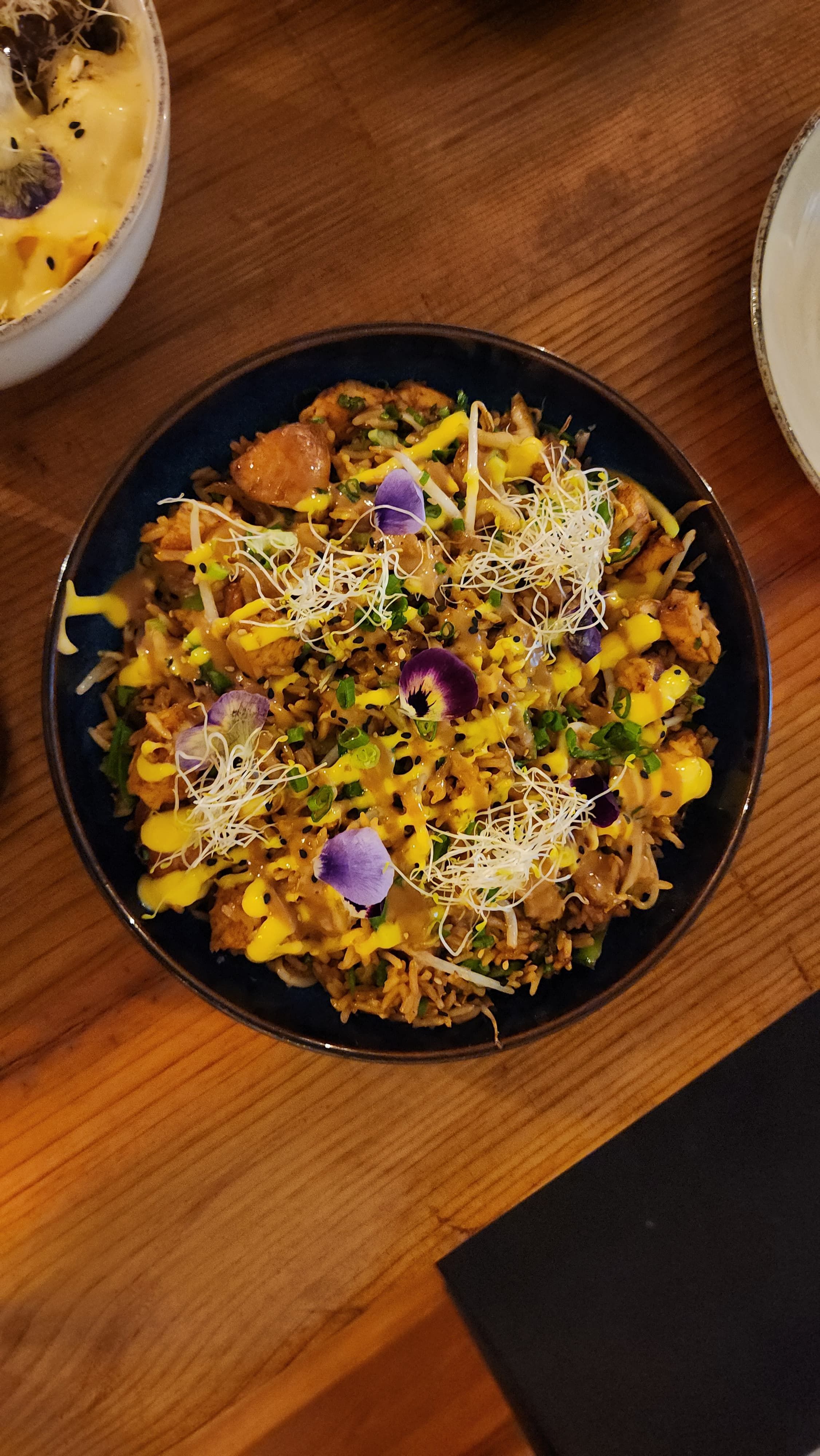
The diets react (see scores below)
Common Ingredients
- rice
- fermented pork
- coconut
- curry paste
- peanuts
- lime
- chili
- scallions
- cilantro
- fish sauce
Specific recipes may vary.
Incompatible with 9 of 11 diets
Diet Ratings
Nam Khao is fundamentally built around crispy fried rice, which is the dish's defining ingredient and primary component. Rice is a high-glycemic grain with approximately 45g of net carbs per cup, making a standard serving of this dish far exceed the daily keto carb limit of 20-50g on its own. The fermented pork, coconut, fish sauce, lime, and herbs are keto-compatible, and peanuts are borderline, but none of this offsets the massive carb load from the rice base. This dish cannot be adapted to keto without fundamentally changing what it is.
Nam Khao contains multiple animal-derived ingredients that make it entirely incompatible with a vegan diet. Fermented pork (naem) is a cured pork product, and fish sauce is a liquid condiment made from fermented fish — both are direct animal products. These are core, structural ingredients in this dish, not incidental traces. There is no vegan version of traditional Nam Khao without a fundamental recipe overhaul.
Nam Khao is fundamentally incompatible with the paleo diet. The dish is built around rice, a grain that is explicitly excluded from paleo eating. Peanuts are legumes, also a clear paleo violation. Fermented pork, while pork itself is paleo-approved, is a processed form that likely contains added salt, preservatives, or additives. Fish sauce typically contains added salt and sometimes sugar. Curry paste often includes non-paleo additives and salt. The paleo-compliant ingredients — coconut, lime, chili, scallions, and cilantro — are a small minority in this dish. With multiple core violations (grains, legumes, processed meats), this dish cannot be modified into a paleo meal without fundamentally changing its identity.
Nam Khao presents multiple significant conflicts with Mediterranean diet principles. The primary protein is fermented pork (sai krok), a processed red meat product that is explicitly limited to a few times per month in Mediterranean guidelines. The dish is built on a base of white/fried rice (a refined grain, not a whole grain), and uses coconut as a fat source rather than extra virgin olive oil. Coconut is high in saturated fat and is not a traditional Mediterranean ingredient. Curry paste adds further non-Mediterranean flavor complexity. While several ingredients are Mediterranean-friendly — peanuts (legumes), lime, chili, scallions, cilantro, and fish sauce (a fermented condiment analogous to ancient garum) — the core structural elements of the dish (processed pork, refined rice, coconut fat) all contradict foundational Mediterranean diet principles simultaneously, making this a dish to avoid rather than merely moderate.
Nam Khao is almost entirely incompatible with the carnivore diet. The dish is built on a base of rice (a grain), and includes coconut (plant-based), curry paste (plant-based spice blend), peanuts (legume), lime (fruit), chili (plant), scallions (plant), and cilantro (plant). The only potentially carnivore-compatible ingredients are the fermented pork and fish sauce, both animal-derived. However, these are minor components within an overwhelmingly plant-based dish. Even in the most permissive carnivore frameworks, the majority of ingredients here are explicitly excluded. This dish cannot be adapted to carnivore without essentially rebuilding it from scratch.
Nam Khao contains multiple excluded ingredients that make it clearly non-compliant with Whole30. Rice is a grain and is explicitly excluded from the program. Peanuts are legumes and are also explicitly excluded. Fermented pork (naem) typically contains added sugar and sometimes rice as a binding/fermentation agent, adding further excluded ingredients. Curry paste often contains shrimp paste and other compliant ingredients, but commercial versions frequently include added sugar. The remaining ingredients—coconut, lime, chili, scallions, cilantro, and fish sauce—are generally Whole30-compliant, but the core structural components of this dish (rice and peanuts) are dealbreakers regardless of the other ingredients.
Nam Khao contains several high-FODMAP ingredients that make it problematic during the elimination phase. The primary concerns are: (1) Curry paste — virtually all commercial and traditional curry pastes contain garlic and/or onion, which are high in fructans and are among the most potent FODMAP triggers. This alone would typically disqualify the dish. (2) Fermented pork (naem/som moo) — traditional Lao fermented pork contains garlic and sometimes other high-FODMAP aromatics as part of the fermentation process, adding further fructan load. (3) Scallions — the white bulb portions are high-FODMAP (fructans); only the green tops are safe. In restaurant or home preparation, both parts are typically used. (4) Coconut — shredded or fresh coconut is low-FODMAP at 1/2 cup (45g) per Monash, but coconut cream or large amounts of desiccated coconut can become high-FODMAP; serving size matters here. The remaining ingredients (rice, peanuts at ≤32g, lime juice, chili, cilantro, fish sauce) are generally low-FODMAP at standard servings. However, the curry paste and fermented pork virtually guarantee significant FODMAP exposure from fructans, making this dish unsafe during elimination without significant modification.
Monash University has not specifically tested Nam Khao as a composite dish, and FODMAP load depends heavily on how much curry paste and fermented pork are used. Some FODMAP practitioners suggest that small amounts of garlic-containing pastes may be tolerable for certain individuals, particularly in the personalization phase — but during strict elimination, clinical consensus is to avoid dishes where garlic/onion-containing pastes are structural ingredients.
Nam Khao presents multiple significant concerns from a DASH diet perspective. The dish contains fermented pork (high sodium, processed meat), coconut (saturated fat from tropical oil/flesh — explicitly limited by DASH), fish sauce (extremely high sodium, often 900–1,400mg per tablespoon), and curry paste (typically high in sodium). Together, these ingredients likely push a single serving well beyond the DASH daily sodium limit of 2,300mg, let alone the stricter 1,500mg threshold. The fermented pork is a processed red meat, doubly problematic under DASH guidelines which limit both red meat and processed/high-sodium foods. Coconut flesh adds saturated fat from a tropical source, which DASH specifically discourages. While the dish does include some DASH-friendly components — peanuts (healthy fats, magnesium), lime (vitamin C, potassium), scallions, cilantro, and chili — these positives are vastly outweighed by the sodium load and saturated fat content. The white rice also provides little fiber compared to the whole grains DASH recommends. This dish, as traditionally prepared, is fundamentally incompatible with DASH principles.
Nam Khao presents several Zone Diet challenges. The dish is built on a fried rice base, which is a high-glycemic, unfavorable Zone carbohydrate — white rice raises blood sugar rapidly and is difficult to balance without significantly restricting portion size. Fermented pork (sai krok isan-style) is a fatty, processed protein rather than a lean Zone-approved source like skinless chicken or fish, introducing saturated fat and making the protein block harder to calibrate cleanly. Coconut adds saturated fat, which Zone (especially in Sears' earlier writings) discourages in favor of monounsaturated fats. Peanuts contribute some monounsaturated fat but are also calorie-dense and high in omega-6. On the positive side, lime, chili, scallions, cilantro, and fish sauce are Zone-friendly flavor components that add polyphenols and minimal glycemic load. The dish does contain all three macronutrient categories, which is the starting point for any Zone meal, but the ratio is skewed: high-GI carbs dominate, protein is fatty rather than lean, and fat leans saturated rather than monounsaturated. A Zone practitioner could attempt to eat a very small portion of the rice component while increasing vegetable sides, but as traditionally served, the dish does not align well with Zone ratios or food quality guidelines.
Some Zone practitioners, particularly those following Sears' later, more flexible anti-inflammatory framework, might argue that fermented foods (including fermented pork) have probiotic value worth acknowledging, and that a small rice portion combined with the dish's protein and fat could approximate a Zone block with careful portioning. Coconut's medium-chain triglycerides have also been partially rehabilitated in Sears' more recent work. However, the rice-heavy, fatty-protein profile still makes this a difficult Zone fit by the original favorable/unfavorable food classification system.
Nam Khao is a Lao crispy rice salad with a mixed anti-inflammatory profile. On the positive side, it contains several beneficial ingredients: chili peppers (capsaicin is anti-inflammatory), lime (vitamin C, flavonoids), cilantro and scallions (polyphenols, antioxidants), and peanuts (resveratrol, healthy fats in moderation). Fish sauce, while high in sodium, is minimally processed and contributes umami without significant inflammatory burden. Curry paste typically contains turmeric, ginger, and other anti-inflammatory spices, adding meaningful benefit. However, the dish has notable concerns: fermented pork (sai krog) is a processed, cured meat high in saturated fat and sodium — falling in the 'limit to avoid' category. Coconut, while containing medium-chain triglycerides, is high in saturated fat, which is moderated under anti-inflammatory guidelines. White rice (the base) is a refined carbohydrate with limited anti-inflammatory value. The dish is also typically deep-fried (the rice is crisped in oil), adding oxidized fat concerns depending on the oil used. The fermented pork is the most significant concern — it's the primary protein and a processed red meat product. Overall, the anti-inflammatory positives from the herbs and spices are real but insufficient to offset the processed pork, saturated fat from coconut, and refined carbohydrate base.
Some fermentation advocates argue that fermented pork products like sai krog provide beneficial probiotics and bioavailable nutrients that can support gut health and modulate inflammation — a perspective endorsed by fermented food researchers like Dr. Sonnenburg. However, mainstream anti-inflammatory frameworks (including Dr. Weil's pyramid) do not extend this exception to cured and fermented meats, which remain in the 'limit' or 'avoid' category due to their saturated fat and sodium content.
Nam Khao is a Lao crispy rice salad that presents multiple significant challenges for GLP-1 patients. The dish is built on a fried or oven-crisped rice base, making it high in refined carbohydrates with low protein density per calorie. The primary protein — fermented pork — is a fatty, processed meat with high saturated fat content, which can worsen nausea, bloating, and reflux that are hallmark GLP-1 side effects. Coconut adds significant saturated fat, further compounding GI risk. Peanuts contribute unsaturated fat and some protein but in quantities too small to meaningfully offset the dish's deficiencies. Curry paste and chili may trigger reflux or nausea in GLP-1 patients with heightened GI sensitivity due to slowed gastric emptying. Fish sauce adds sodium without nutritional benefit. The overall profile is high fat, high refined carb, low protein density, and potentially spicy — hitting multiple avoid criteria simultaneously. This is not a small-portion-friendly dish, as the satisfying crispy texture requires meaningful volume. The lime, scallions, and cilantro are nutritionally negligible in context.
Some GLP-1 clinicians and dietitians would note that individual tolerance to fermented foods and spice varies widely, and a small tasting portion consumed with awareness could be acceptable in a social or cultural eating context. However, there is broad agreement that the fried rice base combined with high saturated fat from pork and coconut makes this dish genuinely problematic rather than merely portion-dependent, so the avoid rating reflects clinical consensus for regular consumption.
*See how scores were generated at our methodology page.
Nutritional profile
Six traits that cut across every diet.
Fiber & Plants
How much whole-plant food and fiber it delivers.
Healthy Fats
The quality of its fats (unsaturated, omega-3).
Whole / Unprocessed
How close it is to its natural, unprocessed form.
Gut Gentle
How easy it is on digestion (low FODMAP, few irritants).
Low Glycemic
How little it spikes your blood sugar.
Protein Density
How much protein it packs per calorie.
Controversy Index
Higher controversy = more disagreement between diets.
Diet-Specific Tips
 Zone — 4/10
View tips
- White rice is a high-glycemic, unfavorable Zone carbohydrate that dominates the dish
- Fermented pork is a fatty, processed protein — not a lean Zone protein source
- Coconut contributes saturated fat, which Zone favors minimizing in favor of monounsaturated fats
- Peanuts add omega-6-heavy fat rather than preferred monounsaturated sources like almonds or avocado
- Lime, chili, scallions, and cilantro are Zone-friendly polyphenol-rich additions
- As served, macronutrient ratio skews heavily toward carbs and saturated fat rather than the 40/30/30 Zone target
 Anti-Inflammatory — 4/10
View tips
- Fermented pork (sai krog) is a processed, cured meat high in saturated fat and sodium — pro-inflammatory
- Coconut adds significant saturated fat, which anti-inflammatory guidelines recommend moderating
- White rice is a refined carbohydrate with limited anti-inflammatory benefit
- Rice is typically deep-fried, adding oxidized fat depending on oil used
- Curry paste contributes anti-inflammatory spices (turmeric, ginger, chili)
- Chili peppers, lime, cilantro, and scallions provide polyphenols and antioxidants
- Peanuts offer some anti-inflammatory phenolic compounds and healthy fats in moderation
- High sodium content from fish sauce and fermented pork