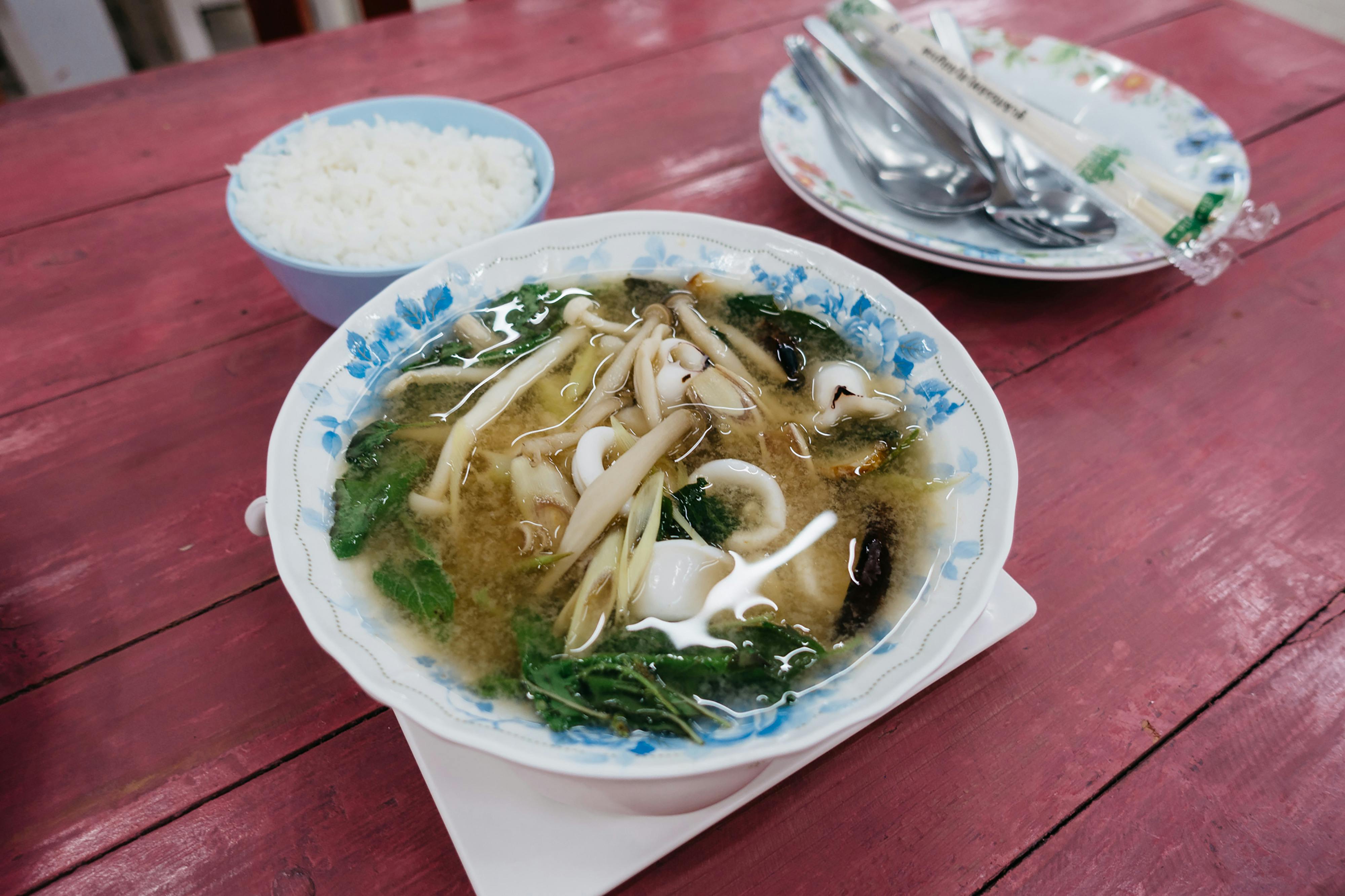
Photo: Markus Winkler / Pexels
The diets react (see scores below)
Common Ingredients
- eggplant
- long beans
- mushrooms
- sakhan wood
- chili
- lemongrass
- dill
- padaek
- wood ear mushrooms
- buffalo meat
Specific recipes may vary.
Incompatible with 4 of 11 diets
Diet Ratings
Or Lam is a traditional Lao stew with a mixed keto profile. Buffalo meat is an excellent high-protein, moderate-fat keto-friendly base. Mushrooms (including wood ear), lemongrass, chili, dill, and sakhan wood are all very low-carb aromatics and acceptable. However, eggplant and long beans add moderate net carbs — long beans in particular can accumulate carbs at larger servings (roughly 4-7g net carbs per 100g). Padaek (fermented fish paste) is generally low-carb and keto-friendly. The concern is portion size and the ratio of long beans and eggplant in the dish; a standard serving of Or Lam may push net carbs toward 10-15g, which is manageable within a keto budget but requires mindfulness. Overall, this dish is conditionally compatible with keto when portion-controlled, especially limiting long beans.
Strict keto practitioners may flag the cumulative carb load from long beans and eggplant together, arguing that traditional serving sizes of this stew — where vegetables are prominent — can exceed comfortable single-meal carb limits for those targeting under 20g net carbs per day. They would recommend either reducing vegetable portions significantly or avoiding the dish entirely.
Or Lam contains two clear animal-derived ingredients: buffalo meat (a direct animal product) and padaek (a traditional Lao fermented fish paste/sauce). Either ingredient alone would disqualify this dish from being vegan. The remaining ingredients — eggplant, long beans, mushrooms, sakhan wood, chili, lemongrass, dill, and wood ear mushrooms — are all fully plant-based, but they cannot offset the presence of animal products in the dish.
Or Lam is a traditional Lao stew with mostly paleo-compliant ingredients: buffalo meat, eggplant, mushrooms (including wood ear), chili, lemongrass, dill, and sakhan wood (a Lao aromatic bark used as a spice) are all acceptable. Long beans, however, are a legume, which is explicitly excluded under paleo rules. The more significant concern is padaek — a traditional Lao fermented fish paste/sauce — which is a heavily processed, salted, and fermented condiment. While fermented fish in principle aligns with ancestral eating patterns, padaek is laden with added salt and undergoes extended industrial-style fermentation, placing it in processed food territory. These two problematic ingredients (long beans and padaek) prevent a clean approval, though the dish's overall profile is heavily vegetable- and meat-forward.
Some paleo practitioners, particularly those influenced by ancestral or traditional-foods perspectives (e.g., Weston A. Price-adjacent paleo), would argue that naturally fermented condiments like padaek are beneficial for gut health and represent true ancestral food preparation. They might also overlook long beans given their negligible anti-nutrient load compared to other legumes.
Or Lam is a traditional Lao stew with a mixed nutritional profile from a Mediterranean diet perspective. The vegetable base — eggplant, long beans, mushrooms, wood ear mushrooms, chili, lemongrass, and dill — is strongly aligned with Mediterranean principles, being rich in plant-based ingredients. However, buffalo meat is the primary protein, and as a red meat (and a particularly lean but still red meat), it falls into the 'limit to a few times per month' category under Mediterranean guidelines. Padaek (fermented fish paste) is a high-sodium, heavily processed condiment not consistent with Mediterranean dietary patterns, though fermented foods are not universally excluded. Sakhan wood (a Lao spice) is neutral. The dish's heavy reliance on buffalo meat as a centerpiece and the use of padaek push it into 'avoid' territory overall, despite its impressive vegetable content.
Some Mediterranean diet interpreters might rate this as 'caution' rather than 'avoid,' noting that the dish is overwhelmingly plant-forward with buffalo meat as one component among many vegetables, and that buffalo is a very lean red meat. Traditional Mediterranean diets in rural communities also occasionally included lean game or working animals in stew-style dishes in small quantities.
Or Lam is a traditional Lao stew that is overwhelmingly plant-based. While it does contain buffalo meat, the dish is defined by a large number of plant-derived ingredients: eggplant, long beans, mushrooms, wood ear mushrooms, sakhan wood (a plant-based aromatic), chili, lemongrass, dill, and padaek (fermented fish paste that may contain plant additives). The vast majority of the ingredient list is composed of vegetables, herbs, and plant aromatics, all of which are strictly excluded on the carnivore diet. Even the buffalo meat cannot redeem a dish so thoroughly built around plant foods. This is not a carnivore-compatible dish in any form.
Or Lam is a traditional Lao stew with most ingredients being Whole30-compliant: buffalo meat (compliant protein), eggplant, long beans (a legume-adjacent vegetable but not a restricted legume — similar to green beans, these are the pod/vegetable form), mushrooms, wood ear mushrooms, chili, lemongrass, dill, and sakhan (a peppery Lao spice wood) are all acceptable. The primary concern is padaek (Lao fermented fish paste/sauce). Padaek is a fermented fish condiment that may contain added sugar, sulfites (now allowed per 2024 rules), or other additives depending on preparation. Traditional padaek is made from fermented fish and salt, which would be compliant, but commercial versions frequently contain added sugar or other excluded ingredients. Label-reading is essential. Long beans are also worth noting — while not on the explicit exception list like green beans, they are a pod vegetable consumed for their pods rather than the legume seed, placing them in a similar category to snow peas and green beans.
Some Whole30 practitioners argue that long beans, being more mature than green beans and closer to a true legume pod, may not fall under the green bean exception. Additionally, padaek is a fermented, processed condiment that may test the spirit of the program's emphasis on whole, unprocessed foods — official Whole30 guidelines would require verifying no added sugar in any condiment.
Or Lam contains multiple high-FODMAP ingredients that make it unsuitable during the elimination phase. Eggplant is high-FODMAP at standard serving sizes (low-FODMAP only at ~33g, which is unrealistically small for a stew component). Long beans contain moderate-to-high GOS/fructans at typical servings. Mushrooms are high-FODMAP due to polyols (mannitol) — both regular mushrooms and wood ear mushrooms are problematic at standard portions. Lemongrass is low-FODMAP in small culinary amounts but is used as a primary flavoring here. Padaek (fermented fish paste/sauce) may contain added ingredients or fermentation byproducts that are difficult to assess. Buffalo meat itself is low-FODMAP as a plain protein. Sakhan wood (Zanthoxylum rhetsa, a Lao spice) has no Monash testing data. Dill and chili are generally low-FODMAP. The combination of eggplant, long beans, and mushrooms makes this dish high-FODMAP at any reasonable serving.
Monash University has not specifically tested sakhan wood or padaek, so their FODMAP contribution is uncertain — some clinical FODMAP practitioners may consider fermented fish sauces acceptable in small culinary quantities (similar to fish sauce). However, the remaining high-FODMAP ingredients (eggplant, long beans, mushrooms) are sufficient to render this dish unsuitable during elimination regardless of these unknowns.
Or Lam is a traditional Lao stew with several DASH-positive ingredients — eggplant, long beans, mushrooms, wood ear mushrooms, lemongrass, dill, and chili are all vegetables or herbs that fit well within DASH guidelines, providing fiber, potassium, and micronutrients. However, two ingredients raise significant concerns. First, buffalo meat is a red meat, which DASH limits in favor of lean poultry and fish; while buffalo is leaner than beef, it is still categorized as red meat and should be minimized. Second, and more critically, padaek (Lao fermented fish paste/sauce) is extremely high in sodium — a single tablespoon can contain 1,000–2,000mg of sodium, which alone can exceed or approach the entire DASH daily sodium limit of 1,500–2,300mg. Padaek is a foundational flavoring in this dish and is not easily omitted without changing the dish fundamentally. These two factors — red meat and very high-sodium fermented condiment — prevent approval despite the otherwise vegetable-rich profile. Prepared with reduced padaek or a low-sodium fish sauce substitute, and a smaller portion of buffalo meat, this dish could score higher.
Traditional NIH DASH guidelines would flag padaek's sodium load and buffalo as red meat as problematic. However, some DASH-oriented clinicians note that buffalo meat is among the leanest red meats available, and that overall dietary sodium context matters — if padaek is used sparingly as a condiment and the rest of the day's sodium is tightly controlled, this dish may fit within a flexible DASH framework for non-hypertensive individuals.
Or Lam is a traditional Lao stew featuring a mix of vegetables (eggplant, long beans, mushrooms, wood ear mushrooms) alongside buffalo meat, aromatics (lemongrass, dill, chili, sakhan wood), and padaek (fermented fish paste). The vegetable base is broadly Zone-friendly — eggplant, long beans, and mushrooms are low-glycemic carbohydrate sources that fit well within Zone carb blocks. The aromatics and herbs add polyphenols with negligible macro impact, which aligns with Sears' anti-inflammatory emphasis. However, buffalo meat introduces complexity: while leaner than domestic beef, it is still a red meat with notable saturated fat content, which the Zone classifies as an 'unfavorable' protein compared to skinless poultry or fish. The fat profile is not primarily monounsaturated. Padaek (fermented fish paste) adds sodium and some omega-3s, which is neutral to mildly positive. The dish lacks a significant fat block from favorable sources (olive oil, avocado, almonds), and the protein source is suboptimal. With careful portioning — controlling the buffalo meat to one Zone block (~28g cooked) and ensuring the fat comes from a monounsaturated source added separately — this dish can be incorporated into a Zone meal, but as served it requires modification. The vegetable variety and low-glycemic carb base are genuine positives.
Some Zone practitioners following Sears' later anti-inflammatory writings (particularly 'The Mediterranean Zone') may rate buffalo meat more favorably, as buffalo (bison) has a better omega-6 to omega-3 ratio than conventional beef and a leaner fat profile overall. In this context, the dish could approach a 6-7 with appropriate portion control. Conversely, strict early-Zone adherents would flag buffalo as an unfavorable protein and the absence of monounsaturated fat as a structural deficit, keeping the score at 4-5.
Or Lam is a traditional Lao stew with a complex anti-inflammatory profile. On the positive side, it contains several strongly anti-inflammatory ingredients: mushrooms (including wood ear mushrooms, which have immunomodulatory polysaccharides), eggplant (anthocyanins, nasunin), long beans (fiber, polyphenols), chili (capsaicin reduces inflammatory markers), lemongrass (citral has anti-inflammatory properties), dill (flavonoids, antioxidants), and lemongrass — all of which align well with anti-inflammatory principles. Sakhan (Piper ribesioides), a Lao aromatic wood related to black pepper, contains piperine-like compounds with documented anti-inflammatory activity. The primary concern is buffalo meat: red meat is in the 'limit' category due to saturated fat and arachidonic acid content, which can promote pro-inflammatory eicosanoids. However, buffalo meat is notably leaner than beef, with a fat profile closer to game meat, which somewhat mitigates this concern. Padaek (fermented fish paste) is a fermented food that may offer probiotic-adjacent benefits, though its very high sodium content is a consideration and it contains no clear pro-inflammatory compounds. Overall, the dish is rich in vegetables, herbs, and functional ingredients that provide meaningful anti-inflammatory benefit, but the red meat component prevents a full 'approve' rating.
Nightshade advocates (AIP/autoimmune protocol, Dr. Tom O'Bryan) would flag the eggplant as problematic for sensitive individuals due to solanine and lectins, potentially shifting the rating lower for autoimmune contexts. Conversely, mainstream anti-inflammatory researchers (Dr. Weil's framework) would emphasize eggplant's anthocyanin content as beneficial, and some would consider lean buffalo meat an acceptable protein given its relatively favorable fat profile compared to conventional beef.
Or Lam is a traditional Lao stew with a mixed nutritional profile for GLP-1 patients. On the positive side, it contains high-fiber vegetables (eggplant, long beans, wood ear mushrooms, mushrooms) and aromatic herbs (lemongrass, dill) that support digestion and nutrient density. Buffalo meat, when present, provides meaningful protein, but the dish is listed with no primary protein designation, suggesting it may be served in a vegetable-forward ratio where protein per serving is insufficient to meet the 15–30g per meal GLP-1 target. The significant concerns are: (1) chili and sakhan wood (a pungent, spicy Lao aromatic related to Sichuan pepper) can worsen GLP-1-associated nausea, reflux, and GI irritation — sakhan in particular is a strong GI stimulant used medicinally in Lao cuisine; (2) padaek (fermented fish paste) is high in sodium and can contribute to bloating; (3) fat content from buffalo meat is variable but generally leaner than beef, which is a modest positive. The soup format and vegetable density are GLP-1-friendly for hydration and digestibility. Overall: acceptable in moderation with portion control, but the spice profile and uncertain protein adequacy per serving are real concerns.
Some GLP-1-focused dietitians would rate this more favorably if the buffalo meat portion is substantial, arguing that the high vegetable fiber content and broth-based format are ideal for GLP-1 patients; others would rate it lower due to sakhan and chili being consistent GI irritants in a population already prone to nausea and reflux, recommending the dish be modified or avoided during dose escalation phases.
*See how scores were generated at our methodology page.
Nutritional profile
Six traits that cut across every diet.
Fiber & Plants
How much whole-plant food and fiber it delivers.
Healthy Fats
The quality of its fats (unsaturated, omega-3).
Whole / Unprocessed
How close it is to its natural, unprocessed form.
Gut Gentle
How easy it is on digestion (low FODMAP, few irritants).
Low Glycemic
How little it spikes your blood sugar.
Protein Density
How much protein it packs per calorie.
Controversy Index
Higher controversy = more disagreement between diets.
Diet-Specific Tips
 Keto — 5/10
View tips
- Buffalo meat is keto-friendly: high protein, zero carbs
- Long beans are the primary carb concern (~4-7g net carbs per 100g)
- Eggplant adds moderate net carbs (~3g per 100g), manageable in small portions
- Wood ear mushrooms and regular mushrooms are low-carb but not zero
- Aromatics (lemongrass, chili, dill, sakhan) are negligible in carbs
- Padaek (fermented fish paste) is low-carb and keto-compatible
- Total net carbs per serving are portion-dependent; standard serving likely 10-15g net carbs
- No grains, sugars, or starches present
 Paleo — 5/10
View tips
- Buffalo meat is fully paleo-approved — unprocessed, nutrient-dense red meat
- Long beans are a legume and explicitly excluded from the paleo diet
- Padaek (fermented fish paste) is heavily salted and processed, conflicting with paleo guidelines
- Eggplant, mushrooms, wood ear mushrooms, chili, lemongrass, dill, and sakhan wood are all paleo-compliant
- Fermented foods occupy a gray zone — traditional fermentation is ancestral, but the salt content and processing of padaek push it toward 'avoid'
 Whole30 — 5/10
View tips
- Padaek (fermented fish paste) requires careful label inspection for added sugar — traditional versions with only fish and salt are compliant
- Long beans are a pod vegetable similar to green beans and likely compliant, but not explicitly listed as an exception
- Buffalo meat is a compliant protein source
- Sakhan wood, lemongrass, dill, chili are all compliant herbs/spices
- Eggplant and mushrooms are fully compliant vegetables
- No grains, dairy, or explicitly excluded ingredients if padaek is sugar-free
 DASH — 4/10
View tips
- Padaek (fermented fish paste) is extremely high in sodium, potentially exceeding the entire DASH daily sodium limit in a single serving
- Buffalo meat is a red meat, which DASH limits in favor of lean poultry and fish
- Eggplant, long beans, mushrooms, and wood ear mushrooms are excellent DASH-compatible vegetables rich in fiber and potassium
- Herbs and aromatics (lemongrass, dill, chili) are DASH-friendly and add flavor without sodium
- Low-sodium fish sauce or reduced padaek quantity would significantly improve DASH compatibility
- Buffalo is leaner than most red meats, partially mitigating saturated fat concerns
 Zone — 5/10
View tips
- Low-glycemic vegetable base (eggplant, long beans, mushrooms) aligns well with Zone carb blocks
- Buffalo meat is a red meat with saturated fat — classified as 'unfavorable' protein in Zone methodology, though leaner than domestic beef
- No monounsaturated fat source present; Zone-favorable fat would need to be added separately
- Polyphenol-rich aromatics (lemongrass, chili, dill, sakhan wood) support Sears' anti-inflammatory goals
- Padaek adds sodium and fermented complexity; minor omega-3 contribution is mildly positive
- Dish is macro-imbalanced as served — protein and fat blocks require careful adjustment to hit 40/30/30 ratio
- Traditional preparation likely produces a protein-heavy, saturated-fat-present bowl that needs portioning discipline
 Anti-Inflammatory — 5/10
View tips
- Buffalo meat is red meat (limit category) but is significantly leaner than beef, reducing saturated fat concern
- Mushrooms and wood ear mushrooms provide immunomodulatory beta-glucans and polysaccharides
- Eggplant contributes anthocyanins and nasunin (antioxidants); flagged by AIP protocols for autoimmune conditions
- Chili pepper contains capsaicin, a well-documented anti-inflammatory compound
- Sakhan wood (Piper ribesioides) contains piperine-related alkaloids with anti-inflammatory activity
- Lemongrass and dill add polyphenols and flavonoids supporting anti-inflammatory profile
- Padaek (fermented fish paste) is high in sodium but adds umami with no strong pro-inflammatory signals
- Overall vegetable and herb density is a significant anti-inflammatory asset
 GLP-1 Friendly — 5/10
View tips
- Sakhan wood and chili are strong GI irritants that may worsen GLP-1 nausea and reflux
- Padaek (fermented fish paste) adds high sodium and may contribute to bloating
- Buffalo meat provides lean protein but primary protein is listed as none — protein per serving may be insufficient
- High fiber from eggplant, long beans, and mushrooms supports digestion and satiety
- Broth-based soup format supports hydration and easy digestibility
- Vegetable-forward and nutrient-dense per calorie overall
- Spice tolerance is highly individual — risk is elevated during GLP-1 dose escalation