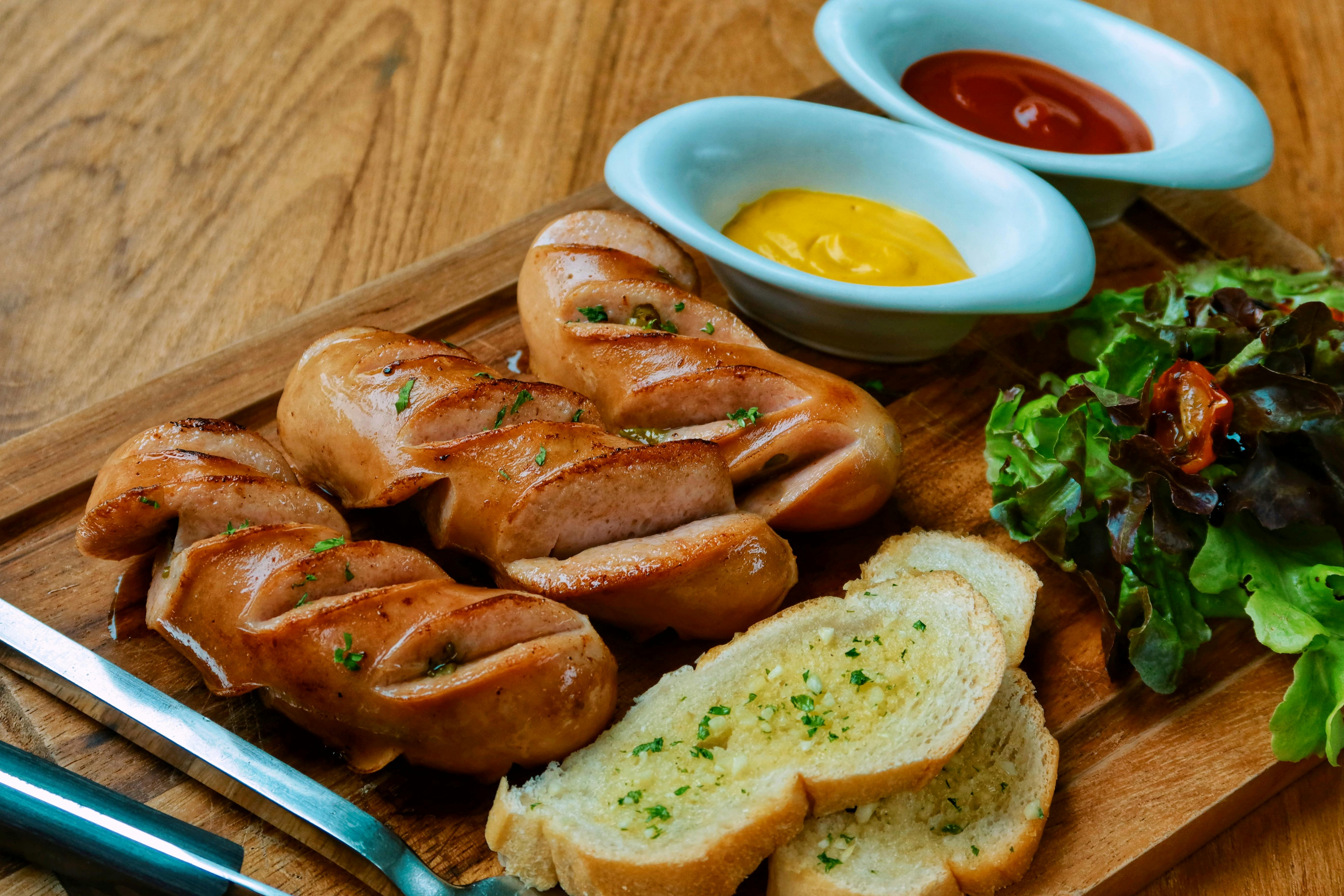
Photo: Baworn Srisatjalertwaja / Pexels
The diets react (see scores below)
Common Ingredients
- pork
- lemongrass
- galangal
- kaffir lime leaves
- garlic
- shallots
- chili
- cilantro
- fish sauce
- padaek
Specific recipes may vary.
Incompatible with 7 of 11 diets
Diet Ratings
Sai Oua is a Lao herbed pork sausage made primarily from ground pork with aromatic herbs and seasonings. The base is fatty pork, which is highly keto-friendly. The aromatics — lemongrass, galangal, kaffir lime leaves, garlic, shallots, chili, cilantro — are used in relatively small quantities as flavor agents, contributing minimal net carbs per serving. Fish sauce and padaek (fermented fish paste) add negligible carbs per typical serving amounts. Shallots and garlic are the highest-carb aromatics here but are used in small enough quantities that net carbs per sausage link remain well within keto limits. Overall, this dish is a protein- and fat-forward preparation that fits comfortably within ketogenic macros.
Some strict keto practitioners flag fermented condiments like padaek and fish sauce for potential hidden sugars or additives depending on the brand or preparation method, and may also be cautious about the cumulative carb load from multiple aromatic ingredients (shallots, garlic, lemongrass) if portions are large.
Sai Oua is a Lao/Northern Thai herbed sausage that is fundamentally built on pork as its primary protein. Additionally, it contains fish sauce (a fermented fish product) and padaek (a traditional Lao fermented fish paste), both of which are animal-derived ingredients. Multiple core components independently disqualify this dish from vegan compliance. There is no meaningful debate within the vegan community about any of these ingredients — pork, fish sauce, and padaek are all unambiguously animal products.
Sai Oua (Lao herb sausage) is built on a paleo-friendly foundation — pork, lemongrass, galangal, kaffir lime leaves, garlic, shallots, chili, and cilantro are all whole, unprocessed ingredients well within paleo guidelines. However, two ingredients disqualify the dish. Fish sauce is a processed condiment that typically contains added salt and sometimes sugar, both excluded under strict paleo rules. More significantly, padaek (Lao fermented fish paste) is a heavily fermented, salted, and processed condiment with additives and preservatives that fall clearly outside paleo parameters. Because the dish's identity and flavor profile are inseparable from these condiments, it cannot be approved as traditionally prepared.
Some paleo practitioners in the ancestral health community (aligned with the Weston A. Price tradition or the 'Practical Paleo' approach) accept naturally fermented, additive-free fish sauces and fermented fish pastes as probiotic-rich, ancestrally consistent foods — arguing that fermentation predates agriculture and the salt content is negligible at serving quantities. Under this view, a high-quality, minimally processed fish sauce could be tolerated.
Sai Oua is a Lao herb-infused pork sausage. While the aromatic herbs (lemongrass, galangal, kaffir lime leaves, garlic, shallots, chili, cilantro) are plant-based and compatible with Mediterranean principles, the dish is fundamentally a processed pork sausage product. Pork is red meat, which the Mediterranean diet limits to a few times per month, and sausage is a processed meat product — doubly problematic. Padaek (fermented fish paste) is a highly processed, very high-sodium condiment with no equivalent in Mediterranean cuisine. Fish sauce also adds significant sodium. The dish contains no olive oil, no whole grains, no legumes, and centers entirely on processed red meat. This combination of processed red meat as the primary protein, processed condiments, and no Mediterranean-aligned fat source places it firmly in the avoid category.
Sai Oua is a Lao herbal sausage that, while pork-based, is heavily loaded with plant ingredients that are explicitly excluded on the carnivore diet. Lemongrass, galangal, kaffir lime leaves, garlic, shallots, chili, and cilantro are all plant-derived aromatics and herbs. Padaek (fermented fish paste) is animal-derived and would be acceptable, and fish sauce is generally tolerated, but these two ingredients are vastly outnumbered by the extensive list of plant additives. The dish is fundamentally defined by its herbal profile — removing the plant ingredients would leave an unrecognizable product. This is not a borderline case; the dish contains six or more distinct plant foods making it clearly incompatible with carnivore principles.
Sai Oua is a Lao/Northern Thai herb-packed sausage. Most ingredients are clearly Whole30-compliant: pork, lemongrass, galangal, kaffir lime leaves, garlic, shallots, chili, and cilantro are all whole, unprocessed foods. Fish sauce is generally compliant but requires label-checking to confirm no added sugar or non-compliant additives. The significant concern is padaek (Lao fermented fish paste/sauce), which is a traditional fermented fish condiment. Padaek often contains only fermented fish and salt, which would be compliant, but some versions or commercial preparations may include added sugars, rice bran, or other excluded ingredients. Additionally, Sai Oua is a sausage, and commercial or restaurant versions could use casings treated with non-compliant ingredients or include fillers. If made at home with verified compliant fish sauce and padaek (fermented fish + salt only), this dish is Whole30-compliant. Careful ingredient sourcing and label-reading are essential.
Official Whole30 guidelines would likely approve this dish when prepared with fully compliant ingredients, as it is a whole-food herb-and-meat preparation with no inherently excluded categories. However, the community debate centers on padaek: its fermentation process and variable commercial formulations make it difficult to verify compliance without thorough label investigation, and some practitioners would advise avoiding it unless homemade or from a verified compliant source.
Sai Oua (Lao herb sausage) contains multiple high-FODMAP ingredients that are central to the dish's flavor profile and cannot be reduced to safe portions without fundamentally altering the recipe. Garlic and shallots are both high in fructans and are used in significant quantities as core aromatics — garlic is one of the highest-FODMAP foods tested by Monash and must be entirely avoided during elimination. Shallots are also high-FODMAP (fructans) at any realistic serving. These two ingredients alone make this dish a clear avoid. Additionally, padaek (fermented fish paste) is a complex fermented condiment whose FODMAP status is not well-characterized but poses risk. Lemongrass, galangal, kaffir lime leaves, chili, cilantro, and fish sauce are generally low-FODMAP at typical culinary quantities. The pork itself is low-FODMAP. However, the presence of garlic and shallots as non-negotiable structural ingredients makes this dish unsuitable during the elimination phase regardless of portion size.
Sai Oua is a Lao/Northern Thai-style herb sausage made primarily from ground pork, which is a red meat with significant saturated fat content. The dish is heavily seasoned with fish sauce and padaek (fermented fish paste), both of which are extremely high in sodium — two ingredients that directly conflict with DASH's core sodium restriction (<2,300mg/day standard, <1,500mg/day low-sodium). Padaek in particular is a pungent, high-sodium fermented condiment that alone can push a serving well over daily sodium limits. The pork base, while containing some lean cuts, is typically fatty ground pork used in sausage form, contributing saturated fat. The aromatic herbs (lemongrass, galangal, kaffir lime leaves, cilantro, garlic, shallots, chili) are DASH-friendly and nutritionally positive, but they cannot offset the high sodium burden from fish sauce and padaek. DASH guidelines explicitly limit red meat and high-sodium condiments/processed meats, placing this dish firmly in the 'avoid' category.
Sai Oua is a Lao herbed sausage made primarily from ground pork, which presents a mixed Zone picture. The protein source (pork) is workable in the Zone but is not ideal — it contains moderate-to-high saturated fat depending on the cut used (typically fatty pork belly or shoulder is traditional). The aromatic herbs and seasonings — lemongrass, galangal, kaffir lime leaves, garlic, shallots, cilantro, chili — are all Zone-favorable low-glycemic flavor contributors with negligible glycemic impact and notable polyphenol/anti-inflammatory benefits that align with Sears' later anti-inflammatory emphasis. Fish sauce adds sodium but minimal macronutrient concern. Padaek (fermented fish paste) is similarly negligible in macro terms. The main Zone challenge is the fat profile: traditional Sai Oua uses fatty pork, pushing saturated fat higher than Zone ideals. If made with leaner pork, the dish becomes a reasonable protein block contributor. Portioning is key — a modest serving (~1 oz/28g cooked) can serve as a Zone protein block (~7g protein), paired with low-GI vegetables and a monounsaturated fat source to complete the 40/30/30 ratio. The dish provides essentially zero carbohydrate blocks on its own, so it must be paired with vegetables and fruit to achieve Zone balance. It is not a complete Zone meal alone, but it functions as a protein/fat component.
Some Zone practitioners would rate this more favorably, noting that Sears' later work (The Anti-Inflammation Zone, The Mediterranean Zone) acknowledged that the inflammatory profile of saturated fat depends heavily on context and overall diet quality. The polyphenol-rich herbs (lemongrass, galangal, kaffir lime leaves, chili, garlic) align strongly with Sears' anti-inflammatory protocol and could offset concerns about pork fat. Others would rate it lower, citing that traditional preparation uses pork belly, making saturated fat control difficult in practice.
Sai Oua is a Lao/Northern Thai herb sausage made primarily from ground pork with an impressive array of anti-inflammatory aromatics. The herb profile is genuinely outstanding: lemongrass contains citral and flavonoids with documented anti-inflammatory effects; galangal (related to ginger) contains galangin and other bioactive compounds that suppress inflammatory cytokines; kaffir lime leaves provide antioxidant limonene and citronellol; garlic contains allicin and organosulfur compounds that reduce NF-κB signaling; chili provides capsaicin, a well-established anti-inflammatory compound; shallots offer quercetin and other flavonoids; and cilantro provides polyphenols. These herbs collectively represent a remarkably dense anti-inflammatory spice load. However, the protein base is pork — a red meat high in saturated fat and arachidonic acid — which is in the 'limit' category under anti-inflammatory guidelines. The fat content depends heavily on the cut used; traditional Sai Oua often uses fatty pork shoulder or belly, increasing saturated fat load. Fish sauce is high in sodium but not inherently pro-inflammatory. Padaek (fermented fish paste) adds sodium and a strong umami profile; as a fermented food it may offer modest probiotic benefit, though it is extremely high in sodium. The dish is best assessed as a mixed profile: pro-inflammatory pork fat base partially offset by an exceptional constellation of anti-inflammatory herbs and spices. Consumed occasionally with leaner pork, this dish is acceptable. Regular consumption of a fatty pork version is less advisable.
Some anti-inflammatory practitioners following the Autoimmune Protocol (AIP) would flag both the chili (nightshade, contains capsaicin irritants) and the high sodium from fish sauce and padaek as concerns beyond just the pork fat. Conversely, proponents of traditional food systems and fermented foods might argue that padaek's fermentation and the synergistic herb load make this dish net anti-inflammatory despite the pork base, especially compared to processed Western meats.
Sai Oua is a Lao herbal sausage made primarily from fatty ground pork, which is high in saturated fat and typically moderate-to-high in total fat per serving. The aromatic herb profile (lemongrass, galangal, kaffir lime, cilantro) is nutritionally positive but does not offset the core concerns. Chili content may worsen GLP-1-associated reflux or nausea in sensitive individuals. Padaek (fermented fish paste) adds sodium, which is a minor concern but tolerable in small amounts. The sausage format typically means the pork is not a lean cut — ground pork used in sausage commonly includes belly or shoulder with significant fat content. High fat per serving directly worsens GLP-1 side effects (nausea, bloating, delayed gastric emptying compounded by fat). While protein is present, the fat-to-protein ratio is unfavorable compared to lean protein sources. It scores low because the fat content and spice level together create meaningful GLP-1 side effect risk, and the dish does not provide meaningful fiber or hydration support.
Some GLP-1-focused dietitians may allow small portions of higher-fat proteins if total daily fat is managed, noting that the herb-forward spice profile of Sai Oua is less aggressively spicy than chili-dominant dishes; however, the sausage format makes portion control and fat estimation difficult, and most obesity medicine practitioners would recommend substituting a lean protein source instead.
*See how scores were generated at our methodology page.
Nutritional profile
Six traits that cut across every diet.
Fiber & Plants
How much whole-plant food and fiber it delivers.
Healthy Fats
The quality of its fats (unsaturated, omega-3).
Whole / Unprocessed
How close it is to its natural, unprocessed form.
Gut Gentle
How easy it is on digestion (low FODMAP, few irritants).
Low Glycemic
How little it spikes your blood sugar.
Protein Density
How much protein it packs per calorie.
Controversy Index
Higher controversy = more disagreement between diets.
Diet-Specific Tips
 Keto — 8/10
View tips
- Primary ingredient is fatty ground pork — excellent keto base
- Aromatics (lemongrass, galangal, kaffir lime leaves, garlic, shallots, chili) used in small quantities, contributing minimal net carbs
- Fish sauce and padaek contribute negligible carbs per serving in typical amounts
- No grains, sugars, or starchy ingredients in the traditional recipe
- Moderate portion control advised if consuming multiple sausages due to cumulative aromatic carbs
 Whole30 — 5/10
View tips
- Pork, lemongrass, galangal, kaffir lime leaves, garlic, shallots, chili, and cilantro are all Whole30-compliant whole foods
- Fish sauce is generally compliant but must be checked for added sugar or non-compliant additives
- Padaek (fermented fish paste) is the primary concern — traditional versions (fish + salt) are compliant, but some commercial varieties may contain rice bran or added sugar
- Sausage form requires verification that no non-compliant fillers, binders, or casing treatments are used
- Home preparation with verified ingredients would be compliant; restaurant or commercial versions carry more risk
 Zone — 5/10
View tips
- Pork is a 'unfavorable' Zone protein due to higher saturated fat compared to lean options like chicken breast or fish
- Fatty pork cuts (belly/shoulder) traditional in Sai Oua push saturated fat above Zone ideals
- Rich in Zone-favorable polyphenol and anti-inflammatory herbs: lemongrass, galangal, kaffir lime, garlic, chili, cilantro
- Near-zero carbohydrate content means this cannot stand alone as a Zone meal — must be paired with low-GI carb sources
- Fish sauce and padaek add sodium but negligible macronutrient impact
- Lean pork versions would improve Zone compatibility significantly
- Portion control critical: small serving (~1 oz) fits as a protein block contributor
 Anti-Inflammatory — 5/10
View tips
- Pork is a red meat high in saturated fat and arachidonic acid — anti-inflammatory guidelines recommend limiting red meat
- Lemongrass contains citral and luteolin with documented anti-inflammatory and antioxidant activity
- Galangal provides galangin and bioactive compounds that inhibit inflammatory cytokines
- Garlic contains allicin and organosulfur compounds that reduce NF-κB signaling
- Chili delivers capsaicin, a well-researched anti-inflammatory and pain-modulating compound
- Shallots and kaffir lime leaves contribute quercetin, flavonoids, and polyphenols
- Fish sauce and padaek are very high in sodium, which may contribute to inflammatory load in high quantities
- Padaek is a fermented food with potential probiotic properties, though evidence is limited
- Herb density is exceptionally high for a meat dish, meaningfully offsetting some inflammatory risk from pork