Photo: Markus Winkler / Pexels
The diets react (see scores below)
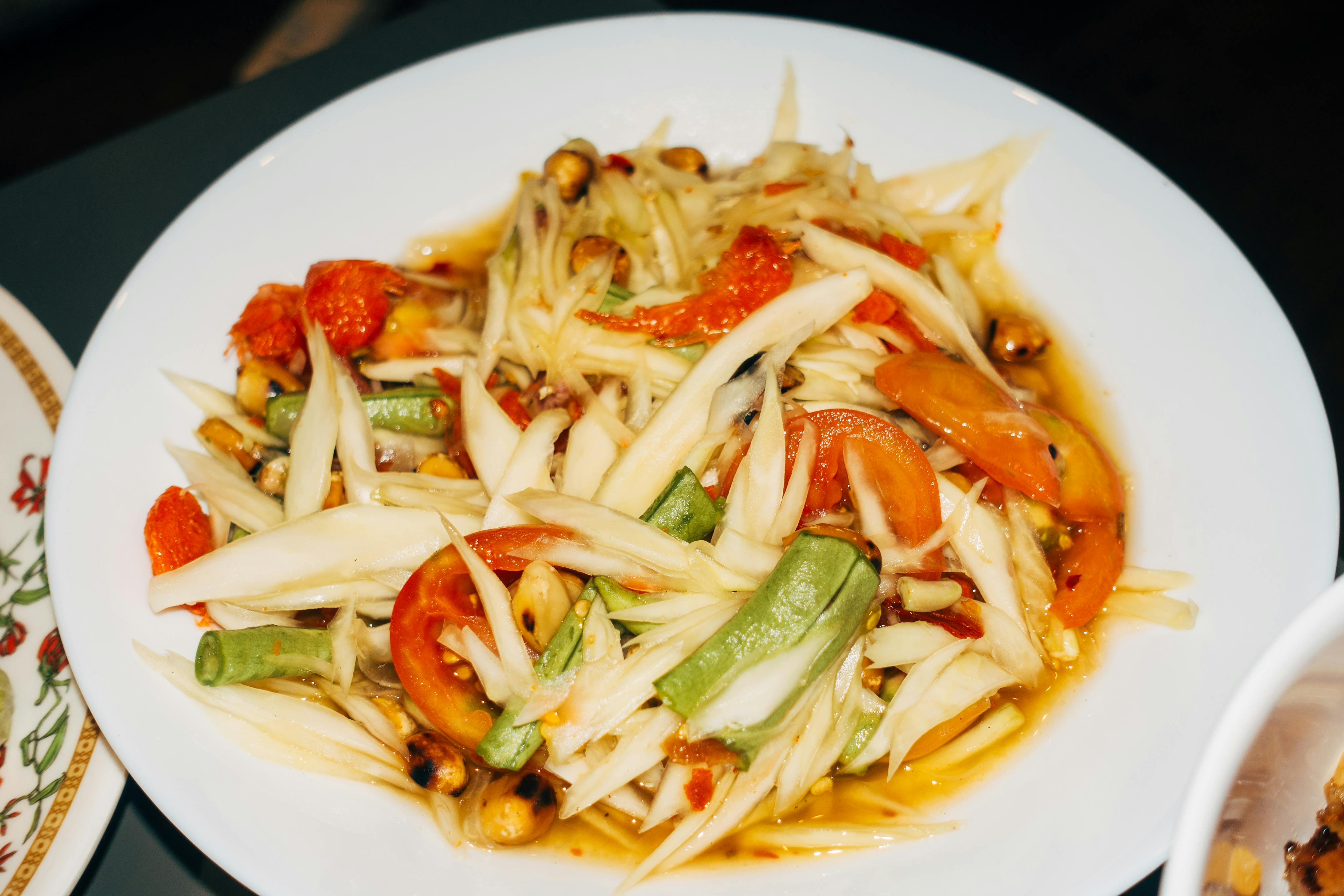
Common Ingredients
- green papaya
- padaek
- tomatoes
- long beans
- chili
- garlic
- lime
- palm sugar
- fish sauce
- eggplant
Specific recipes may vary.
Incompatible with 6 of 11 diets
Diet Ratings
Tam Mak Hoong (Lao green papaya salad) is fundamentally incompatible with a ketogenic diet. The primary ingredient, green papaya, contains significant net carbs (approximately 8-10g per 100g). More critically, palm sugar is a direct-added sugar that immediately disqualifies this dish from keto compliance. Fish sauce and padaek (fermented fish paste) also contain small amounts of sugar/carbs. Long beans add additional net carbs, and tomatoes and eggplant, while lower in carbs, contribute to the cumulative count. A standard serving of this dish likely contains 20-35g of net carbs, predominantly from green papaya and palm sugar, which alone could exceed a strict keto daily limit in a single serving. There is no meaningful fat content to redeem this dish from a keto macronutrient perspective.
Tam Mak Hoong (Lao green papaya salad) as traditionally prepared contains two clear animal-derived ingredients: fish sauce and padaek. Padaek is a fermented fish paste that is a defining, foundational ingredient in Lao cuisine — it is not a trace contaminant but a primary flavoring agent. Fish sauce is similarly derived from fermented fish. Both are unambiguously animal products, making this dish incompatible with a vegan diet in its traditional form. The base vegetables (green papaya, tomatoes, long beans, chili, garlic, lime, eggplant) and palm sugar are all plant-based, so a vegan adaptation is theoretically possible by substituting soy sauce or vegan fish sauce alternatives and omitting padaek, but the dish as described cannot be approved.
Tam Mak Hoong (Lao green papaya salad) contains several non-paleo ingredients that make it incompatible with the diet. The most significant offenders are long beans (a legume, strictly excluded from paleo), padaek (a fermented fish paste that is heavily processed, often containing added salt and preservatives), and fish sauce (a processed condiment with added salt). Palm sugar, while natural, is a refined/concentrated sugar that falls into the avoid category rather than caution since it is a highly processed sweetener. The remaining ingredients — green papaya, tomatoes, chili, garlic, lime juice, and eggplant — are paleo-friendly vegetables and aromatics. However, the combination of a legume (long beans), a heavily processed fermented product (padaek), added-salt fish sauce, and refined palm sugar creates enough violations to push this dish firmly into avoid territory.
Tam Mak Hoong (Lao green papaya salad) is overwhelmingly plant-based: green papaya, tomatoes, long beans, chili, garlic, eggplant, and lime are all whole vegetables and fruits strongly aligned with Mediterranean principles. The small amounts of palm sugar and fish sauce are used as condiments for flavor rather than main ingredients, keeping added sugar and sodium modest. The dish is fresh, fiber-rich, and requires no cooking fat. The main point of nuance is padaek (Lao fermented fish paste), which is a fermented condiment — not a direct Mediterranean ingredient, but fermented foods are broadly accepted. Overall, this salad fits the Mediterranean spirit of abundant vegetables with minimal processing.
Some strict Mediterranean diet frameworks would flag padaek and fish sauce as highly processed, sodium-dense condiments outside the traditional pantry, and palm sugar as an added sugar to minimize. A conservative interpretation might rate this 'caution' due to these non-traditional flavor bases, even if the vegetable content is exemplary.
Tam Mak Hoong (Lao green papaya salad) is almost entirely plant-based. The primary ingredient is green papaya, accompanied by tomatoes, long beans, chili, garlic, lime, palm sugar, and eggplant — all plant-derived and strictly excluded on a carnivore diet. While fish sauce and padaek (fermented fish paste) are animal-derived condiments, they appear only as minor flavor components in what is fundamentally a vegetable salad. Palm sugar is a plant-derived sweetener that would be excluded even in the most lenient carnivore frameworks. There is no meaningful animal protein in this dish. No version of this dish — strict Lion Diet, standard carnivore, or even Saladino's animal-based approach — would permit a salad whose foundation is vegetables, fruit, and legumes.
Tam Mak Hoong (Lao green papaya salad) contains two disqualifying ingredients: palm sugar (an added sugar, explicitly excluded on Whole30) and padaek (Lao fermented fish paste/sauce, which typically contains added sugar and often sulfites or other non-compliant additives in commercial preparations). Even setting padaek aside, palm sugar alone is a clear excluded ingredient — it is a sweetener, and Whole30 prohibits all forms of added sugar including coconut sugar, palm sugar, cane sugar, and similar. The remaining ingredients (green papaya, tomatoes, long beans, chili, garlic, lime, fish sauce, eggplant) are largely compliant, with fish sauce needing a label check to confirm no added sugar. However, the dish as traditionally prepared cannot be made Whole30-compliant without removing or substituting the palm sugar and finding a compliant alternative to padaek.
Tam Mak Hoong (Lao green papaya salad) contains multiple high-FODMAP ingredients that make it unsuitable during the elimination phase. The most significant offender is garlic, which is high in fructans and a clear 'avoid' at any culinary quantity. Long beans (yard-long beans) are high in GOS/fructans and should be avoided. Padaek (fermented fish paste) is a complex fermented ingredient with uncertain FODMAP status but may contain high-FODMAP additives. Eggplant is low-FODMAP at small servings (75g per Monash) but portions in this dish can exceed that threshold. Green papaya is not well-tested by Monash but is generally considered low-FODMAP in moderate servings. Tomatoes, chili, lime juice, fish sauce, and palm sugar are low-FODMAP in typical quantities. However, the combination of garlic and long beans alone is sufficient to classify this dish as high-FODMAP. This is a traditional dish where ingredient substitution (e.g., garlic-infused oil, omitting long beans) would be needed to make it elimination-phase safe.
Monash University has not specifically tested padaek or yard-long beans with definitive data, and some FODMAP practitioners note that the actual FODMAP load per serving depends heavily on preparation and portion size. However, the presence of whole garlic cloves — standard in this dish — is a near-universal 'avoid' recommendation among both Monash guidelines and clinical practitioners during elimination.
Tam Mak Hoong (Lao green papaya salad) features several DASH-friendly ingredients — green papaya, tomatoes, long beans, chili, garlic, lime, and eggplant are all vegetables/fruits rich in potassium, fiber, and antioxidants. However, the dish contains two high-sodium fermented condiments: padaek (fermented fish paste) and fish sauce. Padaek in particular is extremely high in sodium, often contributing 800–1,500mg or more per serving depending on quantity used. Combined with fish sauce, the sodium load of a typical serving can approach or exceed the standard DASH daily limit of 2,300mg in a single dish, making it problematic for a sodium-restricted eating plan. Palm sugar adds modest amounts of added sugar, which DASH limits but is not a primary concern in small quantities. The core vegetable base is excellent for DASH, but the fermented, high-sodium condiments prevent a full approval.
NIH DASH guidelines categorically limit high-sodium condiments and fermented fish products. However, some DASH-aligned clinicians working with Southeast Asian populations note that the vegetable density of this dish is exceptional and suggest that using reduced quantities of padaek or substituting low-sodium fish sauce could rehabilitate this dish to an 'approve' rating — reflecting a culturally adaptive interpretation of DASH rather than strict exclusion.
Tam Mak Hoong (Lao green papaya salad) is predominantly a low-glycemic vegetable dish with favorable ingredients. Green papaya is low in net carbs and glycemic index, tomatoes and long beans are Zone-favorable vegetables, and the aromatics (chili, garlic, lime) are essentially free foods. The dish is rich in polyphenols, which aligns with Sears' anti-inflammatory emphasis. However, several factors push it into caution territory: palm sugar adds high-glycemic simple sugars that raise the glycemic load, padaek (fermented fish paste) is highly processed and sodium-heavy, and the dish lacks meaningful protein — making it an incomplete Zone meal on its own. The fat content is minimal, meaning the 40/30/30 ratio is significantly off without additions. As a side dish or salad component paired with a lean protein and a monounsaturated fat source (e.g., grilled fish + avocado), this works well in a Zone meal. Standalone, it fails the macro balance test. The palm sugar portion is the key variable — traditional recipes use it sparingly, which keeps the glycemic impact manageable, but restaurant versions may use significantly more.
Some Zone practitioners would rate this more favorably, noting that green papaya is explicitly listed as a favorable Zone carb, the vegetable base is exemplary, and the palm sugar quantity in a typical serving is small enough that net glycemic impact is low. Dr. Sears' later writings (The Mediterranean Zone, The OmegaRx Zone) increasingly emphasize polyphenol-rich vegetables as foundational — and this dish qualifies strongly on that basis. Others would rate it lower due to padaek's heavy processing and the complete absence of protein or fat blocks.
Tam Mak Hoong (Lao green papaya salad) is a nutrient-dense dish built largely on anti-inflammatory principles. Green papaya provides papain, vitamin C, and fiber. Tomatoes contribute lycopene and antioxidants. Long beans offer fiber and plant protein. Chili peppers contain capsaicin, a well-studied anti-inflammatory compound. Garlic is rich in allicin and organosulfur compounds with documented anti-inflammatory effects. Lime provides vitamin C and flavonoids. These core vegetables and aromatics align strongly with anti-inflammatory guidance. The dressing uses palm sugar (a concern — it is still an added sugar, though used in small quantities) and fish sauce (high sodium, but used in modest amounts as a condiment and fermented, lending some probiotic properties). Padaek — fermented fish paste — is the most complex ingredient: it is high in sodium and traditionally fermented, placing it in a gray zone. Eggplant (a nightshade) is considered anti-inflammatory in mainstream frameworks due to its nasunin and chlorogenic acid content, though AIP protocols flag nightshades as potentially problematic for sensitive individuals. Overall, the dish is predominantly plant-based, rich in antioxidants and anti-inflammatory phytonutrients, with a modest amount of added sugar and sodium as the primary concerns.
Mainstream anti-inflammatory nutrition (Dr. Weil's framework, IF Rating system) would generally approve this dish for its vegetable density and phytonutrient richness. However, Autoimmune Protocol (AIP) adherents would flag both tomatoes and eggplant as nightshades potentially triggering inflammation in susceptible individuals, and practitioners concerned with high sodium diets would note that padaek and fish sauce combined can represent a significant sodium load, which some researchers link to systemic inflammation at high intake levels.
Tam Mak Hoong (Lao green papaya salad) is a nutrient-dense, low-calorie dish built around raw green papaya, vegetables, and a bold dressing. It has meaningful strengths for GLP-1 patients: green papaya is high in fiber and water content, tomatoes, long beans, and eggplant add further fiber and micronutrients, and the overall dish is low in fat and easy on calories. Lime juice and fresh vegetables support hydration and digestion. However, the dish has notable drawbacks in this context. It contains essentially no protein, which is the top dietary priority for GLP-1 patients — every meal should deliver 15–30g of protein to protect muscle mass. The chili content is potentially significant: Lao tam mak hoong is often very spicy, and high chili load can worsen nausea, reflux, and GI discomfort, which are already common GLP-1 side effects. Padaek (fermented fish paste) contributes sodium and a small amount of umami but negligible protein. Palm sugar and fish sauce add sugar and sodium, though in typical serving quantities these are modest concerns. The dish works best as a side or starter paired with a high-protein main (grilled fish, tofu, chicken), not as a standalone meal. Spice level is the primary variable — a milder preparation is significantly more GLP-1-appropriate than the traditional very-spicy version.
Some GLP-1-focused dietitians would rate this more favorably as a high-fiber, low-fat vegetable dish that supports satiety and digestion, arguing that protein can come from accompanying dishes and that patients should not be discouraged from culturally meaningful foods. Others would flag the chili content and near-zero protein more strictly, recommending it only as a condiment-sized side rather than a salad portion, given that GLP-1 patients have limited appetite and cannot afford low-protein meals.
*See how scores were generated at our methodology page.
Nutritional profile
Six traits that cut across every diet.
Fiber & Plants
How much whole-plant food and fiber it delivers.
Healthy Fats
The quality of its fats (unsaturated, omega-3).
Whole / Unprocessed
How close it is to its natural, unprocessed form.
Gut Gentle
How easy it is on digestion (low FODMAP, few irritants).
Low Glycemic
How little it spikes your blood sugar.
Protein Density
How much protein it packs per calorie.
Controversy Index
Higher controversy = more disagreement between diets.
Diet-Specific Tips
 Mediterranean — 8/10
View tips
- Predominantly whole vegetables and fruits (green papaya, tomatoes, long beans, eggplant, chili, garlic)
- No animal protein as a primary component
- Fresh, uncooked preparation preserving nutrients
- Padaek (fermented fish paste) is a high-sodium non-traditional condiment
- Palm sugar adds a small amount of added sugar
- Fish sauce used in small amounts as a seasoning, not a protein source
- No refined grains or saturated fats
- No olive oil, but no added fat at all — acceptable for a salad
 DASH — 4/10
View tips
- Padaek (fermented fish paste) is very high in sodium — a major DASH concern
- Fish sauce adds additional significant sodium load
- Core vegetables (green papaya, tomatoes, long beans, eggplant) are excellent DASH foods
- Rich in potassium, fiber, and antioxidants from vegetable base
- Palm sugar contributes small amounts of added sugar
- Combined sodium from padaek and fish sauce may exceed DASH daily limits in one serving
- Low-sodium substitutions (e.g., reduced fish sauce, omitting padaek) would significantly improve DASH compatibility
 Zone — 6/10
View tips
- Green papaya is a Zone-favorable low-glycemic carbohydrate
- Tomatoes, long beans, and eggplant are excellent Zone vegetables high in polyphenols
- Palm sugar introduces high-glycemic simple carbohydrates, raising glycemic load
- Padaek (fermented fish paste) is heavily processed and very high in sodium
- No protein source — dish is an incomplete Zone meal without addition of lean protein
- Negligible fat — requires pairing with monounsaturated fat to approach Zone ratios
- Lime, chili, and garlic are anti-inflammatory and essentially calorie-free Zone additions
- Fish sauce adds sodium but negligible macronutrient distortion
 Anti-Inflammatory — 7/10
View tips
- Green papaya: rich in papain, vitamin C, fiber — anti-inflammatory
- Chili and garlic: capsaicin and allicin — strong anti-inflammatory compounds
- Tomatoes: lycopene and antioxidants — anti-inflammatory (nightshade caveat for AIP)
- Eggplant: nasunin antioxidant — mainstream anti-inflammatory approved, AIP excluded
- Padaek (fermented fish paste): high sodium, fermented — mixed profile
- Fish sauce: high sodium condiment — acceptable in small quantities
- Palm sugar: added sugar — modest pro-inflammatory concern, small quantity used
- Lime: vitamin C and flavonoids — anti-inflammatory
- Long beans: fiber and plant protein — anti-inflammatory
- No refined carbohydrates, no seed oils, no processed additives
 GLP-1 Friendly — 5/10
View tips
- Near-zero protein — fails the 15–30g per meal protein target entirely
- High fiber from green papaya, long beans, eggplant, and tomatoes — supports digestion and satiety
- High water content — supports hydration, a key GLP-1 concern
- Chili content is a meaningful GI risk — traditional Lao preparation is very spicy, which may worsen nausea and reflux
- Low fat — aligns well with GLP-1 dietary priorities
- Palm sugar and fish sauce add sugar and sodium — modest concern at typical serving size
- Padaek adds sodium and fermented flavor but negligible protein
- Best used as a side dish paired with a high-protein main, not a standalone meal
- Milder spice preparation significantly improves GLP-1 compatibility