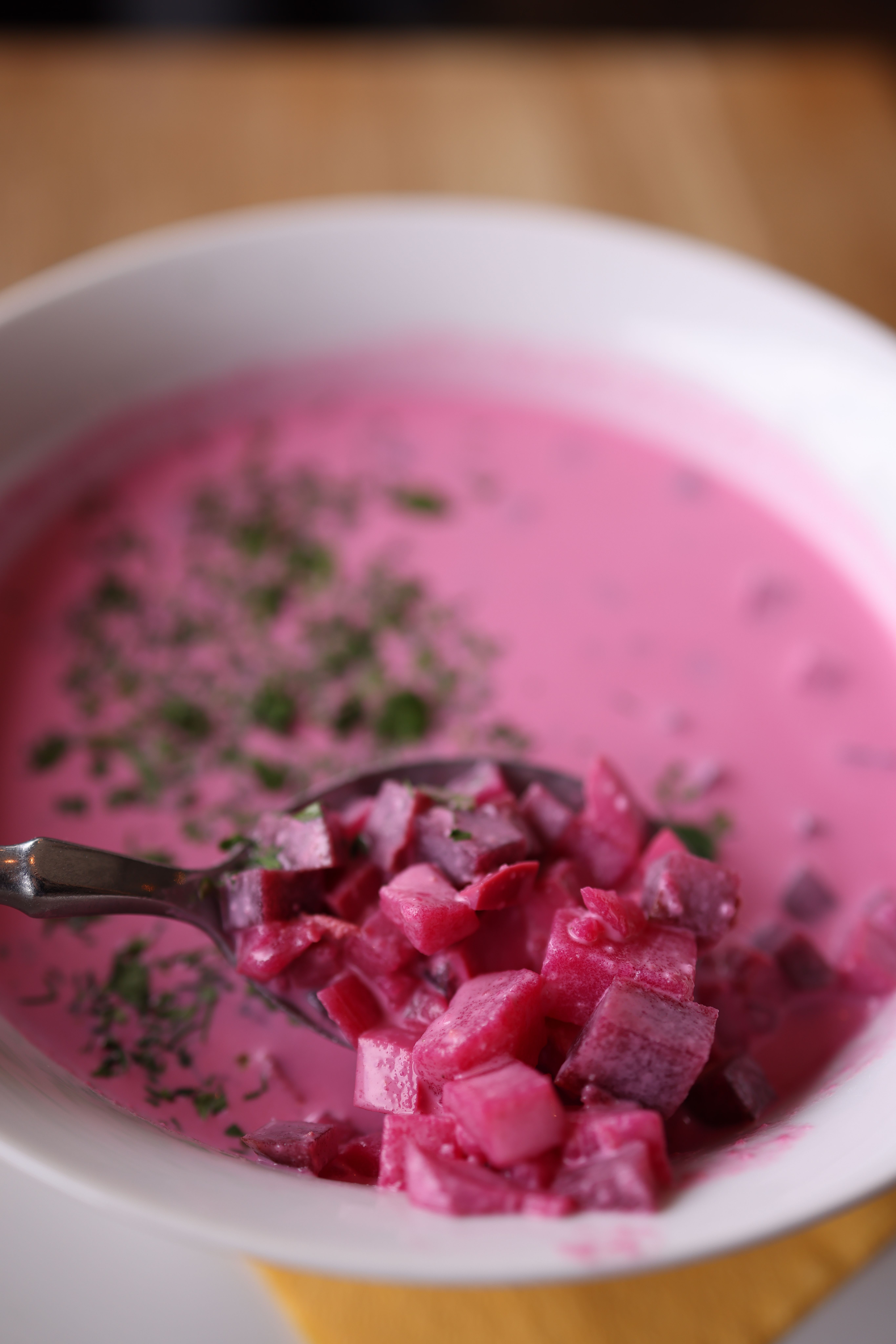
Photo: Valeria Boltneva / Pexels
Latvian
Auksta Zupa
The diets react (see scores below)
Common Ingredients
- beets
- kefir
- cucumbers
- dill
- green onions
- eggs
- salt
- pepper
Specific recipes may vary.
Incompatible with 6 of 11 diets
Diet Ratings
Auksta Zupa (Latvian cold beet soup) is fundamentally incompatible with a ketogenic diet due to beets being the primary ingredient. Beets are a high-sugar root vegetable with approximately 7-8g net carbs per 100g, and this soup typically uses a substantial quantity. A standard serving could easily contribute 15-25g net carbs from beets alone, consuming the majority or entirety of a day's keto carb budget in one dish. Kefir adds a modest additional carb load (around 4-6g per cup from lactose). While the remaining ingredients — cucumbers, dill, green onions, eggs, salt, and pepper — are largely keto-friendly, they cannot offset the core problem: beets are a starchy, high-glycemic root vegetable that is widely excluded from ketogenic eating. There is no meaningful way to portion-control this dish without fundamentally changing what it is.
Auksta Zupa (Latvian cold beet soup) contains two clear animal-derived ingredients: kefir (a fermented dairy milk product) and eggs. Both are excluded under all mainstream vegan definitions. The base vegetables — beets, cucumbers, dill, and green onions — are fully plant-based, but the dish as traditionally prepared cannot be considered vegan. A vegan adaptation is possible by substituting kefir with plant-based yogurt or kvass and omitting the eggs, but the traditional recipe as listed here is not compliant.
Auksta Zupa (Latvian cold beet soup) is disqualified from a paleo standpoint primarily because of kefir, a fermented dairy product. All dairy — including fermented forms like kefir, yogurt, and buttermilk — is excluded under paleo guidelines. Additionally, salt is listed as an ingredient, which is also discouraged under strict paleo rules. The remaining ingredients (beets, cucumbers, dill, green onions, eggs, pepper) are all paleo-approved, but the kefir is a core, non-optional component of this dish that cannot be overlooked. Without it, the dish loses its defining character entirely.
Auksta Zupa (Latvian cold beet soup) is built largely on Mediterranean-friendly ingredients: beets, cucumbers, dill, and green onions are all plant-forward vegetables strongly encouraged by the diet. Eggs are an acceptable moderate food. The main departure from Mediterranean principles is kefir as the base, which is a dairy product — acceptable in moderation but not a core Mediterranean staple (yogurt-based cold soups like tzatziki are closer analogs). There are no processed ingredients, added sugars, or red meat, making this a relatively clean dish overall. The egg inclusion keeps it in the moderate/caution range rather than a full approve, as eggs plus dairy in one dish nudges toward the upper limit of moderate consumption.
Some Mediterranean diet interpretations, particularly those aligned with traditional Greek or Turkish cuisine, would view fermented dairy like kefir favorably — similar to how yogurt-based cold soups are common in Eastern Mediterranean traditions. Under this lens, the dish could edge closer to an approve rating, especially given its predominantly vegetable composition.
Auksta Zupa (Latvian cold beet soup) is almost entirely plant-based and categorically incompatible with the carnivore diet. The dish is built on beets as its primary ingredient — a high-carbohydrate root vegetable that is strictly excluded. Cucumbers, dill, and green onions are all plant foods with zero place on a carnivore protocol. Kefir is a fermented dairy product that some carnivore practitioners debate, and eggs are a commonly accepted carnivore food, but these two ingredients are minor components in a soup whose entire foundation and character is plant-derived. Even the most permissive 'animal-based' carnivore frameworks (e.g., Saladino) would reject this dish outright due to its dominant plant composition. There is no meaningful way to adapt this dish within carnivore guidelines — it would need to be reconstructed from scratch.
Auksta Zupa (Latvian cold beet soup) is disqualified by kefir, which is a dairy product. Kefir is a fermented milk beverage and falls squarely within the excluded dairy category (milk, yogurt, and dairy-based fermented drinks are all excluded on Whole30). All other ingredients — beets, cucumbers, dill, green onions, eggs, salt, and pepper — are fully Whole30-compliant, but the presence of kefir as the soup's base makes the dish incompatible with the program as traditionally prepared.
Auksta Zupa (Latvian cold beet soup) contains multiple high-FODMAP ingredients that make it problematic during the elimination phase. Kefir is a lactose-containing dairy product — while fermentation reduces lactose somewhat, it is not reliably low-FODMAP at a standard serving (a full bowl). Green onions (scallions) are only low-FODMAP when using the green tops exclusively; traditionally the whole scallion is used, adding fructans. Beets are high-FODMAP due to excess fructose and GOS — Monash rates them as high-FODMAP at servings above 2 small beets (~75g), and a beet soup would typically use a much larger quantity. Cucumbers, dill, eggs, salt, and pepper are all low-FODMAP. However, the combination of kefir, beets (at soup quantities), and potentially whole green onions creates a high-FODMAP dish overall. Even with careful ingredient swaps, achieving a compliant version would require significant reformulation.
Monash University notes that kefir may be better tolerated than regular milk due to fermentation reducing lactose, and some FODMAP practitioners allow small amounts of kefir for individuals who tolerate it well. However, during strict elimination phase, most clinicians advise avoiding all standard lactose-containing dairy including kefir, and beet portions in a soup context will almost certainly exceed the low-FODMAP threshold of ~75g.
Auksta Zupa (Latvian cold beet soup) is built around ingredients that align well with DASH principles. Beets are rich in potassium, magnesium, and fiber, and are associated with blood pressure reduction due to their nitrate content. Cucumbers, dill, and green onions are low-calorie, low-sodium vegetables that fit DASH vegetable servings. Kefir is a fermented dairy product; if low-fat, it aligns with DASH's low-fat dairy emphasis and provides calcium and probiotics. Eggs are acceptable in moderation under current DASH-aligned dietary guidance. The main concern is salt — the dish calls for added salt, which must be controlled to keep sodium within DASH limits (<2,300mg/day or <1,500mg for stricter adherence). If kefir is full-fat, that introduces some saturated fat consideration. Overall, with salt minimized and low-fat kefir used, this dish is a DASH-friendly option rich in vegetables, low-fat dairy, and moderate protein.
NIH DASH guidelines specify low-fat dairy and limited sodium, which supports this dish when prepared carefully. However, the egg content introduces a mild debate: conservative cardiologists may still advise limiting whole eggs, while the 2020-2025 Dietary Guidelines and most updated DASH clinicians allow eggs in moderation. Full-fat kefir is another point of divergence — some updated interpretations are relaxing strict low-fat dairy rules given newer cardiovascular research.
Auksta Zupa (Latvian cold beet soup) has a reasonable Zone-compatible profile but requires attention to beet portions and overall macro balance. Beets are a higher-glycemic vegetable that Zone classifies as 'unfavorable' carbs — they have meaningful sugar content and a moderate-to-high glycemic index, so portions must be controlled. Kefir provides protein and fat but is primarily a carbohydrate-protein source (low-fat kefir skews carb-heavy). Eggs provide good lean protein and some fat, moving the dish toward a better 30% protein target. Cucumbers, dill, and green onions are excellent Zone-favorable low-glycemic vegetables. The overall dish lacks a dedicated lean protein block (no chicken, fish, etc.) and the fat content is modest unless full-fat kefir is used. To Zone-balance this meal, one would need to: (1) limit beet quantity to 1 block (~½ cup cooked), (2) use low-fat kefir and count carbs carefully, (3) ensure 2–3 eggs per serving for adequate protein blocks, and (4) add a small drizzle of olive oil or a few almonds on the side to reach the 30% fat target. With these adjustments it can fit into a Zone meal, but as served in traditional proportions it likely skews carb-heavy relative to protein and fat.
Some Zone practitioners would rate beets more harshly — Dr. Sears' original 'Enter the Zone' lists beets as an 'unfavorable' carbohydrate alongside corn and carrots, suggesting this soup should be approached very cautiously or the beets minimized significantly. Others in the later anti-inflammatory Zone framework note that beets are rich in polyphenols and nitrates, which align with Sears' anti-inflammatory emphasis, making them more acceptable in moderate portions. The verdict depends on which era of Zone methodology is applied.
Auksta Zupa (Latvian cold beet soup) is a predominantly plant-forward dish with a strong anti-inflammatory profile. Beets are rich in betalains, nitrates, and folate — compounds shown to reduce oxidative stress and inflammatory markers including CRP. Cucumbers provide quercetin and hydration. Dill and green onions contribute flavonoids and organosulfur compounds with established anti-inflammatory activity. Eggs provide choline and selenium, and while they carry some debate around arachidonic acid, they are considered acceptable in moderation. The main consideration is kefir: as a fermented dairy product, it offers probiotic benefits and may reduce systemic inflammation via gut microbiome support, but it is a low-fat dairy source that falls in the 'moderate' category. Salt is worth noting — excessive sodium can contribute to inflammatory signaling — but as a seasoning in context it's not a concern. Overall, this dish is heavily vegetable-based, fermented, and free of refined carbohydrates, sugars, trans fats, or processed additives, aligning well with anti-inflammatory principles.
Kefir, while generally praised for its probiotic content, is a dairy product. Some anti-inflammatory practitioners and autoimmune protocol (AIP) frameworks discourage all dairy due to casein and the potential for immune reactivity in sensitive individuals. Eggs are also flagged in some anti-inflammatory contexts for their arachidonic acid content. However, Dr. Weil's Anti-Inflammatory Pyramid and most mainstream frameworks include both fermented dairy and eggs in moderation, supporting a favorable overall verdict here.
Auksta Zupa (Latvian cold beet soup) is a nutrient-dense, low-fat dish with several GLP-1-friendly qualities, but its protein content is modest and portion-dependent. Kefir provides probiotics and some protein (~3-4g per cup), eggs contribute meaningful protein (~6g each), and beets offer fiber, folate, and antioxidants. Cucumbers add hydration and easy digestibility. The dish is low in fat, low in calories, easy to digest, and high in water content — all positives for GLP-1 patients. However, with no dedicated primary protein source beyond eggs and kefir, a standard serving may fall short of the 15-30g per meal protein target unless eggs are portioned generously (2+ eggs). Beets contain moderate natural sugars but are fiber-rich and not a glycemic concern in typical serving sizes. The dish is well-tolerated digestively and unlikely to worsen GLP-1 side effects. Score reflects strong nutritional quality but a protein gap that should be addressed — either by adding a lean protein on the side or ensuring 2 eggs per serving.
Some GLP-1-focused dietitians may rate this more favorably if kefir is counted as a meaningful protein and probiotic source, particularly given that GLP-1 patients frequently experience gut dysbiosis and constipation — making fermented dairy especially valuable. Others may flag kefir as a concern for patients who develop temporary lactose sensitivity on GLP-1 medications, which is a known but individually variable side effect.
*See how scores were generated at our methodology page.
Nutritional profile
Six traits that cut across every diet.
Fiber & Plants
How much whole-plant food and fiber it delivers.
Healthy Fats
The quality of its fats (unsaturated, omega-3).
Whole / Unprocessed
How close it is to its natural, unprocessed form.
Gut Gentle
How easy it is on digestion (low FODMAP, few irritants).
Low Glycemic
How little it spikes your blood sugar.
Protein Density
How much protein it packs per calorie.
Controversy Index
Higher controversy = more disagreement between diets.
Diet-Specific Tips
 Mediterranean — 6/10
View tips
- Beets, cucumbers, dill, and green onions are plant-forward and strongly Mediterranean-compatible
- Kefir is a fermented dairy product — acceptable in moderation but not a Mediterranean staple
- Eggs are a moderate Mediterranean food, acceptable a few times per week
- No red meat, processed ingredients, refined grains, or added sugars
- Combination of dairy and eggs in one dish slightly increases caution rating
- Cold fermented dairy soups have some parallels in Eastern Mediterranean cuisines
 DASH — 7/10
View tips
- Beets are rich in potassium, fiber, and nitrates — strongly DASH-aligned
- Cucumbers, green onions, and dill are low-sodium DASH-friendly vegetables
- Kefir provides calcium and probiotics; low-fat version aligns with DASH dairy guidelines
- Eggs acceptable in moderation; cholesterol concern is debated in updated guidelines
- Added salt must be strictly controlled to stay within DASH sodium limits
- Full-fat kefir would add saturated fat — low-fat or non-fat kefir preferred
- No red meat, processed ingredients, or added sugars — favorable DASH profile
 Zone — 6/10
View tips
- Beets are 'unfavorable' Zone carbohydrates due to moderate-high glycemic index and sugar content — portions must be small
- Kefir contributes protein and carbohydrates; low-fat version should be used and counted in carb blocks
- Eggs provide lean protein blocks and help balance the macro ratio
- Cucumbers, dill, and green onions are excellent Zone-favorable low-glycemic additions
- Dish lacks a strong monounsaturated fat source — olive oil addition recommended to hit 30% fat target
- No primary lean protein anchor (chicken, fish) means egg quantity becomes critical for Zone balance
- Traditional portions likely skew carbohydrate-heavy relative to Zone's 40/30/30 target
 Anti-Inflammatory — 8/10
View tips
- Beets: rich in betalains and nitrates with documented anti-inflammatory and antioxidant effects
- Kefir: fermented dairy with probiotic benefits; moderate category but net positive for gut-inflammation axis
- Cucumbers: provide quercetin and hydration with mild anti-inflammatory properties
- Dill and green onions: flavonoids and organosulfur compounds support anti-inflammatory response
- Eggs: moderate; choline and selenium are anti-inflammatory, but arachidonic acid is a minor concern
- No refined carbohydrates, added sugars, seed oils, or processed additives
- Whole, minimally processed ingredients throughout
 GLP-1 Friendly — 6/10
View tips
- Moderate protein from eggs and kefir — likely 10-14g per typical serving, below the 15-30g per meal target
- High water content from cucumbers and kefir supports hydration, which GLP-1 medications can compromise
- Beets provide fiber and micronutrients with moderate natural sugars — not a glycemic concern in normal portions
- Fermented kefir supports gut health, relevant given GLP-1-associated constipation risk
- Low fat content — no significant saturated fat load, unlikely to worsen nausea or reflux
- Easy to digest and light — well-suited to slowed gastric emptying
- Nutrient-dense per calorie — strong micronutrient profile relative to caloric load
- Protein gap should be closed by serving with 2 eggs minimum or adding a lean protein side