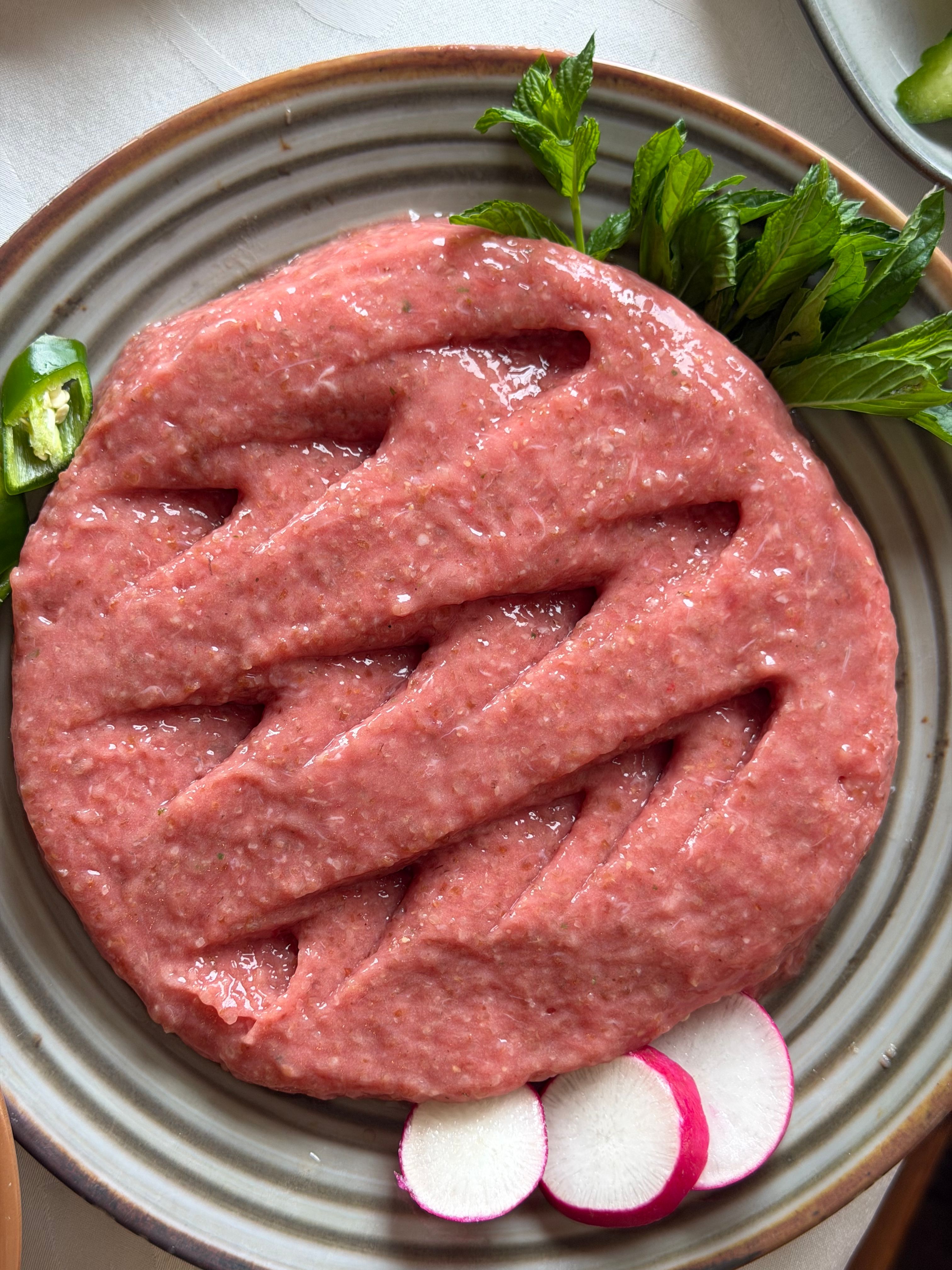
Photo: Anthony Rahayel / Pexels
Levantine
Kibbeh Nayyeh
The diets react (see scores below)
Common Ingredients
- lamb
- fine bulgur
- onion
- olive oil
- cinnamon
- allspice
- mint
- salt
Specific recipes may vary.
Incompatible with 8 of 11 diets
Diet Ratings
Kibbeh Nayyeh's defining ingredient is fine bulgur wheat, a whole grain that is high in net carbs. A standard serving (100g) of bulgur contains approximately 19-22g of net carbs, and even a modest portion of Kibbeh Nayyeh will include enough bulgur to push a meal well over typical keto limits. While the raw lamb, olive oil, and spices are keto-friendly, the bulgur is structurally central to this dish — it cannot be reduced to a trace amount without fundamentally changing the recipe. The dish is incompatible with ketosis as traditionally prepared.
Kibbeh Nayyeh contains raw lamb as its primary protein and defining ingredient. Lamb is unambiguously an animal product — specifically red meat from a young sheep — making this dish entirely incompatible with a vegan diet. There is no meaningful debate within the vegan community on this point. The remaining ingredients (bulgur, onion, olive oil, cinnamon, allspice, mint, salt) are all plant-based, but the dish cannot be separated from its core animal-derived component. A vegan adaptation would require replacing the lamb entirely, resulting in a fundamentally different dish.
Kibbeh Nayyeh is disqualifying due to fine bulgur, which is cracked wheat — a grain explicitly excluded from the paleo diet. Bulgur is a core structural ingredient in this dish, not a minor additive, making the dish fundamentally non-paleo regardless of the otherwise acceptable ingredients. Lamb, olive oil, onion, cinnamon, allspice, and mint are all paleo-approved. Salt is discouraged under strict paleo rules but is a minor factor here. The dish cannot be meaningfully adapted without removing the bulgur, at which point it would no longer be Kibbeh Nayyeh.
Kibbeh Nayyeh is a traditional Levantine raw lamb dish. Its primary protein is red meat (lamb), which the Mediterranean diet limits to a few times per month. While the dish contains positive Mediterranean elements — whole-grain bulgur, olive oil, fresh herbs, and aromatic spices — the dominant ingredient is raw lamb, placing it in the 'avoid' category by strict Mediterranean diet guidelines. The dish is also served raw, which raises food safety considerations not directly addressed by diet frameworks but relevant to practical dietary advice. The bulgur and olive oil components are genuinely praiseworthy, but they cannot offset the centrality of red meat.
Traditional Levantine and broader Eastern Mediterranean culinary traditions — which are foundational to the Mediterranean diet concept — regard kibbeh nayyeh as a culturally significant and relatively lean preparation of lamb. Some Mediterranean diet authorities, particularly those emphasizing the diet's cultural origins (e.g., Ancel Keys' observations of Lebanese and Syrian eating patterns), would note that lamb consumed occasionally in small portions with whole grains and herbs is within the spirit of the diet, especially given the high bulgur-to-meat ratio in this dish.
Kibbeh Nayyeh is fundamentally incompatible with the carnivore diet. While it does contain lamb as the primary protein — which would otherwise be an excellent carnivore food — the dish is built around fine bulgur (cracked wheat), a grain that is entirely plant-derived and explicitly excluded from any tier of carnivore eating. Beyond the bulgur, the recipe also includes onion (plant), olive oil (plant oil), cinnamon (plant spice), allspice (plant spice), and mint (plant herb). Only the lamb and salt are carnivore-compliant. The ratio of non-compliant to compliant ingredients, and especially the structural role bulgur plays in the dish, means this cannot be adapted within its traditional form. A carnivore practitioner would need to eat plain raw lamb seasoned with salt only — which would no longer be Kibbeh Nayyeh.
Kibbeh Nayyeh contains fine bulgur, which is a cracked wheat product — a grain explicitly excluded on the Whole30 program. Bulgur is a core, non-negotiable ingredient in this traditional Levantine raw lamb dish; without it, the dish ceases to be Kibbeh Nayyeh. All other ingredients (lamb, onion, olive oil, cinnamon, allspice, mint, salt) are fully Whole30-compliant, but the presence of bulgur makes the dish a clear avoid.
Kibbeh Nayyeh contains two significant high-FODMAP ingredients that make it unsuitable during the elimination phase. First, fine bulgur wheat is a wheat-based grain and a major source of fructans — it is high-FODMAP at any standard serving size used in this dish. Second, onion is one of the highest-FODMAP foods per Monash University, rich in fructans, and is a core structural ingredient in kibbeh nayyeh that cannot simply be removed in small amounts. Lamb itself is low-FODMAP (plain meat contains no carbohydrates), and olive oil, cinnamon, allspice, mint, and salt are all low-FODMAP at typical culinary quantities. However, the combination of bulgur wheat and onion as primary ingredients — not incidental additions — makes this dish clearly high-FODMAP at any reasonable serving.
Kibbeh Nayyeh is a raw lamb dish with fine bulgur, olive oil, and aromatic spices. It has several DASH-compatible elements: bulgur is a whole grain providing fiber and magnesium, olive oil is a recommended vegetable oil, onion and herbs are DASH-friendly aromatics, and the spices add flavor without sodium. However, lamb is a red meat that DASH explicitly recommends limiting due to its saturated fat content. A typical serving of raw lamb contains moderate-to-high saturated fat, which DASH discourages. Additionally, raw meat consumption carries food safety concerns that are orthogonal but relevant to overall health guidance. The salt content can be significant depending on preparation. The bulgur component partially offsets concerns, and portion size matters considerably — a small serving is more defensible than a large one. Overall this dish sits in the caution zone: not a DASH core food due to red meat and saturated fat, but not as problematic as processed meats or high-sodium dishes.
NIH DASH guidelines categorically limit red meat including lamb due to saturated fat, recommending lean poultry or fish instead. However, some updated DASH-oriented clinicians note that unprocessed lean red meat in small portions (2-3 oz, trimmed of visible fat) can fit within DASH macronutrient targets, and the whole grain bulgur and olive oil in this dish partially align with DASH principles — making strict avoidance overly conservative for non-hypertensive individuals.
Kibbeh Nayyeh is a traditional Levantine raw lamb dish combining ground lamb, fine bulgur, onion, olive oil, and spices. From a Zone perspective, it has both favorable and unfavorable elements. The olive oil is an ideal monounsaturated fat source, and the onion, mint, and spices contribute polyphenols aligned with Sears' anti-inflammatory emphasis. However, lamb is a moderately fatty red meat — not categorically excluded in Zone but less preferred than skinless chicken or fish due to higher saturated fat content. The fine bulgur is a whole grain carbohydrate that Zone generally classifies as 'unfavorable' (higher glycemic than vegetables, though lower than white bread) and should be limited to 0-1 servings/day. The dish can be portioned into Zone blocks — roughly 1-2 protein blocks of lamb with a modest bulgur portion — but requires careful control of the bulgur quantity and awareness that lamb's fat profile is less ideal than lean proteins. The raw preparation is a food safety consideration but not a Zone Diet concern per se. With proper portioning (small bulgur, controlled lamb portion for ~25g protein, olive oil as the fat source), this can fit into a Zone meal, but it is not an effortless fit.
Some Zone practitioners and later Sears writings place greater emphasis on the anti-inflammatory polyphenol content (mint, spices, onion) and the olive oil fat profile, which could push this dish toward a more favorable rating. Additionally, lean cuts of lamb have a more acceptable fat profile than commonly assumed, and bulgur's moderate glycemic index (lower than white rice or bread) makes it more Zone-compatible than many grain-based carbs. Traditionalists strictly following early Zone 'favorable/unfavorable' lists would flag both lamb and bulgur as unfavorable, keeping this firmly in caution territory.
Kibbeh Nayyeh is a traditional Levantine dish of raw lamb mixed with fine bulgur, onion, olive oil, and spices. Evaluating its components: Lamb is red meat — anti-inflammatory frameworks generally recommend limiting red meat due to saturated fat and arachidonic acid content, which can promote inflammatory eicosanoids. However, lamb is less processed and lower in saturated fat than many other red meats, and when consumed in moderation, its impact is debated. The raw preparation means no oxidized fats from cooking, which is a modest positive. Fine bulgur is a whole grain with fiber and moderate anti-inflammatory properties. Olive oil is a clear anti-inflammatory asset (oleocanthal, polyphenols). Cinnamon and allspice both contain polyphenols with anti-inflammatory activity. Mint offers modest antioxidant benefit. Onion provides quercetin, a well-studied anti-inflammatory flavonoid. The dish's profile is therefore mixed: beneficial whole grain, quality fat, and anti-inflammatory spices are offset by red meat as the primary protein. The raw lamb also raises food safety concerns unrelated to inflammation per se, but worth noting. Overall, this dish lands in caution territory — not aggressively pro-inflammatory, but red meat as the dominant protein prevents an approval. Consumed occasionally in moderate portions, it is broadly acceptable within an anti-inflammatory framework.
Some anti-inflammatory practitioners (aligned with Weil's pyramid) would argue that lean red meat in moderate, infrequent portions is acceptable within an overall healthy dietary pattern, and the high-quality spice and whole grain profile here partially offsets the red meat concern — this view might score it a 5–6. Conversely, stricter anti-inflammatory and autoimmune protocol (AIP) advocates would flag both the red meat and potentially the bulgur (a gluten-containing grain) as pro-inflammatory, pushing this dish toward a lower score.
Kibbeh Nayyeh is raw ground lamb mixed with bulgur, onion, and spices — a traditional Levantine dish consumed uncooked. For GLP-1 patients, this dish presents two distinct problems that together make it a clear avoid. First, raw lamb carries significant food safety risk (E. coli, Salmonella, Toxoplasma, Campylobacter). GLP-1 medications slow gastric emptying, meaning raw or undercooked meat spends an extended period in the stomach, increasing pathogen exposure time and the risk of severe GI illness — a particularly serious concern for this population. Second, even setting food safety aside, lamb is a fatty red meat with a high saturated fat content per serving, which is associated with worsening GLP-1 side effects including nausea, bloating, and reflux. The bulgur is a positive element — it provides fiber and is a whole grain — and olive oil is an acceptable unsaturated fat, but neither offsets the raw meat risk or the saturated fat load. Spices (cinnamon, allspice, mint) are mild and not a concern. The dish does provide protein, but the fat profile and raw preparation make it unsuitable for GLP-1 patients.
*See how scores were generated at our methodology page.
Nutritional profile
Six traits that cut across every diet.
Fiber & Plants
How much whole-plant food and fiber it delivers.
Healthy Fats
The quality of its fats (unsaturated, omega-3).
Whole / Unprocessed
How close it is to its natural, unprocessed form.
Gut Gentle
How easy it is on digestion (low FODMAP, few irritants).
Low Glycemic
How little it spikes your blood sugar.
Protein Density
How much protein it packs per calorie.
Controversy Index
Higher controversy = more disagreement between diets.
Diet-Specific Tips
 DASH — 4/10
View tips
- Lamb is a red meat — explicitly limited on DASH due to saturated fat content
- Fine bulgur is a DASH-approved whole grain contributing fiber and magnesium
- Olive oil is a DASH-recommended vegetable oil
- No added sugars, processed ingredients, or tropical oils
- Salt is added — sodium content depends on preparation amount
- Raw meat preparation raises food safety concerns beyond DASH scoring
- Portion size is critical — small portions reduce saturated fat impact
- No dairy, legumes, or high-potassium vegetables to offset red meat concerns
 Zone — 5/10
View tips
- Lamb is a moderately fatty red meat — higher saturated fat than preferred Zone proteins like chicken or fish
- Fine bulgur is an 'unfavorable' Zone carbohydrate — whole grain but higher glycemic than vegetables; should be portioned minimally (0-1 servings/day)
- Olive oil is an ideal monounsaturated fat and strong Zone-favorable ingredient
- Onion, mint, cinnamon, and allspice provide polyphenols supporting Sears' anti-inflammatory framework
- Raw lamb raises food safety concerns unrelated to Zone classification
- Dish can be block-portioned into a Zone meal but requires careful bulgur restriction and lean lamb selection
 Anti-Inflammatory — 4/10
View tips
- Red meat (lamb) as primary protein — linked to arachidonic acid and saturated fat, pro-inflammatory in excess
- Fine bulgur — whole grain, provides fiber and modest anti-inflammatory benefit
- Extra virgin olive oil — strong anti-inflammatory (oleocanthal, monounsaturated fats)
- Cinnamon and allspice — polyphenol-rich spices with documented anti-inflammatory properties
- Onion — quercetin content supports anti-inflammatory profile
- Raw preparation — avoids oxidized fats from high-heat cooking, a minor positive for lamb quality
- No processed ingredients, additives, or seed oils — clean ingredient list