Photo: Polina Tankilevitch / Pexels
Levantine
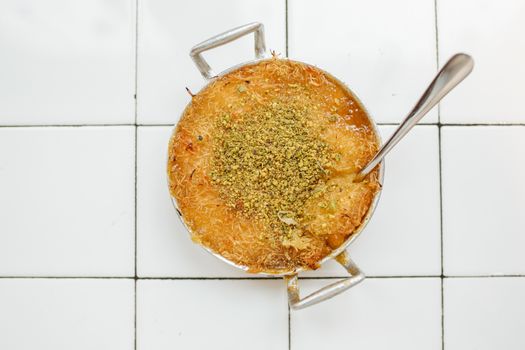
Knafeh Nabulsieh
The diets react (see scores below)
Common Ingredients
- akkawi cheese
- kataifi pastry
- semolina
- sugar
- orange blossom water
- butter
- pistachios
Specific recipes may vary.
Incompatible with 11 of 11 diets
Diet Ratings
Knafeh Nabulsieh is fundamentally incompatible with a ketogenic diet. It contains multiple high-carbohydrate ingredients that make it impossible to consume without breaking ketosis. Kataifi pastry is a shredded wheat-based dough, semolina is a refined grain product, and large amounts of sugar are used both in the dough and in the sugar syrup that saturates the dish. Combined, these ingredients deliver an enormous carbohydrate load — easily exceeding 60-80g of net carbs in a single serving — which is well beyond an entire day's keto carb allowance. While akkawi cheese, butter, and pistachios in isolation may be keto-friendly, they are overwhelmed by the grain and sugar components that form the structural and flavor backbone of this dish. There is no realistic portion size that would make this dish compatible with ketosis.
Knafeh Nabulsieh contains multiple animal-derived ingredients that make it incompatible with a vegan diet. Akkawi cheese is a dairy product (animal-derived), and butter is also a dairy product. These are core, defining ingredients of the dish — not incidental additives. The kataifi pastry may also contain eggs and dairy depending on preparation. There is no vegan version of traditional Knafeh Nabulsieh; substituting the cheese and butter would produce a fundamentally different dish. The pistachios, semolina, sugar, and orange blossom water are plant-based, but the animal ingredients are central to the recipe.
Knafeh Nabulsieh is fundamentally incompatible with the paleo diet. Nearly every core ingredient violates paleo principles: kataifi pastry is made from wheat (a grain), semolina is also a wheat-derived grain product, akkawi cheese is a dairy product, sugar is a refined sweetener, and butter is dairy. The only paleo-compatible ingredients are orange blossom water and pistachios. This dish is essentially a grain-and-dairy-based dessert loaded with refined sugar — three of the most excluded food categories in paleo eating. There is no meaningful way to consider this dish paleo-friendly in any form.
Knafeh Nabulsieh is a traditional Levantine dessert that conflicts with core Mediterranean diet principles on multiple fronts. It is high in added sugar (heavy sugar syrup), uses refined/processed pastry (kataifi) and semolina as the base, and relies on butter as the primary fat rather than olive oil. The akkawi cheese adds saturated fat, and the overall dish is calorie-dense with minimal nutritional benefit. While pistachios are a Mediterranean-approved nut, they appear in small garnish quantities insufficient to offset the other concerns. The combination of refined grains, high sugar load, and butter makes this a poor fit for regular Mediterranean diet consumption.
Some Mediterranean diet scholars argue that traditional sweets from the Levant, Middle East, and North Africa — including nut- and cheese-based pastries — have historical roots in the broader Mediterranean food culture and can be enjoyed occasionally as part of a balanced dietary pattern. From this perspective, the pistachios, cheese, and semolina have some nutritional merit, and infrequent indulgence aligns with the Mediterranean diet's emphasis on enjoyment and cultural food traditions over strict restriction.
Knafeh Nabulsieh is almost entirely plant-based and processed, making it completely incompatible with the carnivore diet. The dish consists primarily of kataifi pastry (shredded wheat dough), semolina (grain), and sugar — all strictly excluded plant-derived or refined ingredients. Orange blossom water is a plant extract, and pistachios are nuts, both forbidden. While butter and akkawi cheese are animal-derived, they are minor components of a dish that is fundamentally a grain-and-sugar dessert. Even the most permissive 'animal-based' carnivore practitioners would reject this due to the dominant grain, sugar, and nut content. There is no version of the carnivore diet under which this dish would be considered acceptable.
Knafeh Nabulsieh contains multiple excluded ingredients that make it clearly non-compliant with Whole30. First, akkawi cheese is dairy, which is excluded (only ghee and clarified butter are permitted dairy exceptions). Second, kataifi pastry is made from wheat flour, a grain that is excluded. Third, semolina is a wheat-derived grain product, also excluded. Fourth, sugar is explicitly excluded as an added sugar. Finally, regular butter is excluded dairy (only ghee/clarified butter is allowed). Even setting aside the spirit-of-the-program concern about recreating a dessert/sweet snack, the dish fails on at least five distinct excluded ingredients.
Knafeh Nabulsieh contains multiple high-FODMAP ingredients that make it problematic during the elimination phase. The primary concerns are: (1) Semolina is derived from durum wheat and is high in fructans — Monash rates semolina as high-FODMAP. (2) Kataifi pastry is a wheat-based shredded dough, also high in fructans. (3) Akkawi cheese is a brined soft/semi-soft cheese with moderate to high lactose content; unlike hard aged cheeses where lactose is minimal, fresh brined cheeses like akkawi retain significant lactose. (4) Pistachios are high-FODMAP in standard serving sizes (Monash rates them as high in GOS and fructans above ~10 pistachios, and knafeh typically contains a generous garnish). The combination of wheat-based fructans from two sources (semolina + kataifi) and lactose from akkawi makes this dish clearly high-FODMAP at any realistic serving. Sugar, butter, and orange blossom water are low-FODMAP and not concerns.
Some FODMAP practitioners note that akkawi cheese, when heavily desalted by soaking (as is traditional in Nabulsieh preparation), may have reduced lactose — but there is no Monash testing of akkawi specifically, and the soaking process removes salt rather than lactose. The wheat-based components (semolina and kataifi) remain high-FODMAP regardless of preparation, so the overall verdict does not change.
Knafeh Nabulsieh is fundamentally incompatible with DASH diet principles across multiple dimensions. Akkawi cheese is a brined, high-sodium cheese that directly conflicts with DASH's sodium limits (<2,300mg/day standard, <1,500mg/day low-sodium). Butter contributes significant saturated fat, which DASH explicitly limits. The dish is loaded with added sugar (the syrup component is central to the dessert), conflicting with DASH's guidance to limit sweets. Kataifi pastry made with refined flour offers little nutritional benefit and no fiber. The combination of high sodium from the cheese, high saturated fat from butter and full-fat cheese, and high added sugar makes this a multi-category DASH violation. While pistachios are a DASH-friendly nut, they are a minor component that does not offset the other concerns. This is a traditional celebratory dessert-style snack designed for indulgence, not health optimization.
Knafeh Nabulsieh is a traditional Levantine dessert that is fundamentally incompatible with Zone Diet principles. The dish is built around a core of high-glycemic carbohydrates — kataifi pastry (refined wheat), semolina, and substantial added sugar — which would cause a significant glycemic spike, exactly what the Zone Diet aims to prevent. The fat profile is also problematic: butter provides saturated fat, which the Zone discourages, and there is no meaningful lean protein anchor. While akkawi cheese provides some protein, it is a full-fat dairy cheese that also contributes saturated fat and sodium, and cannot serve as a Zone-favorable lean protein source. The overall macronutrient ratio is wildly skewed toward carbohydrates and saturated fat, with negligible lean protein. Even in small portions, the sugar and refined carb density make it nearly impossible to incorporate into a Zone-balanced snack without completely destroying the 40/30/30 ratio. The pistachios offer a small redeeming monounsaturated fat contribution, but they are a minor ingredient relative to the dominant high-glycemic, high-saturated-fat components. This is a dessert treat with essentially no Zone-favorable structural elements.
Knafeh Nabulsieh is a traditional Levantine dessert with a profile that conflicts substantially with anti-inflammatory principles. The dominant ingredients are problematic: butter is a saturated fat that anti-inflammatory guidelines recommend limiting; akkawi cheese is a full-fat dairy product, also in the limit/avoid category; kataifi pastry and semolina are refined carbohydrates with a high glycemic load; and the dish requires a significant quantity of added sugar (in both the pastry and the sugar syrup), which is a primary driver of inflammatory markers like CRP and IL-6. The orange blossom water is neutral and pistachios are a genuine positive — rich in polyphenols, fiber, and healthy fats — but they are a minor garnish-level ingredient and cannot offset the inflammatory burden of the base. This dish is essentially a high-sugar, high-saturated-fat, refined-carbohydrate confection. As an occasional indulgence it poses limited risk, but from a strict anti-inflammatory lens it represents a convergence of several ingredients the framework explicitly flags.
Knafeh Nabulsieh is a poor fit for GLP-1 patients across nearly every dietary criterion. It is a dessert-style dish built on a foundation of refined carbohydrates (kataifi pastry, semolina), large amounts of added sugar (sugar syrup), and saturated fat (butter, akkawi cheese). While akkawi cheese does contribute some protein, the protein density per calorie is very low relative to the sugar and fat load. The dish is calorie-dense with negligible fiber, and the high fat and sugar content is likely to worsen common GLP-1 side effects including nausea, bloating, and reflux due to slowed gastric emptying. Butter adds significant saturated fat. The orange blossom syrup adds empty calories with no nutritional benefit. Pistachios offer modest healthy fat and some protein but are present in garnish quantities insufficient to offset the overall nutritional profile. As a snack category item, it provides almost no satiety value appropriate for GLP-1 patients — it delivers a large caloric hit with poor protein, poor fiber, and high glycemic impact in a small serving.
*See how scores were generated at our methodology page.
Nutritional profile
Six traits that cut across every diet.
Fiber & Plants
How much whole-plant food and fiber it delivers.
Healthy Fats
The quality of its fats (unsaturated, omega-3).
Whole / Unprocessed
How close it is to its natural, unprocessed form.
Gut Gentle
How easy it is on digestion (low FODMAP, few irritants).
Low Glycemic
How little it spikes your blood sugar.
Protein Density
How much protein it packs per calorie.
Controversy Index
Higher controversy = more disagreement between diets.