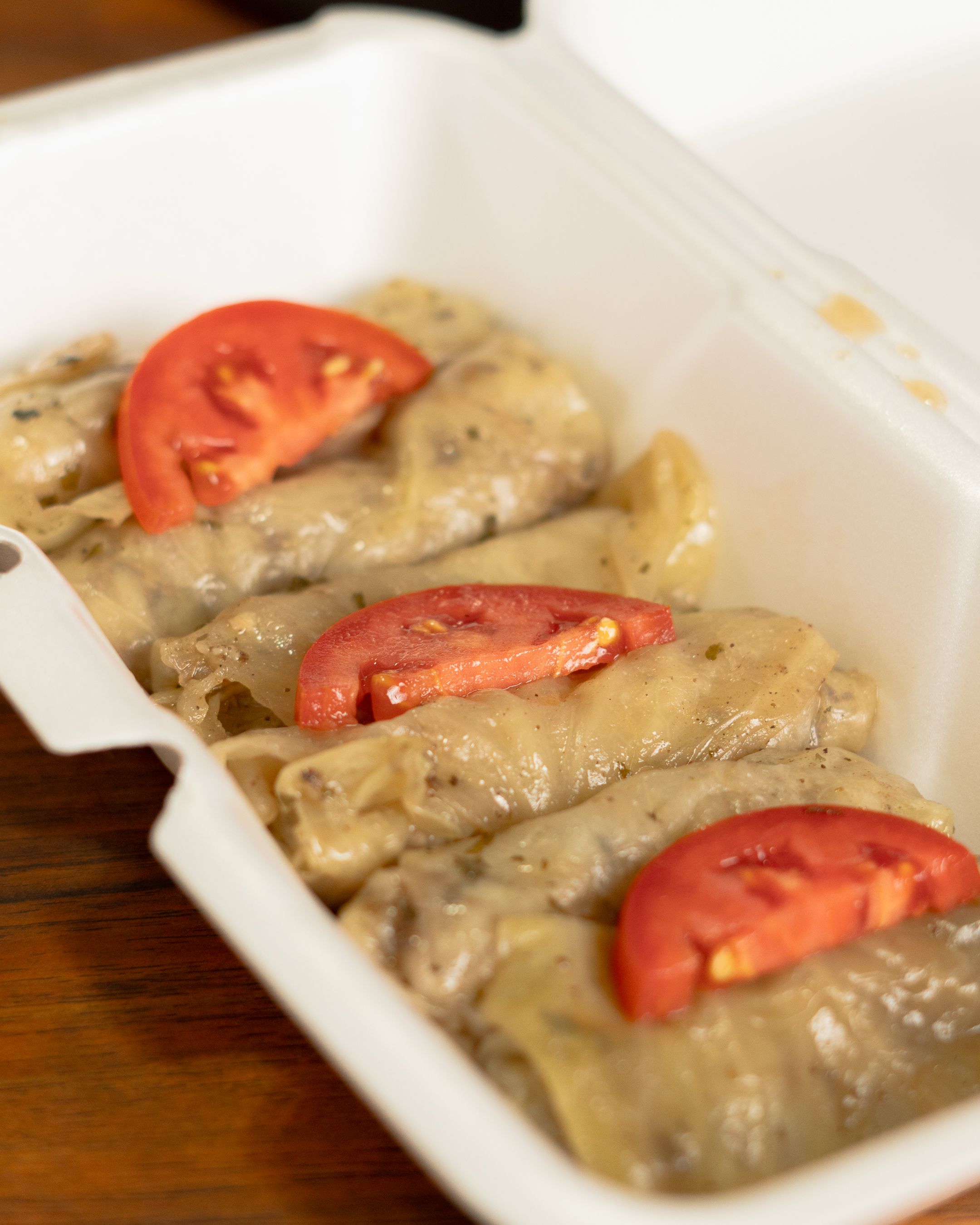
Photo: Alejandro Aznar / Pexels
Lithuanian
Balandeliai
The diets react (see scores below)
Common Ingredients
- cabbage
- ground pork
- rice
- onion
- carrots
- tomatoes
- sour cream
- pepper
Specific recipes may vary.
Incompatible with 6 of 11 diets
Diet Ratings
Balandeliai (Lithuanian stuffed cabbage rolls) are fundamentally incompatible with ketogenic eating due to the inclusion of rice as a core ingredient in the filling. Rice is a high-glycemic grain with approximately 28g net carbs per 100g cooked, and even a modest serving of 2-3 cabbage rolls would easily exceed the entire daily keto carb limit. Beyond rice, the carrots and tomatoes add additional net carbs. While the cabbage wrapper, ground pork, onion, sour cream, and pepper are all keto-friendly components, the rice filling makes this dish a clear avoid. A keto adaptation could substitute cauliflower rice, but as traditionally prepared, this dish is not compatible with ketosis.
Balandeliai are Lithuanian stuffed cabbage rolls containing ground pork and sour cream — two clear animal-derived ingredients. Ground pork is meat, and sour cream is a dairy product. Both are categorically excluded under vegan dietary rules. This dish is entirely incompatible with a vegan diet in its traditional form.
Balandeliai (Lithuanian stuffed cabbage rolls) contains two clear paleo violations: rice (a grain, universally excluded from paleo) and sour cream (a dairy product, excluded from paleo). Rice is the primary filler in the ground pork stuffing and is central to the dish's structure, not a minor garnish. Sour cream is used as a sauce component. The remaining ingredients — cabbage, ground pork, onion, carrots, tomatoes, and pepper — are all paleo-approved, but the dish cannot be considered paleo-compatible with rice and sour cream as core components. There is no meaningful minority paleo view that would permit rice-stuffed dishes with dairy sauce.
Balandeliai are Lithuanian stuffed cabbage rolls filled with ground pork and white rice, served with sour cream. Ground pork is a red meat, which the Mediterranean diet limits to only a few times per month. The white rice is a refined grain discouraged in favor of whole grains. Sour cream adds saturated fat from dairy in a quantity beyond the modest moderation the diet recommends. While some ingredients — cabbage, onion, carrots, tomatoes — are Mediterranean-friendly vegetables, the dish's core structure is built around red meat and refined starch with a heavy dairy topping, making it fundamentally misaligned with Mediterranean dietary principles. There is no olive oil, no legumes, no fish, and no whole grains present.
Balandeliai are Lithuanian stuffed cabbage rolls — a dish that is fundamentally incompatible with the carnivore diet. While ground pork is the protein source and sour cream is an animal-derived component, the dish is dominated by plant-based ingredients: cabbage (the wrapper), rice (a grain filler), onion, carrots, tomatoes, and pepper. Rice alone is a grain that is strictly excluded on carnivore. Cabbage, tomatoes, carrots, and onion are all plant foods with no place in the carnivore framework. The dish cannot be salvaged by removing components — it is structurally built around plant foods. Sour cream is the only partially acceptable element, and even that is debated within strict carnivore circles. This dish scores a 1.
Balandeliai (Lithuanian stuffed cabbage rolls) contains two excluded ingredients: rice (a grain, explicitly prohibited on Whole30) and sour cream (a dairy product, explicitly prohibited on Whole30). These are not edge cases — both are clearly listed in the Whole30 exclusion rules. The dish cannot be made compliant in its traditional form without fundamentally altering the recipe. The remaining ingredients (cabbage, ground pork, onion, carrots, tomatoes, pepper) are all Whole30-compliant, but the rice filling and sour cream sauce are central to the dish.
Balandeliai (Lithuanian stuffed cabbage rolls) contains several FODMAP concerns. Onion is a high-FODMAP ingredient due to fructans and is problematic at virtually any serving size during elimination phase — this is the primary disqualifier. Cabbage (savoy/white) is low-FODMAP at small servings (~75g) but can become moderate at larger amounts. Sour cream contains lactose and is only low-FODMAP at a small serving (2 tablespoons/40g). Carrots, ground pork, rice, and pepper are low-FODMAP and safe. Tomatoes are low-FODMAP at standard servings (up to 65g canned or one small fresh tomato). The presence of onion — typically cooked into the filling and/or sauce — makes this dish high-FODMAP as traditionally prepared. A modified version omitting onion and using the green tops of scallions instead, limiting sour cream to a small dollop, and controlling cabbage portion could potentially be made low-FODMAP.
Monash University clearly flags onion as high-FODMAP at any culinary dose due to fructans. Some FODMAP practitioners allow garlic-infused or onion-infused oil as a workaround, but since onion is directly cooked into this dish, its fructans leach into the filling and sauce, making substitution the only viable option — not portion reduction.
Balandeliai (Lithuanian stuffed cabbage rolls) contains several DASH-friendly ingredients — cabbage, rice, onion, carrots, and tomatoes are excellent DASH vegetables and whole/grain foods. However, the primary protein is ground pork, which depending on fat content can carry significant saturated fat (DASH limits red and fatty meats). Sour cream adds saturated fat and is full-fat dairy, which DASH specifies should be low-fat or fat-free. The dish as traditionally prepared is not inherently high in sodium from added salt alone, but the overall saturated fat load from ground pork and sour cream pulls it away from core DASH compliance. With modifications — lean ground pork or turkey substitution, low-fat sour cream or plain low-fat yogurt — this dish could score higher (7+). As commonly prepared, it sits in the caution zone.
NIH DASH guidelines explicitly limit full-fat dairy and red/fatty meats due to saturated fat content, placing traditional Balandeliai in a cautionary category. However, updated clinical interpretations note that emerging research questions the magnitude of harm from full-fat dairy on cardiovascular outcomes, and that lean pork loin cuts have saturated fat profiles comparable to chicken thighs — some DASH-oriented dietitians would approve a leaner version of this dish without modification.
Balandeliai (Lithuanian stuffed cabbage rolls) present a mixed Zone Diet profile. The cabbage wrapper is excellent — a low-glycemic, high-fiber vegetable that Zone strongly favors. However, the dish has several Zone challenges: (1) Ground pork is a moderate-fat protein — not as lean as skinless chicken or fish, containing saturated fat that Zone discourages, though it does provide adequate protein blocks. (2) White rice inside the filling is a high-glycemic 'unfavorable' carbohydrate in Zone terminology — it raises the glycemic load of the dish meaningfully. (3) Sour cream contributes saturated fat rather than preferred monounsaturated fat. On the positive side, tomatoes, carrots, and onions contribute polyphenols and low-glycemic carbs. The overall macro ratio of a traditional Balandeliai serving likely skews higher in carbs (from rice) and saturated fat than Zone's 40/30/30 target, but with portion control and modifications (less rice, leaner pork, reduced sour cream), it can be worked into a Zone meal. The dish is not a Zone disaster — it has genuine vegetable content and protein — but as traditionally prepared, it requires careful portioning.
Some Zone practitioners would rate this more favorably, noting that the cabbage and vegetable base aligns well with Zone's vegetable-forward carbohydrate philosophy, and that the tomato sauce component provides polyphenols Sears emphasizes in his anti-inflammatory work. If made with very lean ground pork or turkey substitution and reduced rice, this dish could approach Zone-favorable territory. Conversely, strict Zone adherents following Dr. Sears' 'Enter the Zone' favorable/unfavorable food lists would flag both the white rice and sour cream as unfavorable, potentially rating this lower.
Balandeliai (Lithuanian stuffed cabbage rolls) presents a mixed anti-inflammatory profile. On the positive side, cabbage is a cruciferous vegetable with glucosinolates and antioxidants that have demonstrated anti-inflammatory effects. Tomatoes provide lycopene and other carotenoids. Onions and carrots contribute quercetin and beta-carotene respectively. Pepper (black) contains piperine, which has modest anti-inflammatory properties. The dish is vegetable-forward in structure. However, the primary protein is ground pork, which is a red meat — placed in the 'limit' category due to saturated fat content and its association with elevated inflammatory markers like CRP and IL-6 at regular consumption. Sour cream is full-fat dairy, also in the 'limit' category. Rice (presumably white rice) is a refined carbohydrate with a moderate glycemic load. The cooking method (typically braised or baked in tomato-sour cream sauce) is not inherently inflammatory. Overall, this is a traditional comfort dish with meaningful vegetable content but anchored by a pro-inflammatory protein and full-fat dairy. It is acceptable occasionally but not ideal as a regular feature of an anti-inflammatory diet. Substituting ground turkey or a legume-pork blend, using brown rice, and replacing sour cream with a plant-based alternative would substantially improve its profile.
Some anti-inflammatory nutritionists would rate this more favorably, arguing that whole-food pork in moderate portions, combined with a high ratio of vegetables and braising in tomato sauce (lycopene bioavailability increases with cooking), makes this a reasonable meal. Others following stricter anti-inflammatory protocols would score this lower, pointing to regular red meat consumption as a consistent driver of elevated inflammatory biomarkers in epidemiological literature.
Balandeliai (Lithuanian stuffed cabbage rolls) are a mixed dish for GLP-1 patients. On the positive side, cabbage is high in fiber and water content, vegetables (carrots, tomatoes, onion) add micronutrients and additional fiber, and the dish is slow-cooked and easy to digest in that sense. However, ground pork is the primary protein concern: it is typically moderate-to-high in saturated fat depending on the grind (80/20 ground pork is significantly fattier than lean options), which can worsen GLP-1 side effects like nausea, reflux, and bloating. The rice adds digestible carbohydrates but contributes to portion density with limited protein payoff. Sour cream in the sauce adds saturated fat and calories with low protein density. Protein per serving is moderate but not high — likely 15-20g depending on portion size and pork fat percentage, which is acceptable but not optimal. The dish is not fried, not spicy, and is vegetable-forward, which are positives. Overall, it sits firmly in caution territory: acceptable occasionally, especially if made with leaner ground pork (93/7) and reduced sour cream, but not an ideal GLP-1 staple as traditionally prepared.
Some GLP-1-focused dietitians may rate stuffed cabbage more favorably because the cabbage wrapping encourages smaller natural portion sizes and the braised preparation is gentle on the stomach. Others will flag ground pork and sour cream as consistent fat concerns that predictably worsen GI side effects, making this a dish to modify rather than approve in traditional form.
*See how scores were generated at our methodology page.
Nutritional profile
Six traits that cut across every diet.
Fiber & Plants
How much whole-plant food and fiber it delivers.
Healthy Fats
The quality of its fats (unsaturated, omega-3).
Whole / Unprocessed
How close it is to its natural, unprocessed form.
Gut Gentle
How easy it is on digestion (low FODMAP, few irritants).
Low Glycemic
How little it spikes your blood sugar.
Protein Density
How much protein it packs per calorie.
Controversy Index
Higher controversy = more disagreement between diets.
Diet-Specific Tips
 Low-FODMAP — 4/10
View tips
- Onion is high-FODMAP due to fructans at any standard serving — primary disqualifier
- Sour cream is lactose-containing and only low-FODMAP at ≤40g (2 tbsp)
- Cabbage is low-FODMAP at ≤75g but portions in stuffed cabbage rolls often exceed this
- Ground pork, rice, carrots, pepper, and tomatoes are low-FODMAP and safe
- Dish can be modified by replacing onion with scallion greens and limiting sour cream
 DASH — 5/10
View tips
- Ground pork is a red meat with moderate-to-high saturated fat depending on fat percentage — DASH limits red meat
- Sour cream is full-fat dairy, which DASH specifies should be replaced with low-fat or fat-free alternatives
- Cabbage, carrots, onion, tomatoes are excellent DASH vegetables contributing fiber, potassium, and magnesium
- Rice provides carbohydrates; whole-grain rice would be more DASH-aligned than white rice
- No inherently high-sodium ingredients, but preparation often includes added salt
- Substituting lean ground turkey and low-fat yogurt/sour cream would significantly improve DASH compatibility
 Zone — 5/10
View tips
- Cabbage is an excellent Zone-favorable low-glycemic vegetable wrapper
- White rice is an 'unfavorable' high-glycemic carbohydrate in Zone terminology
- Ground pork contains saturated fat — less ideal than lean poultry or fish
- Sour cream adds saturated fat rather than preferred monounsaturated fat
- Tomatoes, carrots, and onions contribute favorable polyphenols and low-GI carbs
- Portion control critical — traditional serving likely exceeds Zone carb block targets due to rice
- Dish can be modified toward Zone compliance by reducing rice and using leaner meat
 Anti-Inflammatory — 5/10
View tips
- Ground pork (red meat) — pro-inflammatory at regular consumption, high in saturated fat
- Cabbage — anti-inflammatory cruciferous vegetable with glucosinolates
- Sour cream (full-fat dairy) — in the 'limit' category for anti-inflammatory diets
- Tomatoes and carrots — antioxidant-rich, lycopene and beta-carotene
- White rice — refined carbohydrate, moderate glycemic load
- Onion — quercetin content is anti-inflammatory
- Black pepper — piperine has mild anti-inflammatory properties
- Braised/baked preparation — not adding inflammatory cooking fats
 GLP-1 Friendly — 5/10
View tips
- Ground pork is moderate-to-high in saturated fat depending on fat percentage — a known GLP-1 side effect trigger
- Sour cream sauce adds saturated fat and calories with minimal protein contribution
- Cabbage provides meaningful fiber and high water content — positives for GLP-1 patients
- White rice adds digestible carbs but reduces overall protein density per calorie
- Dish is braised not fried — easier to digest than pan-fried or deep-fried preparations
- Protein per serving is moderate (~15-20g) but improvable by swapping to leaner protein
- Vegetable-forward ingredient list supports micronutrient density
- Traditional portion size is manageable but the filling can be calorie-dense